one of my favorite skills is /explore-design
based on @trq212 (will link tweet below)
it generates a few design options for you which you can then pick or refine
especially using fable this is such a win
Hi everyone! I'm Remocn - a collection of ready-made animations for creating videos with React and @Remotion
It's simple: install components with @shadcn, tell your AI what you want to create, and get an awesome result
AI native designer at Wealthsimple shows his daily tool stack:
Claude Design - Exploring design concepts
@paper - Co designing with @claudeai@conductor_build - Managing worktrees & doing multiple things at once
Claude Code - Shipping PRs
@mobbin - UI inspiration & industry best practices
@thecosmos - Design inspiration
@WisprFlow - AI dictation
@CleanShot - Sharing screenshots with stakeholders
👀 Full convo on Sneak Peek:
https://t.co/4KELJrRQfd
@dannyjpwilliams shows how he uses different AI tools to design @Wealthsimple 👇
New skill: /apple-design
Apple’s WWDC videos are a goldmine of knowledge. I’ve combed through my favorite ones and came up with 17 design and motion principles.
Use them to review existing work or when working on something new to get it right.
https://t.co/jCwhthpi20
If you dont know, you can use your Codex subscription inside Claude Code.
That means Fable 5 can call GPT 5.5 + 10 subagents to work together.
This will save you atleast 60% of your Fable 5 token consumption.
You just need to setup once. Here's how:
Step 1: Open Claude Code and install the Codex plugin
/plugin marketplace add openai/codex-plugin-cc
/plugin install codex@openai-codex
/reload-plugins
Step 2: Tell Fable 5 to finish the setup
Paste this prompt:
"Set up Codex inside this Claude Code environment. Use the official OpenAI Codex plugin that was just installed. Run /codex:setup. If Codex CLI is missing, install it. If Codex is installed but not authenticated, ask me to authenticate with my ChatGPT account. After auth is complete, verify that Codex works from inside Claude Code. Then confirm that the codex:codex-rescue sub-agent is available. Do not change any project code during setup."
Step 3: Authentication
Fable 5 will trigger the Codex setup.
You authenticate your ChatGPT/Codex account once.
After that, Codex runs from inside Claude Code using your Codex subscription.
Step 4: Tell Fable 5 how to delegate work
Paste this prompt:
"From now on, use this workflow:
You are the orchestrator.
> Use Fable 5 for planning, repo understanding, architecture decisions, task decomposition, and final review.
> Use codex-rescue as the executor when a task needs heavy implementation, debugging, test fixing, refactoring, or multi-file code edits.
When delegating to Codex, use /codex:rescue.
Prefer GPT 5.5 (xtra high) as the go to Codex model.
Keep Codex tasks focused and specific.
After Codex finishes, inspect the result yourself before accepting it.
Do not blindly trust Codex output."
Pro Tips:
1. Turn this into a skill (i named it Fable-GPT) and call that skill at the start of the session.
2. Use skill + goal to get the heavy tasks done. Goals are best for long horizon tasks.
3. If you're on Codex 20x pro plan, you can use subagents. I use 5-7 agents at one time and never hit 5-hour limit.
4. Context rot is real so clear the conversation after 4 compactions. Use /handoff skill to preserve context.
Fun fact: OpenAI handles 800 million users on ChatGPT with just one PostgreSQL primary and 50 read replicas 🤯
Today, OpenAI published an engineering blog explaining how they scaled their Postgres setup to support a massive 800 million users using a single primary and 50 multi-region replicas.
They dive into details around their scaling approach, the PgBouncer proxy, cache locking, and cascading read replicas. It is genuinely neat and impressive.
Some time back, I published a video on my YouTube channel where I dissected the blog and broke down the nuances.
Give it a watch - it is short and fun.
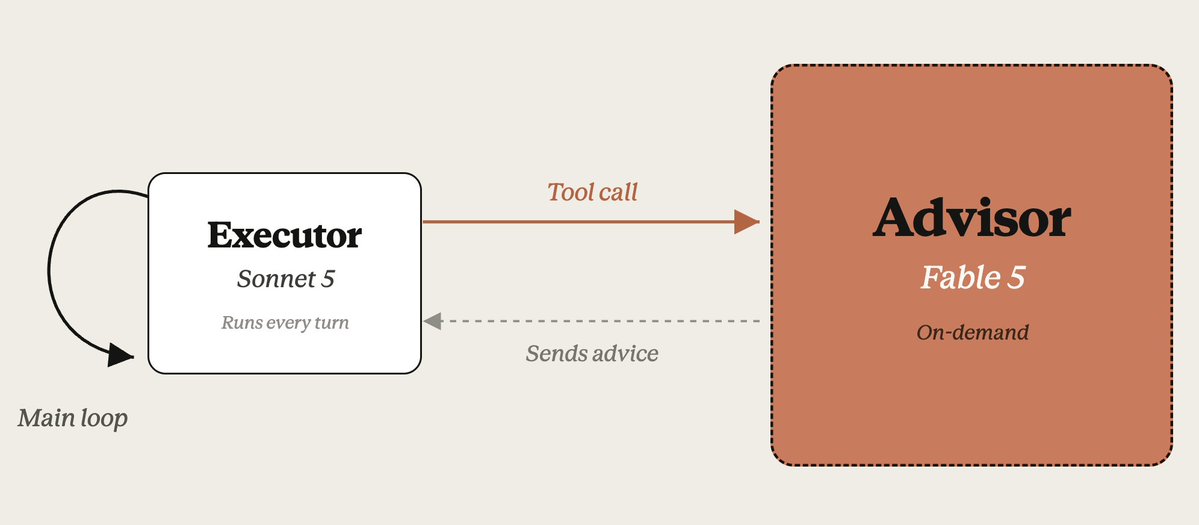
A few patterns we frequently use with Fable 5:
Use Fable 5 as an "advisor."
An executor (Sonnet 5) calls Fable 5 for guidance.
Most tokens are billed at the lower executor rate.
I built a Claude skill that makes motion-style animation.
> Paste a reference image
> It generates frames with Nano Banana 2
> and animates the video with Seedance 2.0
Everything runs in Claude through the Arcads MCP
Comment "Motion", and I'll send you the skill
This is the relevant section of my CLAUDE.md
I'll be real - I haven't read it much. Just vibed out what I was looking for with Fable, and had it confirm it can use Codex for the things I care about
I still find Codex to be WAY better at computer use, verification of UI/UX work, and generally more efficient at execution on well spec'd work
Minmaxing this has genuinely been really fun for me and I'm loving the outputs I've been getting.
I was throwing away ~50% of my end-to-end agent-driven PRs before building this workflow. I haven't had to close a single one today :)
Cloudflare Workers and Hyperdrive with PlanetScale is like tomato and basil.
But how does it work? What is the problem it's solving?
See it in action, and how to create a new PlanetScale database right from the Cloudflare Dashboard. Billed through Cloudflare.
In 5 minutes.
A big skill upgrade to text-to-lottie
Better design taste, better motion, fewer random design decisions, fewer refinements
Generate polished Lottie animations with Claude Code, Codex or Cursor
Try it: $ npx skills add diffusionstudio/lottie