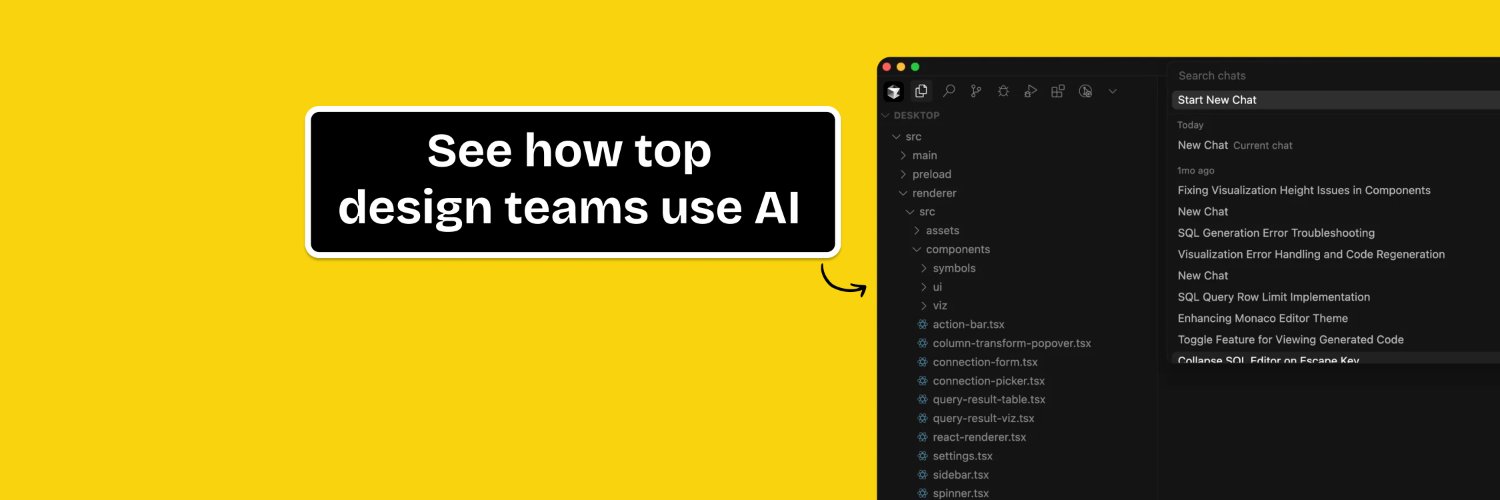
AI designer at a top early stage startup shows her daily tool stack:
@cursor_ai - Editing live code
@figma Make - Prototyping
@claudeai - Getting feedback on the work
@floraai - Stellar image generation
@mobbin - Design Inspiration
@warpdotdev - Terminal of choice
@meetgranola - Capture every single conversation
👀 Full conversation on Sneak Peek:
https://t.co/vfWb7Twnlp
@claireytee shows how she uses different AI tools to design @Chronicle_HQ 👇
This is how a top design leader uses Notion to document their AI native design team philosophy.
I feel more design leaders should copy this approach and document what it means to be an AI native design team at their company. It can also include best practices for vibe coding, custom AI agents and any other resources to help everyone level up.
This approach provides clarity to the designers and increase AI adoption on the team.
👀 Full conversation on Sneak Peek:
https://t.co/I2JdfCqPjd
@heyjovo shows how the @descript design team uses @NotionHQ to document AI best practices👇
This is how an IC designer fixed the design crit process after becoming the Head of Design.
Most design crits are broken. Designers are attending it for visibility rather than getting craft feedback. But my biggest pet peeve is when designers give feedback during crit without having context of the project or constraints.
To fix these issues John Voss implemented a 2 question rule.
Here's how it works - after a designer is done presenting during crit the team has to ask 2 questions before anyone can give feedback on the designs.
This forces the team to get background context before jumping to give feedback.
👀 Full conversation on Sneak Peek:
https://t.co/I2JdfCqPjd
Here's how the @descript design team uses the 2 question rule during crits👇
This is how a top designer uses socratic prompting in Cursor to get high quality outputs.
The idea behind socratic prompting is to describe your goal and ask the AI for what your prompt should be. This approach saves you from prompt mayhem and reduces token wastage.
👀 Full convo on Sneak Peek:
https://t.co/4wr6hZGZvr
@jennlspriggs shows her prompting approach in @cursor_ai for designing @cnn 👇
How are y'all naming your vibe coded prototype versions?
Are you matching it with the Linear/Jira tickets, engineering naming conventions or whatever you feel like?
So far the most structured process I have seen is by this designer at CNN. The way she names her @cursor_ai prototype versions is so thoughtful and give immediate context to stakeholders:
https://t.co/4wr6hZGrFT
I'm interviewing the @Wealthsimple design team on how they use @paper, Claude Design, @conductor_build and other AI tools
Going to nerd out on how the team uses AI for sound design
Shoutout to @pollyinthedart for making this happen 🫶
What do you want to know from @dannyjpwilliams about his AI workflows?
✲ Design Tasks ✲
Collection of real design take-home assignments I completed while interviewing for senior, staff, and founding product designer roles.
This resource gives you a closer look into my process as an experienced designer — from understanding the problem space to shaping the final outcome.
This is how a top design engineer uses Cursor to ship features 2 weeks faster
He designs directly in code. Doesn't waste hours creating static mocks for all the edge cases.
👀 Full conversation on Sneak Peek:
https://t.co/qcAdcojPFt
@_kejk shows how he uses @cursor_ai to ship AI features super fast for @DuckDuckGo 👇
Design Engineer at DuckDuckGo shows his daily tool stack:
@figma - Exploring initial design ideas
@cursor_ai - Going from idea to production
@asana - Source of truth for every project
@GhosttyTermpump - Terminal of choice
👀 Full conversation on Sneak Peek:
https://t.co/15XRRdcJap
@_kejk shows how he uses different AI tools to design @DuckDuckGo 👇
@itspatmorgan@_kejk@cursor_ai Cool! Curious to know how do you're you documenting state combos and edge cases? Do you have a switcher built in your prototype or maybe a sandbox env?
This is how a top designer splits his portfolio presentation into two separate decks for interviews.
The portfolio overview deck focuses on breadth and shows more case studies.
But the panel presentation deck focuses on depth and has only 2 case studies.
👀 Full conversation on Sneak Peek:
https://t.co/TdHOfb1a1S
Alex Fitch shows the portfolio overview and panel presentation decks that got him hired at @descript 👇
This is why a top designer keeps the portfolio presentation boring on purpose
Too many bells and whistles in the presentation deck distract the hiring team from your story
👀 Full conversation on Sneak Peek:
https://t.co/TdHOfb1a1S
Alex Fitch shows the portfolio presentation that got him hired at @descript 👇
Uninstalled all social media apps from my phone. Probably a career suicide move as a creator.
But I'm more present in the moment. If I'm waiting in line I no longer feel the itch to check my notifications, DMs, Youtube stats.
I feel lighter literally. There is no pressure of responding to DMs in an hour as if I'm a VC. I'm often late in replying back. Sometimes even forget to respond back 😳
Good news is that the world didn't end and folks are super understanding.
I'm less caught up in what others are doing and more focused on what I can create.
I maybe missing out on alpha by not being terminally online. But it's worth it!
The way I use social media now is more intentional.
These are just my observations based on 2 weeks. Plan to continue this experiment for next few months and will report back!
I'm interviewing the @Swiggy design team on how they use AI for image generation, video generation and illustrations.
Will go deep into how the team uses @higgsfield_ai, @Kling_ai, @jittervideo and other tools.
Shoutout to @abnux for making the intros and @saptarshipr for making this happen 🫶
What do you want to know from @meshedonions about his AI workflows?
This is how an IC designer fixed the design crit process after becoming the Head of Design.
Most design crits are broken. Designers are attending it for visibility rather than getting craft feedback. But my biggest pet peeve is when designers give feedback during crit without having context of the project or constraints.
To fix these issues John Voss implemented a 2 question rule.
Here's how it works - after a designer is done presenting during crit the team has to ask 2 questions before anyone can give feedback on the designs.
This forces the team to get background context before jumping to give feedback.
👀 Full conversation on Sneak Peek:
https://t.co/I2JdfCqPjd
Here's how the @descript design team uses the 2 question rule during crits👇
Wish I was in London right now to celebrate this historic moment.
But glad I attended Figma Config London last year and toured the Emirates stadium.
Btw any @Arsenal fans attending Config this year?