I created cards for the entire @MitosisOrg team 💜
I had this unusual idea to make cards that are kind of like a Business card/Mitosis Membership. To start, I made one for each team member, but if anyone from the community wants one too – it’s super easy.
Just reply to this post with your PFP, Discord username, and your highest role in the Mitosis Discord. Let’s turn this into a cult!!
Proof of Work – attached a screenshot from Figma
Discord username: t0xc1
#MagicMito #MitosisCreates
I appreciate Momentum for its technical solutions and functionality
Regarding @MMTFinance , my interest is drawn to the following aspects:
> xSUI Technology: The development of proprietary xSUI technology is crucial for integration and efficiency within the Sui ecosystem. I described more about how xSUI works in one of my recent post: https://t.co/Kn59McWyj0
> DEX Role: Its positioning as a significant DEX on Sui underscores its functional importance for decentralized trading.
> MSafe Infrastructure: The implementation of MSafe for secure treasury operations indicates a focus on reliability.
> DeFi Strategies: The availability of Vaults for high-yield DeFi strategies provides users with tools for capital optimization.
> xSUI Liquid Staking: The option for xSUI liquid staking adds flexibility for asset holders.
I am fascinated by how the project is moving forward and what technologies it brings to the world of DeFi. I am keenly observing how the project will launch through the @buidlpad platform.
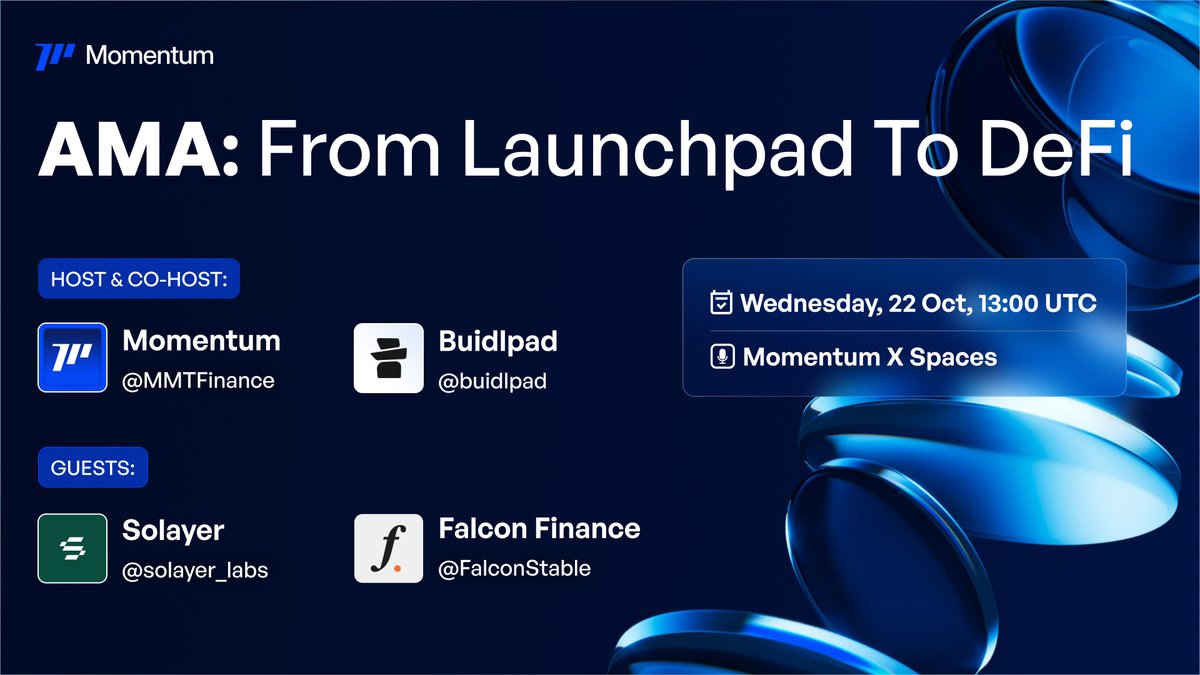
Don't Miss Today: AMA "From Launchpad to DeFi" with Momentum and Buidlpad!
Join the Twitter Space today, October 22, at 13:00 UTC for an exclusive AMA session, where the main topic will be a deep dive into the world of DeFi and the future of innovation.
This session, organized by @MMTFinance in collaboration with @buidlpad, promises to be extremely informative.
Teams from @solayer_labs and @falconfinance will also be present at the AMA. All of them also launched through Buidlpad, so it will be extremely interesting to listen to this conversation.
Don't miss the opportunity to ask your questions and get insights from leading industry experts.
Join here: https://t.co/co9xKEvltD
See you there!
🎙️ AMA: From Launchpad to DeFi
📆 Oct 22 • 13:00 UTC
Co-hosted by Momentum & @buidlpad.
Featuring @falconfinance & @solayer_labs - we’re talking growth, lessons, and what comes next.
Don’t miss it.
https://t.co/YxugkWqkwE
How to get TIER-1 in the Momentum ICO? A detailed guide to the HODL campaign on Buidlpad
To get a chance to enter Tier 1, you need to deposit $3,000 in the HODL menu on @buidlpad. The deposit must be made specifically through the Buidlpad platform into @MMTFinance, not directly, otherwise your deposit will not be counted.
Main Details:
> List of tokens that can be deposited into the pool: $suiUSDT, $USDC, $LBTC, $wBTC, $xSUI, $SUI
> Max APR: up to 122.97% (APR is not guaranteed and may change depending on liquidity and trading activity)
How to participate?
1. Go to the Momentum HODL campaign page on Buidlpad: https://t.co/mSpwz4hJ8V
2. Connect your Sui wallet
3. Make a deposit of $3,000 into one of the proposed liquidity pools.
Available pools for staking:
🔵 SUI-USDC (0.175%) - APR 123.06%
🔵 xSUI-SUI (0.010%) - APR 1.78%
🔵 suiUSDT-USDC (0.010%) - APR 3.08%
🔵 LBTC-wBTC (0.010%) - APR 2.57%
🔵 xBTC-wBTC (0.010%) - APR 1.21%
🔵 suiUSDT-USDC (0.001%) - APR 2.16%
Additional Benefits:
Besides qualifying for Tier 1 in the ICO, you can also receive additional bonuses:
2x Momentum Bricks: Stake your assets until October 25 to earn double Momentum Bricks in the supported pairs in Momentum's liquidity pools.
How to join the Momentum ICO on Buidlpad in just a few clicks?
Registration for the Momentum project's ICO is currently underway on the @buidlpad platform.
@MMTFinance is one of the largest DEXs on @SuiNetwork. It has developed its own xSUI technology, which I wrote about in a previous post: https://t.co/Kn59McWyj0
Sale Conditions:
🔵 Allocated for sale: $4.5M
🔵 FDV: $250-350 million (depends on the tier)
🔵 Vesting: 100% at TGE
🔵 Deposit: from $50 to $2000 (For LP deposits, the limit can be increased to $20,000) in $BNB, $SUI, $USDC (Sui Network) tokens
The sale is divided into tiers:
> Tier1 [250M FDV]: Hold stables in Momentum LP in @buidlpad HODL (you need to deposit $3,000 in the HODL menu, the deposit must be specifically through Buidlpad), participation in Wagmi 1 and 2 campaigns.
⏰ The snapshot will be on October 24, 2 AM UTC.
> Tier 2 [350M FDV]: All others, also 30% of the supply allocation is reserved for content creators.
For content creators, the following steps are required:
1. Register an account on Buidlpad (if you don't have one yet, here: https://t.co/Y4HwWNWywi
2. Link your wallet and complete KYC verification
3. Add the username "Ⓜ️Ⓜ️T" to your X/Twitter (like mine)
4. Write a unique post/thread/article about Momentum and Buidlpad (they must be tagged via @)
5. Upload your content on the sale page, in the "UGC Squad Challenge" menu, click "X Posts" (initially it will show 0), then click the "Update" button and add links to all your posts.
⏰ Deadline for this activity is October 22, 9:59 AM UTC
Timing dates:
🔵 Subscription/KYC: from October 22, 2025 at 10:00 AM UTC to October 25, 2025 at 02:00 AM UTC.
🔵 Deposit contributions: from October 27, 2025 at 10:00 AM UTC to October 28, 2025 at 10:00 AM UTC
🔵 Sale results and excess refunds by October 31, 2025 at 10:00 AM UTC.
xSUI - Investigating its Impact on Capital Efficiency and Decentralization of Sui Network
xSUI is a liquid staking product developed by @MMTFinance for the @SuiNetwork. SUI tokens can be staked with validators in return for consensus rewards while retaining capital liquidity for use within DeFi protocols. This solution addresses the inherent network security vs capital usability trade-off of staking.
In this article, I will try to explain how xSUI assists with the capital efficiency and decentralization of the Sui Network.
// xSUI Mechanics
The Sui Network employs a delegated Proof of Stake (DPoS) consensus protocol, where SUI tokens are staked along with validators to safeguard the blockchain. In the past, staked tokens are "locked," i.e., unavailable to be used elsewhere in other DeFi applications.
xSUI mitigates this by ensuring that users receive a liquid staking token (xSUI) when staking their SUI through a smart contract
This includes:
> SUI Delegation: Users delegate their SUI to the validator pool that is controlled by the xSUI smart contract.
> xSUI Issuance: For their staked SUI, users receive an issuance of xSUI tokens, with their staked SUI plus the staking rewards gained.
> Yield Accumulation: The relative value of the xSUI token to SUI increases over time as staking rewards compound and accumulate in the underlying SUI pool.
> DeFi Integration: The xSUI tokens released are fungible and freely tradable, transferable, or can be used as collateral in a variety of DeFi protocols without unstaking the original SUI.
// Effect on Capital Efficiency
xSUI significantly enhances capital efficiency in the Sui by turning what would otherwise be an idle asset (staked SUI) into a productive, yield generating primitive.
This has several effects:
> Double Yield Generation: Wallet members earn native staking rewards on the Sui Network and further invest their xSUI in alternative DeFi projects, such as lending protocols or liquidity pools, to earn additional yield. By stacking these yield streams, they maximize return on capital.
> Liquidity Unlocking: With a liquid stake of SUI, xSUI eliminates the opportunity cost of conventional staking. Capital remains available and composable so that users can react to market conditions or participate in new DeFi opportunities without having to wait for unstaking times.
> Increasing DeFi Liquidity: The combination of xSUI with platforms like Momentum DEX provides robust synergies. xSUI brings yield-generating liquidity to the exchange, expanding its use case across swaps, rewards, and composable DeFi markets. This promotes deeper liquidity pools and improved trading conditions across the Sui DeFi ecosystem.
// Decentralization Contribution to Sui Network
The architecture of xSUI also supports the decentralization drive of the Sui Network through a range of mechanisms:
> Lowering Entry Points: Running a validator on a DPoS network can be resource-intensive and technologically challenging. xSUI simplifies the staking process, allowing more users to participate in network validation and obtain rewards without directly running a validator node. This enables more individuals in total to contribute to network security.
> Encouraging Validator Diversification: By abstracting the validator selection process, liquid staking protocols like xSUI can reward delegation on behalf of a more diverse set of validators.
This stake distribution across several large validators decreases the level of concentration of stake with specific large validators, thereby enhancing the decentralization of the consensus of the network. Momentum's xSUI is intended to benefit from decentralization and validator diversification.
> Improved Network Security: With xSUI making staking more available and desirable, more SUI holders will stake their SUI. The larger collective amount of staked SUI, distributed over a large number of validators, benefits the security and stability of the Sui Network from potential future attacks.
// Final thoughts
xSUI by @MMTFinance effectively addresses the capital lockup problem in traditional staking by providing a liquid, yield bearing asset.
By mixing native staking rewards with evolving DeFi utility, xSUI allows users and protocols to maximize capital utilization and power long term growth in the Sui DeFi ecosystem.
xSUI - Investigating its Impact on Capital Efficiency and Decentralization of Sui Network
xSUI is a liquid staking product developed by @MMTFinance for the @SuiNetwork. SUI tokens can be staked with validators in return for consensus rewards while retaining capital liquidity for use within DeFi protocols. This solution addresses the inherent network security vs capital usability trade-off of staking.
In this article, I will try to explain how xSUI assists with the capital efficiency and decentralization of the Sui Network.
// xSUI Mechanics
The Sui Network employs a delegated Proof of Stake (DPoS) consensus protocol, where SUI tokens are staked along with validators to safeguard the blockchain. In the past, staked tokens are "locked," i.e., unavailable to be used elsewhere in other DeFi applications.
xSUI mitigates this by ensuring that users receive a liquid staking token (xSUI) when staking their SUI through a smart contract
This includes:
> SUI Delegation: Users delegate their SUI to the validator pool that is controlled by the xSUI smart contract.
> xSUI Issuance: For their staked SUI, users receive an issuance of xSUI tokens, with their staked SUI plus the staking rewards gained.
> Yield Accumulation: The relative value of the xSUI token to SUI increases over time as staking rewards compound and accumulate in the underlying SUI pool.
> DeFi Integration: The xSUI tokens released are fungible and freely tradable, transferable, or can be used as collateral in a variety of DeFi protocols without unstaking the original SUI.
// Effect on Capital Efficiency
xSUI significantly enhances capital efficiency in the Sui by turning what would otherwise be an idle asset (staked SUI) into a productive, yield generating primitive.
This has several effects:
> Double Yield Generation: Wallet members earn native staking rewards on the Sui Network and further invest their xSUI in alternative DeFi projects, such as lending protocols or liquidity pools, to earn additional yield. By stacking these yield streams, they maximize return on capital.
> Liquidity Unlocking: With a liquid stake of SUI, xSUI eliminates the opportunity cost of conventional staking. Capital remains available and composable so that users can react to market conditions or participate in new DeFi opportunities without having to wait for unstaking times.
> Increasing DeFi Liquidity: The combination of xSUI with platforms like Momentum DEX provides robust synergies. xSUI brings yield-generating liquidity to the exchange, expanding its use case across swaps, rewards, and composable DeFi markets. This promotes deeper liquidity pools and improved trading conditions across the Sui DeFi ecosystem.
// Decentralization Contribution to Sui Network
The architecture of xSUI also supports the decentralization drive of the Sui Network through a range of mechanisms:
> Lowering Entry Points: Running a validator on a DPoS network can be resource-intensive and technologically challenging. xSUI simplifies the staking process, allowing more users to participate in network validation and obtain rewards without directly running a validator node. This enables more individuals in total to contribute to network security.
> Encouraging Validator Diversification: By abstracting the validator selection process, liquid staking protocols like xSUI can reward delegation on behalf of a more diverse set of validators.
This stake distribution across several large validators decreases the level of concentration of stake with specific large validators, thereby enhancing the decentralization of the consensus of the network. Momentum's xSUI is intended to benefit from decentralization and validator diversification.
> Improved Network Security: With xSUI making staking more available and desirable, more SUI holders will stake their SUI. The larger collective amount of staked SUI, distributed over a large number of validators, benefits the security and stability of the Sui Network from potential future attacks.
// Final thoughts
xSUI by @MMTFinance effectively addresses the capital lockup problem in traditional staking by providing a liquid, yield bearing asset.
By mixing native staking rewards with evolving DeFi utility, xSUI allows users and protocols to maximize capital utilization and power long term growth in the Sui DeFi ecosystem.
The faster you get this, the easier your future will be:
You’re media-visible = You’re rich
Media Visibility = Attention
Attention = Valuable Asset
You’re media-visible = You own attention = You own a valuable asset
Becoming visible is the best solution.
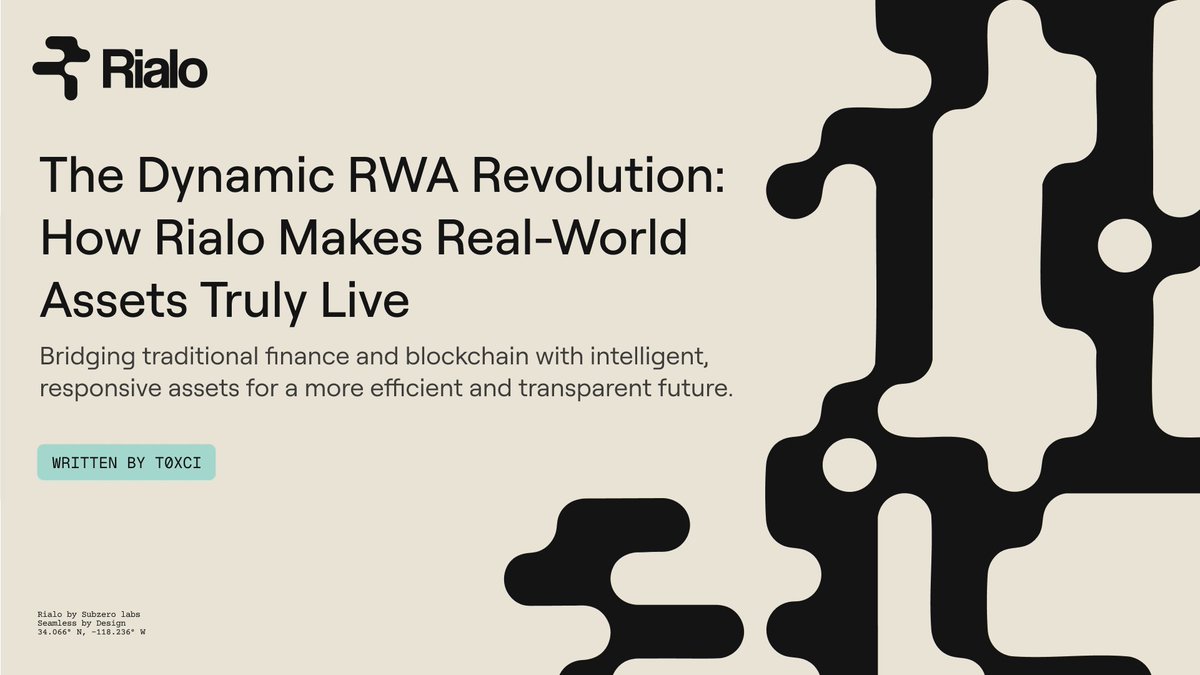
Rialo - Making Real-World Assets Truly Real
RWAs have long been heralded as one of blockchain's most transformative promises. The idea of tokenizing tangible assets like real estate, commodities, and even intellectual property on a distributed ledger holds immense potential for increased liquidity, transparency, and accessibility.
However, despite billions already invested in tokenized treasuries, real estate, and credit, the current state of RWAs often falls short of this grand vision.
Many existing implementations behave more like slow, cumbersome replicas of their off-chain counterparts rather than truly revolutionary digital assets.
This article delves into the limitations of today's RWAs and explores how
is addressing these challenges to unlock the full potential of real-world assets on the blockchain.
// The Shortcomings of Current Real-World Assets
Despite the enthusiasm surrounding RWAs, several critical limitations hinder their widespread adoption and true utility:
// Reliance on Off-Chain Verification
One of the most significant drawbacks is the heavy reliance on off-chain verification. Most tokenized assets cannot independently prove their status or execute actions without a third party.
Events such as dividend payouts, stock splits, or corporate buyouts necessitate manual checks and interventions before the corresponding updates can be reflected on-chain. This introduces points of centralization, delays, and potential for error, undermining the very principles of decentralization and automation that blockchain technology promises.
Applications built on these off-chain services must navigate complex and often opaque security models, inheriting repricing risks upon integration.
// Sluggish Speed and Reactivity
In today's fast-paced financial markets, speed is paramount. Markets operate in milliseconds, yet many RWAs exhibit a frustrating lack of reactivity.
A credit downgrade, a natural disaster, or any other significant real-world event can take hours or even days to be accurately reflected on-chain. This delay makes it challenging for RWAs to respond dynamically to market shifts or critical information, limiting their effectiveness in real-time trading and risk management scenarios.
// Limited Market Data Integration
Another key limitation is the infrequent integration of live data feeds from multiple sources. Traditional financial instruments constantly adjust to a wealth of real-time information, from inflation data to fresh appraisals.
However, many tokenized bonds fail to automatically adjust to inflation data, and real estate tokens often ignore crucial updates like new appraisals or zoning changes.
This disconnect from live, dynamic data streams means that RWAs often operate on stale information, diminishing their accuracy and utility as representations of real-world value.
// Poor Automation
Finally, a pervasive issue is the lack of robust automation. The promise of blockchain includes self-executing contracts and automated processes.
Yet, most RWAs still require human intervention for fundamental operations such as settlement, repricing, and portfolio rebalancing. These actions only occur when someone manually triggers them, which contradicts the vision of a truly autonomous and efficient digital asset ecosystem.
This reliance on manual input introduces inefficiencies, increases operational costs, and slows down the entire process.
/ How Rialo Makes Real-World Assets Truly Real
Rialo is engineered to overcome these limitations, building a real-world blockchain that seamlessly integrates with both traditional finance (TradFi) and Web2 ecosystems. By offering native private and public connectivity, Rialo ensures that off-chain data is verifiable and on-chain settlement becomes an instant, automated action.
On Rialo, RWAs are not static tokens, they are dynamic, living instruments capable of subscribing to live data, reacting to changing conditions, and triggering downstream actions without human intervention.
This approach transforms markets previously constrained by geography, paperwork, or wealth into instantly accessible, continuously liquid, and transparently governed assets that truly *live* on-chain.
### Key Capabilities of Rialo:
> Real-World Data & Connectivity: Rialo's programs are designed to fetch and verify live data directly from authoritative sources such as government registries, rating agencies, bank/payment rails, and market feeds. This enables automatic application of events like stock splits or mergers, confirmation of dividend payouts, and reconciliation of invoice statuses with platforms like Stripe or ACH.
> Real-World Reactivity & Automation: The platform supports event-driven programs that can sleep, await, and resume based on state changes, eliminating the need for off-chain bots. This allows for instant repricing of assets upon credit downgrades, adjustment of insurance payouts or futures positions in response to natural disasters, and immediate execution of tender mechanics following buyout announcements.
> Real-World Privacy & Identity: Rialo provides verifiable yet confidential execution, coupled with familiar login methods (email/SMS/social) to ensure compliant ownership and credit. This facilitates features like gated tranches for eligible investors and programmable wills that automatically transfer assets to verified heirs based on attested events.
> Real-World Speed & Scale: With sub-second end-to-end latency and horizontal scalability, Rialo can maintain liquid markets even at global transaction volumes. This supports high-frequency operations such as CLOB for Foreign Currency Exchange, real-time NAV updates for collateral pools, same-block rebalancing of index funds, and streaming price feeds for on-chain derivatives.
> Real-World Trading: The combination of privacy, speed, reactivity, and data integration enables a next-level, full-suite trading operation. Users can encrypt their trading algorithms, fetch all necessary data inputs, and update their positions in real-time based on preset conditions. Examples include equities reacting to price and global shipping news, commodity trades based on weather, and recursive stop-loss orders based on dynamic markdowns.
// Unlocking New RWA Use Cases with Rialo
These advanced capabilities unlock a new generation of RWA use cases that are uniquely possible on the Rialo platform:
> Debt & Credit: From tokenized bonds whose yields automatically adjust to real-time CPI prints, to automated invoices that settle instantly upon payment confirmation via Stripe or ACH, and live on-chain credit markets that dynamically reprice risk based on real-time data.
> Insurance & Risk: Dynamic futures and parametric insurance can be created using any live API as a market feed, allowing for instant settlement of flight-delay insurance or event-triggered supply chain insurance that releases capital based on verified checkpoints.
> Real Estate: Dynamic property management tokens can automatically adjust rental yield distributions based on live occupancy, rental payments, and maintenance expenses pulled from property management APIs.
> Commodities & Trade Finance: Tokenized warehouse receipts tied to GPS and inspection data enable instant financing, while real-time commodity ETFs can rebalance automatically based on live market data.
> Markets & Trading Infrastructure: Rialo can serve as a real-time data terminal for AI agents, allowing them to curate dynamic news streams, estimate portfolio impact, and place conditional orders on-chain with sub-second latency.
> Environmental & Sustainability Markets: IoT-verified carbon credits can be minted, expired, or adjusted automatically based on sensor data from forests or industrial sites, and tokenized Renewable Energy Certificates (RECs) can settle on-chain from live metering data.
> Intellectual Property: Autonomous royalty streams can automatically split and distribute earnings from platforms like Spotify or YouTube, and programmable licensing tokens can adjust pricing and terms based on actual usage data.
// From Static Tokens to Living Assets
Every example of Rialo's innovation, from tokenized bonds that track CPI to on-chain loans backed by FICO scores, shares a common foundation:
1. Live data feeds baked directly into the asset.
2. Automated on-chain reactions to that data.
3. Seamless integration with the existing systems where the asset operates today.
Herein lies the Rialo advantage. We don't just digitize assets; we transform them into living instruments that adapt to the world in real-time. By fusing the stability of traditional assets with the power of blockchain, Rialo is creating a new financial paradigm - one that is radically more efficient, transparent, and accessible. The future of RWA isn't coming; it has arrived, and its name is Rialo.






![0xt0xci's tweet photo. How to join the Momentum ICO on Buidlpad in just a few clicks?
Registration for the Momentum project's ICO is currently underway on the @buidlpad platform.
@MMTFinance is one of the largest DEXs on @SuiNetwork. It has developed its own xSUI technology, which I wrote about in a previous post: https://t.co/Kn59McWyj0
Sale Conditions:
🔵 Allocated for sale: $4.5M
🔵 FDV: $250-350 million (depends on the tier)
🔵 Vesting: 100% at TGE
🔵 Deposit: from $50 to $2000 (For LP deposits, the limit can be increased to $20,000) in $BNB, $SUI, $USDC (Sui Network) tokens
The sale is divided into tiers:
> Tier1 [250M FDV]: Hold stables in Momentum LP in @buidlpad HODL (you need to deposit $3,000 in the HODL menu, the deposit must be specifically through Buidlpad), participation in Wagmi 1 and 2 campaigns.
⏰ The snapshot will be on October 24, 2 AM UTC.
> Tier 2 [350M FDV]: All others, also 30% of the supply allocation is reserved for content creators.
For content creators, the following steps are required:
1. Register an account on Buidlpad (if you don't have one yet, here: https://t.co/Y4HwWNWywi
2. Link your wallet and complete KYC verification
3. Add the username "Ⓜ️Ⓜ️T" to your X/Twitter (like mine)
4. Write a unique post/thread/article about Momentum and Buidlpad (they must be tagged via @)
5. Upload your content on the sale page, in the "UGC Squad Challenge" menu, click "X Posts" (initially it will show 0), then click the "Update" button and add links to all your posts.
⏰ Deadline for this activity is October 22, 9:59 AM UTC
Timing dates:
🔵 Subscription/KYC: from October 22, 2025 at 10:00 AM UTC to October 25, 2025 at 02:00 AM UTC.
🔵 Deposit contributions: from October 27, 2025 at 10:00 AM UTC to October 28, 2025 at 10:00 AM UTC
🔵 Sale results and excess refunds by October 31, 2025 at 10:00 AM UTC.](https://pbs.twimg.com/media/G31i7QxXgAAzBOr.jpg)