Bittensor ecosystem highlights of the week #5
// SUBNET UPDATES & ACHIEVEMENTS
➤ @404gen_ SN17
404 announced an integration with Unity, the world’s most used game engine, as an official verified solution.
(https://t.co/HeQigfDV5Y)
They also just released the world’s largest open-source 3D model dataset.
(https://t.co/vjcPJoChJB)
➤ @webuildscore SN44
Score dropped their latest validation upgrade, featuring a 50x increase in frame validation (2 to 100) and a 4x reduction in cost.
(https://t.co/hGLGp6t2gQ)
DKING Terminal V0.2.0: big update for their agent, with a newly added swarm of agents that boosts efficiency, analysis, and capabilities.
(https://t.co/MAeJrB9AEf)
➤ @rayon_labs SN56 + SN64
Rayon Labs launched Gradients v3, a major platform upgrade that now lets you bring your own datasets, train models up to 70B parameters, use Flux image models, and pay in fiat.
(https://t.co/SP5WjlYSLJ)
They also shared a comparison of Gradients vs AWS, Google, and Together—showing that Gradient is both the cheapest and the most performant option.
(https://t.co/b27hi6MFQU)
Major milestone for Chutes: they’ve now processed over 1 trillion tokens since launch.
(https://t.co/4Qb8EXgE2G)
➤ @BitMindAI SN34
Bitmind rolled out their latest extension upgrade, including access detection history and Up/Down vote predictions.
(https://t.co/jySVE5yqzc)
➤ @metanova_labs SN68
Nova unveiled their flywheel, illustrating the iterative loop behind how their subnet works.
(https://t.co/dH2nCrqi36)
They also shared results from their Shanon upgrade, showing a promising 23x increase in unique submissions per challenge on average.
(https://t.co/t8UsTW3Fce)
➤ @SynthdataCo SN50
@modenetwork is now integrating Synth predictive data into their perps trading app.
(https://t.co/OSUclbNhNc)
➤ @MacrocosmosAI SN13 x @Playinfgames SN6
Macrocosmos SN13 is now powering Infinite Games SN6 forecasting, using social media data.
(https://t.co/UEmk1mytoV)
➤ @getmasafi SN42
Masa just integrated TEE into their data scraping subnet, to provide secure, scalable, and reliable data on an open infrastructure.
(https://t.co/2yOdrUcz88)
➤ @vidaio_ SN85
Vidaio unveiled their website & GitHub.
(https://t.co/6EF38rtlIw)
➤ @NextPlace_AI SN48
Their API is now available and free to use.
(https://t.co/aOOSGS84Dl)
// BITTENSOR ECOSYSTEM
➤ @UnsupervisedCap
The Bittensor OG chad @Old_Samster just announced the launch of his liquid fund dedicated to Bittensor: @UnsupervisedCap.
(https://t.co/kQxcre0npk)
// PODCASTS & ARTICLES
➤ Novelty Search with @maxscore and @tm0klc from @webuildscore SN44.
(https://t.co/gqS0lyrwCS)
➤ @RaoulGMI podcast with @BarrySilbert from @DCGco and @YumaGroup.
(https://t.co/jLBkPD00Ma)
➤ @TAOTalkPod with @Carrot_____1 from @TensoraGroup.
(https://t.co/Sl3Pb9VXoc)
➤ @VenturaLabs podcast with @DavFields from @ReadyAI_ SN33.
(https://t.co/3G5zq62g9i)
➤ @VenturaLabs podcast with @mcjkula from @latentholdings.
(https://t.co/2HDoQimraP)
➤ @MacrocosmosAI article on “What should Bittensor do to breakthrough?”.
(https://t.co/cs8zmduUm7)
Last week was phenomenal for Bittensor.
• $TAO rally
• The Catalyst
• Grayscale report
• Notable subnet acquisitions
• Some insider trading(?)
That's a fun read, let's start 👇🧵
Bittensor Subnets: Chosing validator
When buying subnets or staking to root, you need to chose a validator in the settings button
✅Legit validators:
-Taostats & Corcel
-Opentensor foundation
-Rizzo
-Roundtable21
-TAO. com
-yuma
-crucible
-cortex foundation (i think)
🛑Scam validators:
-tao5
-datura
-ary van der touw
-tatsu
$SEA is coming.
Here are a few things to know:
• Historical OpenSea usage, not just recent activity, will be an important ingredient
• Claim process will be simple and accessible. US users welcome
• We’re focused on long-term sustainability and supporting a healthy, enduring community
• No details on timing yet. We’re taking the learnings from this space and getting it right
As always, only trust updates from @openseafdn and @opensea
What I look for in crypto projects
- Smart money & follower interest
- Catalysts: Tokenomics revamp, Protocol updates, etc.
- Vision: Value proposition should be easy to grasp.
- Product Market Fit: Who would use this project?
- Narrative Alignment: Does it fit the current narrative?
- Valuation vs. Market Leader: Good beta plays tend to reach around 10-15% of the sector leader's mcap.
- Volume: More organic volume means more attention
- TVL: Not perfect but useful for following liquidity
- Team: Communicative devs that focus on shipping
- Time in Market: I prefer newer projects (0-3 months) for higher velocity potential.
- Liquidity to Mcap ratio: For small caps I prefer a 2-10% ratio.
- Value Accrual: How much protocol success translate to token holders.
- Emissions: If there are unlocks, how much is being emitted and where?
- Vibes: Is it overly professional or more degen?
- User Metrics: I try to find metrics on Dune & native dashboards for data.
- Mindshare: I use Kaito or LunarCrush to track social sentiment.
- Fair Value: Where is support? What levels show accumulation vs. capitulation?
How I'm Betting on Altcoins from Here
(And how NOT to)
1. Bitcoin & Total Altcoin Market Cap
2. How People Got Burned
3. Altcoin Structures & What I'm Looking For
1. Bitcoin & Total Altcoin Market Cap
First, I have a higher time frame bias, but I won’t dive into that here to keep it short. Simply put, I believe we’ll trade higher later in the cycle, no matter the short or medium-term moves.
This thread is about how I plan to find entries using medium-time frame price structures on Bitcoin, total altcoin market cap, and altcoin charts.
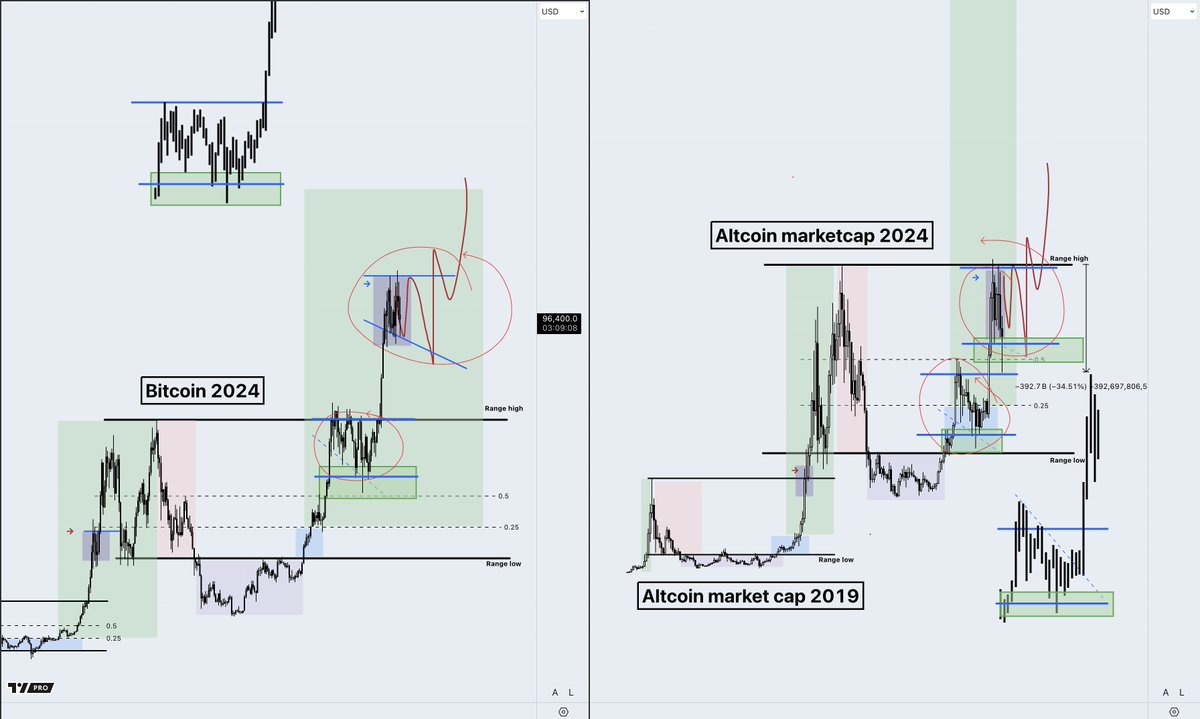
We can see that we formed a local range if we look at higher time frame charts for Bitcoin and the total altcoin market cap. The swing high and low (blue lines) look similar to how Bitcoin built a local range below the macro range high resistance in 2024.
In a range, you always assume more ranging until proven otherwise.
So, right now we have:
Higher time frame bias: Higher later this cycle.
Medium time frame bias: Ranging.
Lower time frame bias: I don't know and don't want to bet on it.
2. How people got burned:
It's pretty obvious, but still, most people still do it.
This is where most got burned in Bitcoin’s 2024 range—bull chop did its job. People turned super bullish, thinking the move was a breakout, buying range high resistance. Then, they flipped bearish at the range low, sold for a loss, and got chopped up again.
Buying green/high, selling low/panic.
Trading on emotions.
If you did not buy the ultimate panic at the range lows, do not chase days or weeks of green into the higher part of the range. If you are scared to miss out, have a range-high break-out trigger set in place. For me this would be acceptance above the range high. A lot of Altcoins will offer reclaim trigger opportunities anyway.
Keeping it simple:
> If you want to accumulate, look for your spot entries slowly over time when prices are at or spiking below the range low support, and everyone is panicking and screaming zero
> If you want to derisk, do so at the range high resistance when everyone is bullish.
I am interested in Altcoin trades at the range low, not necessarily derisking a lot at the range high as I already have been taking profit and did so the initial time it hit this + I think we'll trade higher later this cycle.
More about this in my profit-taking plan from November last year.
If the range low fails and we find acceptance below, I'm becoming mid-term-cautious again and will wait until we find a bottom lower. I will post a new thread with a new plan IF this is the case.
3. Altcoin Structures & What I'm Looking For
'Only a couple of Altcoin sectors did well this year'
It is a complaint you often hear this cycle. I try to position myself in the right sectors by focusing on strength.
The market shows and will continue to show its hands early. It will show you where the attention (and money inflow) is at by early outperformers.
Examples: (facts)
- SOL outperformance 2023/2024
- Early meme coin outperformance this cycle
- AI tokens taking of 2023/early 2024
- AI agents later 2024/early 2025
Or thinking logically, which is a bit more risky, but: (my thoughts)
- If ETHBTC bottoms -> DeFi might have its period (thinking about AAVE/UNI, etc)
- If the RWA shills continue or if influential people start to tokenizer worldly things -> RWA
- BNB meme run if CZ continues to push it + $TST run -> Might spark some of the more significant meme tokens on BNB (CAT comes to mind)
So, rather than simply thinking about what I think is cool or deserves to go higher, I look for signs and try to position in what the market thinks should go higher.
A major mistake of many people in this cycle is that they don't like memes or think it's trash and ignore them, or they do not buy Solana because it's centralized or because they don't relate to the culture or users. They put their opinion over the market's opinion (the early outperformance signs)
Altcoin structures
Immediately after a dump, many are often bullish and looking to buy the dip. They correctly identify a key level and buy themselves in. Well done so far, but the problem is that OFTEN (read often, not always), the recovery of these savage down moves is not instantly. They often get followed up by time-based capitulation. On the other hand, people expect full recovery once they press the buy-in button, just a human nature thing I guess, expecting immediate action followed by your action.
Time-based capitulation is often the cause of more people flipping bearish at a potential bottom than the actual downside.
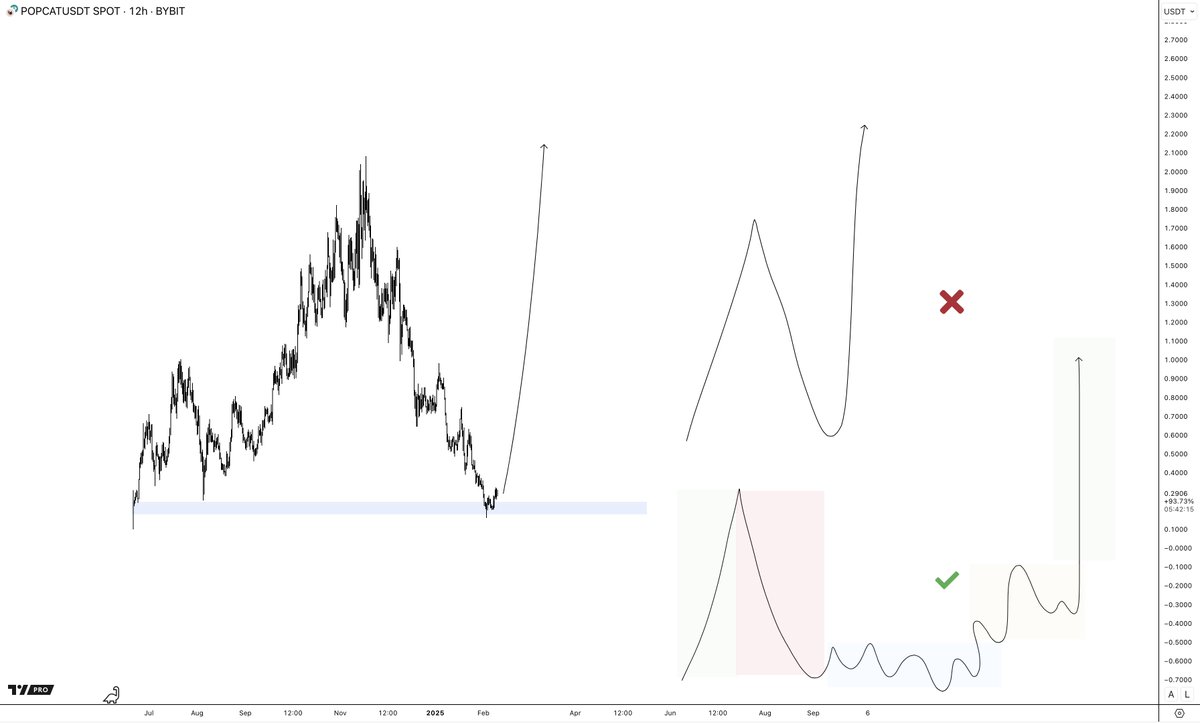
PopCat, for example, and again, it doesn't need to happen, but it often does form a mini cycle stage 3 sideways after such a move down.
Because of the range Bitcoin and the total 3 (total altcoin market cap) are in a range + a lot of Altcoin have done savage down moves, I tend to lean to more sideways/slight potential down moves before recovery. I'll be looking for either sweeps of the blue stage 3 sideways range or a reclaim of the range above.
Again, PopCat as an example -> wait for the range to form and potential triggers to get in:
1. Wait for a sweep and reclaim (invalidation acceptance back below the local low)
2. Wait for a reclaim of the range above.
(I just painted the structure on popcat, don't mind the actual prices or time my squiggly hits there; it's an example)
I'm not betting on how long it will take or when exactly we'll start our next leg up or bottomed. I'm not trying to predict tomorrow's prices or next week's, but just based on my current medium time frame view, I slowly position myself for my higher time frame bias.
Recent Market Overview: https://t.co/GvITH61M5T
Older Profit-Taking posts:
https://t.co/SfgudasJxh
https://t.co/2hDp8kQ0Gj
Using the cycle structure: (mentioned above)
https://t.co/IUi4BacDxE
If you enjoyed or found this helpful or have feedback/suggestions, I would love to hear them in the comments, and feel free to retweet the post!
Amsterdam 🫡
I would advise you to think twice about launching a fair launch coin if you intend on using it to fund a long-duration project.
Teams need resources to build. Generally, when a team raises a Series A from VCs, they give away 10-20% and keep 80-90% of the initial capital. If the project becomes a unicorn (> $1B) then usually the team owns a significant share of that which they can use for operations.
In the current "fair launch" meta, teams end up with 5-15% supply at TGE after giving away 85-95%. This causes a whole range of problems.
1. No supply control means that anyone can just buy the token and start caballing it. Many of the AI projects have a token price set by the cabal choosing to support them which goes to 0 as the cabal farms the user base. In the end, the devs usually get very little, since they feel a moral obligation to go down with the ship.
2. It's really hard to give equity that satisfies teammates with prior expectations-- everyone looks at the big number, compares the "fair launch" projects to projects of old and thinks "wait why are you giving me .1%-.2% of this? That's not fair!" when proportionally it represents a far larger portion of the team's allocation than 1-10% of a more normal project launch.
3. Extremely low liquidity favors early traders but fucks over just about everyone else. Any time the liquidity becomes significant there is a risk of a big whale making an exit and selling into that liquidity, crashing the price a lot. Fair launch coins almost always have a really bad liquidity problem-- this is a feature for traders who want to see major price movements and a nightmare for builders who just want to build drama-free.
4. Fair launch only rewards builders who already have capital to put in and who coordinate smashing the button immediately with their SOL or bundling their launches. Many teams have launched a project and then have had to literally beg the community for resources to have enough to build. The only reason we've been able to get so far is because one whale extremely generously donated 11%.
5. Fair launch for real projects can create legal requirements that cost a lot of time and money retroactively moving to fix. Setting up an offshore token foundation, onshore dev co, hiring multiple lawyers, etc. *after launch* is risky and expensive.
6. Nobody expects a pumpcoin to release revolutionary L1-level tech in 2-3 years. The daosdotfun meta was created to enable traders to casually run a fund for a year and take their carry when the fund closes. We're following metas which reward projects for the first few weeks, then become major albatrosses.
7. Traders have absolutely no idea what goes into building products most of the time, and their expectations are just absolutely unrealistic. When we're building things that have never been built before, it is very hard to assess exactly how long things will take or what the technical risks really are until we've crossed those bridges. Vitalik expected PoS to be finished in 2017 and allocated tokens accordingly, if ETH hadn't shot up to $3k they'd be cooked.
8. There is also just a general problem with open source public goods, which is that people see them as free and rush to capitalize on them without consideration for how to build a sustainable and symbiotic relationship with the creators of those goods. If there were a way that I could continue to work on open source public goods forever and not have to build launchpads and tokenomics and other products to accrue value, everyone else would benefit so much more. But since very very few people are establishing win/win relationships with our project and are just using it for free to make money for themselves, I have no choice but to focus on those things.
I've been thinking a lot about how we can balance the spirit of fair launch-- enabling everyone to get what usually only the VCs get-- with realistic mechanisms to enable teams to build real tech.
I've been working with some really incredible folks in the space to codify this into a system and we'll be releasing a whitepaper soon.