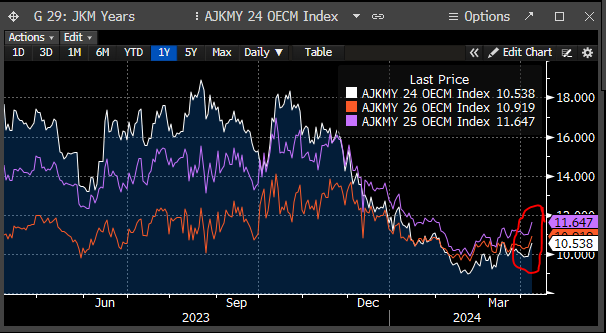
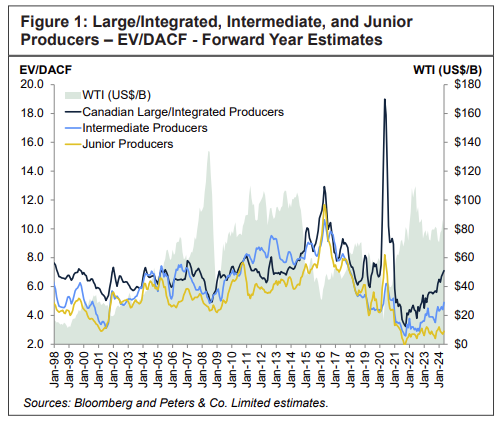
Massive valuation gap between large caps and small...symptomatic of an inefficient market with few active participants and generalists chasing the same "safe" 1-3 names. We continue to look where others are not.
Power Thought
GS dropped 3 AI / Power reports this morning (my cup overfloweth!) and over the past 3 weeks we've seen over a dozen estimates from research houses and industry participants alike.
If you want to take a law of large numbers approach the median expectation is for ~5 Bcfpd of additional natural gas power burn by 2030, which squares to effectively just the market share capture of the anticipated load growth.
If gas can continue to increase market share (as it has in both coal switching regions but also greening regions as a key source of grid hardening) then we can cast our eyes upward towards the 10 Bcfpd+ trajectories.
One thing that these reports never seem to overtly capture is (a) the global picture (GS did a bit today and sees 34-48% power growth [all sources and fuels] in Europe by 2032) and (b) where price will play a role.
On the gas side if price floats from $2 to $4 over the next 1-2 years as is expected (CAL26 strip trades $4 for the first time since November today) there will be some elasticity in demand, some coal/oil will come back. $4 is still low enough for a lot of capacity build out to make sense, but it is interesting to see in this whole theme which analysts seem to be the most nervous - the Utilities analysts.
They see a sector that sized debt obligations in a 1% interest rate world, about to see 3-5% interest rates for longer than they were expecting, higher feedstock costs (nat gas prices), and an increasingly cost conscious customer base in which to try and place growth capital into a rate-base increase. Tricky!
It might be that the real infrastructure demand play is all independent power producers (IPPs) who step up to install behind-fence power solutions for the industrial (data center) players who need it. Much like crypto, this will stumble upon the market without the regular fanfare of publicized capacity timelines and que filings.
The decentralization of power could be a pretty big disruptor for the utility sector, regulatory capture, and climate goals. It also could be a really large accelerator for the power sources that can step up for the 24hr load demands facing the market. Perhaps 10 Bcfpd by 2030 is not just possible but probable.
US-Style Oil Megadeals Viable in #Canada, BMO Energy Banker Says
Bank’s energy chief says investors likely to support big deal
Need to find drilling inventory not a factor, BMO’s Wells says
#oott
https://t.co/eKDDHX5geK
$xle $xop $oih
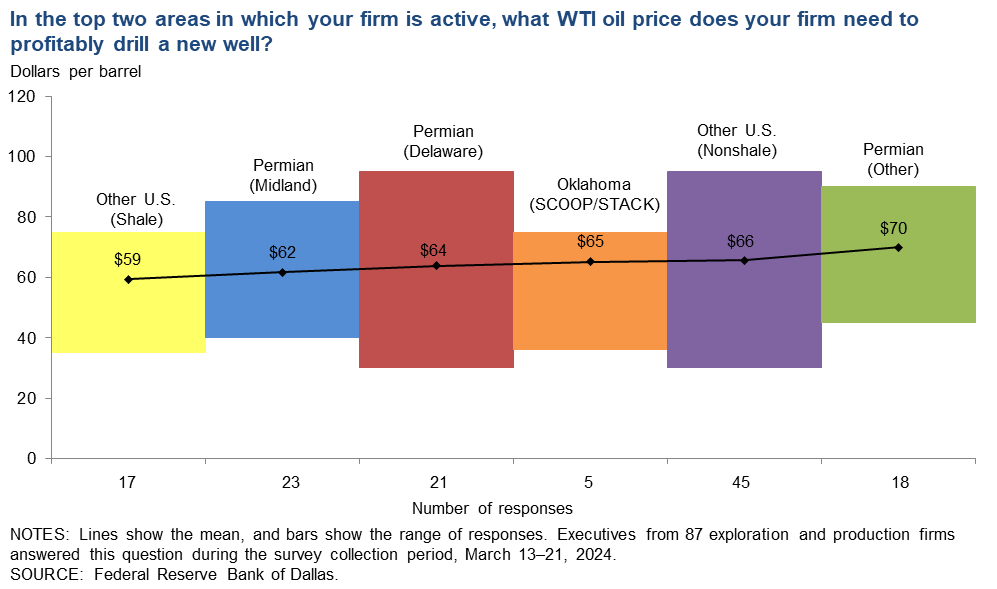
Breakeven estimates for new oil wells from the recent Dallas Fed energy survey now vs. two years ago; the marginal Permian barrel cost has gone up from $54 to $70; probably why each $CL dip into the $60s has been fairly short-lived:
@Amena__Bakr@energyintel Hi @Amena__Bakr - X won't allow me to DM you but I always hold you and the @energyintel team in very high regard and would be thrilled to attend if there is space available!
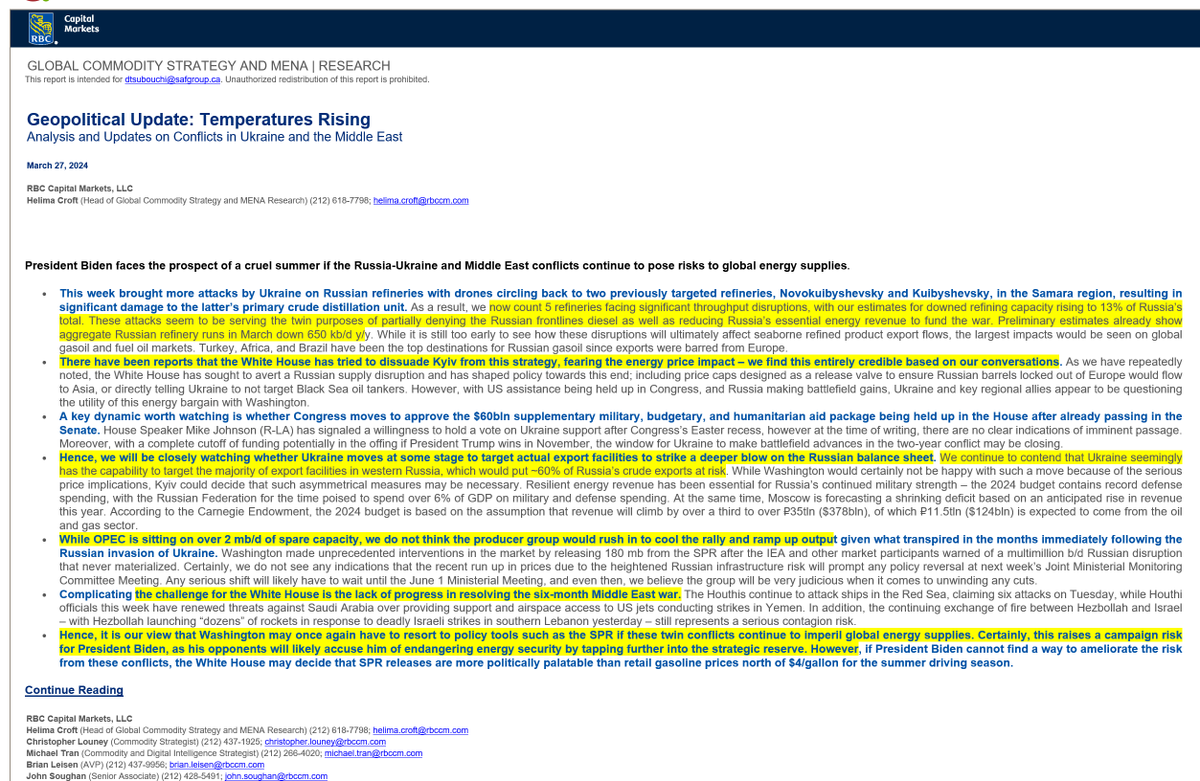
Must read from well plugged-in, not subject to hyperbole @CroftHelima.
Multiple geopolitical risk premium events over the coming weeks/months, NOT years.
#OOTT
Dallas Fed Energy Survey: In the top two areas in which your firm is active: What WTI oil price does your firm need to profitably drill a new well? #oott
No surprise HH #NatGas prices are $1.80 given @NOAA reminds it was the warmest winter on record.
Would be <$1.50 if EQT, CHK & others weren't shutting in supply.
Challenge for #NatGas is that shoulder season is starting ie. leave the windows open temperatures.
#OOTT
EQT Corporation today announced it made the strategic decision to curtail approximately 1 Bcf per day of gross natural gas production beginning in late February in response to the current low natural gas price environment resulting from warm winter weather and consequent elevated storage inventories.
https://t.co/GocKfkAj0D
The US just experienced its warmest winter on record 🇺🇸 🥵
🗺️ El Niño, a warming of the equatorial Pacific Ocean, led to a drier and milder season
📉 The warm weather reduced gas demand, sending domestic prices plummeting to the lowest level since 2020
https://t.co/OLfTvmcA1F
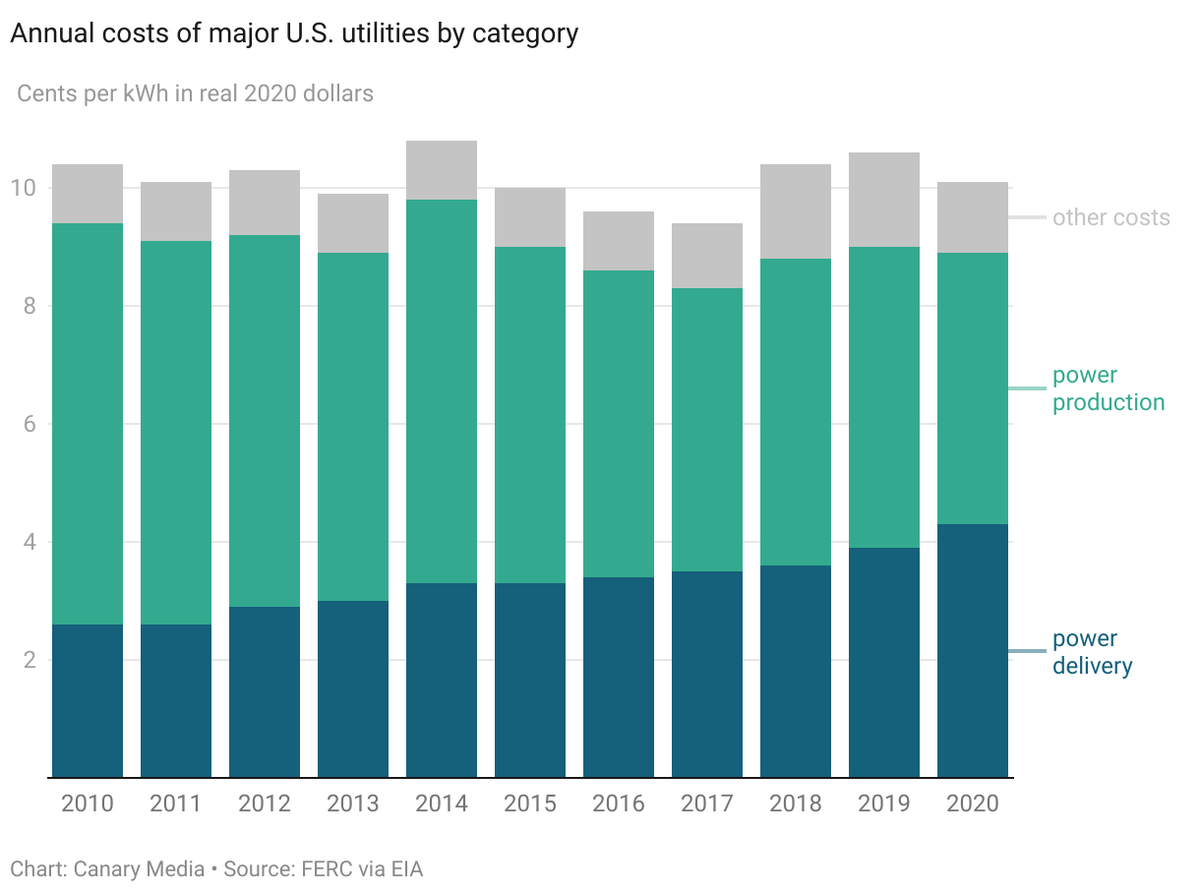
If renewables are so cheap, why are electricity prices going up?
As many (like @duncancampbell) have pointed out, electricity generation is actually getting cheaper but delivering that electricity is getting more expensive.
Increased delivery costs are often attributed to transmission needed to connect renewables, but transmission isn't actually the problem.
Transmission operates at high voltages and benefits from economies of scale. Distribution (that part of the grid that delivers power to your home) operates at lower voltages and is much more expensive.
The U.S. has about 200,000 miles of transmission lines, but around 5,500,000 miles of distribution lines. Distribution makes up over 2/3 of the cost of delivering electricity!
Technologies like nuclear can help lower transmission costs, but even an SMR in every town won't fix rising distribution costs. So what makes distribution so expensive, and how do we fix it?
Transmission & distribution capacity costs a lot to build, but the marginal cost of using that capacity is zero. The problem is that we need to build capacity to serve peak demand, but on average we use a very small portion of that capacity. Residential load factors (average demand/peak demand) are often just 10-20%!
Capital costs have to be amortized over relatively few units of energy, which makes distribution expensive per unit. To lower the cost, we need to smooth out demand. This is where distributed energy resources (DERs) can help.
DERs can generate energy locally or shift consumption to times where excess capacity is available. This helps consumers use more electricity with less grid capacity.
Home batteries, smart EV charging, more efficient HVAC systems, better insulation, home solar (paired with storage), smart water heaters, etc. are all technologies that can greatly improve load factor and lower distribution costs.
The reason we don't see more of these technologies is that costs are socialized and consumers can't internalize the financial benefit of lowering grid costs.
T&D is typically charged with flat volumetric $/kWh pricing. T&D costs however arise from peak kW system demand. Moving to time of use (or real time) T&D pricing would give consumers the price signal needed to lower both their own costs and system costs.
Distribution costs are not going to be solved without distributed resources. They're rising because we're forcing a centralized "solution" on a problem that requires a decentralized solution. We don't need to pick technology winners. Consumers are smart and they can solve rising grid costs if we just empower them to do so.
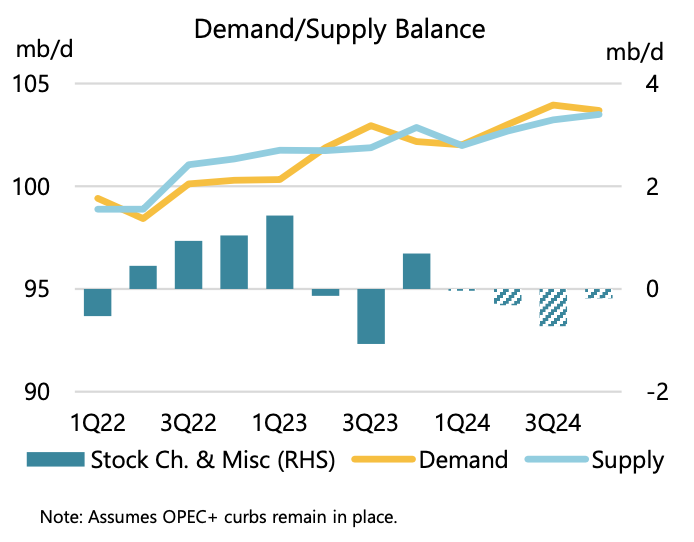
Feb ‘24 EIA STEO calls for flat 🇺🇸 oil production Dec23 to Dec24. +400Kbbls/d in ‘25. Non 🇺🇸 supply needed to satisfy +2M bbls/d demand growth next 2 years. Futures curve waking up to this with significant structural changes last 2 months
ICYMI
Here's key reason why HH #NatGas went below $2 in Jan.
Even with Arctic freeze in mid-Jan, Jan was 48th warmest in last 129 yrs and, most importantly, NE US and Great Lakes was near record warmth.
Nov 1-Jan 31, was 5th warmest in last 129 yrs.
Thx @NOAA#OOTT








![JamieHeard5's tweet photo. Power Thought
GS dropped 3 AI / Power reports this morning (my cup overfloweth!) and over the past 3 weeks we've seen over a dozen estimates from research houses and industry participants alike.
If you want to take a law of large numbers approach the median expectation is for ~5 Bcfpd of additional natural gas power burn by 2030, which squares to effectively just the market share capture of the anticipated load growth.
If gas can continue to increase market share (as it has in both coal switching regions but also greening regions as a key source of grid hardening) then we can cast our eyes upward towards the 10 Bcfpd+ trajectories.
One thing that these reports never seem to overtly capture is (a) the global picture (GS did a bit today and sees 34-48% power growth [all sources and fuels] in Europe by 2032) and (b) where price will play a role.
On the gas side if price floats from $2 to $4 over the next 1-2 years as is expected (CAL26 strip trades $4 for the first time since November today) there will be some elasticity in demand, some coal/oil will come back. $4 is still low enough for a lot of capacity build out to make sense, but it is interesting to see in this whole theme which analysts seem to be the most nervous - the Utilities analysts.
They see a sector that sized debt obligations in a 1% interest rate world, about to see 3-5% interest rates for longer than they were expecting, higher feedstock costs (nat gas prices), and an increasingly cost conscious customer base in which to try and place growth capital into a rate-base increase. Tricky!
It might be that the real infrastructure demand play is all independent power producers (IPPs) who step up to install behind-fence power solutions for the industrial (data center) players who need it. Much like crypto, this will stumble upon the market without the regular fanfare of publicized capacity timelines and que filings.
The decentralization of power could be a pretty big disruptor for the utility sector, regulatory capture, and climate goals. It also could be a really large accelerator for the power sources that can step up for the 24hr load demands facing the market. Perhaps 10 Bcfpd by 2030 is not just possible but probable.](https://pbs.twimg.com/media/GMWbFxGWMAA1nJ7.png)