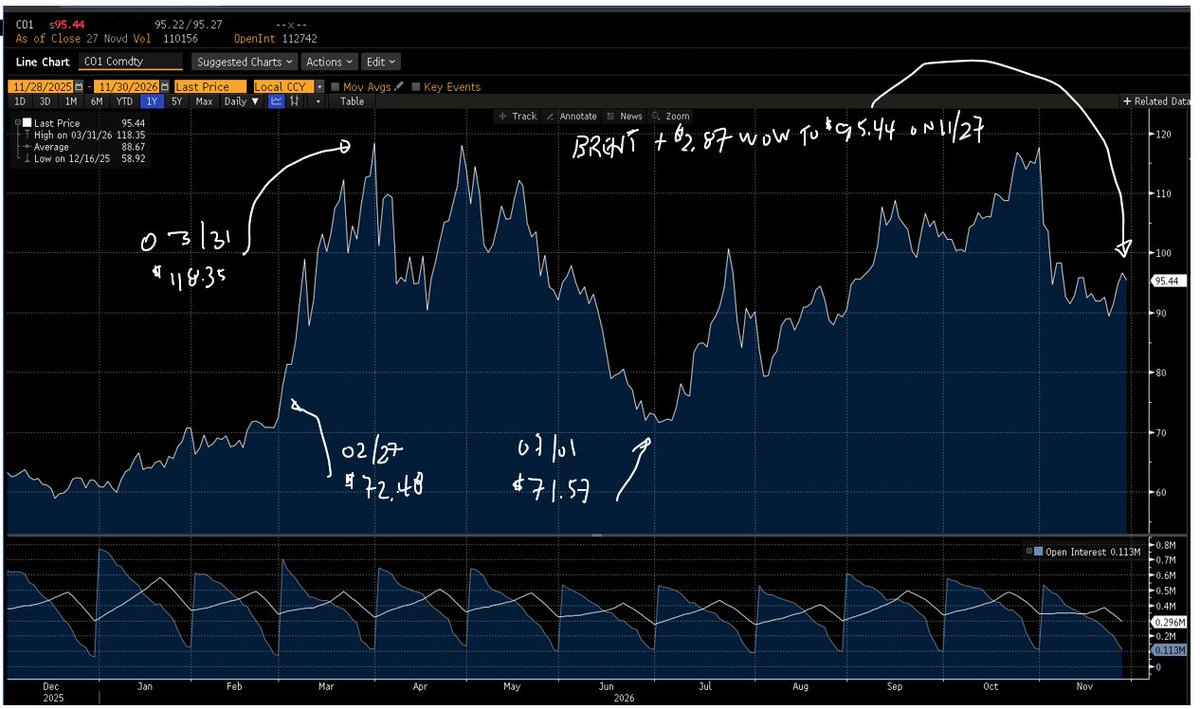
It's only one week but Vortexa's initial estimate for crude oil floating storage of 68.96 mmb on 11/27 is the first time below 70 mmb since Q3/25.
Vortexa's 1st estimates of crude oil floating storage for 11/27 as posted early this morning.
Total -15.95 WoW to 68.96 mmb on 11/27. 11/20 of 84.91 mmb was revised -0.59 mmb from 85.50 mmb originally posted on 11/21. Floating storage has been below the low 80's for the last seven weeks. This is the only time below 70 mmb well before US attacked Iran.
Middle East -2.98 mmb WoW to 20.65 mmb on 11/27. 11/20 of 23.63 mmb was revised +3.24 mmb from 20.39 mmb originally posted on 11/21. With the continued US/Iran standoff and tankers moving out to some degree via going dark and US escorts, Middle East has been <25 mmb for the last several weeks.
Asia +1.50 mmb WoW to 19.22 mmb on 11/27. 11/20 of 17.72 mmb was revised -2.30 mmb from o21.02 mmb originally posted on 11/21. The last 13 wks have been at or below 25 mmb incl 8 wks below 20 mmb, which is by far the lowest levels since US attacked Iran.
Note the Sat am estimates are Vortexa's initial estimates at the Fri floating storage and get revised either up or down over the weekend and thru the week.
Thx @vortexa@business https://t.co/ArXhS13BaY #oott
US gasoline and diesel price continue down big WoW as Nov is the normal seasonal weaker gasoline price period and the recent oil price weakness.
Diesel prices flow thru to impact just about every product price, not just agriculture. And as Tyson Foods CFO noted, they just get passed thru to the customer. (see my 👇09/13 post)
AAA average gasoline and diesel prices posted early morning on Nov 28.
Gasoline:
National: -$0.13 WoW to $3.53, -$0.95 MoM, +$0.51 YoY. Now +$0.55 vs $2.98 when US attacked Iran on 02/28.
California: -$0.11 WoW to $5.37, -$0.60 MoM, +$0.80 YoY.
Diesel:
National: -$0.08 WoW to $5.67, -$0.68 MoM, +$1.90 YoY. Record high of $6.53 was hit on 09/22.
California: -$0.21 WoW to $7.59, -$0.84 MoM, $2.46 YoY. Record high of $8.51 was hit on 10/18.
Thx @AAAnews
#oott
High jet fuel prices + lessening oil hedge position = European airlines cutting capacity = less air travel than previously expected.
The reduced Europe air travel is due to European airlines taking out capacity right now. There will still be peak Xmas air travel but at lower levels than had been expected.
See my 👇11/08 post. @Ryanair CEO O'Leary on the earnings call warned that all European airlines were cutting capacity on their winter schedules.
Eurocontrol 7-day moving average of arrivals/departures turned negative YoY three weeks ago and continue negative YoY after 24 consecutive weeks of positive YoY from 05/21 thru 10/29.
Vs 2025, turned negative two weeks ago.
11/26: -1.3% YoY
11/19: -1.7%
11/12: -2.1%
11/05: -0.2%
10/29: +1.1%
10/22: +0.9%
10/15: +0.6%
10/08: +0.7%
10/01: +2.7%
09/24: +2.9%
08/27: +2.4%
07/30: +2.9%
07/23: +2.8%
07/16: +1.9%
07/09: +2.2%
07/02: +3.2%
06/25: +2.2%
05/28: +2.1%
04/30: -0.5%
03/26: +2.3%
03/19: +1.0%
03/12: -1.0%
03/05: -1.3%
02/26: +3.1%
Vs pre-Covid, Europe air travel (arrivals/departures) continues back above pre-Covid.
11/26: -1.5% vs pre-Covid
11/19: -1.8%
11/12: -1.1%
11/05: +2.5%
10/29: +4.9%
10/22: +3.9%
10/15: +4.1%
10/08: +4.0%
10/01: +4.6%
09/24: +3.2%
08/27: +3.2%
08/20: +3.3%
08/13: +4.9%
08/06: +5.1%
07/30: +4.3%
07/23: +4.1%
07/16: +2.5%
07/09: +2.7%
07/02: +1.0%
06/25; +0.6%
05/28: +3.8%
04/30: +0.5%
03/26: -0.7%
03/19: -2.6%.
03/12: -3.1%.
03/05: -3.5%.
02/26: -1.4%
Thx @eurocontrol
#oott
High jet fuel prices + lessening oil hedge position = European airlines cutting capacity = less air travel than previously expected.
The reduced Europe air travel is due to European airlines taking out capacity right now. There will still be peak Xmas air travel but at lower levels.
@Ryanair CEO O'Leary on the earnings call "Certainly, if you look at the way the European airlines are managing this winter schedule, they all, including us, originally filed our winter schedules. We have since cut back that winter schedule in taking traffic down from 216 million to 214 million. Honestly, every other airline in Europe has followed us. They are all taking out capacity. I think not many of them are as well hedged as we are. Most of the European airlines are hedged up to the end of October, at the end of December. I think it is dawning on them that they are going to have to pay significantly higher prices for unhedged oil, and they are cutting capacity accordingly."
#oott
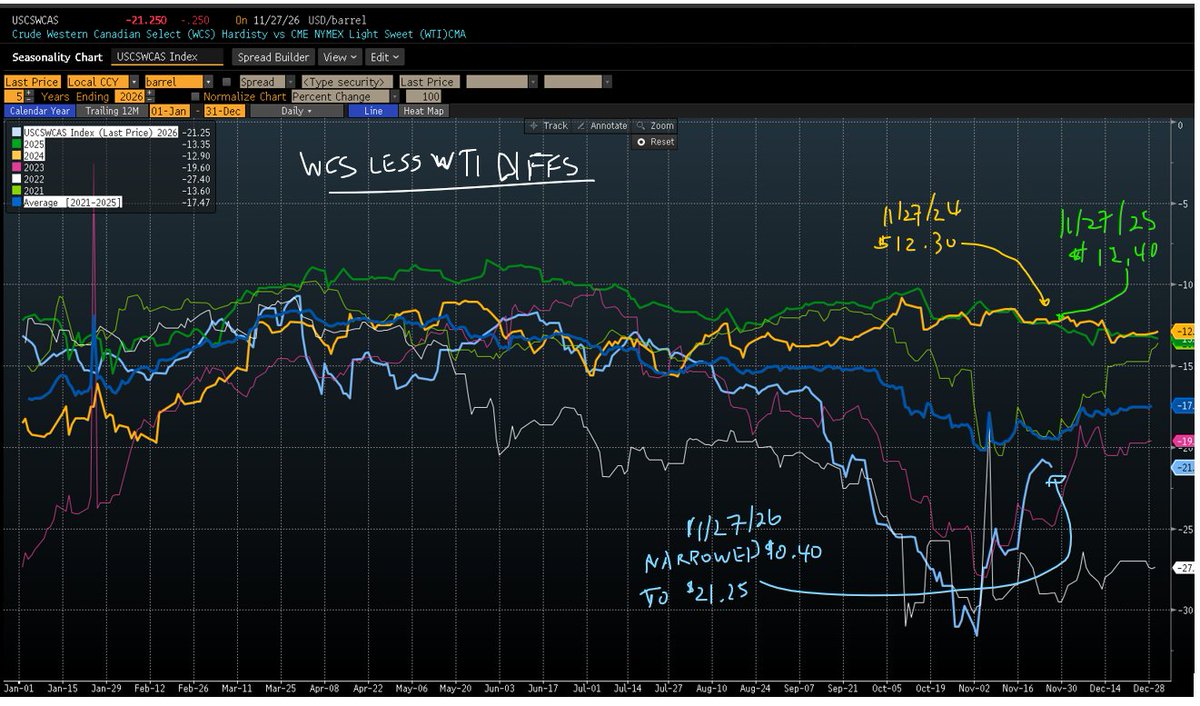
WCS less WTI diffs narrowed $0.40 WoW to $12.25 on 11/27/26. This is +$8.85 YoY vs $12.40 on 11/27/25:.
As Phillips 66 highlighted it its Q3 call, more Venezuelan crude to Gulf Coast is a big negative to Cdn heavy oil diffs. In summer 2025, US oil imports from Venezuela were not much above zero versus more like ~0.6 mmb/d this summer.
Plus sky-high tanker rates are bringing more nearby oil like Brazil into the US Gulf Coast.
Thx @business
#OOTT
321 crack spreads -$2.63 WoW to $43.06 to close on 11/27.
WTI -$0.90 WoW to $83.08 to close on 11/27.
$43.06 are still huge crack spreads in the US and reflect the global thirst for petroleum products from the US. $43.06 is a huge economic incentive for US refiners to draw more crude and run at max capacity to make big margins. Refiners have been running at max levels with these returns.
Thx @business
#oott
Circle K is like Costco in that high gasoline prices meant that customers came to gas station more often but put in less gas per fill up.
But Circle K is not like Costco in that its gas pumps had lower same store gasoline volume sales. Makes sense as Costco, BJ's Wholesale, etc sell more gasoline as their gasoline is cheaper.
"Throughout the quarter, the environment remained volatile, with geopolitical tensions and higher fuel prices weighing on demand in certain regions. In the U.S., same-store fuel volumes declined by 2.1%, while total gallons sold increased by nearly 5%, reflecting the contribution from network expansion. Europe and other regions were down 4.4%, while Canada remained more resilient, with volumes up 2%." Alimentation Couche Tard CEO.
"Our fill rates are down 12%, 13%, 14%, but our traffic at our pumps are up because of the higher prices. I think the key element here is our ability to access those customers and incentivize them or entice them to go into the store." CEO.
Thx @stock_analysisx
Catching up on transcripts post meetings this week.
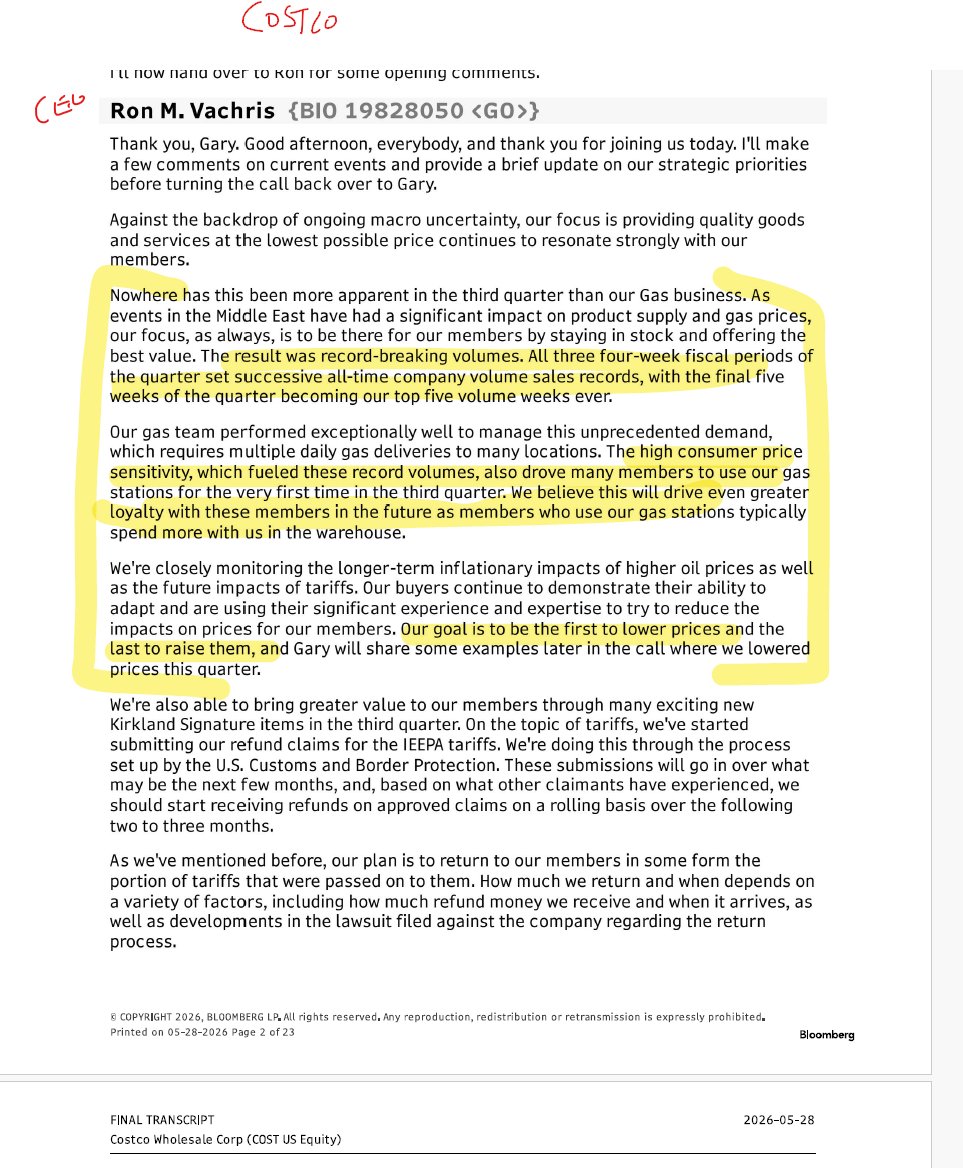
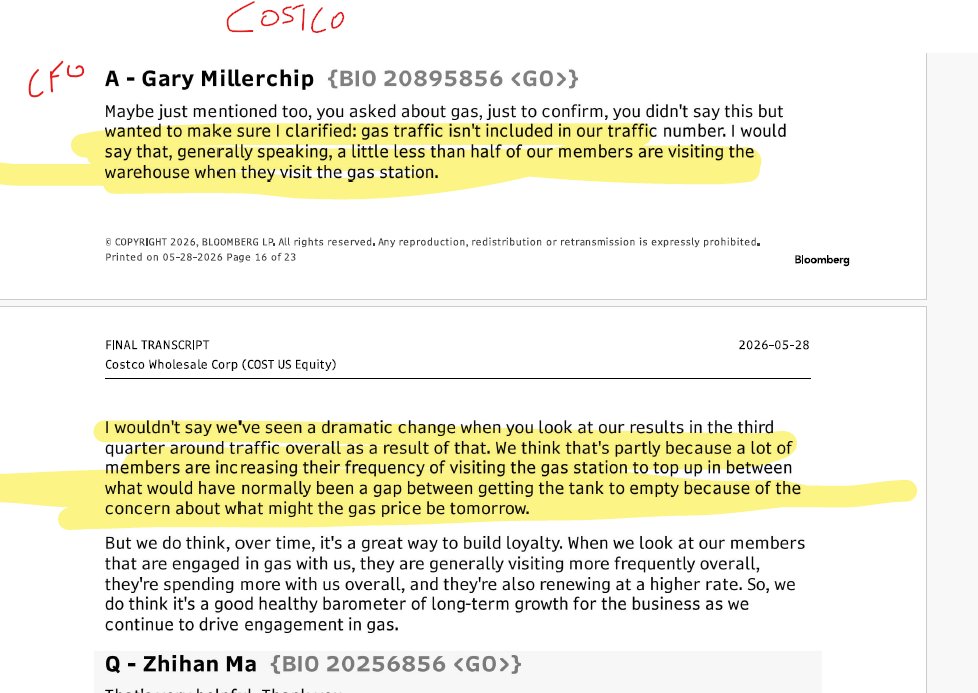
ICYMI. Costco's record breaking gasoline sales with high consumer price sensitivity and more topping up concern on prices might be higher tomorrow..
"Record breaking volumes. All three four-week fiscal periods of the quarter set successive all-time company volume sales records.... The high consumer price sensitivity, which fueled these record volumes, also drove members to use our gas stations for the very first time.... Our goal is to be the first to lower prices and the last to raise them". CEO
"A lot of members are increasing their frequency of visiting the gas station to top up in between what would have normally been a gap between getting the tank to empty because of the concern what might the gas price be tomorrow" CFO.
Fits Walmart's comments. See my 👇05/21 post that that lower-income consumers put <10 gallons per fill up, 1st time since 2022.
Thx @business transcript
#oott
J.M. Smucker another company to warn freight costs are pushing up inflation on their products.
Analyst "turning back to inflation. So you reaffirmed your mid-single-digit inflation guide, excluding the impact of green coffee tariff expenses and tariff refunds, but it also sounds like you are seeing increased inflation, particularly coming from freight. So is it just a matter of you've moved higher within that mid-single-digit range? Or are there any other offsets that you haven't discussed yet?"
CFO "the way that you laid that out is correct. As we stepped out of the second quarter, absent the implications of green coffee deflation or tariffs, the balance of the portfolio was seeing mid-single-digit inflation. And again, that's, in our mind, a range. So now we're probably pushing to the higher end of the range. And again, a component of that is freight and freight impacts total company."
Thx @themotleyfool
Catching up on transcripts after meetings this week.
Elevated freight costs to continue to impact cost of snack foods to consumers.
Freight costs and also fuel costs have led to big increase in J&J Snack Foods distribution costs. CFO.
Q4 call Q&A on Wed. "Yeah. Good morning, Todd. Yeah, so obviously we're up 21.6% distribution costs in the quarter. Most of that was really driven by freight and fuel. It's really the freight cost that's having the biggest impact on the P&L. As it stands today, we have seen some declines in diesel prices this quarter. We hit a record or near record here, and unfortunately in the quarter of over $6. I see the EIA is reporting that's just below $6 a gallon now. So, we do expect to see some fuel relief. As it relates to freight, at least for the foreseeable future, it does feel like it's going to remain elevated. We are taking some steps to mitigate that pressure.
Essentially, the teams have been working on reconfiguring our pallet sizes to ensure that we are packing as much as we can on a truck and reducing the number of trucks that we have to utilize to get our products to market. We have even moved a small quantity of product to rail transportation to take advantage of some savings. There are some instances where we have been able to shift production from within our manufacturing network just to get closer to the customer. For now, it feels like it is going to remain elevated. I think that once we get to the second half, once we get to about May or June next year, we will start to lap the increase that really kicked in over the summer." CFO
Thx @stock_analysisx transcripts.
Kohl's core customers are facing inflation pressures that are altering their spending when shopping discretionary. Also upper income are trading down.
"The core customers that we serve are facing inflationary pressures in their daily expenses that are altering their behaviors when shopping discretionary categories. While customers have remained resilient, it is clear that they are migrating to value with their purchases". CEO.
"The lower-income customer really looking for value, but that higher-income customer who is trading into Kohl's for those key national brands." CEO.
"Well, I would say in terms of the customer, when you're in a macro environment that we're navigating, we see a trade-down out of a higher income into our stores, and we need to take advantage of that.... Sephora serves as a great anchor for that as well, are all opportunities for us to keep that customer in. I think from a keeping that customer, we also see trade-offs in the middle, and that's where we're benefiting off of our proprietary brands right now. People have to make choices. They are definitely struggling in terms of where they're going to make payments with pressure and fuel and inflation. So, if we can give them a great product at a little bit lesser price point, that's where we see people making trade-offs.." CFO.
Don't forget Kohl's home/building is <15% of total revenues. Kohl's has not yet posted its 10Q for Q3, but 👇is its 10Q for Q2.
Thx @stock_analysisx transcripts.
Catching up on transcripts after meetings this week.
One company that isn't seeing consumer weakness is Best Buy.
Q3 comparable sales growth +6.1% "was ahead
of our expectations and our highest in five years,” "helped drive broad-based topline momentum
across nearly all product categories", and "strength and breadth of our results give us confidence to raise our full-year guidance". CEO
"Again, we talked about growth in almost all of our categories. We see really, really strong demand from the customer." CEO
"As I mentioned earlier, we are seeing really, really strong demand above $1,500 in computing, which is maybe a little bit surprising in the environment we are in, but we are seeing a lot of positive reactions to innovation." CEO
"I think the thing I'm most excited about right now is just the momentum we have across most categories in the business. We've talked about pretty much growth across almost all categories at this point in time, so that momentum is something that's really, really exciting. You have categories like computing and mobile phones that have multiple quarters of positive growth. Then you have categories like appliances and TVs, both of which on their second quarter of growth. And things like a TV, what we think is that multi-year upgrade cycle starting to kick in."
Thx @stock_analysisx
Catching up on transcripts after meetings this week.
US consumers trading down = attracting new customers, middle/upper income consumers, at Dollar Tree. More than half of growth is from new higher income customers.
"And if you look, so much of our growth is this trade-in customer, too. It's -- our business is still the lower income customer, but we're seeing a lot of growth in the middle and higher income customer. And they're finding a Dollar Tree and finding an assortment because of multi-price that is just far more relevant to them. And that drives the repeat visits. That is a huge factor as we look to this run of traffic that we can go on and ticket. I mentioned we're now seeing mixed baskets that have both opening price point and multi-price in it. It's 25% of the baskets.
It's half the sales because that basket comes so much bigger with a 2.5x the size of the basket. So I think that's another good proof point of this customer acceptance." CEO
"Obviously, we're growing. We're growing households. We are, as I mentioned, whether I look at a lower-income store or a middle-income store or a high-income store, they're all growing. The more than half of our growth is coming from that trade-in customer.... " CEO
"The most difficult thing for most businesses is actually attracting new customers. And in fact, one of the big assets for our business is the fact that we have enormous penetration. Think about it, more than 100 million out of 130 million households in the United States. The challenge is not so much for us to add customers. It is just simply to get existing customers to come and visit us more frequently. And that is at the very heart of the benefit that multi-price offers.
You've got a big group of customers who find your store much more interesting because they've got more money and they'd like to come to your store more frequently because there's a greater assortment on offer." CFO
Thx @themotleyfool
Catching up on transcripts after meetings this week.
Consumers keeping tight rein on discretionary spending.
"Consumers are under pressure, and they are increasingly selective about where and how they spend. When under pressure, shoppers prioritize value and buy closer to need. They are also more selective with their purchases." Dollar Tree CEO.
"Our consumables comp accelerated to 8.9% as customers look for ways to stretch their budgets" CEO.
On consumables increasing but discretionary still low. "I think the mix is reflective of a consumer right now that is really buying for need, looking to stretch their budget. And the broad-based strength we saw in consumables is exactly what that consumer needs." CEO.
👇Q3 slide shows discretionary % continuing low vs strong consumables growth.
Thx @themotleyfool
Catching up on transcripts after meetings this week.
Reminder freight and fuel prices flow thru to product prices AND higher freight costs are not just diesel but also truck driver shortage.
Dollar Tree Q3/26 call on 11/24.
"there are some items to keep in mind. First, the current elevated fuel and freight environment has persisted. This not only manifests itself as pressure on domestic and direct import transportation costs, but also product cost inflation" CFO.
"But at the same time, as you pointed out, the cost environment has some volatility, particularly around fuel freight and the knock-on to product costs. And in freight, we're seeing pressure from tighter driver market and fuel rates and maybe the watch out for 2027, which I actually called out last year at the same quarter, didn't manifest itself this year, but we always have a watchful eye on what will happen in the freight -- ocean freight rates as we get to the spring contracting season". CFO
"We've taken benefit this year from favorable ocean rates generally as against history and lower spot usage, but we've seen higher fuel costs offsetting that, and those come in surcharges. And I said last quarter, those surcharges, of course, will move up and down with the price of fuel. So I think over the long haul, that's probably a positive. On the domestic side, we contract those rates by lane with carriers. And the challenge right now is that there's a very tight driver market. And when those carriers don't have enough drivers, we have to rely more on the higher cost surge drivers. So domestically, we're dealing with higher fuel costs and a tight driver market and on imports, that pressure is coming from fuel. " CEO.
Consistent with JB Hunt Q3 call that reminded freight costs are higher NOT just because of continued near record diesel prices BUT also because of shortage of truck drivers to move/deliver the freight. See my 👇10/15 post.
Thx @themotleyfool
Catching up on transcripts after meetings this week.
#oott
Reminder freight costs are higher NOT just because of continued near record diesel prices BUT also because of shortage of truck drivers to move/deliver the freight.
JB Hunt Q3 call today.
"Hey, costs are a challenge for our industry; bringing on drivers; driver pay, all things insurance related. Just we're faced with a number of cost challenges. And we're asking for larger rate increases certainly than what we've shown so far..." EVP
"Since our last earnings call three months ago, we have seen increased inflationary cost pressures in our business primarily related to driver availability, which has only amplified the magnitude of the price increases needed during this bid season." EVP
"Capacity remains constrained, operating costs continue to move higher, and supply chains are seeking out providers that can deliver reliable capacity at scale. Most importantly, customers have gained a much clearer understanding of these realities. The conversations we are having today are materially
different than those we were having a year ago, six months ago, or even last quarter." EVP
Thx @business transcript
#oott