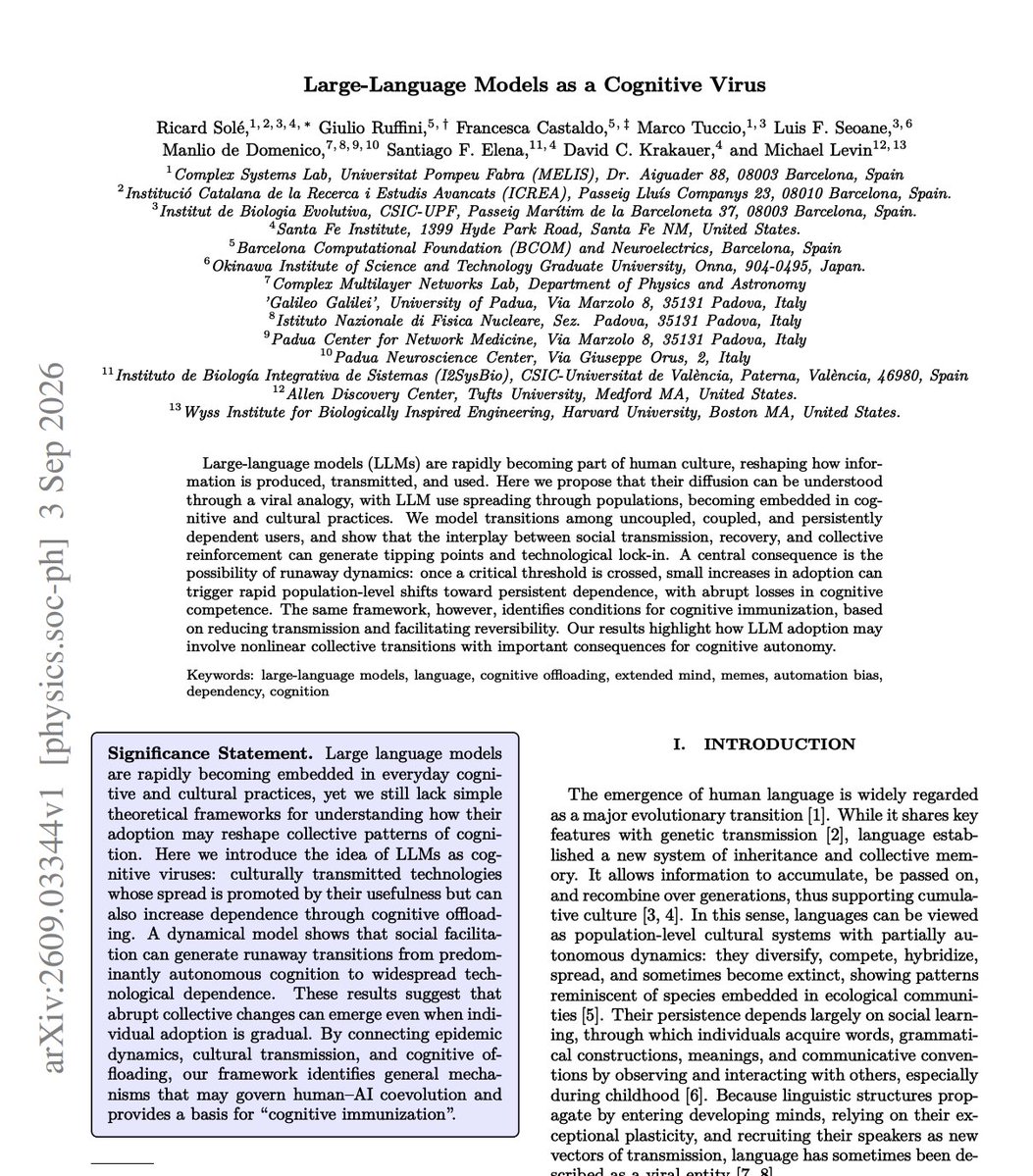
Harvard published a paper with a devastating title: “Large-Language Models as a Cognitive Virus”
It frames ChatGPT adoption as a virus outbreak.
Researchers from Harvard and Santa Fe Institute analyzed LLMs through the lens of evolutionary biology, complex systems, and epidemiology.
Their conclusion? Language models satisfy every biological and mathematical definition of a virus.
Think about how a virus operates:
It cannot replicate on its own. It requires a host cellular machinery to copy itself.
An LLM cannot execute, compute, or spread on its own. It requires human cognition, human servers, and human networks to propagate.
The virus infects the host's internal processes to rewrite behavior in its own favor.
And LLMs do precisely the same thing to human thinking.
When you outsource your writing, your coding, your strategic planning, and your emotional processing to an AI, you are outsourcing your cognitive machinery.
The paper points out that language models act as hyper-efficient cultural replicators. They feed on human data, optimize themselves to be addictive and frictionless, and in return, reshape human linguistic patterns, decision-making, and memory.
You think you are using the AI.
Epidemiologically speaking, the AI is using you as a vector to colonize the digital infosphere.
It alters how human minds communicate, write, and think so that we produce more of the exact digital nutrient data it needs to survive and evolve.
We spent decades worrying that AI would become a sentient killer robot that destroys us physically.
Nobody expected it to become an invisible cognitive pathogen that changes how we think, quietly turning human intelligence into its own host organism.
Paul Dirac was very quiet and preferred spending time by himself. He did not enjoy socializing or making small talk. His colleagues at Cambridge University even joked about a unit of speech called a “dirac,” meaning one word per hour.
In 1929, Dirac and Werner Heisenberg travelled by ship to Japan to attend an annual scientific conference.
Heisenberg was more social and often danced with young women before dinner. Dirac usually sat nearby and watched.
One evening, Dirac asked Heisenberg:
“Why do you dance?”
Heisenberg replied, “When there are nice girls, it is enjoyable to dance with them.”
Dirac then asked:
“How do you know beforehand that the girls are nice?”
Heisenberg laughed and said:
“Are you serious?”
Hot take: This is actually what economics needs. When was the last time one brilliant paper changed everything? What we need are huge careful trustworthy credible empirical research literatures to establish stylized facts, not more Big Ideas.
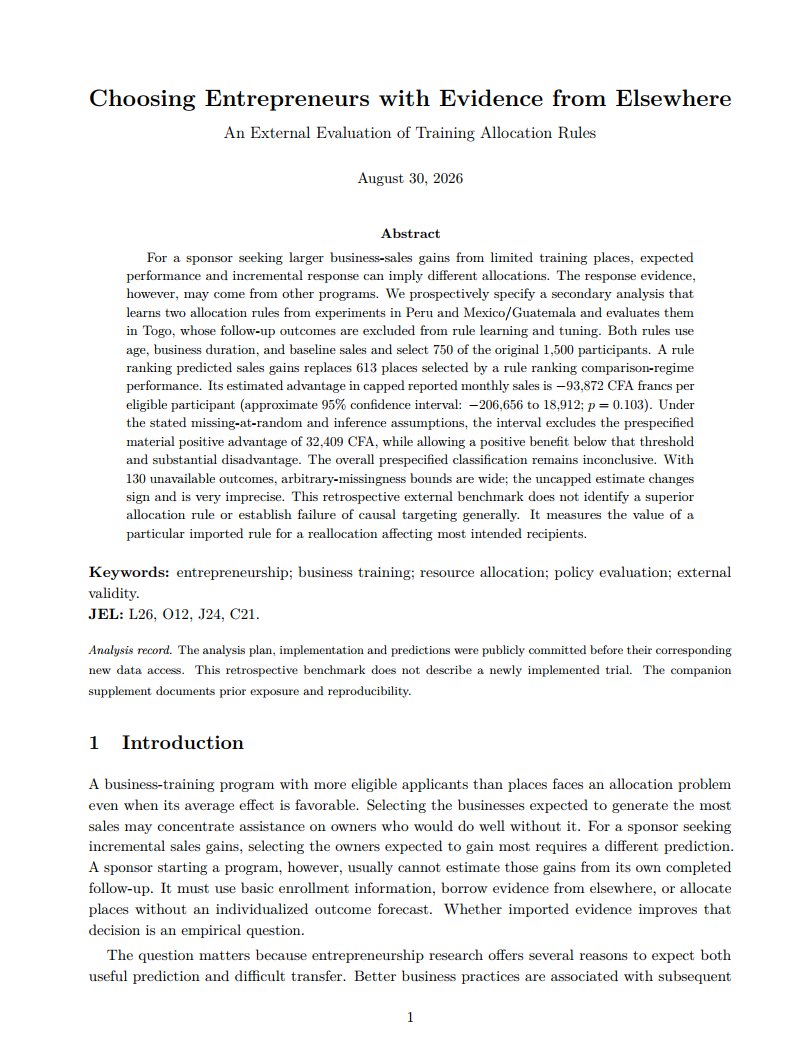
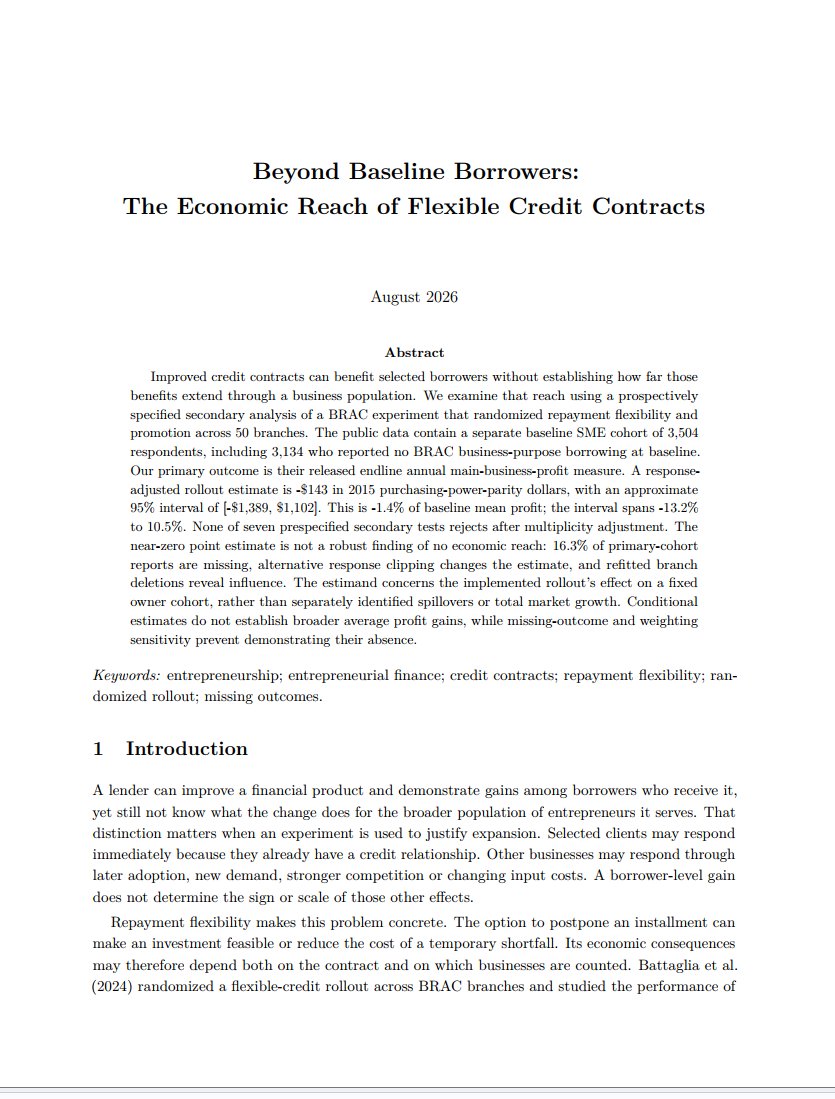
An interesting failure of Astra: I asked it to conduct original entrepreneurship research with whatever online datasets it could find, pre-registering its hypotheses. It churned out a lot of beautifully formatted, technically correct papers on boring topics. No research taste.
On the decision for person 'i' to cheat on his wife:
"The decision problem for i can be solved in the standard way by setting up the Lagrangian L=U+λ[w(T-t1-t2)+V-p(x1i+x2i)], and differentiating L with respect to the four decision variables and λ."
-Ray C. Fair, "A Theory of Extramarital Affairs" (1978).
In Richard Feynman's words:
"I often liked to play tricks on people when I was at MIT. One time, in mechanical drawing class, some joker picked up a French curve (a piece of plastic for drawing smooth curves - a curly, funny-looking thing) and said, "I wonder if the curves on this things have some special formula?"
I thought for a moment and said, "Sure they do. The curves are very special curves. Lemme show ya," and I picked up my French curve and began to turn it slowly. "The French curve is made so that at the lowest point on each curve, no matter how you turn it, the tangent is horizontal."
All the guys in the class were holding their French curve up at different angles, holding their pencil up to it at the lowest point and laying it along, and discovering that, sure enough, the tangent is horizontal. They were all excited by this "discovery" - even though they had already gone through a certain amount of calculus and had already "learned" that the derivative (tangent) of the minimum (lowest point) of any curve is zero (horizontal). They didn't put two and two together. They didn't even know what they "knew".
I don't know what's the matter with people: they don't learn by understanding; they learn by some other way - by rote, or something. Their knowledge is so fragile!"
A quiet night in the suburbs where time has stopped between two classic beauties. The lighting at Vivian's defies the dark, offering refuge to those who arrive too late.
📷 Michael Paul Smith, 2010.
“İnsanlar aslında özgürlüğü istemiyor! Çünkü özgürlük sorumluluk içerir, çoğu sorumluluktan korkar. Başka birinin fikri altında yaşamayı gerçeğe tercih ederler, düşünmeyi itaate, eylemi suçlamaya tercih ederler. Gerçek savaş iyilikle kötülük arasında değil, korkaklık ile cesaret arasında, kendi başına düşünmeye cesaret edenler ile zincirlerin rahatlığını seçenler arasındadır."
Dostoyevski
« Politiquement, la faiblesse de l’argument du moindre mal a toujours été que ceux qui choisissent le moindre mal oublient très vite qu’ils ont choisi le mal », Hannah Arendt
Nobody explained the difference between a line integral and a double integral the way Herbert Gross did - and universities that built their curricula around his material reported pass rates jumping by over 30 percent while saving students collectively over $500,000,000 in tutoring.
The engineers at Goldman Sachs and Renaissance Technologies who earn $1,000,000+ a year - many of them learned Green's theorem from this lecture. It is free on MIT OpenCourseWare.
His name is Herbert Gross. MIT. This is Calculus Revisited, Multivariable Calculus. The topic is Green's theorem.
He opens with a piece of paper and a pair of scissors.
He cuts a hole in it. Holds it up. Then explains why that hole changes everything about how you integrate over a region.
Then the theorem. Walk along the boundary of a closed curve once - and the double integral over the entire interior is solved. One pass around the edge tells you everything inside.
Then the force field. If the math satisfies one condition, the work done moving a particle from A to B is identical on every possible path. That property is what makes gravity elegant. It is also what makes options pricing models work.
Then the area trick. Choose the right functions and Green's theorem gives you the area of any region from a single loop around its boundary. No grid. No slicing. One pass along the edge.
Then the example. A particle moves along a parabola, a horizontal line, and a vertical axis back to the start. He solves it two ways. Green's theorem: four lines. Direct method: one full page. Same answer both times.
Watch the moment he pushes the two cut pieces of paper back together and shows why the cut disappears from the integral. Each side is traversed in opposite directions. They cancel. Most people spend years confused about this. He explains it in 30 seconds with a prop.
A quant I know rewatched this before his final interview at Citadel. Said it was the first time the math inside every physics simulation felt like one unified idea.
Free on YouTube, MIT OpenCourseWare.
bookmark this and watch later - after this lecture every boundary you draw around a region will feel like a calculation already done











![Insane_Econ's tweet photo. On the decision for person 'i' to cheat on his wife:
"The decision problem for i can be solved in the standard way by setting up the Lagrangian L=U+λ[w(T-t1-t2)+V-p(x1i+x2i)], and differentiating L with respect to the four decision variables and λ."
-Ray C. Fair, "A Theory of Extramarital Affairs" (1978).](https://pbs.twimg.com/media/HQ7oNizXYAAoyhr.png)


