Thanks a lot @MLStreetTalk for giving space to this team.
Hope it will spark curiosity beyond the easy "oh crypto ".
#taunet#tau#logic
https://t.co/HnqGEV6iAT
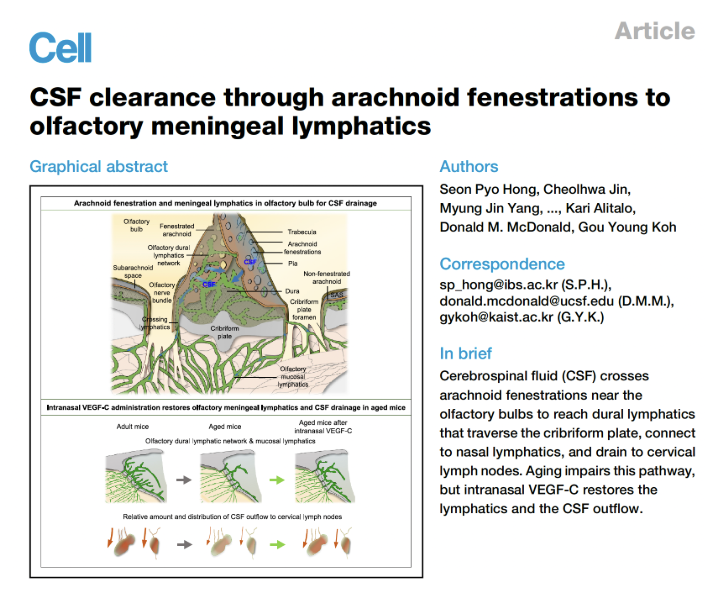
It's been a huge mystery how the brain clears toxins and why clearance slows with age.
Researchers showed (in mice) that the brain has a trash chute in the form of microscopic holes right behind the nose.
As mice age, those holes narrow and drop in number, cutting total fluid outflow by 40-50%.
A single intranasal gene therapy doubled the size of the drainage pipes downstream that allowed fluid flow to be on par with young adult levels within six weeks, even though the original holes remained narrowed.
The skies over both Europe and USA have officially been unlocked, and personal aviation will never be the same again! Jetson has officially secured the FIRST EVER official ultralight identification number for a personal eVTOL in Italy (and all of Europe!) @jetson_aero
I've written a new blog post exploring how long scientific claims live, by analyzing the history of 3,444 claims over the last 50 years. You can use this to predict the acceleration in scientific progress - how much faster the turnover of facts is by decade. 1/4
Blockchain upgrades usually require new software and a coordinated restart across all nodes.
Tau Net introduces technology that allows a blockchain to amend itself without a hard fork, client updates, or downtime.
This demo shows how Tau Net users can upgrade the network's consensus mechanism simply by stating their requirements and agreeing to them.
You can change the law of the Tau Net blockchain right inside a block, ushering in a new era of blockchain and software governance capabilities.
Showcasing Pointwise Revision:
Pointwise Revision is a built-in mechanism that jointly takes new software requirements and the current specification as input. Then outputs a program that consistently satisfies both the new requirement and the maximum of the previous specification.
This allows software to update correctly according to given rules, and it is all handled by providing only the required changes to the software.
Explore testnet alpha here: https://t.co/HHRC2GV0pb
[9/N] How end-to-end can generative models actually become with exploration?
There are two ways to handle the many-valid-outputs problem: decompose generation (existing approaches), or decompose training, which is Explorative Modeling.
It turns out these are interchangeable, meaning that as exploration increases, the best models use fewer generation steps.
This makes how end-to-end a model is no longer a fixed design choice, but something you can scale via exploration.
Taken to the limit, this yields end-to-end Explorative Models (XMs), where training and inference are identical, and generation is a single forward pass.
On robotics control, end-to-end XMs match Diffusion Policy behavior cloning performance with 1 forward pass instead of 100, and match Diffuser world model planning performance with up to 256× fewer inference steps.
Backprop-free planning: goal-directed sampling from learned cognitive maps
Most planners we deploy today are expensive. RL needs retraining when the goal changes, MCTS and MPC re-search the space at every decision, and all of it usually rides on deep networks and gradient-heavy training. Brains do something different: they plan online, adapt to new goals instantly, and run on about 20 watts. What data structure and learning rule makes that possible?
Hui Lin and coauthors offer a concrete answer. They build a generative cognitive map learner (GCML), a transparent network that learns a forward model plus a linear inverse model through local, Hebbian-style plasticity, so no backpropagation and no backprop through time. The trick for planning is stochastic: they inject Gaussian noise into action selection, which turns a deterministic map-follower into a generative sampler. Given a goal state, the inverse model points roughly toward it, and repeated noisy sampling produces a diverse set of goal-directed trajectories that self-correct back toward the target even after a bad first step.
They validate it in three very different settings from one recipe. In 2D navigation it reproduces rodent hippocampal replay, including rerouting around novel barriers and visiting space never seen during training. On random graphs it becomes an online approximate k-shortest-path solver, returning a menu of near-optimal routes. On an NP-hard tiling task it decomposes shapes it never encountered, trained on 5-block silhouettes and generalizing to 8, with near-perfect success.
The efficiency numbers are the real story for practitioners. Against K*, mA*, BELA*, an RL baseline and MPC, GCML visits far fewer nodes, generates the first step immediately without building a full solution path, and pays essentially zero replanning cost when the goal moves. Because the update rule is local, it maps cleanly onto in-memory and neuromorphic hardware.
This is a template for planning at the edge. In materials screening, drug candidate routing, or energy system control, where goals shift constantly and compute budgets are tight, a model that learns online and replans for free could replace heavy retraining loops with something you can run on-device. It is a reminder that solving genuinely novel problems does not always require a large model.
Paper: Lin et al., Nature Machine Intelligence (2026), CC BY 4.0 | https://t.co/nl1QNE5gIB
New #preprint - @YanboZhang3
"Intelligence from Learnable Novelty"
https://t.co/PQz0lPckcL
What if we optimize Epiplexity (https://t.co/YYjWdlqKzn @m_finzi@andrewgwils ) instead of measuring it? We have derived a closed-form approximation of Epiplexity and discovered a deep connection between it and intelligence. This allows us to reinterpret Epiplexity as a form of learnable novelty, providing a brand-new understanding of what intelligence is. By maximizing Epiplexity across various systems, all of them exhibited interesting behaviors:
Cellular Automata: Maximizing Epiplexity directly generates complex soliton interactions similar to Rule 110.
Image Encoders: It automatically causes the encoding to cluster, successfully categorizing different handwritten digits without supervision.
Reinforcement Learning: Introducing Epiplexity improves the performance of PPO in sparse reward tasks.
We also explored the relationship between the theory of learnable novelty, the free energy principle, and novelty search. We hope this work helps us better understand the nature of intelligence and its origins.
Your eyes don't see a whole scene at once — they dart around in a sequence of foveated glimpses.
Modern vision models take in the whole image in one shot.
That difference decides if a model can generalize to scenarios that are out-of-distribution.
🧵:
A vision-in-the-loop robot that catches its own mistakes: closing the automation gap in self-driving labs
Self-driving labs get described as fully autonomous, but there is an unglamorous step that usually still needs a human: swapping the substrate, the little glass slide that materials get deposited onto between experiments. Automating it is deceptively hard, because the substrates are thin, fragile and transparent, and transparent objects are one of the classic failure cases for computer vision. Edges vanish into reflections and refraction, and most transparent-object detectors are trained on curved glassware like beakers, whose distortion gives the model something to grab onto. A flat slide offers almost nothing.
Kelsey Fontenot and coauthors solve both the seeing and the acting. The perception trick is physical: light the slide from the side with a blue LED in the dark, so refraction makes the edges glow. That converts a near-invisible object into a clean, high-contrast outline. On top of that they run a two-stage detector. A geometry model compares the glowing substrate outline against the target slot to catch large misplacements, and a small convolutional network catches the sub-millimetre errors the geometry model misses. A placement counts as good only if both agree, which biases the system toward false alarms rather than silent failures, exactly the safe direction when one bad slide corrupts an entire downstream run.
The closed loop is the point. When either model flags a failure, the arm discards the slide and places a fresh one, then re-checks. Across 200 uncued reload cycles it hit 94% first-time placement accuracy, and with automatic retries every substrate ended up correctly placed by the third attempt. The CNN caught small, medium and large errors at 97 to 100% confidence.
For building automated pipelines in materials, catalysis, battery or perovskite research, the lesson is that throughput is capped by the least reliable manual step, and error correction matters more than raw accuracy. A cheap sensing tweak plus a detect-and-retry loop turns a brittle handoff into a hands-off one, which is what actually lets these labs run unattended overnight.
Paper: Fontenot et al., Digital Discovery (2026) — CC BY-NC 4.0 | https://t.co/ZdLKOh73Jq
Human vision is very different from AI models, because it uses local glimpses and saccades to look around. We show that there can be a _huge_ benefit to that, because it allows for compositional generalization (tasks in which all frontier models fail.) https://t.co/j92qUrqC7e
first time in history ANYONE recorded this label-free, alive, real time. this is HUGE and no one is talking about it.
Ferroptosis = cancer kill itself.
The final boss of “AI drugs” are the cells that fight them.
We just FILMED the FIGHT. here’s why it matters.
🧵
1/ How does one cell become an entire animal? We can now film it in 3D, but turning those movies into accurate cell tracks is brutally hard. Enter our new #Kaggle challenge: $60K prize pool, to help crack 3D+time cell tracking at scale!
https://t.co/68IRjUuGxk
@biohub
Together with UC Berkeley we are announcing the laser phase plate - a breakthrough in atomic resolution imaging. This is the brightest continuous wave laser in the world, 100 million times the intensity of the surface of the sun.
Phase contrast plays an important role in microscopy, but it was thought close to impossible for electron microscopy, where it would require interfering with an electron beam. Holger Mueller and Robert Glaeser proposed exactly this using a standing wave laser. It has taken over 15 years to make this a reality. Biohub partnered with UC Berkeley and Mueller to support this work and to engineer and build the technology.
Contrast has been the critical barrier to achieving atomic resolution imaging of the cell. In cryo-electron tomography, a cellular imaging technology that uses electron microscopy, the low contrast makes it impossible to resolve anything but the largest proteins within their cellular context. The laser phase plate removes that barrier.
With advances in AI this breakthrough in contrast will start to open up a new frontier in structural biology, that will allow us to see the molecular machines of the cell, and how they assemble into far more complex and dynamic systems, and understand how they work.


![AlexiGlad's tweet photo. [9/N] How end-to-end can generative models actually become with exploration?
There are two ways to handle the many-valid-outputs problem: decompose generation (existing approaches), or decompose training, which is Explorative Modeling.
It turns out these are interchangeable, meaning that as exploration increases, the best models use fewer generation steps.
This makes how end-to-end a model is no longer a fixed design choice, but something you can scale via exploration.
Taken to the limit, this yields end-to-end Explorative Models (XMs), where training and inference are identical, and generation is a single forward pass.
On robotics control, end-to-end XMs match Diffusion Policy behavior cloning performance with 1 forward pass instead of 100, and match Diffuser world model planning performance with up to 256× fewer inference steps.](https://pbs.twimg.com/media/HOkb4IGbYAAOvuq.png)



![AlexiGlad's tweet photo. [9/N] How end-to-end can generative models actually become with exploration?
There are two ways to handle the many-valid-outputs problem: decompose generation (existing approaches), or decompose training, which is Explorative Modeling.
It turns out these are interchangeable, meaning that as exploration increases, the best models use fewer generation steps.
This makes how end-to-end a model is no longer a fixed design choice, but something you can scale via exploration.
Taken to the limit, this yields end-to-end Explorative Models (XMs), where training and inference are identical, and generation is a single forward pass.
On robotics control, end-to-end XMs match Diffusion Policy behavior cloning performance with 1 forward pass instead of 100, and match Diffuser world model planning performance with up to 256× fewer inference steps.](https://pbs.twimg.com/media/HOkb6HNbQAA8MoV.jpg)