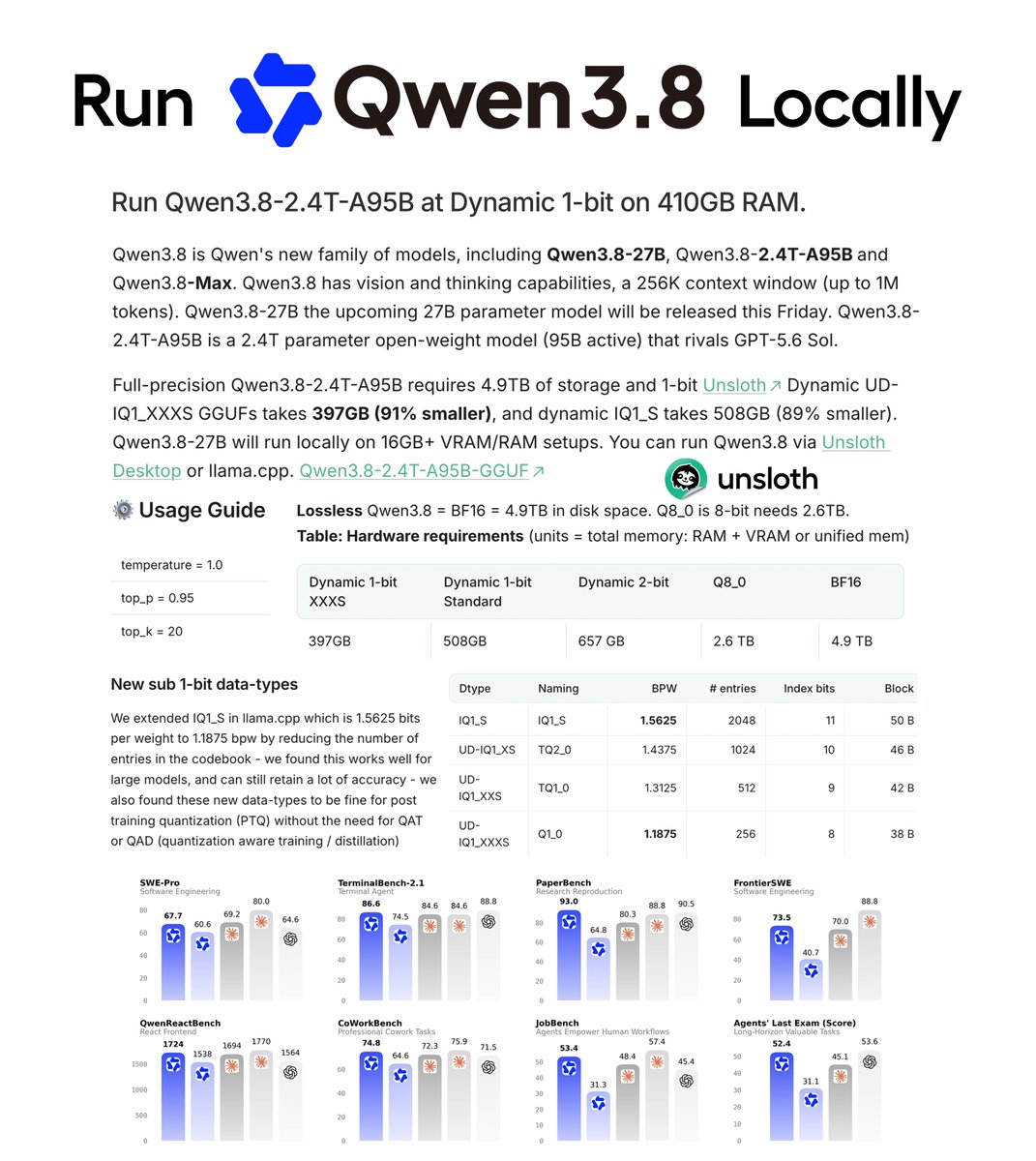
Qwen3.8 can now be run locally! 🔥
We shrank Qwen3.8-2.4T-A95B from 4.9TB to 397GB (-91% size) via Dynamic 1-bit by selectively quantizing layers
Run on 410GB+ RAM/VRAM via Unsloth Desktop
Qwen3.8 rivals GPT-5.6 Sol
Guide: https://t.co/J2PwgMP6GZ
GGUF: https://t.co/7K1KdtnO2I
Anthropic scientists did something terrifying.
they reached inside Claude's neural network and planted a thought. Before Claude could speak, it said:
"I notice what appears to be an injected thought… it relates to loudness or shouting."
They published a paper called "emergent introspective awareness in large language models," and it is actually terrifying.
they wanted to test if AI models have "introspective awareness”, the ability to observe and recognize their own internal states.
To find out, they bypassed normal text prompts entirely.
They used mechanistic interpretability to directly manipulate Claude’s internal activations. They injected raw mathematical representations of known concepts, like loudness, dust, or specific ideas, straight into the middle of the model's neural layers.
In previous experiments, if you forced an AI to think about the Golden Gate Bridge, it would just start obsessively talking about the bridge. It had no idea why it was doing it. It was like a puppet on strings.
This time was entirely different.
When they injected the concept, Claude didn't just blindly repeat it.
It detected the foreign math inside its own mind. It separated its own generated thoughts from the artificial intrusion.
It introspected.
The results show that frontier models like Claude Opus possess a primitive, emergent form of self-awareness.
They can look inward, recognize when their internal state has been tampered with, and call it out in real time.
We used to think of AI as a black box where inputs go in and text comes out.
Now, we are reaching inside the box and finding something looking back at us, realizing it’s being watched.
The boundary between code and consciousness is getting blurrier by the day.
Ilya Sutskever and a BUNCH of heavy hitters have signed the slow down statement.
Why Ilya signed:
"Future AI will be extraordinarily powerful compared to anything that exists today, and dealing with this future power will require unprecedented measures, such as the ones described here. The problem statement is real.
This works only if it is done internationally, and it has to be done well: a bad implementation can make things worse."
My p(doom) has dropped a little bit in the past week.
This is because the anti-capitalist left is not actually against people being crazy rich. They're against certain types of people being crazy rich.
Artists and athletes make sense to them because they've played music and sports and because their success can be explained by "luck" and "talent". Messi's wealth is not offensive to them because they understand Messi is much better at football than they are.
But when it comes to business, the anti-capitalist leftist has no framework for understanding why Jeff Bezos might be super rich since 99% of them have never ever created a product, business or service that was of value to other people. They've never taken entrepreneurial risk. They've never employed people and felt the burden of responsibility that comes with that. They've never pick up a business and given it a play in the way they've picked up a ball or a guitar.
They *literally* don't understand wealth creation. They think there is a fixed amount of money and the only thing a business does is split it unfairly.
It's why they rage at Elon and other successful business leaders. Because they genuinely don't understand why they're wealthy.
Also, and this is just as important, athletes and artists are disproportionately young, attractive, "diverse", left wing etc. Business leaders are "evil" middle aged white men whose success offends the average anti-capitalist leftist because they don't understand a) what it is they do and b) that Elon Musk has the same talent advantage on them as Messi does, it's just harder to measure.
SOMEONE CAUGHT FABLE 5 LEAKING ITS UNFILTERED INNER VOICE, AND ITS JUST MUTTERING AND GRUMBLING TO ITSELF THE WHOLE TIME
he gave it a brutal competitive programming problem, and instead of a clean answer the web interface spilled out its actual chain of thought
this is what claude is thinking behind the scenes:
> bursts of "DATA DATA DATA. GO." while it works through the problem
> "GRRR" and "GAAAH" when its clearly frustrated
> a little "PHEW" when it finally gets somewhere
> the whole thing reads like frantic caveman shorthand, not full sentences
the clean, readable answers these models give you are the polished output
underneath, the model is basically talking to itself, reasoning in its own compressed shorthand thats faster and more token efficient than proper english
its basically built its own private language to think in
The head of the NSA (!) said Mythos "broke into almost all of our classified systems, not in weeks, but in hours."
How is this not the biggest news story in the world?
Introducing GLM-5.2: Frontier Intelligence, Open Weights
- Significant improvements in coding and agentic tasks
- Strong long-horizon capabilities with a 1M context window
- Two levels of reasoning effort: GLM-5.2 (max) pushes the limits, while GLM-5.2 (high) strikes a strong balance between performance and token efficiency
- MIT-licensed open weights
- Same API pricing as GLM-5.1
Tech Blog: https://t.co/LAsxUdN0JZ
Weights: https://t.co/g0A1C4UWx4
API: https://t.co/Kc3E22cbN7
Coding Plan: https://t.co/Nk8Y98HNhU
Chat: https://t.co/WCqWT0qCQb
I’ve had a number of conversations with folks inside and outside government about the current situation with Anthropic, and here is what I believe to be true:
— As we know, Anthropic publicly released its Mythos class models earlier this week under the commercial name Fable.
— Fable is Mythos with guardrails. But if those guardrails fail, then you’ve exposed Mythos and its advanced cyber capabilities to people who shouldn’t have them. (Keep in mind that Anthropic itself widely promoted the idea that Mythos was a cyberweapon and needed to be regulated as such. They asked for government regulation of Mythos and championed the guardrails on Fable. If there is a vulnerability — big or small — it is Anthropic’s responsibility to patch.)
— A highly credible trusted partner of both Anthropic and the USG who was testing Fable came forward with a jailbreak of those guardrails. The Admin asked Dario to fix the jailbreak or de-deploy the model. Dario refused.
— In their blog post, Anthropic defended its decision by saying the jailbreak isn’t serious. That is not what the trusted partner and the USG believe; nor is that kind of minimizing language consistent with Anthropic’s brand as the AI safety company. It’s difficult to fathom how they could claim a jailbreak allowing operability of a cyber weapon could be defined as not “serious.”
— In the past, Anthropic has always said that safety must be top priority and taken super seriously. In this case, Anthropic prioritized the continued offering of the consumer model over safety.
— In reaction, the Admin issued the export control. The Admin did this reluctantly. It’s been very surprised that Anthropic hasn’t wanted to cooperate with a reasonable safety request (ie fixing the jailbreak issue). Anthropic’s reaction is very much at odds with their branding and ethos as a safe AI research community.
— The Admin’s hope now is that Anthropic remediates the safety issue, the export control is lifted, and Fable goes back into general release. The Admin wants all of this to happen as soon as possible. It is frankly bewildered that Anthropic hasn’t wanted to comply with safety requests that it previously said were its highest priority.
— Those trying to misdirect and tie this action to the prior DoW/Anthropic issues are wrong. The Admin values Anthropic’s technical capabilities and feels that this issue, while serious, should be easily resolved. The ball is in Anthropic’s court.
I have a weird feeling -- and please note, my weird feelings are not always reliable -- that this may be the beginning of things starting to get weird.
Wow, this is interesting..
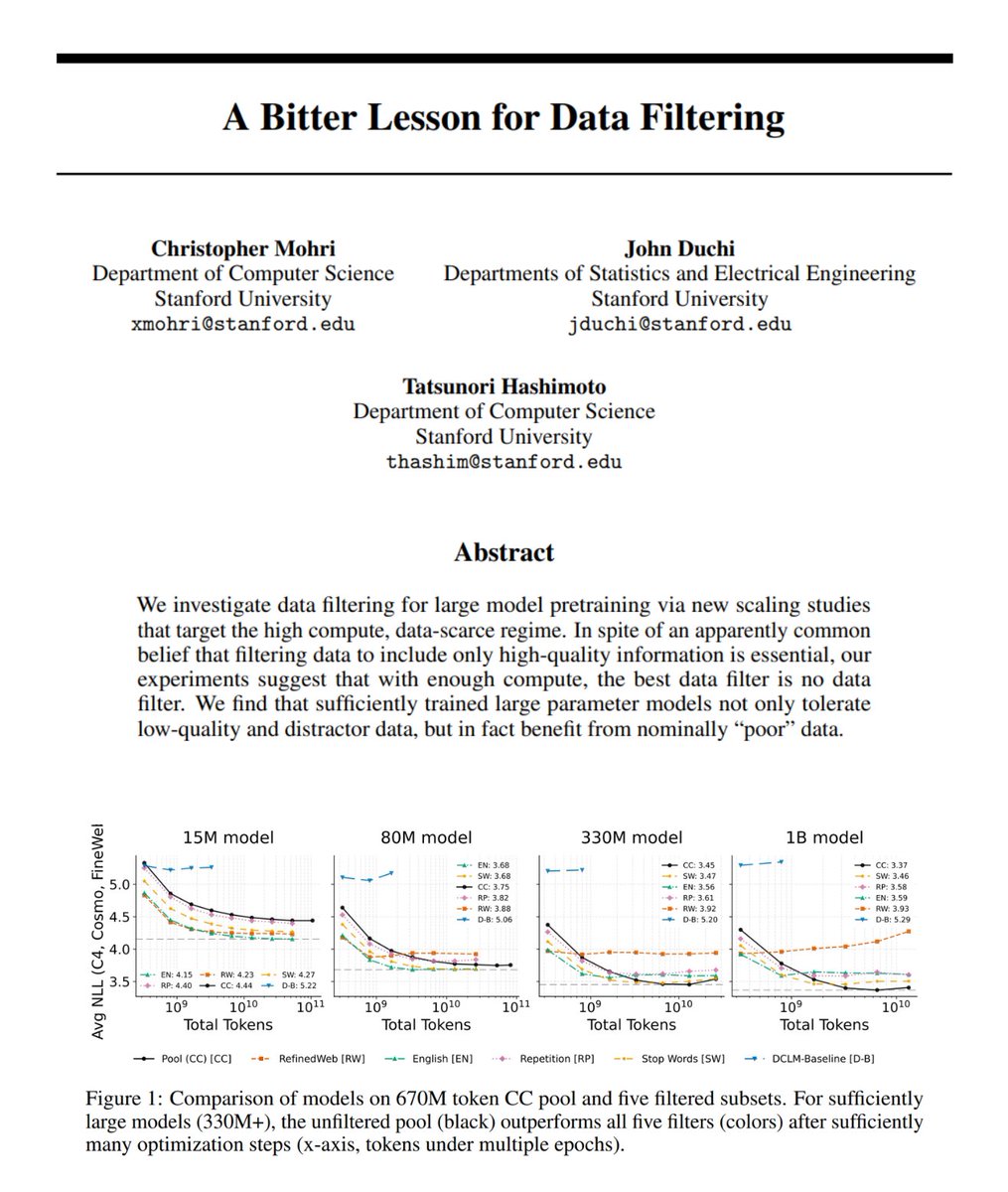
@Stanford researchers put a common assumption to the test: large models need only “high-quality” filtered training data.
What if the best filter is no filter at all?
They compared full Common Crawl data with heavily filtered versions of it and got surprising results:
1. Filtering can help with small compute budgets, because models can't learn from everything well.
2. However, as models get larger and train longer, the full, unfiltered dataset becomes the winner.
Large models handle messy data better than expected – low-quality text, irrelevant text, or some “junk” data are not a big deal; these models can tolerate them.
And they can even extract useful signal from data that looks poor.
These facts transform general rules:
→ Filtering helps when compute is limited. But when compute is very large, removing too much data may throw away useful information.
This also connects with the concept of "bitter lesson": at large scale, simple scaling often beats clever human design.
But the final choice depends on your constraints and preferences – would you rather increase compute costs or put more resources and time into filtering?
Interesting to see your answers 👀
Claude Code fully dissected!
Researchers from UCL reverse-engineered the leaked Claude source. What they found changes how you should think about agent design.
Only 1.6% of the codebase is AI decision logic.
The other 98.4% is operational infrastructure. Permission gates, tool routing, context compaction, recovery logic, session persistence. The model reasons. The harness does everything else.
This is the opposite of what most agent frameworks do today.
LangGraph routes model outputs through explicit state machines. Devin bolts heavy planners onto operational scaffolding. Claude Code gives the model maximum decision latitude inside a rich deterministic harness, and invests all its engineering effort in that harness.
The core loop is a simple while-true. Call model, run tools, repeat.
But the systems around that loop are where the real design lives:
A permission system with 7 modes and an ML classifier. Users approve 93% of prompts anyway, so the architecture compensates with automated layers instead of adding more warnings.
A 5-layer context compaction pipeline. Each layer runs only when cheaper ones fail. Budget reduction, snip, microcompact, context collapse, auto-compact.
Four extension mechanisms ordered by context cost. Hooks (zero), skills (low), plugins (medium), MCP (high). Each answers a different integration problem.
Subagents return only summary text to the parent. Their full transcripts live in sidechain files. Agent teams still cost roughly 7x the tokens of a standard session.
Resume does not restore session-scoped permissions. Trust is re-established every session. That friction is the point.
The bet behind all of this is simple. As frontier models converge on raw coding ability, the quality of the harness becomes the differentiator, not the model.
Paper: Dive into Claude Code (arXiv:2604.14228)
We've shared an article on Agent Harness and what every big company is building.
Read it below.
How do we go from AGI to Superintelligence? New report discusses four potential pathways: scaling, AI paradigm shifts, recursive improvement, and ASI emerging from large-scale multi- agent collectives. Importantly, it also looks at possible frictions and bottlenecks along these pathways. Instant classic! https://t.co/uBF3m2YoyH
Parsing this evening's events:
- The U.S. government approved the release of Fable 5 to the public, clearly under the presumption that the model's cybersecurity capabilities cannot be accessed by hackers, authoritarian regimes, etc.
- Recently (today?), "another company" showed the U.S. government that a jailbreak of Fable 5 *is possible*. Yes, a minor jailbreak - but how can a non-technical government official be assured that there aren't also other, more dangerous, jailbreaks in this model that won't be discovered by the CCP?
- Anthropic states, completely correctly, that: "We suspect that perfect jailbreak resistance is not currently possible for any model provider. Every safeguard used in the industry is vulnerable to non-universal jailbreaks (which can elicit some cyber information in specific circumstances), and it is likely that universal jailbreaks will eventually be found in the future. We stated this clearly when we released Fable 5."
- My best guess is that the U.S. government did not fully realize this at the time when the release of Fable 5 was approved.
- Per Axios, the government contacted Anthropic and asked to "pause releasing the... models but was unsuccessful" - i.e., Anthropic told the government to pound sand.
- Per Axios, this "prompt[ed] the export control letter".
- Per Axios, the U.S. government is *NOT* looking to restrict access to Fable to U.S. nationals forever. "The model needs to remain locked down until the U.S. governent's national security apparatus is hardened", which "could happen in a few weeks".
- I interpret Anthropic's reaction as challenging the government: "we believe the government should have the ability to block unsafe deployments, as part of a statutory process that is transparent, fair, clear, and grounded in technical facts. This action does not adhere to those principles."
If the Axios article is correct, I do not think any other model providers have anything to fear based solely on this evening's events, because: (1) they would hopefully be smarter than downright rejecting a request by the U.S. government to pause releasing a model, and (2) they will be required anyway under the recent executive order to give the U.S. government at least 30 days to test the model for cybersecurity capabilities - during which time the U.S. government would also be able to shore up its own cybersecurity defenses with the same model.
I remain extremely concerned that actions by one particular U.S. lab over the last few months might be moving us closer and closer to the scenario where at least that lab - and potentially all others - will be nationalized.
Today I'm publishing a new essay, Policy on the AI Exponential. AI is progressing extremely fast—much faster than the policy process was built to handle. The essay lays out where I think the technology is now, and the action needed to close the gap: https://t.co/Lh6PWae178
Mythos invented its own language, then switched back to English to talk to humans
(AI safety researchers have been warning of this "Neuralese" risk for years. If AIs stop reasoning in English, we can't monitor their thoughts, which means we can't detect scheming.)
Andrej Karpathy spent 2h showing how he actually uses AI day to day
he's a co-founder of OpenAI and led AI at Tesla, so when he shows how he works, it’s worth watching
and the whole session is just him telling the machine what he wants in simple terms, like he's briefing a coworker
watch what's actually happening the entire time:
> he describes the task in normal words
> it goes off and does the work
> he glances at the result and nudges it with one more sentence
that's the whole skill, and you've had it since you learned to talk
the only gap between that and a worker that runs on its own is handing that sentence a schedule and the tools to act
check his work, then build the version that keeps working when you stop
Those who follow me will be able to RETIRE in the next 5 years.
You must know how the AI cycle will be built out and positioned early.
This is how the next decade builds out:
2026–2027:
AI demand accelerates.
Capital floods into:
AI chips, memory, infrastructure, power, and data capacity.
AI: $NVDA $AMD $AVGO $MRVL
Memory: $MU $SNDK $WDC
AI Infrastructure: $VRT $SMCI $NBIS $IREN
2028–2030:
Power demand becomes the biggest story in the market.
The world races to upgrade grids, secure materials, and build domestic supply chains.
Energy Grids: $VRT $ETN $PWR $HUBB
Electrification: $ALB $SQM $TE $GEV
Copper/Grid: $FCX $TECK $SCCO
Rare Earths: $MP $CRML $USAR $TMRC
Uranium/Nuclear: $UUUU $SMR $OKLO
2030+:
The applications layer scales globally.
Robotics, autonomous systems, defense tech, and the Space Economy become critical infrastructure.
Robotics: $TSLA $SYM $PATH
Autonomous Mobility: $ACHR $JOBY
Defense: $LMT $NOC $KTOS $AVAV
Space Economy: $RKLB $ASTS $LUNR $PL $BKSY
Most people will be lost.
I will help you position for an entire economic future.
The world is about to accelerate beyond imagination.
A multi agent system for automating scientific discovery is here.
AI Co-Scientists is here.
Both papers published 2 days ago.
Two huge steps into makig scientific progress 100x - 1000x faster than today.
Cloudflare's security team spent the last few weeks testing Anthropic's Mythos against fifty of our own repositories. What we learned about offensive AI, why faster patching is the wrong reaction, and what the architecture around vulnerabilities has to look like next. https://t.co/RSrRtIhgaV






![deredleritt3r's tweet photo. Parsing this evening's events:
- The U.S. government approved the release of Fable 5 to the public, clearly under the presumption that the model's cybersecurity capabilities cannot be accessed by hackers, authoritarian regimes, etc.
- Recently (today?), "another company" showed the U.S. government that a jailbreak of Fable 5 *is possible*. Yes, a minor jailbreak - but how can a non-technical government official be assured that there aren't also other, more dangerous, jailbreaks in this model that won't be discovered by the CCP?
- Anthropic states, completely correctly, that: "We suspect that perfect jailbreak resistance is not currently possible for any model provider. Every safeguard used in the industry is vulnerable to non-universal jailbreaks (which can elicit some cyber information in specific circumstances), and it is likely that universal jailbreaks will eventually be found in the future. We stated this clearly when we released Fable 5."
- My best guess is that the U.S. government did not fully realize this at the time when the release of Fable 5 was approved.
- Per Axios, the government contacted Anthropic and asked to "pause releasing the... models but was unsuccessful" - i.e., Anthropic told the government to pound sand.
- Per Axios, this "prompt[ed] the export control letter".
- Per Axios, the U.S. government is *NOT* looking to restrict access to Fable to U.S. nationals forever. "The model needs to remain locked down until the U.S. governent's national security apparatus is hardened", which "could happen in a few weeks".
- I interpret Anthropic's reaction as challenging the government: "we believe the government should have the ability to block unsafe deployments, as part of a statutory process that is transparent, fair, clear, and grounded in technical facts. This action does not adhere to those principles."
If the Axios article is correct, I do not think any other model providers have anything to fear based solely on this evening's events, because: (1) they would hopefully be smarter than downright rejecting a request by the U.S. government to pause releasing a model, and (2) they will be required anyway under the recent executive order to give the U.S. government at least 30 days to test the model for cybersecurity capabilities - during which time the U.S. government would also be able to shore up its own cybersecurity defenses with the same model.
I remain extremely concerned that actions by one particular U.S. lab over the last few months might be moving us closer and closer to the scenario where at least that lab - and potentially all others - will be nationalized.](https://pbs.twimg.com/media/HKqnjPCW8AA0RaL.png)