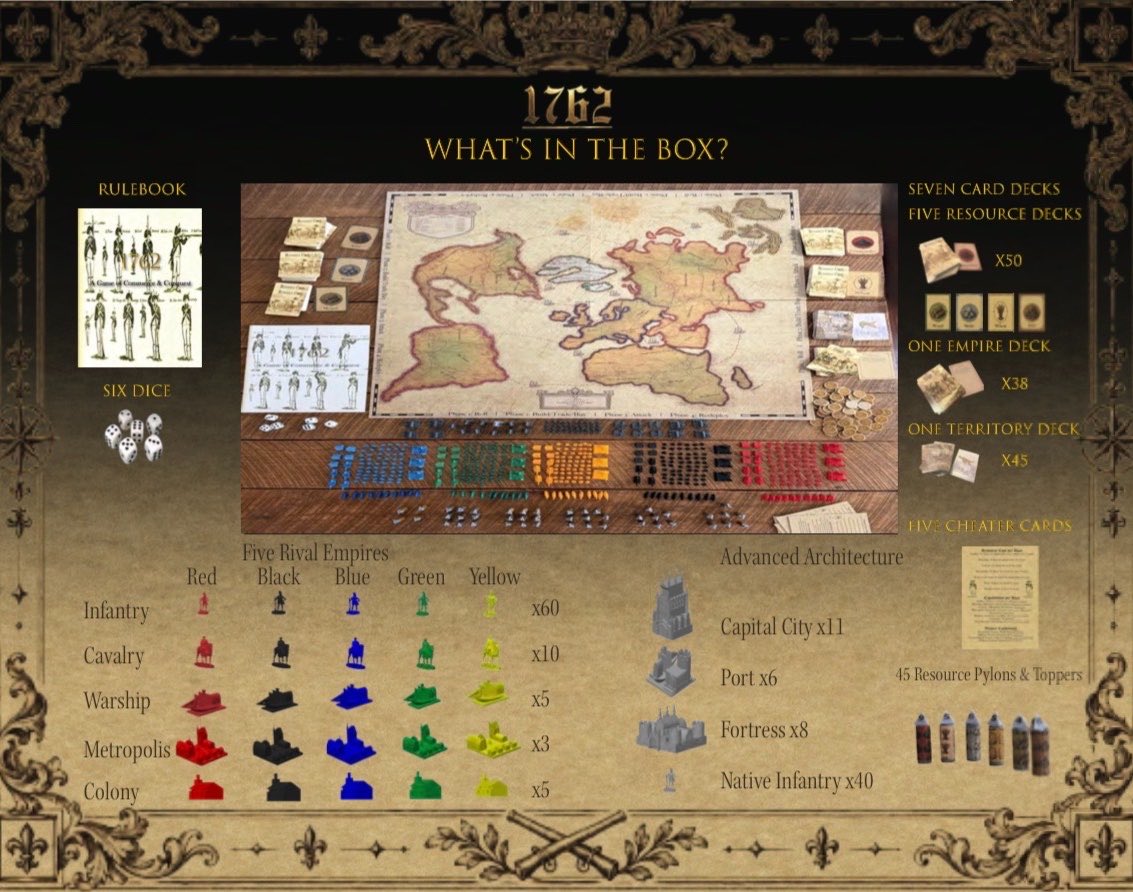
I started designing 1762 because I wanted a strategy game where war wasn’t simply about moving armies around a map.
Armies require resources.
Resources require production.
Production requires territory.
And territory creates conflict.
Everything connects.
#BoardGameDesign
@Marky_X_ Our game changes each and every time you play it, we designed it so that resources location and probability change drastically each time ensuring a fresh economic layout. The random draw of territories also ensures that you cannot pursue the same military strategy either.
The battlefield.
30 × 30 inches of commerce, diplomacy, expansion and war.
Five powers.
Seven regions.
Countless ways to lose.
#BoardGames#StrategyGames#TabletopGaming
@Marky_X_ Your analysis of collection mode is far more nuanced than I expected - thanks for sharing with us.
On another note, we’ll give those games a spin sometime soon
@Marky_X_ This is the exact balance we encountered time and time again during development. How do you make a game strategically complex without overwhelmingly opaque and detailed mechanics?
Your empire needs:
🪙 Gold
🌾 Wheat
🪵 Wood
⛓️ Iron
💥 Gunpowder
🪨 Stone
But you can never have enough of everything.
So what’s your priority?
Economy?
Military?
Expansion?
#BoardGames#TabletopGaming
The Seven Years’ War is sometimes called the first truly global war.
Europe.
North America.
The Caribbean.
India.
The oceans.
1762 turns that global conflict into a strategy game.
#History#BoardGames#WarGames
What if your economy was just as important as your army?
In 1762, you need resources to build.
You need gold to trade.
You need infrastructure to expand.
And eventually, you’re going to need an army.
How you balance them is up to you.
#BoardGames#StrategyGames #1762
The year is 1762.
Europe is at war. Empires are competing for colonies, trade routes, resources, and territory across the globe.
In 1762: A Game of Commerce and Conquest, you decide how to build your empire.
Trade. Build. Conquer.
Coming soon.
#BoardGames#WarGames#Strategy
@HomericFuturist Was it not “woe to the vanquished”?
Perhaps I am splitting hairs as the meaning is identical (mostly) but that is what I remember the classical translation to be.