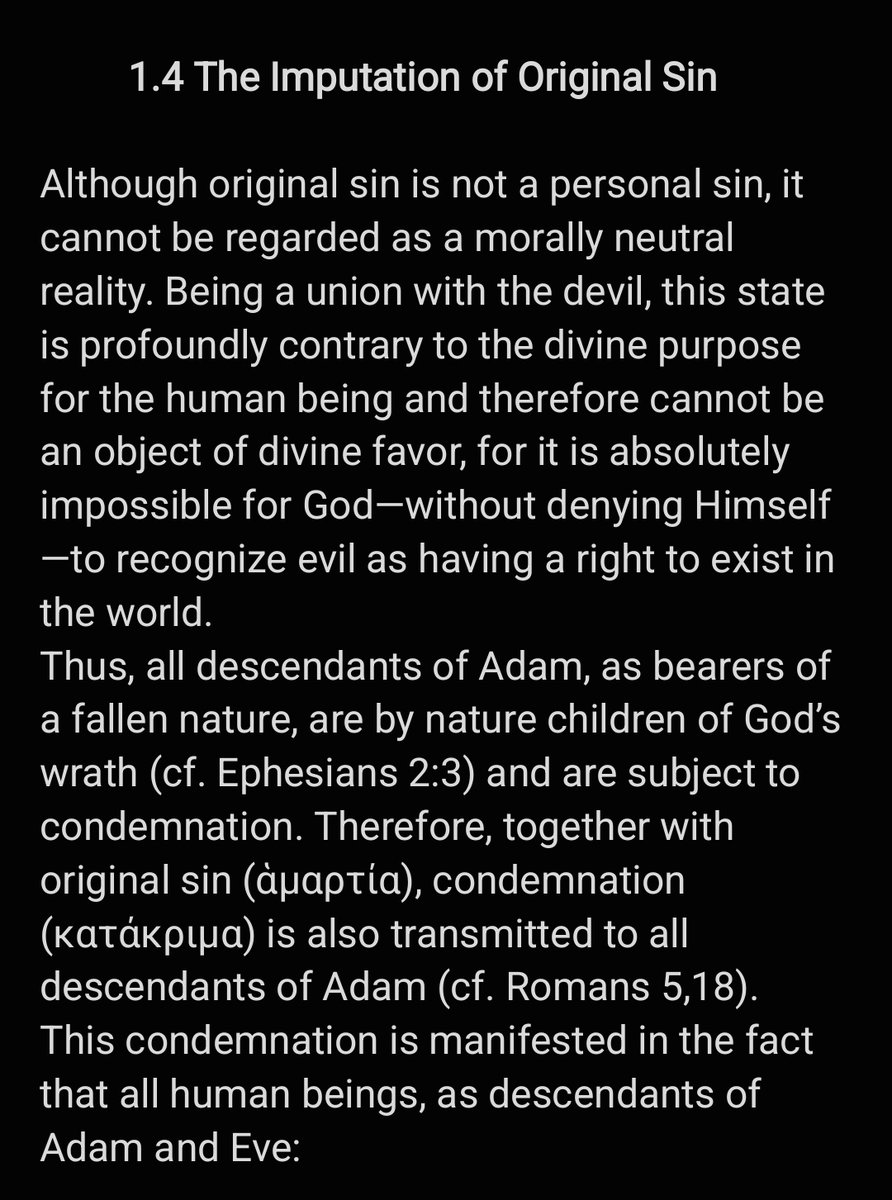
St. Gennadius Scholarius: Adam’s common sin is “justly imputed” to all; humanity cannot “satisfy the common penalty”. No mere man can “become liable” for all and suffice for all; therefore Christ alone assumes the task, reconciles all to God, and reforms human life.
St. Gennadius Scholarius: Christ did not assume an abstract or universal “humanity”, but a concrete, singular human nature in which humanity is said to exist wholly.
‘He [Christ] assumed neither a separated form and Idea of humanity—for no such form exists [...]—nor the universal form; for such a form is not a thing subsisting in itself, but exists only according to our conceptual apprehension, being constituted by abstraction from particulars only in the human intellect [...].
In reality, however, it exists only in each of the individuals, and wholly in each [...]; for each possesses the whole of humanity [...] in so far as the whole of it is enclosed in each of them in reality, according to its own principle and according to the what-it-was-to-be (τί ἦν εἶναι) which belongs to the thing itself.
We therefore neither think nor say that the divine Word assumed the whole of humanity by assuming the Idea of humanity, nor by assuming the universal conception of it, but, first, by reason of the singularity of such a union. For each singular thing is and is called a whole [...] because it possesses the whole form in actuality—as, for example, Peter does [...].’
–St. Gennadius (Scholarius), On the Humanity of Jesus Christ, Q. 4 (OCGS, Vol. 3, pp. 390–396)
Bookmark this
That The Son And Spirit Are Uncaused
St. Gregory the Theologian, Oration 29.19:
For He whom you now treat with contempt was once above you. He who is now human was once uncompounded. What He was, He continued to be; what He was not, He took to Himself. In the beginning He was uncaused – for what causes God (ἐν ἀρχῇ ἦν ἀναιτίως· τίς γὰρ αἰτία θεοῦ)? But afterwards He was born for a cause – and that cause was, that you might be saved, you who insult Him and despise His divinity because He took upon Him your coarseness and, having united himself with flesh by means of the soul, became human, the earthly God.
St. Gregory the Theologian, Oration 30.11:
Nothing then is peculiar [to either One], because all things are common [to both]. For their being itself is common and equal, even though the Son receives it from the Father. It is in this sense that it is said, I live by the Father -- not as though His life and being were kept together by the Father, but because He has His being from the Father beyond all time and beyond all cause (ἀλλ' ὡς ἐκεῖθεν ὑπάρχοντος ἀχρόνως καὶ ἀναιτίως).
St. Epiphanius of Salamis, Panarion 76.49.12 (Against Anomoeans):
The Godhead, then, is exempt from all causation—not only the Father, but the Son and the Holy Spirit as well, since all are agreed that the Godhead of the Father, the Son and the Holy Spirit transcends every cause (ἐξῄρηται οὖν πάσης αἰτίας ὁ θεός, οὐ μόνον πατήρ, ἀλλὰ καὶ υἱὸς καὶ ἅγιον πνεῦμα, τῆς θεότητος πατρὸς καὶ υἱοῦ καὶ ἁγίου πνεύματος ὁμολογουμένης κρείττονος πάσης αἰτίας).
St. Maximus the Confessor, Ambiguum 23.2:
Now if every being which is moved (which also means that it has been created) exists and is in motion and has been created in consequence of a cause, then whatever does not exist in consequence of a cause is obviously neither created nor moved. For that which does not have a cause of being is not moved at all. If, then, the uncaused is necessarily also unmoved, it follows that the Divine is unmoved, insofar as it does not owe its being to a cause (ὡς τοῦ εῖναι μηδεμίαν ἔχον αἰτίαν), being itself the cause of all beings (Ambiguum 23.1).
Idem, Epistle 15, PG 91, 556CD:
For we say that the one hypostasis of Christ--constituted of flesh and godhead through natural union, that is true and real union-has become the common hypostasis of flesh and godhead by the unspeakable union. I say 'common', because one and the same most particular hypostasis of the parts appeared from the union; or rather it was one and the same hypostasis of the Word, now as before. But earlier it existed without a cause (ἀναιτίως) [and was] simple and uncomposite, later for a cause it became truly composite without change through assuming a flesh animated by an intelligent soul.
St. Anastasius of Sinai, Hodegos 2.2:
And God is uncaused essence, all-powerful cause, of every essence super-essential cause (Καὶ θεὸς μέν ἐστιν οὐσία ἀναίτιος, αἰτία παναλκής, πάσης οὐσίας αἰτία τις ὑπερούσιος).
St. John of Damascus, An Exact Exposition of the Orthodox Faith, Book 3, Chapter 4:
But, when we consider the composite Person of the two natures, we sometimes call Christ both God and Man and God incarnate, naming Him from both; and sometimes we name Him from one of the two and call Him just God and Son of God, or just Man and Son of Man. And also, we sometimes name Him from just the sublime attributes and sometimes from just the more humble ones. For He is one who is alike both the one and the other-—the one existing uncaused and eternally from the Father (τὸ μὲν ὢν ἀεὶ ἀναιτίως ἐκ πατρός); the other come into being at a later time because of love for men.
St. Gregory Palamas, Homily 53.6:
She [the Theotokos] is the sacred starting point of the spiritual Israel, by which I mean all Christian people, because she was the cause of Him who is above all causality (τοῦ ὑπέρ αἰτίαν αἰτία γενομένη), and through Him she lifted men up from the earth and rendered them heavenly, showing them to be spirit instead of flesh, and making them children of God.
That The Son And Spirit Are Unoriginate
St. Maximus the Confessor, Various Texts on Theology, the Divine Economy, and Virtue and Vice, First Century, Chapter 1:
The Good that is beyond being and beyond the unoriginate is one, the holy unity of three persons, Father, Son and Holy Spirit ( Ἕν ἐστι τὸ ὑπεράναρχον καὶ ὑπερούσιον ἀγαθόν, ἡ ἁγία τρισυπόστατος Μονάς, Πατὴρ καὶ Υἱὸς καὶ ἅγιον Πνεῦμα). It is an infinite union of three infinites. Its principle of being, together with the mode, the nature and the quality of its being, is altogether inaccessible to creatures. For it eludes every intellection of intellective beings, in no way issuing from its natural hidden inwardness, and infinitely transcending the summit of all spiritual knowledge.
St. Maximus the Confessor, ibid, chapter 2:
The substantive and essential Good is that which has no origin, no consummation, no cause of being and no motion whatsoever (Τὸ κατ᾿ οὐσίαν κυρίως ὃν ἀγαθόν, ἐστὶ τὸ μήτε ἀρχήν, μήτε τέλος, μήτε αἰτίαν τοῦ εἶναι τινὰ κίνησιν ἔχον), so far as its being is concerned, towards any final cause. The goodness to which such terms apply is not substantive since it has an origin, a consummation, a cause of being, and motion, so far as its being is concerned, towards some final cause. Even if what is not being in the substantive sense is said to be, it exists and is said to be by participation, through the will of substantive being (ibid, Chapter 2).
That The Son And Spirit Are Unbegotten
St. Ignatius of Antioch, Ephesians 7.2:
There is only one physician, who is both flesh and spirit, born and unborn (γεννητὸς καὶ ἀγέννητος), God in man, true life in death, both from Mary and from God, first subject to suffering and then beyond it, Jesus Christ our Lord.
St. Basil the Great, Contra Eunomium 1.11:
After dragging unbegottenness away from all other senses, he [Eunomius] shoves it (so he thinks) into the substance itself and says concerning the God of the universe that "it must be unbegotten substance." As for me, I too would say that the substance of God is unbegotten, but I would not say that unbegottenness is the substance (Ἐγὼ δὲ τὴν μὲν οὐσίαν τοῦ Θεοῦ ἀγέννητον εἶναι καὶ αὐτὸς ἂν φαίην, οὐ μὴν τὸ ἀγέννητον τὴν οὐσίαν).
St. Gregory of Nyssa, Answer to Eunomius' Second Book, Lines 29-30:
Since, then, the meaning of the term simple in regard to essence is one and the same whether spoken of the Father or of the Son, differing in no degree, while there is a wide difference between generate and ungenerate (the one containing a notion not contained in the other), for this reason we assert that there is no necessity that, the Father being ungenerate, His essence should, because that essence is simple, be defined by the term ungenerate. For neither of the Son, Who is simple, and Whom also we believe to be generated, do we say that His essence is simplicity. But as the essence is simple and not simplicity, so also the essence is ungenerate and not ungeneracy (ἀλλ’ ὥσπερ ἁπλῆ ἐστιν ἡ οὐσία καὶ οὐχ ἁπλότης, οὕτω καὶ ἀγέννητός ἐστιν ἡ οὐσία καὶ οὐκ ἀγεννησία).
St. Epiphanius of Salamis, Panarion 76.46.6 (Against Anomoeans):
Incomparability with all the creatures which are inferior to the Trinity and which have been created by the Trinity itself, is therefore characteristic of the Father, the Son and the Holy Spirit. But the Trinity is not incomparable with itself, for it is uncreated, ingenerate (ἀγέννητος) and matchless.
St. Epiphanius of Salamis, Panarion 76.50.5 (Against Anomoeans):
The one Trinity is therefore one God, Father, Son and Holy Spirit, containing nothing different from itself: uncreated, unbegotten (ἀγέννητος), unfashioned, a Trinity which is not made but makes, which includes the name of no creature but creates, which is one and not many.
St. Maximus the Confessor, Ambiguum 17.12:
For the Divine is completely without parts, because it is completely without quantity; and it is completely without quantity because it is completely devoid of qualities; and it is completely devoid of qualities because it is completely simple; and it is completely simple because it is completely without extension or dimension; and it is completely without extension or dimension because it is completely infinite; and it is completely infinite because it is completely free of movement (for that which has nowhere to move to never moves); and it is completely free of movement because it is without beginning [ὅτι καί παντελώς άναρχον] (for there is nothing greater that is anterior to it, nor is there anything alongside it that is equal with it, nor is there anything subsequent to it that could parallel or contain it); and it is completely without beginning (άναρχον δέ πάντη) because it is completely unbegotten (ὅτι καί άγέννητον πάντη); and it is completely unbegotten (άγέννητον δέ πάντη) because it is completely one and supremely singular above all others; and it is completely one and supremely singular above all others because it is absolutely undetermined, and this is why it is, in every respect, ineffable and unknown, and why it remains, for all who move toward it rightly and with reverence, the ultimate limit of knowledge, for the ultimate truth that we can know about it is that it cannot be known.
St. Symeon the New Theologian, Hymn 21, Lines 197-220:
For the Spirit also is Lord, and the Spirit is God, Father of the Lord, certainly the Spirit is one, for He is not divided. One who possesses Him truly has the three, but without confusion, if also without division. For He is the Father, how will He be the Son? For He is unbegotten according to essence (ἔστι γὰρ ἀγέννητος τὸ κατ’ οὐσίαν), there is the Son, how would He become the Spirit? The Spirit is Spirit, how would He be revealed as Father? The Father is Father because always the begetter. But how does this begetting always happen? Because He is not at all separated from the Father, and inexplicably all of Him proceeds. He always remains in the paternal bosom, and always comes forth ineffably. The Son is seen everlastingly in the Father. He is begotten, but united, for even in the Son the Father is beheld inseparably, indivisibly, without separation. The Son is the Son because He is always begotten, and before the ages He is begotten, coming forth without being cut off from his root, but He is even apart without being parted, and wholly united to the Father Who is living.
St. Symeon the New Theologian, First Theological Oration, Lines 64-70:
We say that the Father is the cause of the birth of the Son in regard to his bodily generation, but as to that divine subsistence which is without subsistence, the birth which is unborn (ἀγεννήτου γεννήσεως—"unbegotten birth"), the substance which is not substance, and the essence beyond all essence (or whatever else there is beyond my intellect), then if anyone talks about a first he must also refer to a second and a third. This manner of speaking cannot apply in any way to the all-holy Trinity.
St. Gregory Palamas, Homily 21.4:
His resurrection and ascension are the resurrection and ascension of our human nature; and not just of our human nature, but of everyone who believes in Christ and shows his faith in works. Christ was unbegotten and uncreated according to His divinity (ἀγέννητός τε καὶ ἄκτιστος ὢν κατὰ τὴν οἰκείαν θεότητα), and it was for our sake that He became man. He lived as He did because of us, teaching us the path that leads back to true life.
The Menaion, meanwhile, teaches that the Bible is the Word of God. On May 11th, we can find the following in its commemoration of Sts. Cyril & Methodius:
‘...the Slavonic peoples, perishing from hunger for the word of God, ye nourished with the manna of divinely wise teaching and by translating the Gospel of the Son of Thunder [John] nto their native tongue…’
On July 19th:
‘Thou [Roman, Prince of Ryazan] didst continually exercise thyself in the reading of the word of God, the writings of the holy Fathers, and other books profitable to the soul; awaken in us also, O prince, a love for Divine Scripture and spiritual hymns.’
And of course, the prayer in the liturgy of St. John Chrysostom before the reading of the Gospel:
‘O Lord Jesus Christ, open the ears of my heart to hear Thy word, and to understand and accomplish Thy will.’
Scripture is Christ’s word, Christ is God... Therefore, the divine services & the service most commonly offered to God both explicitly teach that the Bible is the Word of God. Of course, this is meant in a certain sense, but anyone who tells you otherwise is signalling to you that they are either a rank modernist or do not listen to and read our liturgy to confirm their beliefs, and either way should not be speaking on any matters of faith.
@J04ch1m@orthobrohammer In “Orthodox Dogmatic Theology”, Fr. Michael Pomazansky uses « the Word of God » through the entire book as a synonym for the Holy Scriptures.
Serbian Metropolitan Irenej of Bačka reposes in the Lord
https://t.co/tDRv6wxh8Y
His Eminence was one of the most influential and longest-serving hierarchs of the Serbian Church, as well as the spiritual father of His Holiness Patriarch Porfirije.
‘..Jesus Christ not only established at the very beginning such an order in the sanctification of men, that the Apostles should become mediators in this great work, appearing as stewards of the mysteries of God as well as teachers and guides of believers. It was also among His direct intentions and purposes to sustain and preserve this order forever.
This is perfectly clear from the fact that, promising to give the Apostles another Comforter, that is, the Holy Spirit, He added to this: that He may abide with you forever (Jhn. 14:16); and also from the fact that, in giving them the command to teach and baptise all nations, He at the same time promised them: and, lo, I am with you always, even unto the end of the age (Mt. 28:20).
And since, under the present conditions of earthly existence, this could be realized only through the uninterrupted and successive transmission of the authority and means of sanctification from the Apostles to their nearer and more distant successors, Christ, as is known, founded from those who believed in Him His particular society, or Church. He founded it precisely so that, beginning with the Apostles, it would exist until the end of the ages, and so that within it, until the end of the ages, both the divinely instituted organs and mediators for the sanctification of men and the sanctifying means themselves would exist unfailingly and without interruption.
After this, it is self-evident that there can and must be no discussion of the possibility of man's sanctification outside the divinely instituted visible mediation and mediatorship, or, what is the same, outside His visible Church, instituted by Christ precisely for such mediation...’
–St. Sylvester (Malevansky), Orthodox Dogmatic Theology, Vol. 4, §116.