India's only fund focused on backing reverse brain drain & highly ambitious Indian founders
&
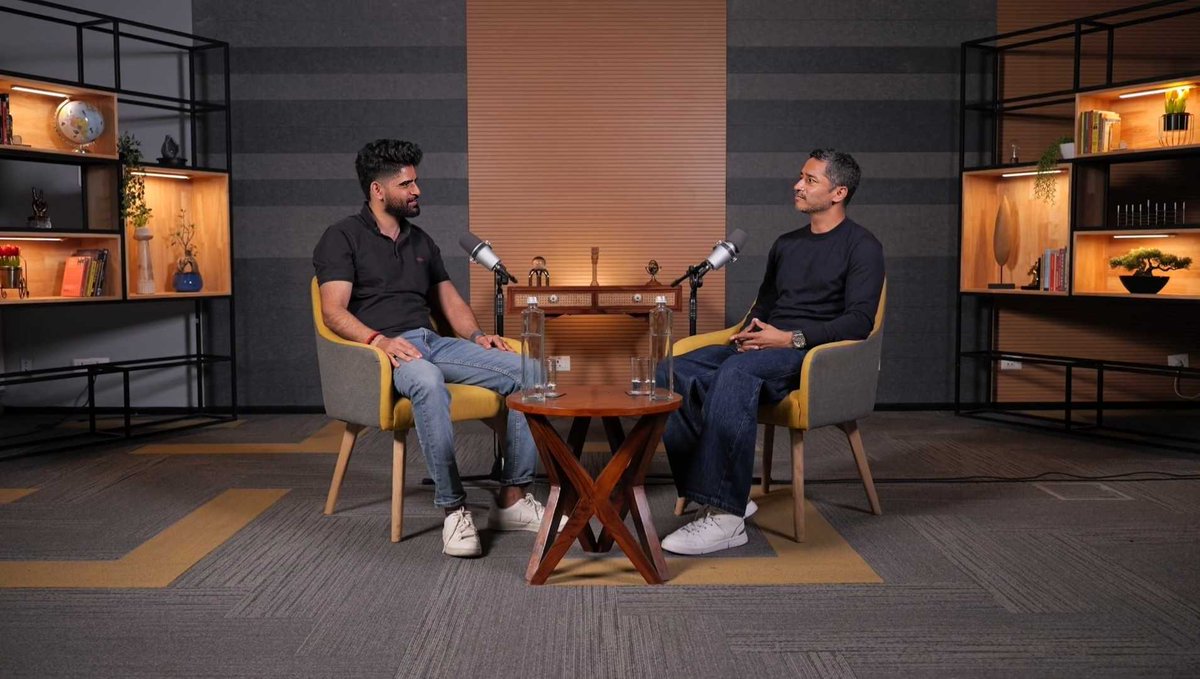
We chill with the most interesting founders and investors on pod
In 2006, while every startup in India was fighting over flights, Aloke Bajpai did the opposite.
He left a comfortable life in France.
Rented a small apartment in Gurgaon.
And bet everything on the 95% of India that couldn't afford to fly → train travelers.
Everyone called it the wrong market.
Today?
→ ixigo touches 1 in 2 internet users in India
→ 500M+ annual active users
→ $2 billion in tickets sold last year
→ 62% of all train bookings outside IRCTC
But here's the wild part most people don't know:
For the FIRST 10 YEARS, ixigo didn't sell a single ticket.
They just obsessed over one thing — solving real problems for the Indian traveler. Where's my train? Will my waitlist confirm? Wake me up before my station.
Utility first. Monetization later.
And now they're reinventing themselves a THIRD time — with AI.
Not a chatbot slapped on top. AI at the core. A travel companion called Tara that knows your context, predicts disruptions, and gives you what Aloke calls the real product: peace of mind.
We also got into something close to my heart 👇
His message to every Indian operator sitting abroad right now:
"We are living through the biggest technological evolution humanity will ever see. This is a make-or-break moment for our country. If even 10% of our best talent decides to come back — it'll be game-changing."
Patience. Conviction. Building for Bharat before Bharat was a pitch deck.
This one's a masterclass. 🎧
Full episode out now → [link]
Full episode on YouTube — link in comments.
@alokebajpai@ixigo
Actually, both Sachin & Binny Bansal were among the earliest believers in Ather.
Back in 2014, they wrote a $1M seed cheque and gave @tarunsmehta & team the runway to chase their dream of building intelligent electric scooters from scratch.
True risk capital in deep-tech hardware … at a time when it was far from obvious. Respect for backing the hard stuff.
"Tumse na ho payega."
India aake kar diya. 🇮🇳
India ka largest fintech exit bana diya.
She left India at 18.
Spent 15 years between Singapore and the US.
Came back with one goal — give credit to people every bank had already said no to.
Before building PaySense, Sayali Karanjkar spent 4-5 months talking to 300+ people. Rickshaw drivers. BPO workers. Train stations.
Just to understand one question — what is really happening in people's lives.
One moment stuck with her.
A woman looked her in the eyes and said — I'm a good person. But nobody will give me credit.
That became the mission.
She built PaySense from scratch.
Sold it for $185 million.
India's largest fintech acquisition at the time.
Today she sits on the boards of Lenskart, MobiKwik, and CMS — three of India's most exciting companies at very different stages of their journeys. Companies that want not just governance but a founder's mindset and a technologist's eye at the table.
In this episode we talked about:
→ Growing up playing soccer when no other girl was. Failing was always OK in her family.
→ Why she came back to India after 15 years abroad — and people told her Tumse na ho payega
→ Talking to 300 strangers on the streets to find the right problem to solve
→ The pivot that changed everything — putting money directly in the hands of the consumer
→ Building a $185M company with a team that had never worked in fintech before
→ Why she thinks every new generation of Indian founders is more audacious than the last
→ What she's excited about building next
She's just getting started.
Full episode on YouTube — link in comments.
Vivek Mishra didn't set out to build a company.
He and his brother couldn't afford to fly home during breaks. So one winter, they gathered some scraps, bought a few parts, and built a drone in a Boston apartment.
Sent the pictures to a few people in India.
Got a free trip home out of it.
A few government officials saw it and said — build this for us.
He told me he learned what product market fit was from Shark Tank.
Today Raphe mPhibr has 900 people, a ~$900 million valuation, and was deployed during Operation Sindoor...
Sometimes the best companies start with scraps and a free flight home :)
@Raphe_mPhibr@VivekMishra___
Arpan Shah walked up to the Robinhood booth at a Stanford career fair.
Not to apply for a job.
To get off their waitlist as a user.
He thought the product was that good.
Next day, co-founder Baiju emails him.
Come meet the team. Interview with us.
The email ended with: "PS — I'm also Gujarati."
He had a return offer from Google sitting on the table.
His parents wanted him to take it.
He joined Robinhood instead.
Team of 10.
Built the data org from scratch.
Owned growth, risk, fraud, and the infrastructure stack that powered one of the fastest growing consumer fintech products ever — all the way to a $100 billion company.
Here's the line that stayed with me:
"You get rewarded for finishing, not starting."
Arpan has finished a lot. Early Robinhood.
Founded a company.
Sold it to Plaid.
Scout at Sequoia.
Partner at Pear.
Now General Partner at Spark Capital — the firm that backed Oculus, Cruise, Twitter, and Anthropic before any of those bets were obvious.
In this episode, we go deep into:
→ What it was really like inside Robinhood's early days
→ Why he joined Spark over every other firm
→ How to think about the AI stack as an investor
→ Why India's infrastructure advantage is massively underappreciated
→ What the next decade of AI looks like from the frontier
Link in comments.
@arpans
Mehul was told three times not to build what he built.
Consumer? Bad idea.
Hardware? Worse idea.
Robot vacuums? The unsexy category nobody cared about.
He did all three anyway.
"Robots don't get tired. Robots don't get bored.
Why can't we have a robot that just continuously cleans on our behalf?"
Simple question.
Billion dollar answer.
Most founders chase what's hot.
Mehul chased what was ignored.
@mehul@maticrobots
Most founders build to exit.
Day one, Mehul Nariyawala & Navneet Dalal wrote three words on a piece of paper: Not for sale.
So when Mehul started Matic Robots, he made a decision: This is the last company I'll ever start.
Let's pick something hard enough that I won't get bored for the next 20-30 years.
He picked consumer hardware. Big no no.
He picked robotics. Bigger no no.
He picked robot vacuums. The unsexiest category in the world.
Then spent 7 years and 167 prototypes before a single customer could buy it.
Tony Fadell told him don't do it.
Everyone told him don't do it.
He did it anyway.
Today — Mark Benioff has it in his Hawaii home.
A founding Tesla FSD engineer called it "the Tesla of home robots."
Tim Ferriss can't stop talking about it. J
ohn and Patrick Collison took the entire seed round.
But here's the coolest thing.
Mehul didn't build Matic to be cool.
He built it to be useful.
There's a difference.
"How do you build a device so useful that you can't even fathom your life without it?"
That's the only question that mattered to him.
In this episode, we go deep into:
→ Why robotics is finally having its moment
→ What Tony Fadell taught him about consumers
→ Why physical AI is much harder than software AI
→ The 7-year grind behind Matic
→ Why "robots are coming" — just slower than you think
🎧 Link in comments.
@maticrobots@mehul
Hosted Krish Ramineni, founder of https://t.co/VXkdpy6YnU on the Pod!
$19 M raised.
Profitable.
$1 B+ company.
But this is what blew my mind 👇
3 out of every 5 startup unicorns in India use Fireflies.
And yet…
From 2016–2019:
→ Zero progress
→ Every product failed
→ Almost shut down
A college friend wrote a $25,000 check just to keep them alive.
Then something interesting happened.
1 year before the world got access to ChatGPT.
Vinod Khosla connected Krish to Sam Altman.
They got early access to GPT-3.
Everything changed.
Today:
• 20M+ users/month
• 75%+ of Fortune 500
• 100+ countries
• Used in the British Parliament
Even the King’s speech was transcribed in 30 minutes.
Earlier it took a week.
What I found most interesting:
The opposite approach to fundraising.
→ $4.5M Seed
→ $14 M Series A (Khosla Ventures)
→ Turned profitable without even using most of it
No hype.
No “raise at any cost”.
His take on AI today:
“A lot of application-layer companies pretend to be model companies…
raise insane money they don’t need…and call it a win.”
Where Fireflies is going:
→ AI that joins calls for you
→ Preps you before meetings
→ Tracks tasks automatically
→ Becomes your personal assistant for work
They built 5–6 products that failed.
Most founders would’ve quit.
They didn’t.
🎧 Link in comments.
@krishramineni
The uncomfortable truth about India's IT industry —
For decades, India's biggest export was talent.
Brilliant engineers, sent overseas, as a service.
Karan Goel of Cartesia thinks that era is over.
Not in 10 years.
In 2 to 3 years.
But here's what excites him more than the disruption —
India has something no other country can replicate at this scale.
1.4 billion consumers, increasingly tech-savvy, increasingly spending.
The companies that figure out how to serve that base with high technology — and then take that technology global — that's where the real opportunity lies.
The ambition shouldn't be to build for India.
It should be to build for the world, from India.
@krandiash@cartesia
From IIT Delhi to Stanford PhD to raising $27M before having a product.
That's Karan Goel story.
No revenue.
No product.
Just strong research, strong demos, and strong conviction.
What does Cartesia do?
In simple language:
It helps businesses automate conversations.
If you’re a small business owner and miss a customer’s call, you may lose revenue.
Cartesia makes it possible for AI to answer that call, qualify the lead, and respond naturally — in real time, and in local languages.
A few things that stood out to me from my conversation with Karan:
→ Cartesia is building some of the fastest voice AI models in the world
→ They’re obsessed with latency because even small delays break conversations
→ They’re betting big on India as a voice-first market
→ Karan believes India should aim to export AI to the world, not just consume it
@krandiash@cartesia
🎧 Link in comments.
A $7.2B AI company started because employees couldn’t find information inside their own company.
That company is Glean.
Its founder, Arvind Jain, grew up in Jaipur.
His parents didn’t know what IIT was.
He says he “accidentally” became an engineer.
Fast forward:
→ Distinguished Engineer at Google
→ Helped build Search, Maps, and YouTube systems
→ Co-founded Rubrik, now a publicly traded ~$10B company
→ Now building Glean, one of the fastest-growing AI companies in the world
But Glean didn’t start with a grand vision.
It started with an employee survey at Rubrik.
The #1 complaint?
“I can’t find anything inside this company.”
Not documents.
Not information.
Not even the right people.
Arvind saw the irony immediately.
The world had Google.
Companies had nothing.
So he built it.
Glean is essentially ChatGPT for your company — but with full context of your business.
It knows your documents.
Your meetings.
Your projects.
Your people.
One line from Arvind stayed with me:
“We want Glean to be your most trusted companion at work.
Not one you go to.
One that comes to you.”
Proactive AI.
AI that understands your role, goals, and deadlines — and helps before you even ask.
We also discussed:
→ Why the best engineers still choose startups over Big Tech
→ How Arvind helped build Google India in 2005
→ Competing for talent against OpenAI and Anthropic
→ Why India has evolved from a “back office” to a global innovation hub
From Jaipur → Google → Rubrik → Glean.
An incredible journey.
🎧 Link in comments.
@jainarvind@glean
In 1995, a guy quit his dream job in the US, moved back to India with no plan, no job, no safety net — and built a $10 billion empire.
This is the story of Sharad Sanghi, the man who introduced data centers to India.
→ grows up in Bombay, loves math
→ gets into IIT Bombay
→ all classmates are leaving for the US
→ dad says "go, but come back"
→ gets into Columbia University
→ lands job building NSFNet — the literal backbone of the internet
→ working on the internet before HTTP even existed
→ 1995: India announces commercial internet
→ quits dream job in the US
→ moves back to Bombay with nothing in hand
→ "I just said I'll figure it out"
→ fixes a BSNL network glitch on the spot
→ gets his first consulting contract same day
→ runs a one-man consulting shop for 3 years
→ 1998: government opens internet to private players
→ flies to Delhi to meet BV Jagdish — CEO of Exodus, the company that invented data centers
→ flight delayed by fog. almost miss him entirely
→ catch him after his talk that evening
→ Jagdish shows him data centers in the US
→ flies back to India with a vision nobody else has yet
→ raises $4M. builds India's first proper data center — 3,000 sq ft
→ dot com bust hits. customers can't pay. survival mode.
→ turns profitable in 13 months anyway
→ slowly, banks come. then Amazon. Google. Microsoft. HDFC. Visa. Citibank.
→ 3,000 sq ft becomes campuses of 300,000+ sq ft
→ NTT acquires.
→ India's #1 data center company. built from zero.
→ age 56. most people slow down.
→ ChatGPT drops. curiosity explodes.
→ does 15-20 AI courses on Coursera
→ kids are top AI engineers at Stanford and Columbia
→ they push him to go again
→ starts Neysa — AI cloud infrastructure for India, valued at $1.2B
→ same bet. same belief. different decade.
→ just keeps building
I sat down with Sharad on the podcast and he said:
"You can look at the cup as half full or half empty. India is behind — but that's exactly where the opportunity is."
Sharad's story is the best reminder that patience, conviction, and an unshakeable belief in India is its own unfair advantage.
The next inflection point is coming. Are you early enough?
What's your bet on India right now? Drop it below 👇
@sharad_sanghi
300,000 livelihoods.
98% of India’s pin codes covered.
3M lives impacted.
In 10 years, Ankit Agrawal built InsuranceDekho into India’s largest agent-led insurance platform — after walking away from UBS in NY because he saw something broken: low insurance access in a 1.4B country.
What stayed with me?
24% of agents are women — including a widow from Haryana who rebuilt her life, hired 3 people, bought a home, and is raising future leaders.
This isn’t just fintech. It’s generational transformation.
We spoke about unemployment, healthcare risk, UPI/Aadhaar tailwinds, 3.5% penetration, and leadership through discipline.
If you believe India’s golden era is just beginning — you’ll want to watch this. Link below.
@Ankit_agrawal29@Insurance_Dekho
India’s biggest AI risk isn’t compute.
It isn’t capital.
It isn’t policy.
As Aakrit Vaish put it recently, it’s this:
Will our best talent believe they can build from India?
According to him, there’s only one real risk to India’s AI story:
👉 the story doesn’t play out, and the talent leaves.
The bull case:
Enough exceptional people fall in love with India’s problems and build companies that create $10–15B of value.
The bear case:
An 18-year-old looks at market size and decides early that their biggest impact won’t come from India.
Once that decision is made early, it’s very hard to undo.
We don’t need 100% of our top talent to stay.
If we can convince just over 50%, the ecosystem works.
This isn’t an AI problem.
It’s a belief problem.
What do you think actually convinces great talent to stay and build?
@aakrit
#India #AI #Talent
India’s AI story is just getting started.
But the ecosystem for AI founders is still being built.
I sat down with Aakrit Vaish, who moved back in 2013 with one mission: build an AI ecosystem for India.
From Haptik (AI assistants before ChatGPT), to TEAM, to Peercheque to contributing to the IndiaAI Mission, everything he’s done ladders up to that goal.
Now he’s all-in with Activate — built around three gaps Indian AI founders face:
→ Capability (real technical depth)
→ Community (AI-first founder networks)
→ Content (a consistent India AI narrative)
A few sharp takes:
→ AI is overestimated short-term, underestimated long-term
→ India’s edge = engineering + product talent
→ Biggest risk = top talent not believing they can build from India
The opportunity:
India will be the 3rd largest economy, with three AI themes defining the decade:
→ AI in Consumption (tutoring, healthcare, wealth, commerce)
→ AI in Services (India as Services 2.0)
→ AI in Government (sovereign models & compute)
If you care about AI + India + long-term value creation, this one’s worth your time.
Link in comments.
@aakrit
Luxury in India is changing.
Not because Indians got richer.
Because Indians got pickier.
I saw this up close on my podcast with Nibhrant Shah, founder of Isprava—one of the people who redefined luxury villas in India.
He didn’t just build homes.
He built an ecosystem:
→ Isprava → 15cr+ villas (sold up to 150cr)
→ The Chapter → 3–6cr, design-led luxury
→ Lohono → villa stays across 6 countries
→ Solène → modern members clubs (ice baths > badminton courts)
But the real insight wasn’t scale.
It was mindset.
Most developers obsess over FSI, density, cost per sq ft.
Nibhrant obsesses over one question:
“How do we upgrade a customer’s life?”
That’s why Isprava feels less like real estate
and more like a lifestyle brand.
A founder moment that stayed with me:
Their first home almost didn’t sell.
A Bollywood couple walked away.
Then a buyer called on Saturday.
Monday, 12 PM: full money in the bank.
No paperwork.
Lesson: cash flow > price. Always.
His India take summed it up:
“India has huge opportunity. Huge friction.
And the friction becomes the moat.”
If you’re building a premium brand in India, this episode is worth your time.
Which Indian brand do you admire for quietly raising the bar?
@NibhrantShah@ispravaluxury
Be relentless.
Be around relentless people.
Design your life so that most of your time is spent with them.
And don’t forget — have fun. Don’t take yourself too seriously.
Did this in 2025.
Looking to accelerate in 2026 ✨
Robots won’t steal your job.
They might save your life.
I had Mahesh Krishnamurthy on the pod.
His journey:
→ Made computers “talk” through light at Intel
→ 7 years on secret autonomy projects at Apple
→ Built self-driving tech at Lyft
→ Founded Vayu Robotics — acquired for $240M by Serve Robotics in 4 years
One idea from our conversation stuck with me:
Traffic lights took away jobs… and created something bigger.
Before them, people stood on roads directing traffic.
Automation replaced the job — cities became safer and more scalable.
Mahesh’s point:
Progress brings short-term disruption — and long-term upside.
Robots should exist for one reason:
➡️ Remove humans from dangerous, repetitive work
so people can move into higher-value roles.
We also talked about Physical AI — the wave after ChatGPT.
If ChatGPT is intelligence for language,
Physical AI moves intelligence into the real world.
One last story I loved:
Mahesh sent 60 cold emails to get into Intel Labs.
When he joined, he was called:
“Mahesh Persistent Krishnamurthy.”
His India take hit hard:
India’s chaos is a data advantage.
If you’re thinking about AI, robotics, or the future of work —
this episode will expand your frame.
🎧 Link in comments
For years, the path was: build in India → scale in the US.
Founders like Arnav Kumar from Leap are flipping it:
Build a global business from India. Day 1.
Why?
✔️ Talent is here
✔️ Ambition is here
✔️ Customers are here
India isn’t just catching up.
India is leading. 🚀🇮🇳
@arnav_kumar
Most of us didn’t choose our careers.
We followed marks, rank, “log kya kahenge” — and hoped it works out.
I sat down with Arnav Kumar (Founder, Leap) who’s fixing exactly that.
What stayed with me:
• Lower-middle-class kid from Ranchi → parents bet everything on education
• At IIT, he found his spike (writing + rallying people) instead of chasing what he wasn’t good at
• His brother’s journey (₹5–6L → $80K in the US) sparked Leap’s mission
• When COVID killed their financing product, they went full-stack AI global careers — now in 14+ countries
• Vision: Leap becomes the default co-pilot for every kid making a career choice 🌍
Wish Leap existed when I was cold-emailing US coaches with a tennis video 😂
If you’re confused about careers, building in edtech/fintech/AI, or bullish on India → global, you’ll love this.
🎧 Full episode with Arnav Kumar — link in comments.
@arnav_kumar@LeapScholar@LeapFinanceIn