I moved back to India in 2013 with a simple mission: to build AI for the country.
Since then, I've been incredibly fortunate to build Haptik, invest in 100+ startups, co-create TEAM for Mumbai and contribute to our sovereign AI strategy through the IndiaAI Mission. Today, all of it comes together in my next act.
Introducing Activate: India’s AI Venture Fund.
We believe AI in India will be built by technical crack teams. Activate is created for such founders, engaging with them well before company formation and investing $500k-$3M at inception.
With @177pc, the one & only person in the world I'd want to do this with.
It starts here. It starts now. It's time to Activate.
Some clarifications on various themes being discussed about @SarvamAI in the last few days:
1. Government Support: The IndiaAI Mission under MeitY has played a pivotal role in bootstrapping India's AI ecosystem. It gave ~20 startups subsidised access (40% discount) to GPUs for training models. We used that access to train Sarvam 105B from scratch, which we completed and open-sourced this February. The government did not pay Sarvam directly, instead like with every supported startup, the subsidy went to GPU cloud providers, helping seed AI infra in the country.
2. Sarvam Token Factory: Open-weight models saw massive adoption globally this year. They offer a cost advantage over closed models and let enterprises own their AI stack. But this choice is not available to all Indian enterprises, which often need data to remain within the country and low latency for interactive use cases. Sarvam Token Factory is one of the first large inference offerings in India. We serve multiple open-weight models on GPUs we have privately procured, without any government support. We have optimised datacenter scale inference to make our token cost comparable to or lower than established providers such as Fireworks, Baseten and Together.
Today, India consumes a few trillion tokens a day and imports the majority of them. Scaling this consumption up and building sovereign capability requires investing in GPU infra, running efficient token factories, and guaranteeing advantages in cost, latency, and data residency. This is the key objective of Sarvam Token Factory. We will continue to reduce costs further and widen access for inferencing in India.
3. Our own models: Building inference capability does not conflict with our core mission: training our own models. Over the last few months, alongside putting together the token factory and scaling up our enterprise offerings, we optimised our training stack for Blackwell GPUs and achieved significantly higher performance. We used this optimised infra to train an improved checkpoint: Sarvam 105B-1711, which we are open-sourcing today. It improves on reasoning, tool-calling, and co-work tasks, while excelling in Indian languages. It is one of the best Flash-Lite class models, open or closed, achieving high accuracy at a low cost of ₹25 per million output tokens. We also optimised it to run on a single RTX Pro GPU with our agentic product Indus. Along with the weights, we release inference and training recipes so others can build upon it.
In the coming two weeks we will release multiple other models across vision, speech, and edge. And crucially, we are working with partners to get the latest training grade compute into India. This will set us up for training our next generation of much larger models.
4. The Sarvam Journey. To put things in perspective, most AI labs invest 100s of millions of dollars into infra to train from scratch, scaling up to billions for frontier capabilities. We are determined to climb that ladder from India, while building a sustainable commercial engine across population scale and enterprise use cases.
Irrespective of the different narratives, some of which appear manufactured, we firmly believe that India can and must win across the full-stack of AI - we have the talent, the demand, and positivity to adopt AI. At Sarvam we will stay focused and build towards this outcome.
We won the last @adaptyv competition with a protein binder.
The current @AnthropicAI x @adaptyv edition asked for more : pH response, receptor activation and selectivity.
Here’s how we approached it, this time with our agentic design platform, Lumos. 🧵
Data residency and the lack of inference in India have kept a lot of teams here off the best open models, despite the favourable cost-accuracy trade-offs.
Today we are launching in GA hosted endpoints for our and other open models for use-cases across chat, code, co-work, and (soon) cyber.
With kernel optimisation, three tier KV caching, infra resiliency, and datacenter scale gpu management, we have achieved cost and reliability metrics that match and often exceed global peers. You will find a lot of technical detail in our release blog.
Open-sourcing our System 1 model Sarvam Prism, trained on Sarvam 105B. It pushes the pareto of accuracy v speed v calibration. Uses block-bidirectional attention, isolates options with a mask and shared positions, and a split attention kernel for fast inferencing.
I recently met a senior researcher at Anthropic who told me that a big topic of conversation at their latest offsite was what careers they should pursue next.
They felt that most of the human work in AI research was already done.
🤖 The march of RSI
“A co-founder of Anthropic says it 'might be the most important technical trend in the world.' It’s a phenomenon known as 'recursive self-improvement,' or RSI, which roughly translates to AI building smarter AI.” — WSJ today
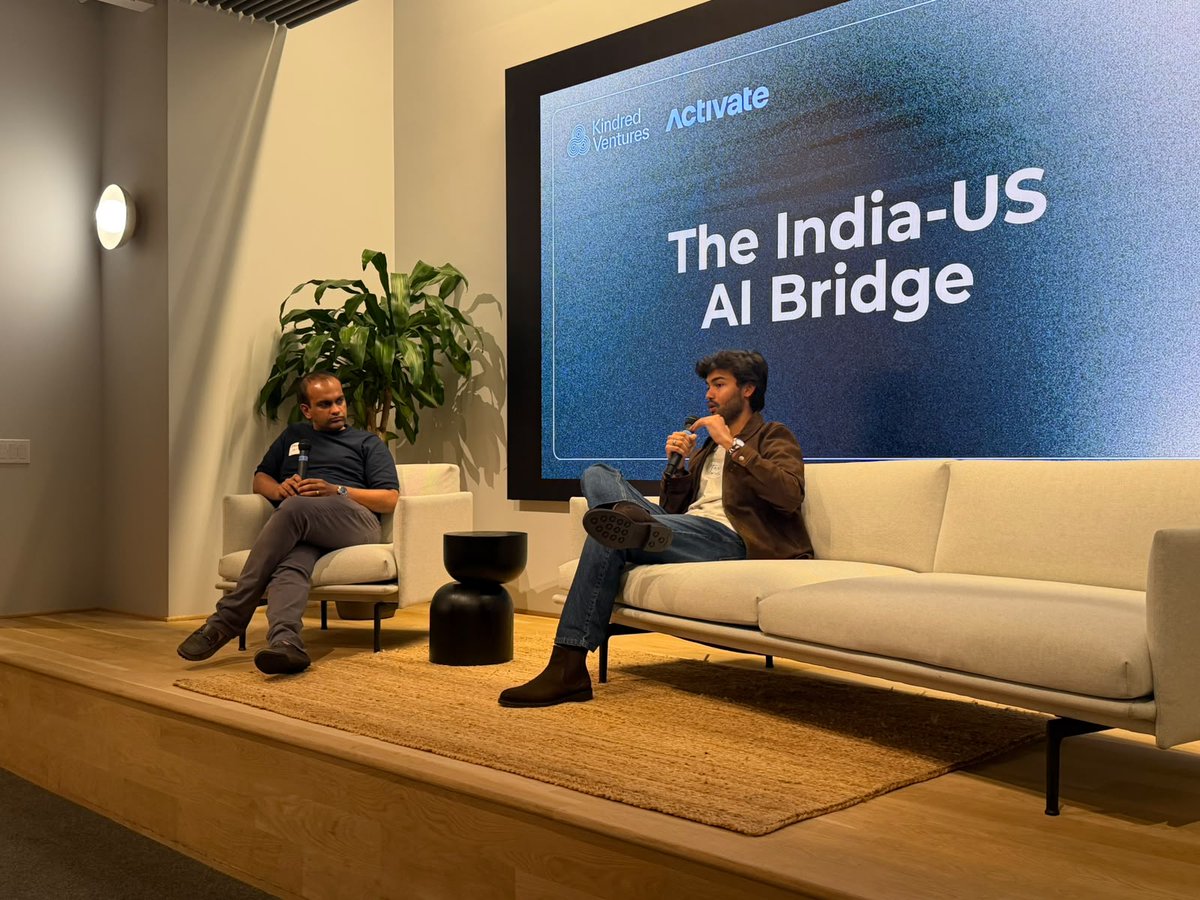
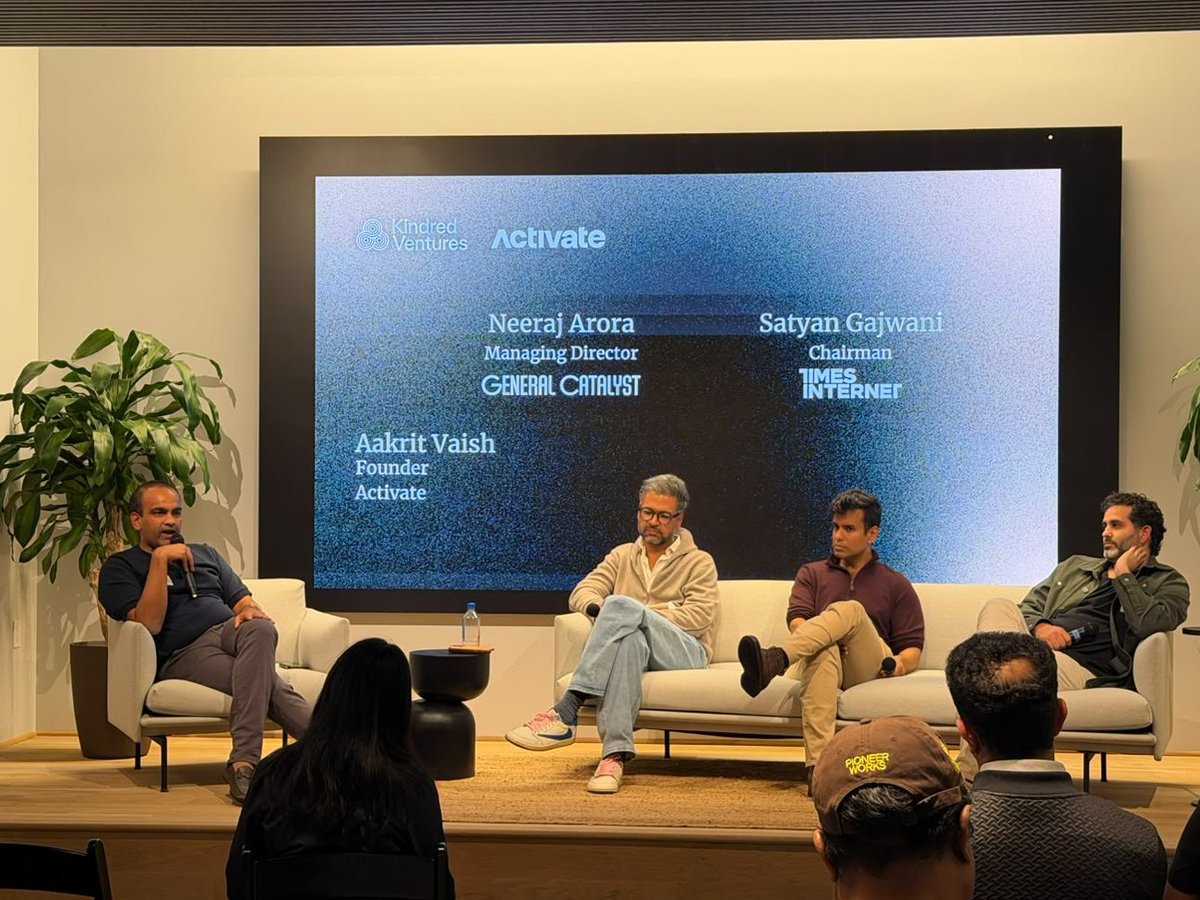
Earlier this week, Activate hosted our first-ever San Francisco gathering alongside our partners @KindredVentures! We brought together ~100 founders & investors along the India-US corridor under one roof for an insightful session to explore the evolving cross-border AI landscape.
We covered Tanay Kothari's (@tankots) journey building @WisprFlow from New Delhi to San Francisco followed by panel insights from Deedy Das (@deedydas), Neeraj Arora (@neerajarora) & Satyan Gajwani (@satyan) that was moderated by Aakrit Vaish (@aakrit) on building along the bridge. The evening also featured an emerging class of Indian founders: Soham Ganatra (@GanatraSoham), Deshraj Yadav (@deshrajdry) & Sudhanshu Mishra (@snmishra311) who are building groundbreaking AI startups in the US, the panel was moderated by Steve Jang (@stevejang).
Huge thank you to our incredible speakers, founders, and investors for making it an evening to remember!
It's amazing to see good people come together towards such an incredible mission.
I've known both @kevinweil and @manohar_paluri in different ways for a few years. Couldn't be more excited for them to join hands.
And thanks for having me as a small angel along the way :)
💥 Introducing Warp Sciences, a new company applying AI and robotics to help the world develop new medicines faster.
We’ve raised a $215M Series A led by @lightspeedvp to bring frontier AI out of the browser and into the lab, and build scientific capacity here in America.
I co-founded Warp with my long-time friend @dpatil, FAIR co-founder @manohar_paluri, and drug hunter Sol Reisberg. The early team is full of incredible people like @bkspears9, who helped achieve Q>1 fusion at LLNL.
We are honored to host Rahul Patil (CTO, @AnthropicAI) on his visit to India! 🇮🇳
From leading global payment infrastructure to scaling compute and inference currently at Anthropic, Rahul is one of the top experts in production-grade AI systems.
Join us for an off-the-record Mixture of Experts gathering hosted by Pratyush Choudhury (@177pc).
Space is strictly limited. Request a spot here: https://t.co/GDeGnfucm2
Fastest company ever to $1b annualized revenue
Nope it’s not Higgsfield or Cursor or Cognition.
Met a data company yesterday that did 0 revenue in November 2025 and 80m “in month revenue” in September 2026. They will hit $1b annualized from 11 months of being started. They are still under the radar so I can’t share who they are. Hopefully soon, with their permission.
I don’t make the rules.
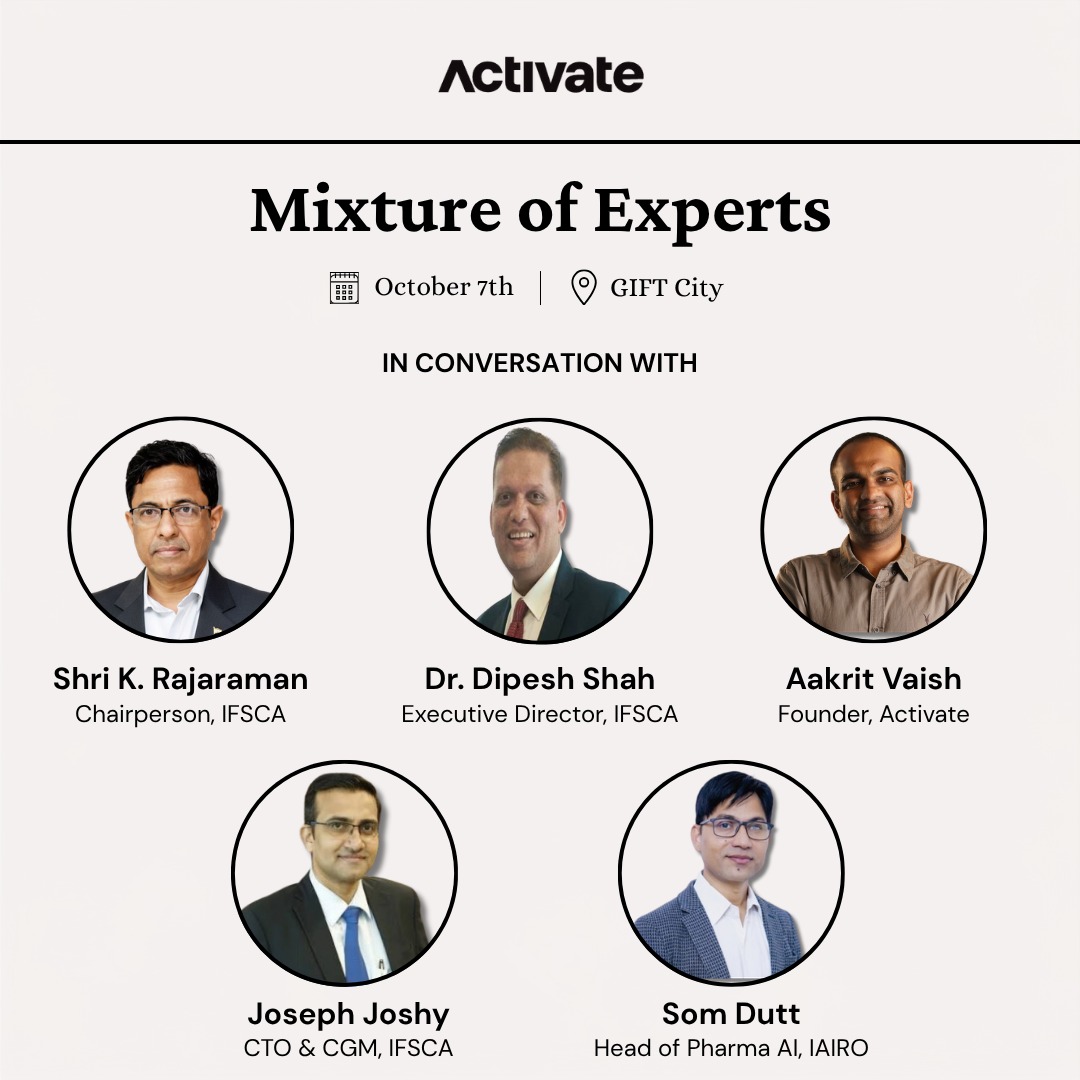
This week we take our flagship Mixture of Experts series to GIFT City in Gujarat, the gateway for global capital in India.
On October 7, I'll be in conversation with Shri K. Rajaraman, Chairperson IFSCA, Dr. Dipesh Shah, ED, Joseph Joshy, and Som Dutt, PhD of Indian AI Research Organization (IAIRO), on where AI meets finance, regulation and what India builds next.
Some of the best conversations happen when regulators, founders and investors are in the same room, and GIFT City is the place where those lines are being drawn.
RSVP: https://t.co/2ddhuqUflD
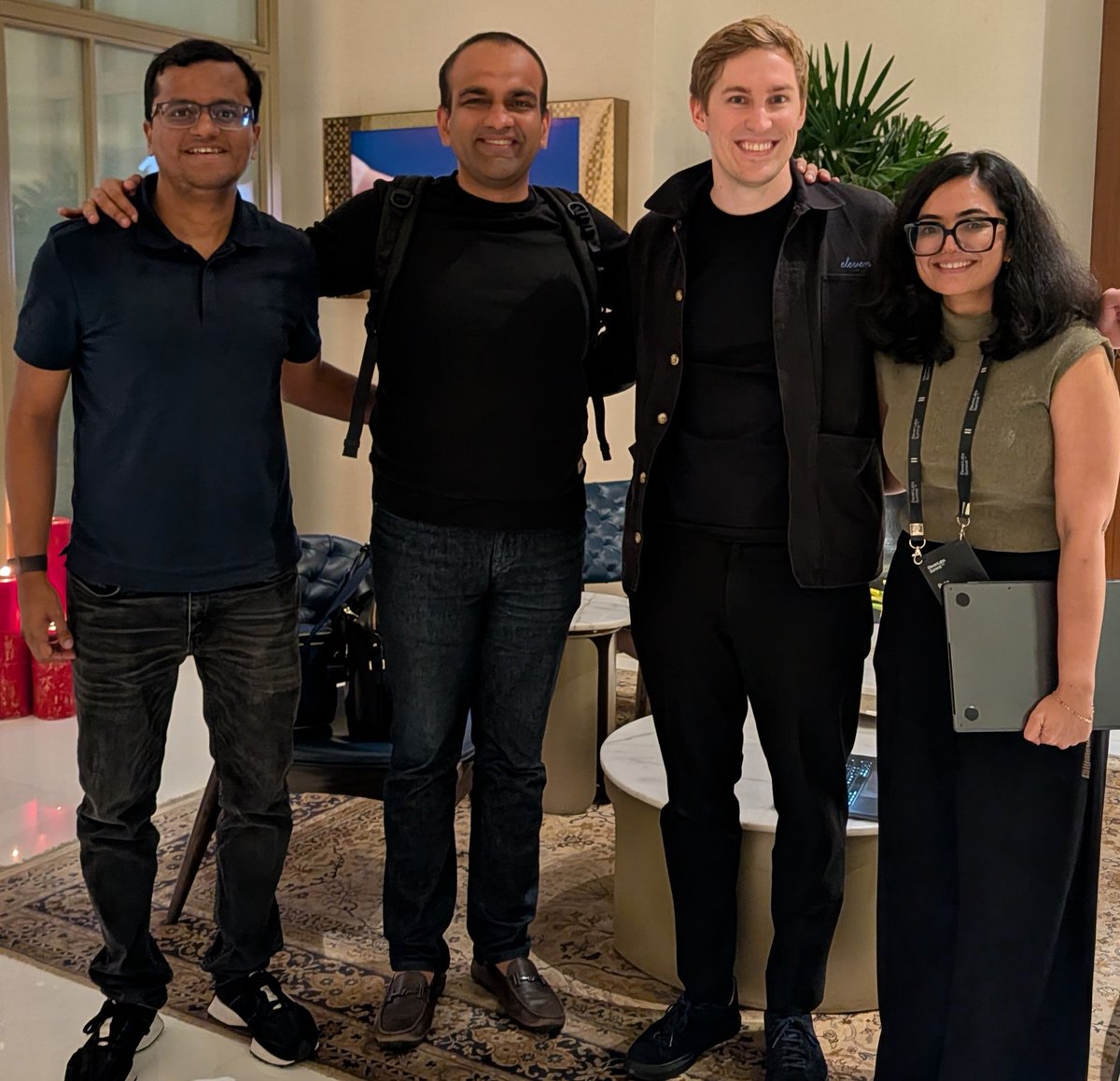
Big moment for @ElevenLabs — now valued at $22B.
When we partnered with ElevenLabs earlier this year, we believed voice would become one of the defining interfaces of the AI era and that India would be one of the most important markets for it.
That conviction has only gotten stronger.
India is already ElevenLabs’ second-largest market. We’re proud to be both investors and their strategic partners on the ground, helping take this technology across the country.
Congratulations to Mati, Piotr, Karthik and the entire ElevenLabs team. What they’ve built in such a short time is extraordinary! Still early 🚀
https://t.co/eyAAJloWUN
@mati@dabkowski_piotr@aakrit@177pc@soaibgrewal
A few weeks ago at the Global Fintech Fest, I sat down with @harshilmathur, Co-Founder & CEO of Razorpay, to talk about something I’ve been particularly curious about: what does it actually mean to turn a fintech giant into an AI company?
@Razorpay has quietly been doing some fascinating work. Most recently, they announced Vulcan, a foundation model for payments, built from scratch in India to improve fraud detection. And Harshil himself has been one of the more AI-pilled CEOs I’ve come across in the country, hands-on building agents and studying the craft.
We went deep into how they’re building with AI, what it changes across payments, and how he thinks about the technology from first principles.
One of the highest-quality technical conversations I’ve had with a CEO in India.🎙️
@ActivateSignal
We just closed an employee tender offer which values @ElevenLabs at $22BN, up 2x from our Series D in February. The tender was led by Wellington and T. Rowe Price.
A few words on how we got here ↓