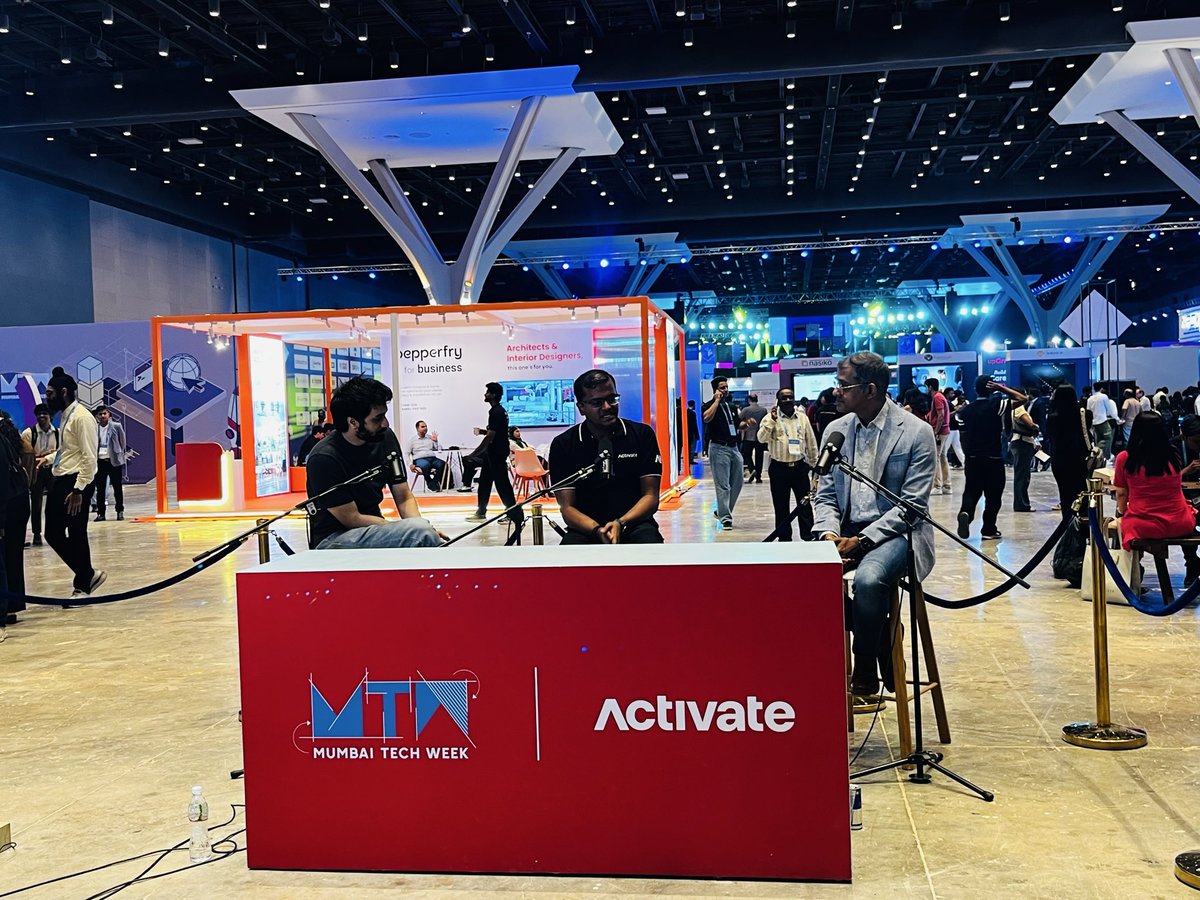
Ravindra Yadav, Senior Director of Data Science at Meesho, sits down with Varun Mayya and Pratyush Choudhury at Mumbai Tech Week to break down how one of India's most distinctly Bharat-first companies is rebuilding e-commerce around how people actually shop. With 264 million annual transacting users who browse rather than search, Meesho's challenge isn't adding AI for its own sake, it's making shopping feel as natural as walking into a kirana store. Ravindra unpacks the insight behind Vani, Meesho's multimodal voice assistant, and the on-ground research that revealed a striking truth: nearly 80% of new e-commerce users make their first purchase on someone else's account because the interfaces were never built for them.
In this conversation, they go deep on:
0:00 How Meesho gets users: organic vs influencer channels
1:08 Why Meesho users are browsing-first, not search-first
1:32 Where AI sits in the Meesho stack
2:04 The vision behind Vani: a virtual kirana you can talk to
2:42 DICE and the on-ground insights that shaped Vani
4:04 Why 80% of new users buy on someone else's account
5:00 Making offline shopping behavior internet-native
5:31 How Vani's multimodal voice and visual understanding works
6:39 Building trust in a brand-new shopping modality
If you're a founder, builder or data scientist thinking about AI, voice interfaces, or building for the next few hundred million Indian shoppers, this one's for you.
@aakrit@waitin4agi_@177pc@Meesho_Official
Arun Srinivas, Managing Director and Head of Meta in India, sits down with Varun Mayya and Pratyush Choudhury at Mumbai Tech Week to break down how Indians actually buy, and where AI and creators fit into it. With nearly three decades spanning FMCG at Hindustan Unilever and now leading Meta's India business, Arun has watched consumption shift from the Doordarshan era to a moment where a viewer in Kanpur follows the same creators and reels as one in Mumbai. He makes the case that the metro versus small-town divide is collapsing, that creators could influence up to a trillion dollars of purchases in India over the next decade, and that the real power of AI sits in the backend, not the buttons a user sees.
In this conversation, they go deep on:
0:00 Intro: Arun on FMCG, Meta, and how Indians buy
0:45 Why fundamental consumer habits haven't changed
3:08 Indian vs global consumer: the blurring lines
4:53 Why rural and metro India now want the same thing
6:07 Influencer marketing: why it's just beginning
6:38 Why brands need a source of authority
8:03 The $1 trillion creator influence stat
8:33 PolicyBazaar and native-language creators
9:42 The US "clipping" trend and Meesho's 10,000 creators
11:16 Micro-dramas, viral series, and brand tie-ins
13:33 How tier-2 and tier-3 India uses Meta differently
15:25 Why founders and creators need to put themselves out there
If you're a founder, marketer or builder thinking about AI, consumer behavior, or the creator economy, this one's for you.
@aakrit@177pc@waitin4agi_@Meta@metaindia
Anupam Mittal, founder and CEO of https://t.co/wMjLe9mXEC and one of India's best-known investors, sits down with Aakrit Vaish and Pratyush Choudhury at Mumbai Tech Week for a wide-ranging conversation on building AI that actually solves problems. A founding voice behind Mumbai Tech Week itself, Anupam makes the case that the real edge isn't AI but truth, and that most of the hundreds of companies chasing the AI label are missing the problem they should be solving. The conversation moves from the AI quietly reshaping matchmaking at https://t.co/wMjLe9mXEC to his own AI agents, his investor take on "AI washing," and what it takes to reinvent a 24-year-old company.
In this conversation, they go deep on:
Timestamps:
0:00 Intro: Anupam at Mumbai Tech Week and the MTW origin story
1:57 Why Mumbai is "magic": the intersection of disciplines
4:09 What's new at Shaadi: AI-forward, but not for the sake of it
5:53 500 models and a billion data signals a day
7:24 The real power of AI is in the backend
9:01 The counterintuitive real problem in Indian matchmaking
10:39 Why what's bigger than AI is truth
12:04 The GOAT culture: grit, ownership, agility, truth
12:39 His personal AI stack and the agents he built with Claude Code
15:14 The investor hat: why VCs can't tell founders the truth
17:05 How he thinks about investing in AI
19:10 "AI washing" and why solving a problem isn't a company
20:04 Making a 24-year-old company AI-forward without mandating it
22:27 Closing: the tortoise route and a word on Activate
If you're a founder, builder or investor thinking about AI, building to last, or cutting through the hype, this one's for you.
@aakrit@177pc@AnupamMittal@ShaadiDotCom
Manish Gupta, Senior Director at Google DeepMind India, sits down with Aakrit Vaish and Pratyush Choudhury at Mumbai Tech Week for a rare on-record conversation about the frontier AI research happening out of Bangalore. Gupta makes a pointed case against the narrative that India lacks AI research talent: a team of roughly 75 researchers, a third of them fresh out of college, producing work on par with the best in the world and feeding directly into Gemini. The conversation goes deep on what DeepMind India actually builds, why Gemini is considered the most efficient model on the planet, and what India needs to become a research leader rather than a fast follower.
In this conversation, they go deep on:
0:00 Intro: Manish Gupta of DeepMind India at Mumbai Tech Week
1:23 What DeepMind India does, and why it's a "mystery"
1:59 The three roles: languages, efficiency, continual learning
2:19 The Haryanvi demo at Google I/O and the cultural playbook
2:38 Making models efficient: from mobile to servers
3:25 Matryoshka transformers and why nested models win
4:20 Why Gemini is the most efficient model on the planet
5:11 Continual learning: using Gemini to improve Gemini
5:50 Google's India plans: consumers, agents, enterprise, government
7:44 Government officials live-coding with AI Studio and NotebookLM
8:30 The India AI talent debate and how the team is structured
10:25 Why India lacks courage and R&D investment, not talent
11:16 DeepMind's global labs and India's outsized impact
13:15 On-device AI: Gemma 3n and 4n
14:08 The headline: 75 world-class researchers in Bangalore
14:58 25 of the 75 are fresh out of college
If you're a founder, builder or researcher thinking about AI, frontier models, or India's place in global AI research, this one's for you.
@aakrit@177pc@GoogleDeepMind@GoogleIndia@ManishGuptaMG1
Pragya Misra, who leads Strategy and Global Affairs for OpenAI in India and was the company's first hire in the country, sits down with Aakrit Vaish at Mumbai Tech Week to unpack OpenAI's India bet and why Codex is changing who gets to build. Two years in, Pragya has had a front-row seat to OpenAI's growth from startup mode to a generational platform, and makes the case that for OpenAI to win globally, it has to win in India. The conversation goes deep on Codex's explosive adoption, the shift from coding model to product-development tool, and what OpenAI is actually building on the ground in India.
In this conversation, they go deep on:
0:00 Day one of Mumbai Tech Week and what Pragya does at OpenAI
2:02 Why she came to MTW and what she saw this year
3:38 Founder stories: a Marathi voice-first wealth manager for Tier 2/3
5:29 Why Codex is suddenly ramping up
6:22 Codex grew 27x in 2026, India a top-five country
7:06 How non-coders are becoming builders
7:56 The Surya Namaskar app demo for PM Modi
9:17 Codex is a product-development model, not just coding
9:48 How Codex changed her day-to-day ("build me a chief of staff")
11:12 OpenAI's India plans: the team and the people joining
14:18 20+ people on the ground and offices in Delhi, Mumbai, Bangalore
14:56 Parting advice for builders: what's coming at OpenAI
15:13 Compressing model releases: every 6-7 weeks, 80-85% coded by Codex
17:04 GPT-5.5, the financial sector, and the AWS partnership.
If you're a founder, builder or operator thinking about AI, or what OpenAI is doing in India, this one's for you.
@aakrit@pragyamisra@OpenAI
Dilip Asbe, MD & CEO of NPCI and one of the key architects behind UPI, sits down with Varun Mayya and Pratyush Choudhury at Mumbai Tech Week to explain why the world's largest real-time payment system is, in his words, only getting started. UPI now processes 22 billion transactions a month at 50-millisecond latency, yet Asbe argues there's still 8 to 10x growth ahead, pointing to the gap between UPI's 230 million daily active users and WhatsApp's 600 million in India. The conversation goes deep on the infrastructure, the AI layer powering fraud detection, and how the next half a billion users get online.
In this conversation, they go deep on:
0:00 22 billion transactions: what Dilip is focused on next
0:43 Why UPI has 8 to 10x growth still ahead
2:06 Inside the tech stack: 4 data centers, 50ms latency
3:01 NPCI's three pillars: UPI infra, fraud/risk, and CBDC
3:57 The HDFC autopay bug fixed in a day
4:41 Hiring philosophy: purpose and fire over skill
6:11 The five leadership principles: agency, authenticity, attitude
8:25 How AI unlocks the next half billion users
9:14 Is UPI really safe? The trust and storytelling gap
If you're a founder, builder or operator thinking about AI, fintech, or building at national scale, this one's for you.
@177pc@aakrit@waitin4agi_@dilipasbe@NPCI_NPCI
Didn’t need a stage. Just a mic and @AnupamMittal🎙️
The crowd gathered, the energy was unreal - Activate Signal at Mumbai Tech Week just had one of its biggest moments. 🔥
Stay tuned for the insane podcast episode drop 👀
@aakrit@177pc
V. Vaidyanathan, founder of Capital First and now MD & CEO of IDFC FIRST Bank, sits down with Varun Mayya and Aakrit Vaish at Mumbai Tech Week to unpack how a seven-year-old bank built itself into a tech-first institution from scratch. After turning around Capital First and merging it with IDFC Bank in 2018 to secure a banking license, Vaidyanathan inherited a balance sheet with bad losses and almost no deposits, and made a contrarian bet: build long, lead with technology, and treat experience as the entire product. The result is a bank that grew retail deposits from 10,000 crore in 2018 to 2.4 lakh crore today, with an app rated number two in the world by Forrester, next only to BBVA.
In this conversation, they go deep on:
0:00 Why finance people are recommending IDFC now
0:47 37,000 startups: how IDFC won the founders
2:14 The newborn-bank advantage and a 4.9-rated app
4:02 Rated #2 banking app in the world, next to BBVA
5:00 From Capital First to the IDFC merger and bank license
6:54 Why "India is in default founder mode"
8:08 Thinking long: building a bank when you start from behind
10:29 Varun's story: from video editing school to a 500-person company
11:17 The numbers: 5.7 lakh crore book and two "magic carpets"
12:21 The bank's AI stack: 63 systems, ML, and personalization
13:37 Would IDFC build a trading platform? The Zerodha tie-up
16:09 The 150-200 person AI team and catching up on tech
18:02 Market cap, stock price, and building at "build stage"
If you're a founder, builder or operator thinking about AI, finance, or building institutions for the long run, this one's for you.
@aakrit@waitin4agi_@IDFCFIRSTBank
The best conversations happen off the main stage. Access to the right mentor at the right time changes everything.
💡Mentorship sessions powered by Activate in full swing at Mumbai Tech Week - with @sharad_sanghi of @Neysa and @khemaniv from @Quantiphi giving their time to the next generation of builders. This is what the ecosystem is about. 🇮🇳 #MumbaiTechWeek
@metaindia Every trip you book is about to get smarter. 🤖✈️ The CEO of @makemytrip on Activate Signal - breaking down how AI is reshaping travel for a billion Indians. This one hits close to home.
India isn’t just a market for AI. It’s where the next chapter gets written. Sat down with @ManishGuptaMG1 Senior Director @GoogleDeepMind at Activate Signal - Mumbai Tech Week. On India’s AI strategy, where we are in the revolution and more. 🎙️ #MumbaiTechWeek
Compute is the new oil - and India is sitting on an opportunity it cannot afford to miss. Day 2 of Activate Signal with @sharad_sanghi, Co-founder & CEO of Neysa. The real talk on building AI infrastructure in India. 🇮🇳🎙️ #MumbaiTechWeek#Activate
Mayank Kumar, founder of upGrad and now BorderPlus, sits down with Varun Mayya and Pratyush Choudhary at Mumbai Tech Week to unpack the bet behind one of the most contrarian plays in AI. After building upGrad into one of India's defining edtech companies, Mayank pivoted to a problem most founders overlook: training healthcare workers across India, the Philippines, Brazil and Egypt, then deploying them into aging economies like Germany and Japan that face severe labor shortages. His thesis is simple and against the grain: AI for blue collar workers is a bigger unlock than AI for coders, and almost no one is building there.
In this conversation, they go deep on:
0:00 Intro: From upGrad to BorderPlus, and why entrepreneurship
3:13 What BorderPlus does: young India, an aging world
6:15 How AI powers the business: learn, ask, do
8:54 What surprised him about blue collar workers
11:21 Why it's AI-proof: Moravec's paradox and the blue collar bet
13:08 What VCs actually look for
16:27 Entrepreneurship in the AI age: distribution and showing up.
If you're a founder, builder or operator thinking about AI, labor, or where the next big opportunity actually lives, this one's for you.
@aakrit@waitin4agi_@mayank_kmr@177pc@upGrad_edu
Closing off Activate Signal with insights from @pragyamisra, the Head of Strategy and Global Affairs for @OpenAI in India talking about Open AI Plans for India, Codex’s explosive expansion and more! 💻