Bitcoin has always been operating in 4 year cycles where it crashes at the end
2014, 2018, 2022, 2026
It's actually great because every 4th year people really get super sad and give up on it (or well that's how it feels like)
There's also surely some sentiment pumping to push the price down so people can buy in cheap again
The next cycle up is 2027-2031
(And it has something to with the halvening which happens every 4 years cutting the reward for miners in half)
BREAKING: SpaceX is acquiring Cursor in a $60 billion all-stock deal.
• Cursor is being valued at $60 billion
• Cursor will become a wholly owned SpaceX subsidiary
• Cursor shareholders will receive SpaceX Class A shares
• The exchange ratio will be based on SpaceX’s 7-day average share price before closing
• Subject to regulatory approvals and customary closing conditions
• Expected to close in Q3 2026
Cursor is one of the world’s leading AI coding platforms and one of the fastest-growing software companies. This marks one of the largest AI acquisitions ever and significantly expands SpaceX’s footprint in AI.
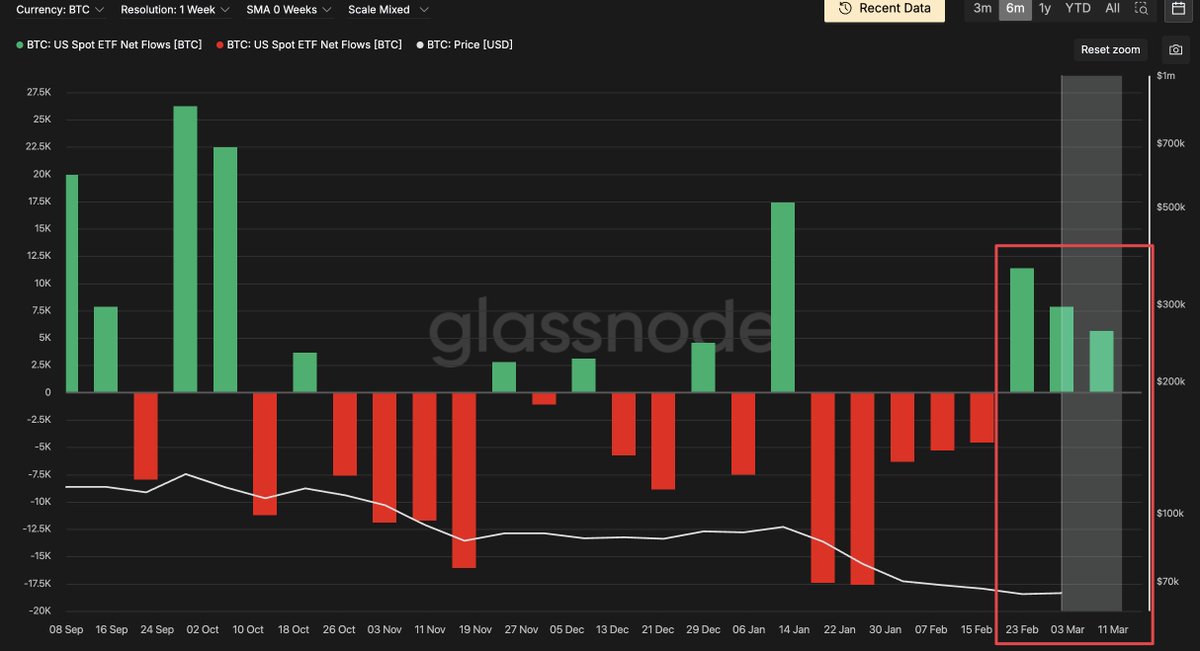
BTC Spot ETF flows are turning green again.
We had 4 consecutive red months of outflows dating back to October. It was getting ugly.
But it looks like the bleeding's stopped for now. We're looking at 3 weeks of positive inflows. The institutions are buying again even in this climate.
I'm not super excited yet bc the bars are tiny compared the inflows we saw half a year ago. Even though the size isn't there, at least the direciton's switching.
ETF flows are one of the cleanest reads on what big money is actually doing.
And right now they're accumulating into weakness while most of crypto Twitter is doom posting.
What I'm watching from here:
• Multiweek inflow trends, not single bars.
• Whether inflows are accelerating or decelerating week over week.
• And spot price action after the settlement window clears.
Think I need to see 2 months of positive inflows and I'll start getting excited.
We're not there yet, but it's good to see the bleeding stop a bit.
It is hard to communicate how much programming has changed due to AI in the last 2 months: not gradually and over time in the "progress as usual" way, but specifically this last December. There are a number of asterisks but imo coding agents basically didn’t work before December and basically work since - the models have significantly higher quality, long-term coherence and tenacity and they can power through large and long tasks, well past enough that it is extremely disruptive to the default programming workflow.
Just to give an example, over the weekend I was building a local video analysis dashboard for the cameras of my home so I wrote: “Here is the local IP and username/password of my DGX Spark. Log in, set up ssh keys, set up vLLM, download and bench Qwen3-VL, set up a server endpoint to inference videos, a basic web ui dashboard, test everything, set it up with systemd, record memory notes for yourself and write up a markdown report for me”. The agent went off for ~30 minutes, ran into multiple issues, researched solutions online, resolved them one by one, wrote the code, tested it, debugged it, set up the services, and came back with the report and it was just done. I didn’t touch anything. All of this could easily have been a weekend project just 3 months ago but today it’s something you kick off and forget about for 30 minutes.
As a result, programming is becoming unrecognizable. You’re not typing computer code into an editor like the way things were since computers were invented, that era is over. You're spinning up AI agents, giving them tasks *in English* and managing and reviewing their work in parallel. The biggest prize is in figuring out how you can keep ascending the layers of abstraction to set up long-running orchestrator Claws with all of the right tools, memory and instructions that productively manage multiple parallel Code instances for you. The leverage achievable via top tier "agentic engineering" feels very high right now.
It’s not perfect, it needs high-level direction, judgement, taste, oversight, iteration and hints and ideas. It works a lot better in some scenarios than others (e.g. especially for tasks that are well-specified and where you can verify/test functionality). The key is to build intuition to decompose the task just right to hand off the parts that work and help out around the edges. But imo, this is nowhere near "business as usual" time in software.
Most people will read this and think optimists live longer because they eat better and exercise more. The study says something wilder.
Lee et al. controlled for smoking, diet, exercise, alcohol, depression, BMI, and socioeconomic status. The longevity effect still held. The most optimistic quartile lived 11 to 15% longer and had 1.5 to 1.7x odds of reaching 85 even after removing every behavioral difference.
Which means something is happening at the level of biology, not just habits.
Rozanski’s meta-analysis across 229,391 participants found optimists carry 35% lower cardiovascular event risk. Blackburn’s Nobel Prize-winning lab at UCSF found pessimistic attitudes are associated with accelerated telomere shortening. Cortisol suppresses telomerase, the enzyme that rebuilds the protective caps on your chromosomes. So chronic negative expectation literally erodes the structures that keep your cells from aging.
The loop runs: pessimistic cognitive style → sustained HPA axis activation → elevated cortisol → telomere degradation → accelerated cellular senescence. Optimists interrupt that loop at the top. They show less emotional reactivity to stressors, faster recovery from acute stress, and they default to reframing threats as challenges rather than catastrophizing.
The part nobody talks about from this paper: the authors explicitly state optimism is modifiable. This isn’t a personality trait you’re born with. Cognitive reappraisal training, morning sunlight for cortisol rhythm regulation, deliberate breathing protocols for vagal tone, structured gratitude practices. All of these shift the prefrontal cortex patterns that determine where you sit on the optimism spectrum.
A 35% reduction in cardiac events from a trainable psychological variable is a bigger effect size than most supplements on the market. That’s the real story buried in this abstract.
“All the good ideas are taken.”
“If I was born 5 years earlier I’d be rich.”
“I missed the window.”
People said this about dot-com, Web 2.0, social, mobile, cloud… and now AI. There’s always another window. The people who aren't complaining are the ones who are seizing it.