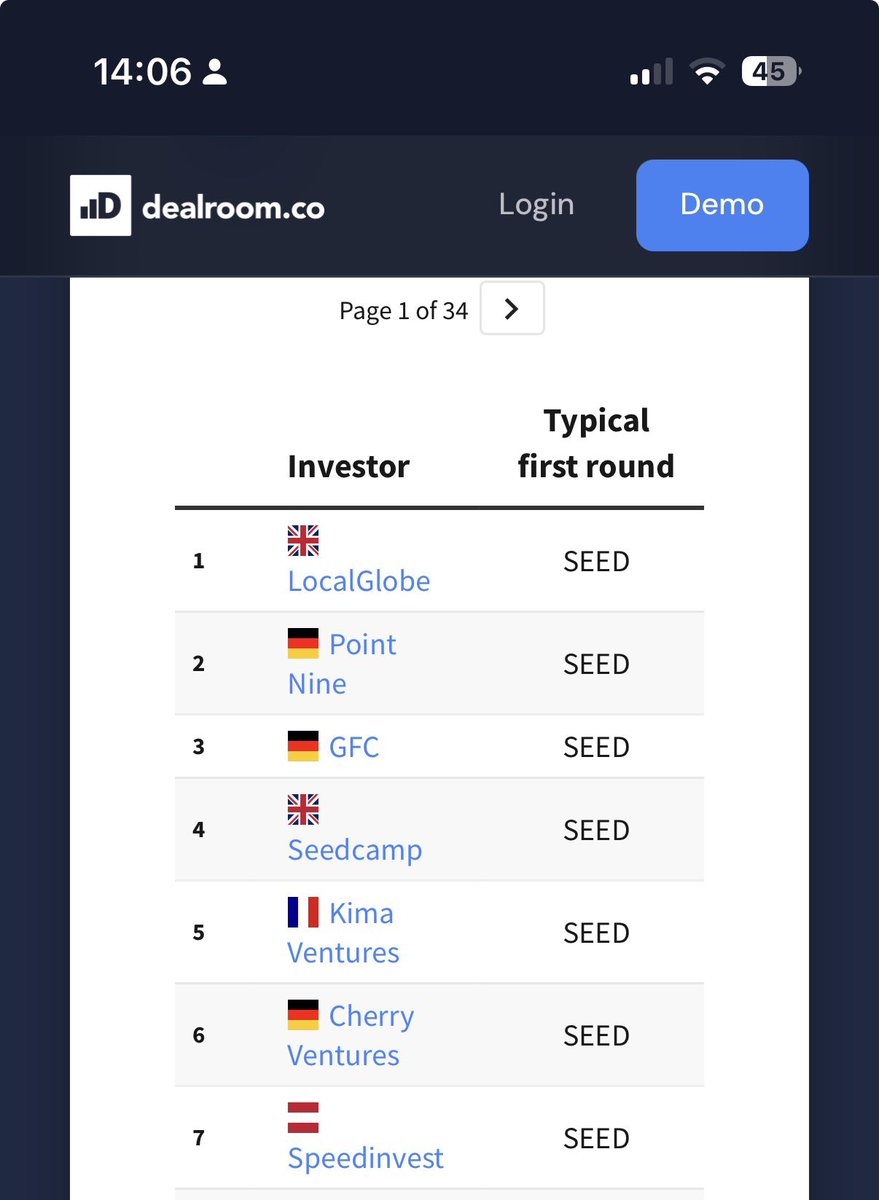
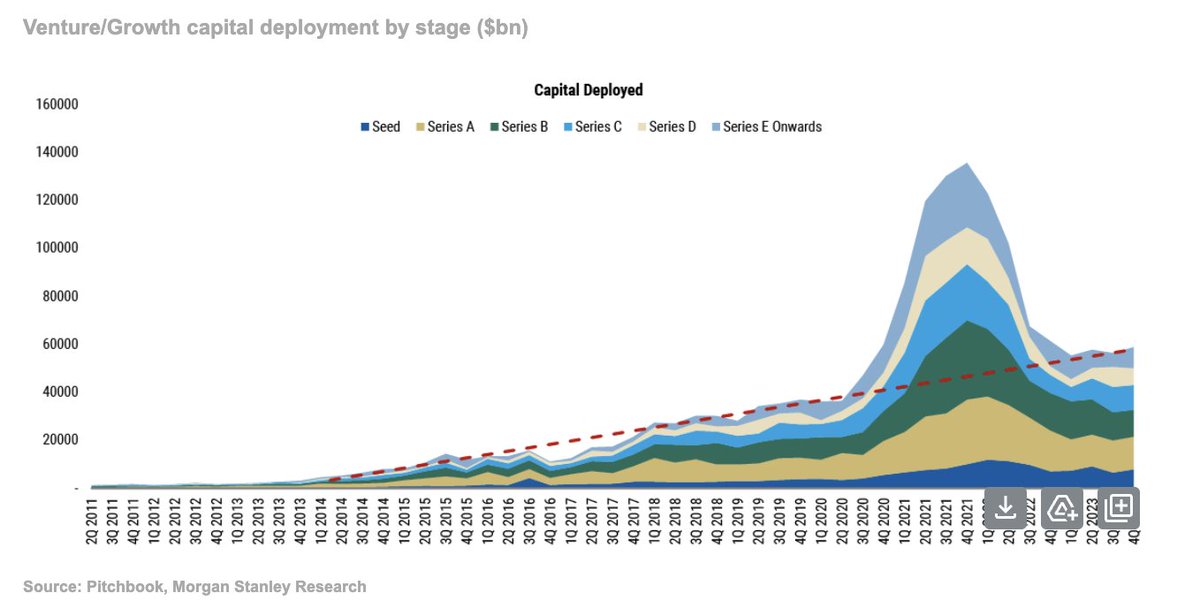
My $0.02. A mega-VC with $5-10B annual funds is really searching for only one thing: a company they can pile over $1b into with a potential for 5-10X on the $1b. With this, seed fund is inconsequential money used to increase the odds of main objective. You are collateral damage.
In 3-5 years, seed funds will generate the majority of liquidity through downstream sponsors or other GP led secondaries. The IPO bar is too high, and not interesting for most companies when private markets are so large. The 10 year model doesn't work and is far too antiquated - Needs a stronger structured liquidity market.
This is the best summary of the current geopolitical situation I have seen. Sir Alex Younger was head of MI6 between 2014 and 2020. Really worth watching.
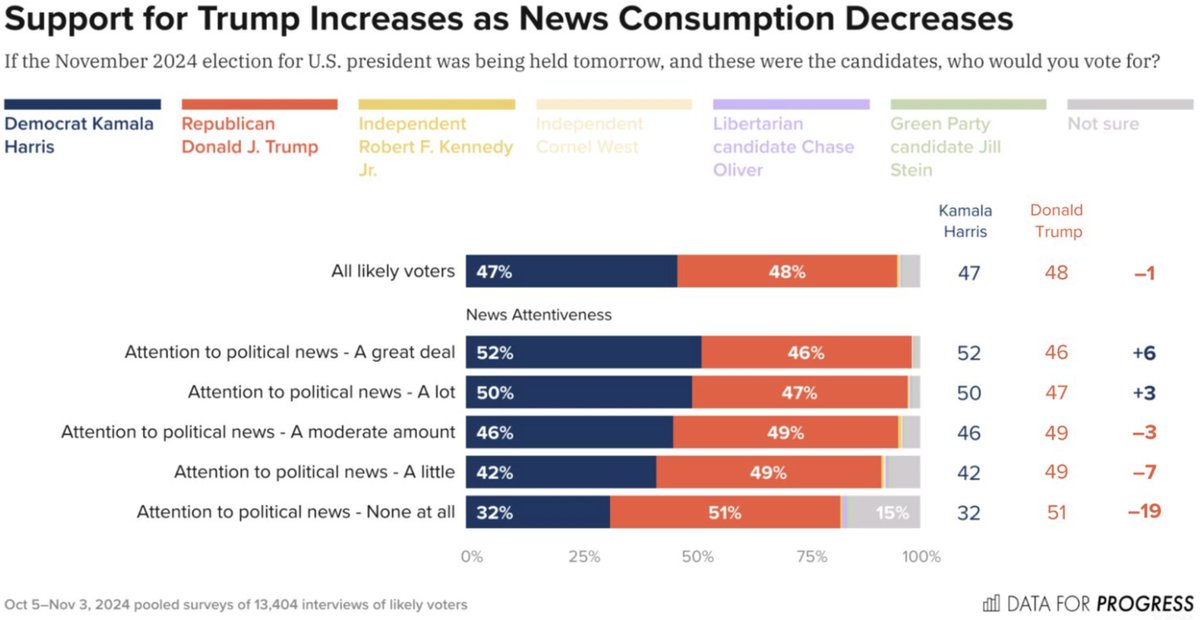
Among the most important charts for thinking clearly about the 2024 election — and politics in general.
The hardest divide to cross isn't left vs. right. It's interested vs. uninterested. https://t.co/KCScv1bklF
If you want Europe to win go and sign & promote https://t.co/s2BP8JU2Kt
Startups is no longer a cute little economic edgecase that’s just interesting for innovative sounding political PR.
We are an industry.
Time we make our voice heard and unite.
7 Things LPs Should Know Before Investing in VC Funds:
- The definition of venture capital (VC) has evolved from being artisanal, early-stage financing to a broad spectrum ranging from inception to pre-IPO. Essentially, VC now represents minority investing in private technology and life science companies.
- The VC landscape has become as fragmented as the buyout space, now encompassing small, mid, and large-cap segments. Each of these has distinct risk/return characteristics. Smaller funds offer substantial cash-on-cash upside but come with significant volatility. In contrast, large, reputable brands are increasingly akin to private equity (PE) risk/return. Small funds represent the potential for venture alpha (with associated risk), and large funds offer venture beta. Both can play a role in a diversified portfolio.
-Track records are helpful but should be seen as a guide rather than an absolute indicator. VC funds typically take 5-7 years to settle into their ultimate performance quartile. Therefore, funds launched in 2019 or later are generally too early for a conclusive assessment, and overemphasis on them can lead to false positives or negatives. Similarly, funds older than 6-7 years are challenging to evaluate accurately, as macro and micro variables (such as fund size and team composition) may have changed over time.
-There's considerable debate on platforms like LinkedIn comparing public equity performance to private equity/VC, with some claiming that public equities perform better. Statistically, this is not true, particularly when focusing on above-median performance. While a 9% buy-and-hold return in public markets might yield over 2x in a decade, comparing this directly to private funds is misleading due to differences in drawdown and distribution periods (capital typically drawn over 4-5 years, with distributions starting in years 4-8, depending on strategy). This is why the Public Market Equivalent (PME) was developed as a more accurate comparative tool.
-Managers often hold similar shares of stock at varying valuations. Therefore, it’s essential to inquire about their valuation methodologies and the holding prices of their most significant positions. Managers who aggressively mark down may appear weak compared to benchmarks, while those who haven't look better than they are.
-Using General Partner (GP) commitment as a percentage of the fund to measure motivation can be a weaker signal than expected. It’s more insightful to assess the GP's commitment as a percentage of their personal balance sheet or understand what drives them by spending time with the manager, which will yield a more accurate signal.
- Every decade sees the emergence of new firms that become dominant players (e.g., in the 2000s, it was firms like First Round, A16z, and USV; in the 2010s, Ribbit and Felicis are a couple of examples). Today, discovering and spotting talent is as crucial as having access when aiming for consistent performance.
🚗✨ What do experts from Prosus Ventures, Kyte, Eurazeo, and Schibsted have in common? They’re speaking on AI-driven mobility marketplaces & classifieds at the MPC🚀!
🎟️ Get your tickets now! https://t.co/PZNRmqiLPx
#AI#Mobility#MarketplaceConference
.@DocclaUK raises a $46M Series B to expand its virtual ward & remote patient monitoring services.
Enabling 24/7 patient monitoring remotely in real-time, and a 100% client retention rate in the UK, Doccla is now expanding to Ireland, Germany & France.
https://t.co/CSaEbSPo9P
We're partnering w/@TEDTalks for @TEDxVienna – their 1st European conference focused solely on AI.
Global AI leaders, inventors & founders will gather in our hometown to discuss what’s next in AI. Meet the speakers & submit your application to attend ⬇️
https://t.co/ouDtwsJ9bJ
.@planqceu raises €50M Series A to take on global competitors with their “Made in Germany” quantum computers.
What's next for Europe's leader in digital atom-based quantum computing founded by scientists from @MPI_Quantum & @LMU_Muenchen? More here 🔽
https://t.co/tvPTidpyqj
.@apidayESG raises a €10m Series A to become the European leader in ESG reporting for private equity funds & SMI companies 💪
@TechCrunch has more on the round and Apiday’s plans for the future🔽
https://t.co/HOf38V2n1k
@daphnivc, @Aenu_impact, @SWENCP, @galionexe, @ReventVC
We’re thrilled to welcome our newest Partner, Rana Abdel Latif!
Rana is joining our Emerging Markets team to further strengthen our commitment to finding, funding, & supporting early-stage startups in Emerging Markets.
Find out more👇
https://t.co/ub6OAfGRA4
Our CEO & Managing Partner @oholle is heading to Founder’s Circle (@FactoryBerlin)!
Don't miss...
👉A panel on accelerating your early-stage startup.
👉Office hours with the panelists & @OsborneClarke.
👉Networking with 100 founders.
Sign up here👇
https://t.co/hMQYUE8ze6