You know what's crazy?
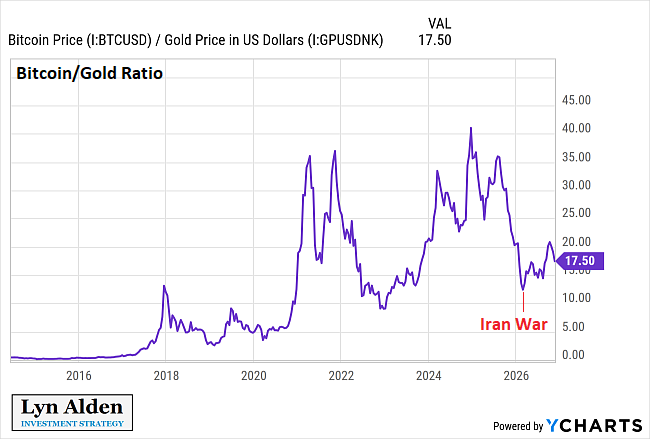
So far, bitcoin bottomed versus gold at the start of the Iran War.
War broke out, and then gold had a worse year than bitcoin from that point, even as both were bad.
That's one of those "the CFA exam doesn't prepare you for this" type of outcomes.
Commodities are getting hit pretty hard alongside the broader equity market as the surging U.S. dollar sucks liquidity out of the global financial system. For those that follow me, I've been saying this from some time that there was risks if the dollar strengthens too quickly.
The issue is that dollar-denominated debt becomes more expensive to service, financial conditions tighten, and investors are forced to raise cash, reduce leverage and sell assets. It becomes less about fundamentals and more about liquidity.
One thing I've learned over the years is that market leverage doesn't necessarily tell you when a correction will happen, but it tells you a great deal about how painful that correction could become. For some perspective, U.S. margin debt has surged to approximately $1.45 trillion, equivalent to roughly 58% of U.S. currency in circulation and 6.2% of M2 money supply. That's an extraordinary amount of leverage in the system, and when markets start moving against investors, it can accelerate the selling pressure.
Unfortunately, even gold isn't immune. During a liquidity-driven selloff, investors often sell what they can, not necessarily what they want to. Gold can become a source of cash to cover margin calls and offset losses elsewhere.
The irony is that the very forces driving the dollar higher could eventually create the conditions for its reversal. The U.S. government and broader financial system have become increasingly reliant on negative real interest rates to help manage an enormous debt burden. A prolonged dollar-driven liquidity squeeze makes that increasingly difficult, raising the risk that something eventually breaks and forces central banks to step in with lower rates and additional liquidity.
That's when things can get interesting for gold. It may get sold during the initial panic, but if policymakers respond by driving real interest rates back into negative territory, the combination of easier money and renewed currency debasement concerns could send gold sharply higher.
In other words, the same liquidity squeeze hurting gold today could ultimately create the conditions for its next rally.
We're watching all of this closely and remaining deliberate about managing exposure through what continues to be a challenging market environment through to the end of the year.
GTA6 drops today on purpose. Perfect cover while Trump, Xi and Putin seal a "peace" deal in China that protects leaders from the ICC and rewires the UN. Anthropic just IPO'd at $1.5T so the AI gods can own everything. Congress quietly pushes energy bills making you subsidize their data centers. Classic bread and circuses. Stay woke.
🚨 WHO IS BEHIND THE #GOLD SELL OFF?
#CFTC data (Nov 10, 2026) reveals a striking concentration on #COMEX:
• Top 4 traders account for 37.4% of #COMEX open interest on the gross-short side.
• Top 8 account for 54.3%.
• On a net-short basis: 35.1% and 49.9%.
• Swap Dealers increased gross shorts by 9,686 contracts.
• Open Interest rose by 5,556 contracts despite sharply falling gold prices.
This raises serious questions about market concentration, short exposure and price discovery.
Who are these dominant players? What are their real exposures? And how much influence do they have over #gold prices?
⚖️ We are looking for experienced lawyers, financial-market experts and investigators willing to help examine this evidence and explore legal action in court.
If you have relevant expertise or contacts, get in touch. We need people prepared to take this further.
The data deserves far more scrutiny. 🥇🔍
Source: CFTC COMEX Gold COT, November 10, 2026.
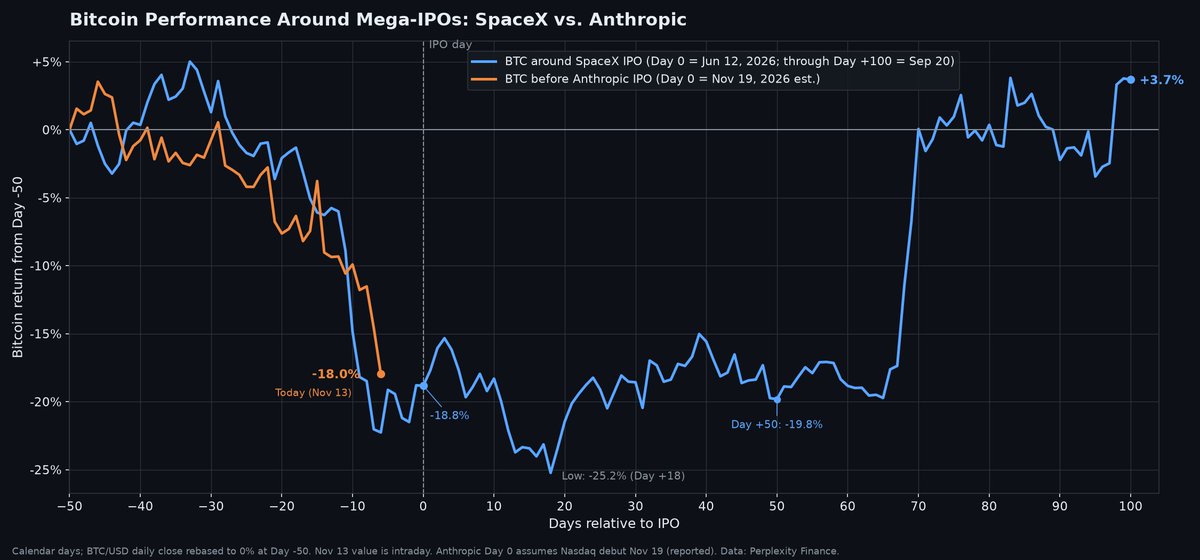
Bitcoin fell 19% into the biggest IPO ever. Now it's down 18% heading into the second biggest.
SpaceX raised $75B when it went public on June 12. In the 50 days before it listed, Bitcoin dropped 19%. Anthropic plans to raise up to $64B when it lists next week, and Bitcoin is down 18% over the same stretch. Overlay the two and they look almost the same.
What happened after the SpaceX IPO is the notable part. Bitcoin bottomed 18 days after the listing, then recovered all the way. By Day 100, it was above where it started.
Bitcoin around the SpaceX IPO:
Day -50 to IPO day: -19%
Low (Day +18): -25%
Day +50: still -20%
Around Day +70: a sharp rally
Day +100: +3.7%
From the IPO-day close to Day +100, Bitcoin gained 28%. From the low, it gained 39%.
The takeaway is that the selling came in the run-up to the listing. The bottom had effectively happened by the IPO, and the recovery came relatively shortly after, and it came all at once.
If Anthropic follows the same pattern, most of the drawdown is behind us, and it could reverse quickly over the next couple of months. And Bitcoin is sitting right at its 200-week moving average.
Map the SpaceX path onto today's price and you get roughly $90k by late February. Markets rarely follow a comparison like this exactly. But we remain very constructive on both the technicals and the fundamentals heading into 2027, and it's not hard to imagine what the narrative would be if anything close to this plays out.
Most BTC trading volume is already in leveraged futures (routinely 5–11× spot on Binance).
When price falls, the forced selling from liquidated longs shows up as futures taker volume, not spot selling.
That does not require privileged accounts building passive shorts in advance.
1. Thin order books outside US hours mean smaller orders move price further. This is structural, not evidence of a timed “hunt.”
2. Rising open interest during a decline usually means new leveraged longs are opening or existing ones are adding as price falls—exactly the setup that produces the next cascade.
3.“Net active selling” metrics from APIs measure taker flow. They do not identify the accounts, show whether orders were placed by market makers with special fee/cancel privileges, or demonstrate coordination between the exchange and external parties.
The post’s four-step story (silent passive shorts → fake walls → timed ladder pull → harvest liquidations) is a possible interpretation of the flows. It is not the only one that fits the same numbers.
Macro selling pressure (post-hack confidence shock, inflation data, dollar strength, ETF outflows) plus high leverage produces the same surface statistics without requiring Binance to have granted special tools for a coordinated harvest.
The data can support “futures and liquidations drove most of the move, and it was worse in thin books.”
It does not uniquely prove “privileged Binance accounts + external whales engineered this drop with minimal capital via the described process.” That stronger causal claim needs evidence the summarized API numbers do not supply.
Jensen Huang getting caught with a suspected Chinese spy is not a national security crisis. It's the greatest liquidity event in market history.
He's running the Lou Pai Enron playbook to perfection. How do you dump billions in $NVDA at the absolute peak of the AI bubble without spooking the tape or triggering an SEC/DOJ insider trading? You get a divorce judge to legally force you to liquidate the position.
Zero regulatory blowback. Generational bag secured. 🏆 Undisputed GOAT.
Regulators hate this one simple trick.
In 1991, a globalist think-tank called the Club of Rome released a document titled 'The First Global Revolution', in which they decided "global warming" would be the new pretext to wage war on humanity.
"The need for enemies seems to be a common historical factor. States have striven to overcome domestic failure and internal contradictions by designating external enemies... Bring the divided nation together to face an outside enemy, either a real one or else one invented for the purpose."
"The sudden absence of traditional adversaries has left governments and public opinion with a great void. New enemies, therefore, have to be identified."
"In searching for a new enemy to unite us, we came up with the idea that pollution, the threat of global warming, water shortages, famine and the like would fit the bill. All these dangers are caused by human intervention and it is only through changed attitudes and behaviour that they can be overcome."
"The real enemy, then, is humanity itself."
So it turns out that the co-founder of the "Nazi" Azov entity in Ukraine is a rabbi who has served in the Israeli army and that one of the main funders of Azov has been Jewish oligarch Ihor Kolomoïsky.
The dam of lies has broken and a flood of truth will sweep zionism away. ⬇️
Under pressure from Israeli prime minister Benjamin Netanyahu, the Trump administration may be within days of launching a nuclear strike on Iran. The target would be Pickax Mountain in central Iran, where Israeli intelligence claims the Iranian government has restarted its nuclear enrichment program. No conventional weapon in the American arsenal can penetrate 300 feet of solid granite to destroy the tunnels where enrichment is supposedly taking place. The only military option is a nuclear strike. Netanyahu has been pushing hard for one. “Bibi calls Trump about it every day,” says an informed observer.
Netanyahu is cornered and desperate. After last week’s election results, he can’t form a government unless Trump intervenes directly in Israeli politics and brokers a deal with other parties that gives Netanyahu 61 seats in the Knesset. Otherwise, he is out as prime minister and on his way to ignominy, investigations and possibly jail. Netanyahu must stay close to Trump. He needs this war.
To that end, he’s applied maximum pressure to his closest allies in the administration, including Secretary of Defense Pete Hegseth and CENTCOM commander Brad Cooper. Both oppose a negotiated settlement to the war they’ve so grievously mismanaged; both are pushing to restart major combat operations. Secretary of State Marco Rubio and CIA director John Ratcliffe are also following Netanyahu’s lead, as are leaders of the Democratic Party. In a recent meeting on the subject, former president Barack Obama said he opposes the current Iran peace deal being drafted in Doha.
The rest of America’s longtime allies in the Middle East are terrified by the prospect of more war. On September 27th, Netanyahu flew secretly to Abu Dhabi to enlist the UAE in his lobbying effort for a final attack on Iran. The Emiratis refused. After eight months of conflict, Gulf economies are teetering. So are global energy and fertilizer markets. They won’t recover soon. Globally, there are a total of about 850 supertankers used to transport oil from producers to the rest of the world. In October alone, 11 of them were badly damaged in Hormuz. At this pace, a global depression is imminent. A nuclear strike would radically accelerate the destruction. Fallout from a ground explosion at Pickax Mountain would contaminate the Persian Gulf, poisoning the water supply for 100 million people.
And those are just some of the immediate consequences for the region. The rest of the world is every bit as exposed. No country other than the United States has ever used a nuclear weapon in war. Some would like to. An American nuclear attack on Iran would set a new precedent. The Russians have already told at least two other governments that an American nuclear strike on Iran would free them to use nuclear weapons against Ukraine. Pakistan and India would be tempted to do the same against each other, as would North Korea against Seoul. After the first nuclear strike, World War Three is inevitable. That war would be short and final.
We’ve been sleepwalking toward this moment for months. Since February, the administration has quietly rewritten America’s nuclear doctrine to make first use of so-called “battlefield nukes” easier and therefore more likely. No one in Washington in either party seems bothered by this. Now we’re on the brink of it.
Close observers say Trump is likely to decide by next weekend whether or not to use nuclear weapons. That would be November 7, six days from now. To his credit, he’s hesitating. At the moment, Trump is listening to his vice president, JD Vance, and to his envoy and friend Steve Witkoff, both of whom argue a deal with Iran can be made.
They’re right, though it won’t be simple. The Iranians are famously frustrating to negotiate with under any circumstances, and elements of that government have become more radical since Ayatollah Ali Khamenei and his family were killed in February. After decades of isolation, even relatively moderate Iranian leaders seem confused by how decisions are made in the West. (There is a widespread belief in Tehran, for example, that the United States government controls Israel.) But overall, people who have spoken to decision-makers in Iran say there is consensus there that more war is bad for everyone and a deal is worth making.
One group that hasn’t been consulted so far is the global population — the hundreds of millions of people who will be killed along with their children if Trump is pushed by Netanyahu into launching a nuclear strike next week. Now would be the time for them to speak up.
Ko smo se odločali za vstop v EU, si ni nihče predstavljal, da bo v kaki njeni članici in uniji nasploh mogoče brez posledic:
1. Razveljaviti predsedniške volitve (Romunija);
2. Ukiniti informativni program na nacionalni RTV (Madžarska);
3. Poslati policijo na Ustavno sodišče (Poljska);
4. Tri tedne pred volitvami poslati v zapor predsednika stranke, ki vodi v anketah (Slovenija);
5. Zasesti nacionalno RTV s policijo in zamenjati vodstvo (Poljska);
6. Prekiniti mandate vodstvu nacionalne RTV in izvesti čistko zaposlenih (Slovenija);
7. Poslati v zapor člane prejšnje vlade brez možnosti obrambe (Madžarska);
8. Podeliti skoraj milijon državljanstev ilegalnim migrantom po hitrem postopku (Španija);
9. Zapreti novo Nuklearno elektrarno in zgraditi plinovod do Rusije (Nemčija);
10. Obdavčiti ogljične energetske vire ob hkratnem zapiranju NE ter preseliti industrijo v države z nizkimi ekološkimi standardi pod pretvezo, da tako rešujemo planet.
Nastala je EU, ki se mora reševati sama pred sabo.
You can cancel an election and ban the winner from running (Romania), you can ban your opponents from ever running again (Hungary), you can threaten to ban the main opposition party and subject it to relentless investigations by the secret police (Germany), you can threaten a ban on the leading presidential candidate and make them wear an ankle monitor (France), every member of your circle can be investigated for corruption (Spain), you can try and cancel local elections because you will lose them (Britain), and you can storm the constitutional court with riot police because you want to control it (Poland).
You can just do all these things. The secret is you just have to be on the right side of the European Commission.
In february 2010, japan offered to enrich uranium for iran.
Two months later, an israeli defense-linked firm suddenly secured a japanese nuclear surveilance safety contract.
Less than a year later, fukushima exploded.
@grok are these dates correct? start with yes or no.