“Psilocybin, the psychedelic component of magic mushrooms, has previously been touted as an effective treatment for depression, anxiety, addiction, and PTSD — but now researchers say it has the potential to be used in Alzheimer’s intervention as well.
In this case study, published in Frontiers in Neuroscience, researchers focused on an 80-year-old Japanese American woman with Alzheimer’s. She had declined over the previous decade and was reduced to urinary incontinence, speaking in single syllables, and dependence on caregivers for mobility support and daily living.
She was then given a 5g dose of magic mushrooms.
During the initial phase, she was agitated, sweated profusely and entered a prolonged sleep state that suggested unconsciousness. But around hour 19, she began speaking in full autobiographical sentences, recalling life events she had been unable to articulate for years.
In the days and weeks that followed, more incredible changes emerged. She regained urinary continence, even in the evenings, and began dressing herself. She was able to make and maintain eye contact, remember social interactions, emotionally respond to others, and hold lucid conversations.”
Wall Street marked corporate Bitcoin at zero.
Strategy finally gave them a reason to change that.
The market currently values the tiny sale by Strategy as the start of a forced selling cascade.
They didn't do it because of price swings or forced liquidations. They did it because no big holder had ever shown they could actually sell some to fund normal business.
Strategy's small sale gave them the first real example.
That changes how the whole sector gets valued going forward.
Strategy sold 32 BTC. They weren't in trouble.
They wanted to show that Bitcoin can actually work as a treasury tool instead of something companies just promise to never touch.
Rating agencies marked Strategy's $60 billion in Bitcoin as worth nothing.
No large corporate holder had ever sold Bitcoin to cover real expenses or dividends.
Without that track record, regulators treat it like it's not real money. The sale filled in the blank they were waiting for.
Saylor didn't cash out. He took a small slice of the treasury and used it to pay dividends. Which was only done to change the narrative, not because it was a financial necessity.
That flipped the story from "Bitcoin only goes one way" to "Bitcoin can fit inside normal company finances."
He gave the agencies and wall street the example it had been asking for, without ditching the bigger plan.
One solid example forces analysts to rewrite their models.
When a serious company shows Bitcoin can handle ordinary business needs, the risk number everyone else carries goes down.
The market will eventually see this wasn’t forced selling under pressure. It was a deliberate move to show Bitcoin has real, usable value to traditional finance.
There are good reasons for this Jim. It is all Fugazi. How to make tens of $billions worth of $NVDA GPUs disappear from balance sheets in 8-12 byzantine stepspvs.
🚨Michael Burry just said Elon Musk and Nvidia's deal is built on fake numbers.
Burry published a detailed breakdown calling the entire structure "Fugazi", his word for fake.
He is alleging that billions of dollars in Nvidia chips are being hidden off balance sheets, and that American retirees are unknowingly funding the whole thing.
Nvidia, the world's largest AI chip company sold $5.4 billion worth of its most advanced GPUs, the GB200, to a company called Valor.
Valor is not a real operating business. It is a special purpose vehicle, a shell company created specifically to hold these chips and nothing else. Nvidia also invested $1.9 billion of its own money directly into Valor on top of the sale.
Those 100,000+ chips are now physically inside xAI's data center. xAI is Elon Musk's artificial intelligence company, the one that builds Grok. xAI is using every single one of those chips right now to run its AI models.
But here is what Burry is flagging.
Neither Nvidia nor xAI owns those chips on paper. Valor, the shell company holds legal title. That means $5.4 billion in GPU assets do not show up on Nvidia's balance sheet as inventory.
They do not show up on xAI's balance sheet as assets. They are legally invisible to both companies.
Nvidia gets to book the $5.4 billion as a completed sale and record it as revenue. xAI gets full use of the chips without owning them. And the risk disappears into a shell company in the middle.
Now here is where American retirees enter the picture.
Valor needed $3.5 billion in debt to fund this structure. Apollo provided it. Apollo is one of the largest asset managers on earth with $1.03 trillion under management and $834 billion specifically in private credit.
Apollo raised the $3.5 billion, packaged it into debt securities, and sold those securities to Athene.
Athene is Apollo's own insurance company. It sells fixed and indexed annuities, retirement savings products, to ordinary Americans.
When a retiree buys an Athene annuity, they believe their money is sitting in safe, stable investments. That money is now inside a structure funding Elon Musk's AI data center.
The numbers inside Athene are most alarming.
Athene holds $74.2 billion in reserves. It has moved $217 billion in assets into a captive insurer based in Bermuda, meaning those assets sit outside normal US insurance regulation and oversight.
Of the entire portfolio, 34.7%, equal to $103 billion, is classified as Level 3 assets.
Level 3 is an accounting classification that means there is no observable market price for these assets. No outside party can independently verify what they are actually worth.
The leverage sitting on top of those unpriced assets is 16 times.
Burry's says:
Every step of this structure is technically legal and publicly disclosed. But the entire thing was deliberately engineered across 8 to 12 steps to move credit risk off balance sheets and away from any market pricing.
- Nvidia books the revenue.
- Apollo collects the fees.
- xAI gets the computing power.
- And retirees sitting at the bottom of a 16x leveraged Bermuda insurance structure, holding $103 billion in assets with no market price carry the risk without knowing it exists.
Testosterone supplementation erased the audience effect in male generosity.
Men on placebo became more prosocial when watched; testosterone-treated men did not.
In other words: they didn’t let an audience dictate their behaviour.
The 6.9 million BTC aren’t at immediate risk from the 15-bit demo. That demo is still orders of magnitude away from threatening real Bitcoin keys. The number refers to coins where the public key is already permanently exposed on the blockchain, making them vulnerable to a future “harvest-now, decrypt-later” attack once a cryptographically relevant quantum computer (CRQC) exists.
🚨 BREAKING - NOW IN IRAQ! 🔥
Massive fire at Erbil oil refinery after alleged attack!
7 CONSECUTIVE ENERGY INCIDENTS IN 7 DAYS!
15 Apr → Australia's Geelong Refinery
16 Apr → Pakistan blast (8 dead)
18 Apr → Russia's Tuapse refineries
20 Apr → India HPCL Rajasthan
20 Apr → Texas oil well explosion
20 Apr → Romania CET Vest blast
22 Apr BREAKING → Erbil refinery fire!
What the heck is happening!😱
🚨 BREAKING: INDOPACOM COMMANDER ADMIRAL PAPARO TELLSENATE ARMED SERVICES:
"BITCOIN IS A VALUABLE COMPUTER SCIENCE TOOL AS POWER PROJECTION" AND THAT "BITCOIN IS A REALITY, A PEER-TO-PEER, ZERO TRUST TRANSFER OF VALUE... THAT SUPPORTS INTERESTS OF THE UNITED STATES OF AMERICA"
Look guys, it's actually really straightforward, a bunch of people staked their ETH on the Ethereum blockchain to earn yield, except they didn't want their capital to be locked up, so they actually staked with a liquid staking protocol called Lido who provided them a liquid staking receipt token called stETH, except they decided to juice their yield further by depositing their stETH receipt tokens into a restaking protocol called Eigenlayer, except they didn't want to lock up their capital, so they actually restaked with a liquid restaking protocol called KelpDAO who provided them with a liquid restaking receipt token called rsETH, except they decided to juice their yield further by depositing their rsETH tokens into a lending protocol called Aave so that they could open a leveraged looping position that borrows ETH against the rsETH collateral and restakes the ETH into rsETH which is then deposited as collateral, except it turns out rsETH used a cross-chain bridge called LayerZero that was hacked by north koreans causing rsETH to become undercollateralized and now these looping positions are stuck and unprofitable, and everyone is pointing fingers at each other, and also DeFi is a very serious industry
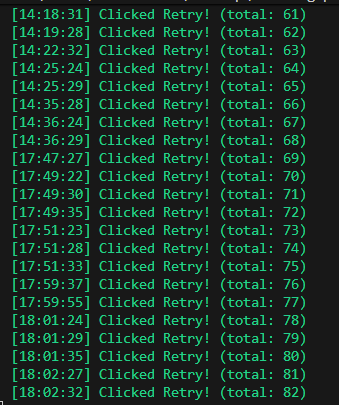
I've built a tiny program that runs locally that scans Google Antigravity for "Agent terminated due to error" messages and automatically clicks the retry button.