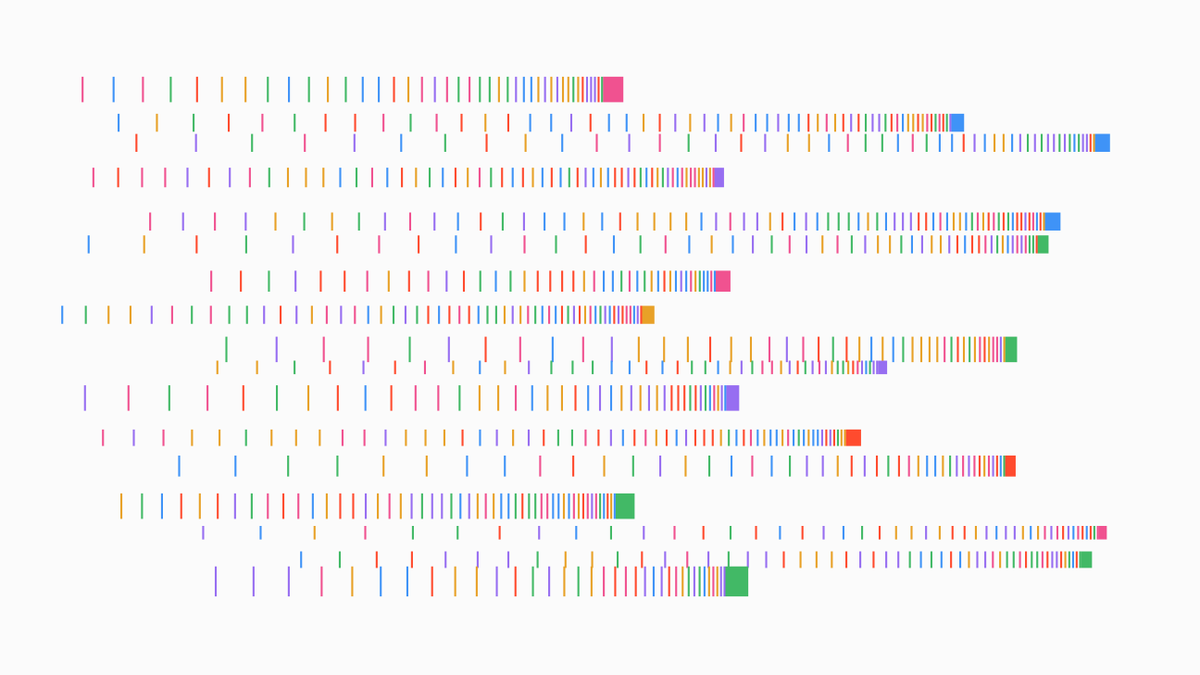
Before launching TrajectoryStore yesterday, we tested it on Luna, our in-house coding agent, which the entire Judgment team uses. We traced every Luna run and stored the results two ways: as standard OTel traces in ClickHouse, and as trajectories in TrajectoryStore.
The storage gains have been massive. Luna’s usage is nearly doubling month over month, and for November alone its traces are projected to reach ~270 GB in ClickHouse. Stored as trajectories, the same runs would take under 4 GB, about 70x smaller and saving huge costs.
Search improves too. We asked the platform agent “which runs had exec fail with ‘Sandbox has stopped execution’, and how often?” across a full week of Luna’s production usage: 1,494 runs and 79K LLM calls, stored both ways. Searching the trajectories returned the answer 3.75x faster with 4.2x fewer tokens than searching the traces, with better accuracy, as there is less data to look over.
Take a demo with an engineer on our website or try for yourself!
Introducing TrajectoryStore.
OTel was designed around spans that each record one small operation, like a single HTTP request or database query. Each span holds different data, so storing every span in full works fine.
Long-horizon agents break that assumption. Every LLM call resends the full conversation so far, and OTel records each call as a separate span with that full input attached. Nothing links one span to the next, so the same context gets stored again on every call. A 200-turn run holds 200 overlapping copies of itself.
TrajectoryStore is a new spec for storing agent traces. Each message, tool result, and model response is stored once, and every LLM call links to what it was sent, so you can still rebuild what the model saw at any call.
What that means for your team:
→ Faster search: keyword search on trajectories scans ~50x less data and returns ~25–40x faster
→ Lower storage costs: 70x fewer bytes stored on our internal coding agent (200+ turns per run), translating to around 10x cost savings for many of our customers
→ One clean trajectory for evals, analysis, and dataset curation
It's the first step in new data infrastructure for storing and searching agent trajectories.
Today we're launching Eval Optimizer
We designed it to make choosing an eval method an incredibly easy experience. It looks at your rubric and trajectories, then chooses from code, a decision model, an LLM judge, or an agent.
Introducing the Eval Optimizer.
Not every eval needs a frontier model. Judgment now learns your agent trajectories and picks the right compute per judge: code, a decision model, an LLM or an agent.
For one customer, it cut the cost per eval by up to 50×. https://t.co/aUTT97Jtu5
Super excited to release this feature!
Software is increasingly used headlessly by agents, so seeing how for your MCP is being used is critical for the next generation of software
Introducing MCP Observability
When you build an MCP, you write tool descriptions and error messages and hope agents use them well. When they don't, your logs show the error, but not what the agent was trying to do or what it did next.
Now you can follow every agent session on your MCP: what it was trying to do, which tools it called, and what it did when one failed.
Introducing Agent-as-a-Judge: evaluating long-horizon agents beyond 1M tokens.
20%+ of our trajectories exceed 1M tokens, the largest 1B+; too long for an LLM judge. Past 1M, agent judge scored 0.21 higher F1 at 62% lower cost than chunked LLM judges. https://t.co/QoC0Iz1GR2
Some news: I’m joining OpenAI to lead product management for Core Products!
I have a lot of respect for OpenAI for showing the world that scaling works, for bringing AI to over a billion people, and for believing great products are core to the mission.
I’m excited to work with @thsottiaux, an incredible PM team, and everyone across OpenAI. Together, we’ll build agents that have your back and your team’s, and keep you in control, so you get more time for the people and work you love.
Lots to learn, and lots to build. Please keep your feedback coming!
Today, @JudgmentLabs opens for general access.
We believe long running agent systems will generate more exhaust data than the world can currently process.
Hidden within agent traces are rich records of how to make these systems better: what users ask for, when agents stumble, and how agents interact with the external world.
Judgment is the most performant monitoring and improvement layer for long-horizon agents.
We’re excited to see what you build!