The Australian pink robin looks like a tiny ball of cotton candy
Native to southeastern Australia, this tiny bird is best known for its brilliant pink plumage and shy nature, often staying hidden in dense forests
Ph.D. is Not for Everyone
- It is a long commitment (5 to 7 years).
- It does not automatically lead to a long-term job.
- It often requires additional postdoctoral training (3 to 5 years).
- Again, it does not automatically lead to a long-term job.
- Not all Ph.D. programs are equal.
gue tau lagi akun techbronya yg mana ☺️ bukan yg kemarin ya. ADA LAGI
masa si techbro ini request "macem macem" ke anak internya dan dalam posisi udah punya anak istri padahal.
blm di up full karena korban masih nyusun kronologi lengkapnya. (tapi bukti udah ada)
mimin menteri pekerja udah bantu korban terhubung sama layanan konseling + lembaga bantuhan hukum yg bisa di hubungi.
buat anak magang diluar sana staysafe ya‼️
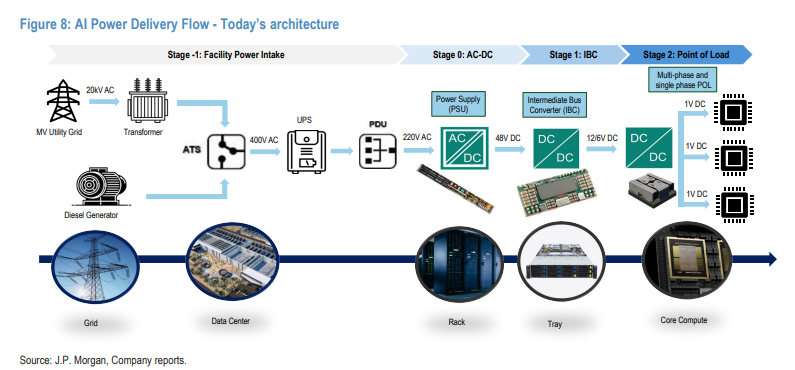
Every AI chip on Earth secretly runs through five hidden power conversion steps before it can even turn on (Save this).
Think of it like a waterfall of electricity, cascading down from a massive, high pressure source at the top to a tiny trickle at the bottom that the AI chip can actually use.
The journey starts at the grid, where huge power lines carry 20,000 volts of AC electricity into the building, backed up by diesel generators in case the grid ever fails.
That power is way too strong for anything inside the building, so a transformer knocks it down to 400 volts, and a battery backup system called a UPS makes sure the power never flickers off even for a second.
From there, electricity gets split up and delivered into each server rack at 220 volts, still way more than a chip can handle.
Inside the rack, a power supply converts that from AC power, the kind from a wall outlet, into DC power, the kind from a battery, dropping it to 48 volts.
Then it drops again to 12 volts, and finally all the way down to just 1 volt, which is the tiny, precise amount of electricity an AI chip like a GPU actually runs on.
Why so many steps? Because jumping straight from 20,000 volts to 1 volt in one shot would be wildly inefficient and dangerous, so each step gradually tames the power while wasting as little energy as possible along the way.
This matters because every single step in that waterfall requires physical hardware, transformers, switches, converters, and cooling, and building AI data centers fast enough now means manufacturing millions of these parts at a scale the industry has never needed before.
Now here is how you can benefit from this process.
Vertiv makes power and cooling equipment used across several of these steps, including the backup power systems that keep electricity flowing without interruption.
Eaton builds the switches and distribution equipment that move power from the building level down into each server rack.
Vicor and Monolithic Power Systems make the small chips that handle the final, trickiest steps, dropping power down to 12 volts and then 1 volt right at the chip itself.
Navitas Semiconductor makes gallium nitride and silicon carbide power chips that are increasingly used in the final DC-DC conversion stages, since these materials handle power more efficiently than older silicon at the tiny voltages GPUs need.
Powell Industries builds electrical switchgear and power control systems used at the facility intake stage, the earliest and highest-voltage step in this entire chain.
Advanced Energy Industries makes precision power conversion equipment used in semiconductor manufacturing and increasingly in data center power delivery, giving it exposure on both ends of the AI buildout.
Bullish on AI power infrastructure, make sure to follow @MelvinInvests for more AI infrastructure insights and check out the link below for more details.
This chart explains why a handful of unknown chip suppliers could be the real winners of the AI boom (Save this).
This table breaks down how much optical networking gear each Nvidia GPU needs, comparing today's systems to the next generation Feynman chips coming down the pipe.
Every GPU in a cluster needs to constantly send data to every other GPU, and that requires physical hardware called optical engines, basically tiny devices that convert electrical signals into light so data can move fast enough between chips.
In today's system, each GPU only needs 2 of these optical engines, but in the most advanced Feynman setup, that jumps to 70 optical engines per GPU, a 35x increase in hardware needed for the exact same basic job.
This is happening because Nvidia is cramming way more GPUs into a single connected cluster, going from 72 GPUs today up to 1,152 GPUs in Feynman systems and all those chips need to talk to each other twice as fast, jumping from 1.6 terabits per second up to 3.2 terabits per second.
To handle that much data without needing a mountain of cables, Nvidia is moving toward something called co-packaged optics, or CPO which glues the optical hardware directly onto the chip package instead of plugging it in separately and that one shift alone pushes the total optical hardware per cluster from 144 units today to over 80,000 units in the most advanced setup.
Now here is some of the stocks that can benefit from this.
Nvidia benefits the most obviously, since it controls this entire roadmap and captures more revenue per system as the hardware gets more complex.
Broadcom is one of the only companies that actually makes the specialized chips needed for co-packaged optics, so every step toward CPO adoption means more silicon Broadcom can sell into each rack.
Coherent and Lumentum make the actual lasers and light components that go inside these optical engines, and demand for their parts scales directly with that jump from 144 to 80,000 units per cluster.
Credo Technology and Marvell supply the chips that clean up and boost these ultra-fast signals, and the table's jump from 100 Gb/s to 200 Gb/s and eventually 400 Gb/s speeds plays right into what they build.
Fabrinet builds and assembles optical modules for major networking companies, meaning it captures manufacturing revenue as optical engine volumes scale into the tens of thousands per cluster.
Ciena makes optical networking systems and increasingly supplies components used in data center interconnects, positioning it to benefit as bandwidth requirements double.
Celestica has become a key manufacturing partner for hyperscalers building custom networking gear, riding the same wave of rack complexity.
Bullish on co-packaged optics, make sure to follow @MelvinInvests for more AI infrastructure insights and check out the link below for more details.
Google Cloud is now at ~$100B revenue run-rate, growing 80%+ and is 40% of Google's search business. Wild that Google Cloud could be nearly as big as Google Search in revenue in the next year or two on its current trajectory.
I just completed Content Discovery room on TryHackMe! Discover hidden web content using manual techniques, OSINT, and Gobuster enumeration. https://t.co/kCvwHbmqJp
My first research paper was rejected by five journals.
One review said: "The research is fine. The paper is not."
That stung, because I thought good research was enough. It is not. A paper is not judged on what you know. It is judged on how you let the reader see it.
TIL unlike blood alcohol concentration, which is the amount of ethanol in a person’s blood as a percentage, cannabis is measured in nanograms of THC per milliliter of body fluid. One nanogram is one billionth of a gram.
https://t.co/sLCZq9l5wc