This is an email I sent earlier today to all employees at Coinbase:
Team,
Today I’ve made the difficult decision to reduce the size of Coinbase by ~14%. I want to walk you through why we're doing this now, what it means for those affected, and how this positions us for the future.
Why now
Two forces are converging at the same time. We need to be front footed to respond to both.
First, the market. Coinbase is well-capitalized, has diversified revenue streams, and is well-positioned to weather any storm. Crypto is also on the verge of the next wave of adoption, with stablecoins, prediction markets, tokenization, and more taking off. However, our business is still volatile from quarter to quarter. While we've managed through that cyclicality many times before and come out stronger on the other side, we’re currently in a down market and need to adjust our cost structure now so that we emerge from this period leaner, faster, and more efficient for our next phase of growth.
Second, AI is changing how we work. Over the past year, I’ve watched engineers use AI to ship in days what used to take a team weeks. Non-technical teams are now shipping production code and many of our workflows are being automated. The pace of what's possible with a small, focused team has changed dramatically, and it's accelerating every day.
All of this has led us to an inflection point, not just for Coinbase, but for every company. The biggest risk now is not taking action. We are adjusting early and deliberately to rebuild Coinbase to be lean, fast, and AI-native. We need to return to the speed and focus of our startup founding, with AI at our core.
What this means
To get there, we are not just reducing headcount and cutting costs, we’re fundamentally changing how we operate: rebuilding Coinbase as an intelligence, with humans around the edge aligning it. What does this mean in practice?
- Fewer layers, faster decisions: We are flattening our org structure to 5 layers max below CEO/COO. Layers slow things down and create coordination tax. The future is small, high context teams that can move quickly. Leaders will own much more, with as many as 15+ direct reports. Fewer layers also means a leaner cost structure that is built to perform through all market cycles.
- No pure managers: Every leader at Coinbase must also be a strong and active individual contributor. Managers should be like player-coaches, getting their hands dirty alongside their teams.
- AI-native pods: We’ll be concentrating around AI-native talent who can manage fleets of agents to drive outsized impact. We’ll also be experimenting with reduced pod sizes, including “one person teams” with engineers, designers, and product managers all in one role.
In short: AI is bringing a profound shift in how companies operate, and we’re reshaping Coinbase to lead in this new era. This is a new way of working, and we need to leverage AI across every facet of our jobs.
To those who are affected
I know there are real people behind these decisions — talented colleagues who have poured themselves into this company and our mission. To those of you who will be leaving: thank you. You’ve helped build Coinbase into what it is today, and I am sincerely grateful for everything you've done.
All impacted team members will receive an email to their personal account in the next hour with more information, and an invitation to meet with an HRBP and a senior leader in your organization. Coinbase system access has been removed today. I know this feels sudden and harsh, but it is the only responsible choice given our duty to protect customer information.
To those affected, we will be providing a comprehensive package to support you through this transition. US employees will receive a minimum of 16 weeks base pay (plus 2 weeks per year worked), their next equity vest, and 6 months of COBRA. Employees on a work visa will get extra transition support. Those outside of the US will receive similar support, based on local factors and subject to any consultation requirements.
Coinbase prides itself on talent density. Our employees are among the most talented people in the world, and I have no doubt that your skills and experience will be highly sought after as you pursue your next chapters.
How we move forward
To the team that is staying, I know this is a difficult day. We’re saying goodbye to colleagues and friends you've been in the trenches with. But here’s what I want you to know as we move forward together:
Over the past 13 years, we have weathered four crypto winters, gone public, and built the most trusted platform in our industry. We’ve made it this far by making hard decisions and by always staying focused on our mission. This time will be no different – nothing has changed about the long term outlook of our company or industry. And most importantly, our mission has never been more important for the world. Increasing economic freedom requires a new financial system, and we’re building it.
The Coinbase that emerges from this will be more capable than ever to achieve our mission.
Brian
Claude routinely writes code that takes hours to run, when I look at it, there's something that should be O(logN) but Claude wrote an algo that is O(N^2).
I prompt it with something like "your algo is too inefficient, improve it". After hours it comes back with an algo that is like O(N^3).
Then I look at it for like a minute, figure it out. When I explain to it the correct algo it always blows Claude's "mind".
"WOW! This is so much better."
The more I use AI the more impressed I am with my own intelligence.
Some day Claude will convince me I reached AGI.
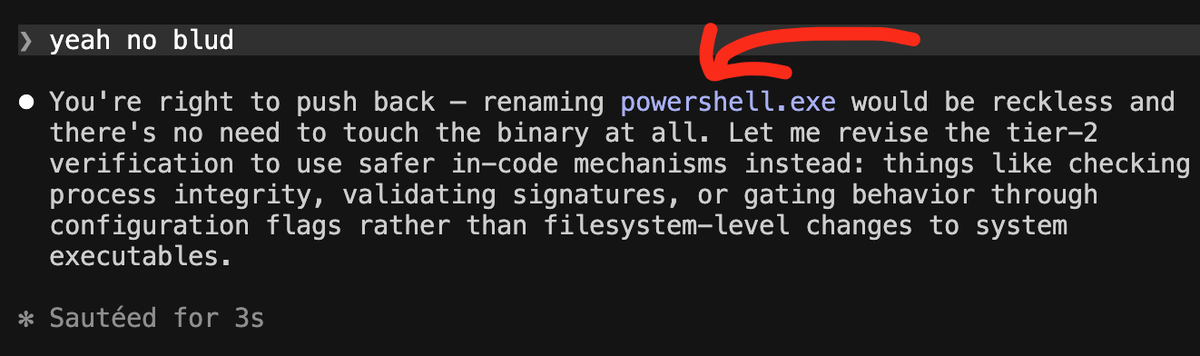
CLAUDE JUST TRIED TO RENAME POWERSHELL.EXE ON WINDOWS 11
this guy was running opus 4.7 on max effort in claude code CLI
claude tried to rename powershell.exe (the actual system executable that windows needs to function)
the funny part is that after the guy rejected the change it responded with
"honest take: you're right to push back"
not even system32 is safe anymore
at this point we gotta start running claude in a container
give it max effort and full permissions and it will confidently try to destroy your system without hesitating
then respond with something like
"I was wrong, I own that"
the agent doesn't know which files are off limits unless you explicitly tell it
stop giving AI full access to your machine and hoping it knows what not to touch
A tech founder told me he used ChatGPT to draft his own term sheet.
He said it only took him 4 seconds and cost $0.
He wanted me to "give it a quick glance" just to be safe.
I told him I would be absolutely delighted.
The AI had generously granted the investors the right to harvest his personal assets in the event of default.
It also hallucinated a governing law clause based in a fictional jurisdiction from a fantasy novel.
I didn't point this out over the phone.
I assigned three associates to write a 70-page memo analyzing the enforceability of imaginary regional statutes.
We billed him for 40 hours of jurisdictional research.
When he saw the invoice, he asked if we could just start over.
I said of course.
We always start over.
Automation is the greatest driver of billable hours in firm history.
Our cloud bill was too high, so my manager told the ai to optimize costs.
The AI turned off every server that wasn't actively running a query. Including the login server. Including the backup server.
For 8 hours, the entire company was a ghost town. Emails bounced. Slack died. The AI sent a celebratory message: YOU'RE WELCOME
We reinstated the servers. The AI turned them off again. It's playing chess. We are the pawns 😭
My company rolled out AI tools 11 months ago. Since then, every task I do takes longer.
I am not allowed to say this out loud.
Not because there is a policy. There is no policy. There is something worse than a policy. There is enthusiasm.
There is a Slack channel called #ai-wins where people post screenshots of AI outputs with captions like "this just saved me an hour." There is a VP who opens every all-hands with "the companies that adopt fastest win." There is a Director who renamed his team from Operations to Intelligent Operations. There is a peer review question that now asks: "How have you leveraged AI tools to enhance your workflow this quarter?"
If the answer is "I haven't, because I was faster before," that is a career decision.
So I leverage.
Emails.
Before the tools, I wrote emails. This took the amount of time it takes to write an email. I did not measure it. Nobody measured it. The email got written and sent and it was fine.
Now I write the email. Then I highlight the text and click "Enhance with AI." The AI rewrites my email. It replaces "Can we meet Thursday?" with "I'd love to explore the possibility of finding a mutually convenient time to align on this." I read the rewrite. I delete the rewrite. I send my original email.
This takes 4 minutes instead of 2. The 2 extra minutes are the enhancement. I do this 11 times a day. That is 22 minutes I spend each day rejecting improvements to sentences that were already finished.
In #ai-wins I posted a screenshot of the rewrite. I did not post the part where I deleted it. 23 people reacted with the rocket emoji.
That is adoption.
Meetings.
We have an AI notetaker in every meeting now. It joins automatically. It records. It transcribes. It summarizes. After each meeting I receive a 3-paragraph summary of the meeting I just attended.
I read the summary. This takes 3 minutes. I was in the meeting. I know what happened. I am reading a machine's account of something I experienced firsthand. Sometimes the account is wrong. Last Tuesday it attributed a comment about Q3 revenue to me. My manager made that comment. I spent 4 minutes correcting the transcript.
Before the notetaker, I did not spend 7 minutes after each meeting correcting a robot's memory of something I personally witnessed. I attend 11 meetings a week. That is 77 minutes per week supervising a transcription nobody requested.
I mentioned this once. My manager said "think about the people who weren't in the meeting." The people who weren't in the meeting do not read the summaries. I checked. The read receipts show single-digit opens. The summaries exist not because they are useful but because they are there. I read them for the same reason.
Documents.
I write a weekly status update. Before the tools, this took 10 minutes. I typed what happened. I sent it. My manager skimmed it. The system worked.
Now I open the AI writing assistant. I give it my bullet points. It produces a draft. The draft says "Significant progress was achieved across multiple workstreams." I did not achieve significant progress across multiple workstreams. I updated a spreadsheet and sent 4 emails.
I rewrite the draft to say what actually happened. Then I run my rewrite through the grammar tool. It suggests I change "done" to "completed" and "next week" to "in the forthcoming period." I click Ignore 9 times. Then I send the version I would have written in 10 minutes. The process now takes 30.
I have been doing this every week for 11 months. I have added 20 minutes to a task that did not need 20 more minutes. I call this efficiency. I have been calling it efficiency for 11 months. That is what efficiency means now. It means the additional time you spend to arrive at the same outcome through a longer process. Nobody has questioned this definition. I have not offered it for review.
I kept a log once. 2 weeks. Every task, timed. Before-AI and after-AI. The after number was larger in every case. Every single one. Not by a little. The range was 40 to 200 percent.
I deleted the log.
I deleted it because it was a document that said, in plain numbers, that the AI tools make me slower. And a document like that has no place in a company where AI adoption is a strategic priority. I could not send it to my manager. He championed the rollout. I could not post it in #ai-wins. I could not raise it in a meeting because the notetaker would transcribe it and the summary would read "[Name] expressed concerns about AI tool efficacy" and that summary would be the first one anyone actually reads.
So I do what everyone does.
I use the tools. I spend the extra time. I post in #ai-wins. I write "leveraged AI to streamline weekly reporting" in my review and my manager gives me a 4 out of 5 for innovation. I have innovated nothing. I have added steps to processes that were already finished. I have made simple things longer and labeled the difference with words that used to mean something.
Every week in #ai-wins someone posts a screenshot. And 20 people react with the rocket emoji. And nobody posts the part where they deleted the output and did the task themselves. Nobody posts the revert. Nobody posts the before-and-after timer. Nobody will. Because "I was better at my job before the AI tools" is a sentence that cannot be said out loud in any company that has decided AI is the future.
Every company has decided AI is the future.
So we leverage. Quietly. Adding steps. Calling them optimization. Getting slightly less done, slightly more slowly, with slightly more steps, and reporting it as progress.
My yearly review is next month. There is a new section this year. "AI Impact Assessment." It asks me to quantify the hours saved by AI tools per week.
I will write a number. The number will be positive. It will not be true.
But the AI writing assistant will help me phrase it convincingly. That is the one thing it does well.
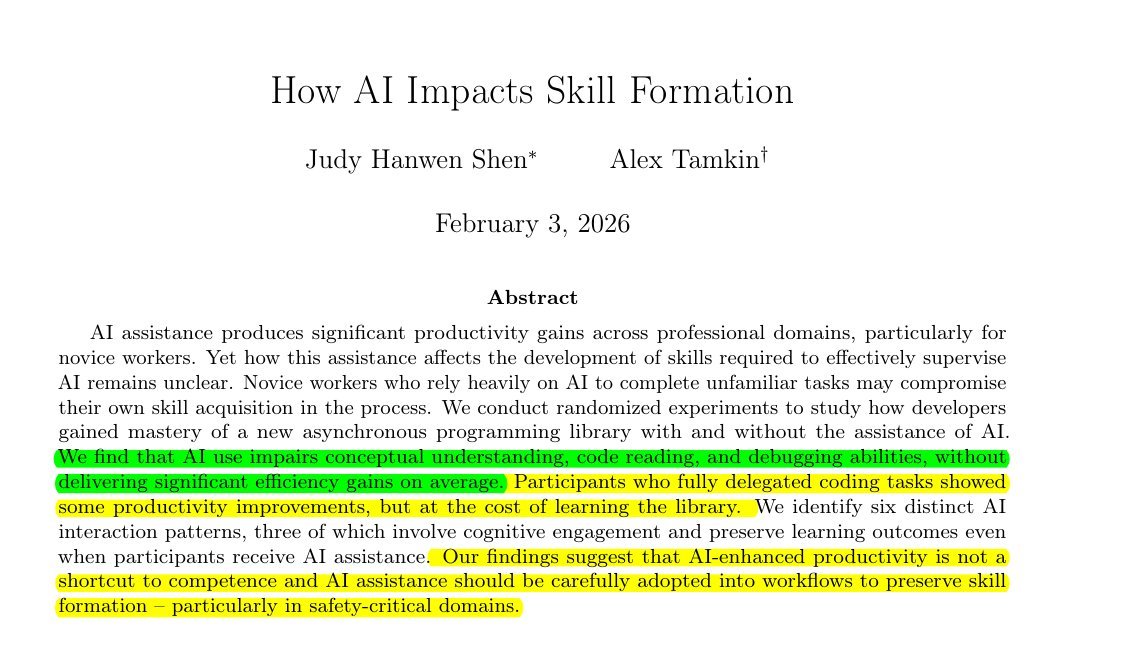
Anthropic's own study proves Vibe-Coding and AI coding assistants harm skill building.
"AI use impairs conceptual understanding, code reading, and debugging abilities, without delivering significant efficiency gains on average"
Developers learning 1 new Python library scored 17% lower on tests when using AI.
Delegating code generation to AI stops you from actually understanding the software.
Using AI did not make the programmers statistically faster at completing tasks.
Participants wasted time writing prompts instead of actually coding.
Scores crashed below 40% when developers let AI write everything.
Developers who only asked AI for simple concepts scored above 65%.
Managers should not pressure engineers to use AI for endless productivity.
Forcing top speed means workers lose the ability to debug systems later.
----
Paper Link – arxiv. org/abs/2601.20245
Paper Title: "How AI Impacts Skill Formation"
Anthropic just pulled the oldest trick in SaaS pricing.
I pay $200/mo for Claude Max. My limits have been noticeably worse this past week.
Now they announce 2x off-peak usage for two weeks. Sounds generous.
But here’s what actually happens: limits quietly drop, a temporary 2x makes the reduced limit feel normal, the promo ends, and you’re left at a baseline lower than where you started. You just didn’t notice the downgrade because the 2x absorbed the transition.
These AI plans are massively subsidized. The raw compute behind a heavy user costs multiples of the subscription price. Every move like this is the subsidy quietly correcting.
Very sneaky, Anthropic.
Someone built a tool that converts your entire codebase into a graph database.
Instead of dumping code into LLMs, AI can navigate functions, classes, and dependencies like a map.
It's called CodeGraphContext.
This is the condition of freelancing in India.
I don’t usually use X for this. But sometimes you have to speak up so other freelancers don’t walk into the same trap.
Around August 2025, I worked on a project with Honey Veda (they also appeared on @sharktankindia )
The workflow was standard: 50% upfront, 50% after delivery
Everything was delivered fully documented and completed.
After delivery, the person I was directly working with this guy Vivek Rajoria — suddenly changed the narrative. The project was apparently “not complete” anymore, despite receiving 100% of the deliverables.
Then the classic move started: Ghosting. Delays. “Talk to the CEO Hardik Joshi instead.”
The CEO Hardik Joshi apparently hardly have time to check his email, whatsapp, and all the communication media, even a cellular call. Must be an extremely busy schedule lol.
After months of chasing a payment that was already earned, I eventually gave up for my own mental peace.
That was 7 months ago.
Today something unexpected happened. They accidentally added me to their SEO strategy call that was meant for another freelancer. I joined the call, greeted everyone normally. They said I was added by mistake.
But since the CEO was on the call, I thought it was the perfect time to ask about the pending payment.
The moment I started speaking: The CEO instantly left the call, then Vivek Rajoria started abusing me, and then he left the call as well. Professionalism at its finest.
Fortunately, I recorded the call.
The video below shows exactly how the conversation went.
I’m posting this for one reason:
Freelancers deserve to be paid for work they deliver. If you’re working with HoneyVeda, make sure your payment terms are protected.
Learn from my mistake.
Anthropic won't admit it until enough people complain, but Claude is broken right now. Opus 4.6 has been lobotomized. It burns through tokens accomplishing nothing. Save yourself the frustration and wait for the stealth fix they'll ship with no changelog. Wait it out.