This Grothendieck quote is the best-kept secret about mathematics:
Always start with your naive intuition, even if it’s plainly dumb, and then refine it by asking a barrage of “stupid” questions. Waiting in silence until you “get it right” will only lead to paralysis.
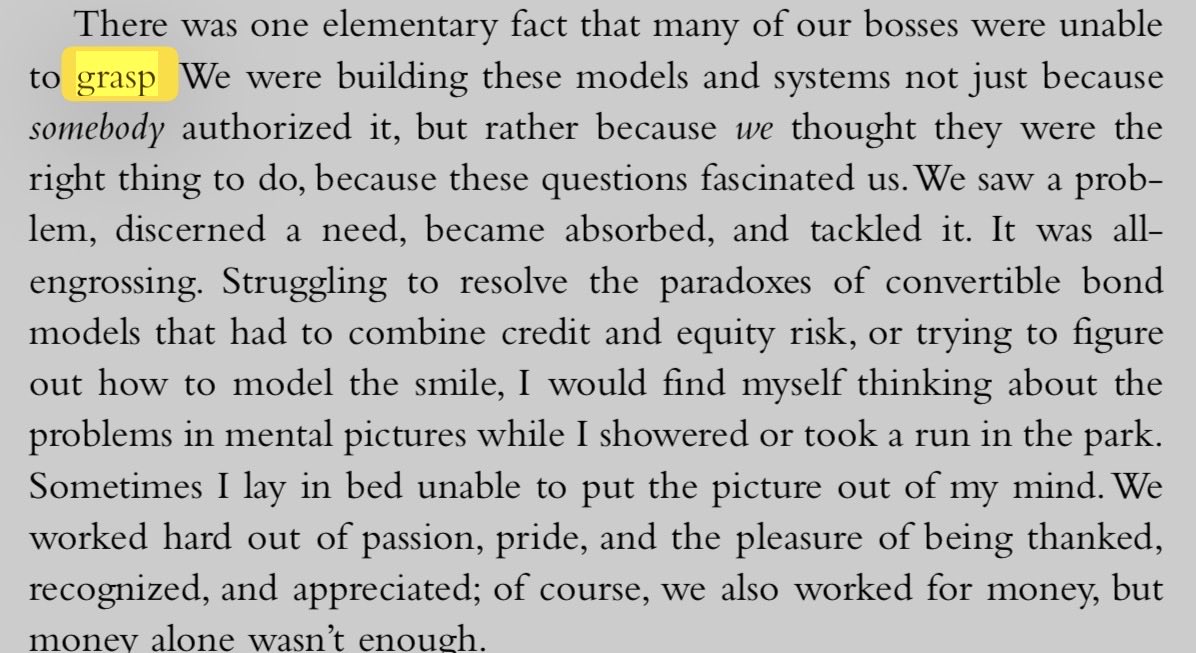
@KylePomykala@miniapeur Differential equations are commonly used in modern financial economics models. For instance, they are used for understanding asset pricing, market microstructure, and so on.
I was a bricklayer.
It was how I paid the bills when I first moved to America. Even the biggest title in bodybuilding, Mr. Olympia, only paid a thousand dollars back then.
It makes me proud that in March, the winner of our Arnold Classic and our Arnold Classic UK took home more than a million dollars. He can focus on bodybuilding.
But in our day, that wasn’t an option. Some guys were teachers. Some sold insurance. Franco and I laid bricks.
We put an ad in the paper and sold ourselves as European craftsmen. We figured if people heard the accents, they would picture old-world masonry instead of two bodybuilders with a wheelbarrow.
It worked.
The phone rang. And then we had to go out and actually do the job, which was the part nobody could fake. Luckily, Franco knew what he was doing.
The work was simple. Mix the mortar. Set the brick. Tap it level. Scrape the edge. Then do it again. And again. Nobody claps for you. There is no crowd, no music, no trophy. There is just the next brick sitting there waiting for you.
You can still find some of the walls we built in Venice.
That’s where my lesson today comes from.
One brick doesn’t look like anything. Ten bricks don’t look like anything. A hundred bricks, you’re starting to see something, but it doesn’t impress anyone.
You just keep laying bricks until the job is done.
And you know what happens after four or five hours on a wall?
You are so damn tired, or you feel so great that you stop measuring.
You are not standing back every ten minutes asking how far from finished it is. You are covered in mortar, your hands are raw, you’re schvitzing, and you are happy. The work took the question away from you.
That is the part nobody tells you about hard work: It doesn’t just build the wall. It terminates the voice that keeps asking when the wall will be done.
"A Mathematical Introduction to Diffusion Models" by Jianfeng Lu is a recent paper that presents diffusion models from a mathematical perspective.
In very simplified terms, diffusion models are generative models based on a forward process that gradually adds noise to data until the distribution becomes simple (typically Gaussian), and a reverse process that uses a learned score to generate new samples from the target distribution.
The paper covers the convergence of Langevin diffusion and ULA, score-based diffusion models, stochastic localization and Polchinski flow, the discretization of continuous diffusion models, error analysis, discrete diffusion models, and topics such as guidance, reward tilting, and inference-time reinforcement learning.
It requires a mathematical background, particularly in probability, linear algebra, and multivariable calculus, but it is a very useful resource for understanding the mathematics behind diffusion models, including the probability, stochastic processes, and numerical analysis on which they are based.
https://t.co/IUniadXMrD
@Nabil_Alouani_@nntaleb even though I had no interest about the thing in the phoyo, your impressive description that showed its use made me interested 😃
@RefineDotInk PS/
For those who don't know about Refine, it's an AI review system that has top performance in substantive error detection for research work in STEM and social scinece.
More details:
https://t.co/2UGovgrdXD
@davidbessis@krichard121212 David can you please talk about your ordinary day while you're actively writing, how do you deal with distractions and how do you plan your day? what are the tricks (if there is any) that you use to make this writing/thinking/creating process smoother and more efficient?
I went looking for the original source of the Einstein quote "Imagination is more important than knowledge". I thought it'd take 30 secs, just out of curiosity. But then I discovered this incredible interview in "The Saturday Evening Post". Here's a tiny excerpt. The whole interview is just wild:
This is an excellent guide on how to read math, and it mirrors how I used to do it as a student. Take homes:
1) Spend hours per page (pages/hour is wrong metric)
2) Multiple readings - simmer between readings.
3) Generate and ask counterfactual why questions.
4) Discuss with others.
5) Write out all intermediate steps between the lines.
6) Solve practice problems.
I wonder what is going on in brains versus machines when brains spend hours per page while machines post train on math via SFT/RL?
Somehow the hours per page allow brains to reach the frontiers of mathematical capability with orders of magnitude less sample complexity than machines.