Zelenskyy: "When our strikes reached Yandex data centers, it suddenly became little easier to breathe on many social media platforms. Many people noticed it.
There was less hate, less division, fewer provocations because there were fewer bots. It's pretty clear where those bots were coming from.
If they disappeared when Yandex went offline, this proves once again that Europe is not the source of the problems."
The big problem is that Russia figured out how modern society consumes information a decade ago, but the West hasn't.
There are millions of bots commenting and posting Russian propaganda. There are paid influencers spreading it, with Russian bots supporting their content.
There is a gigantic machine operating to radicalize and influence Western societies, and there is not enough defense in place.
It doesn't just influence elections, it sows discord, engulfs societies in culture wars, radicalizes teenagers, and shapes political decisions when elected officials fail to read the room.
That needs to change. And fast.
In a recent conversation with Adam Taggart @adamtaggart I made the comment that more printing is inevitable. Some have reached out and said explain it or prove it. The point is that base money must expand to support the growth in debt. Otherwise the debt collapses. IT IS JUST MATH! This chart from our in process EMA Q3 Report shows what I am talking about.
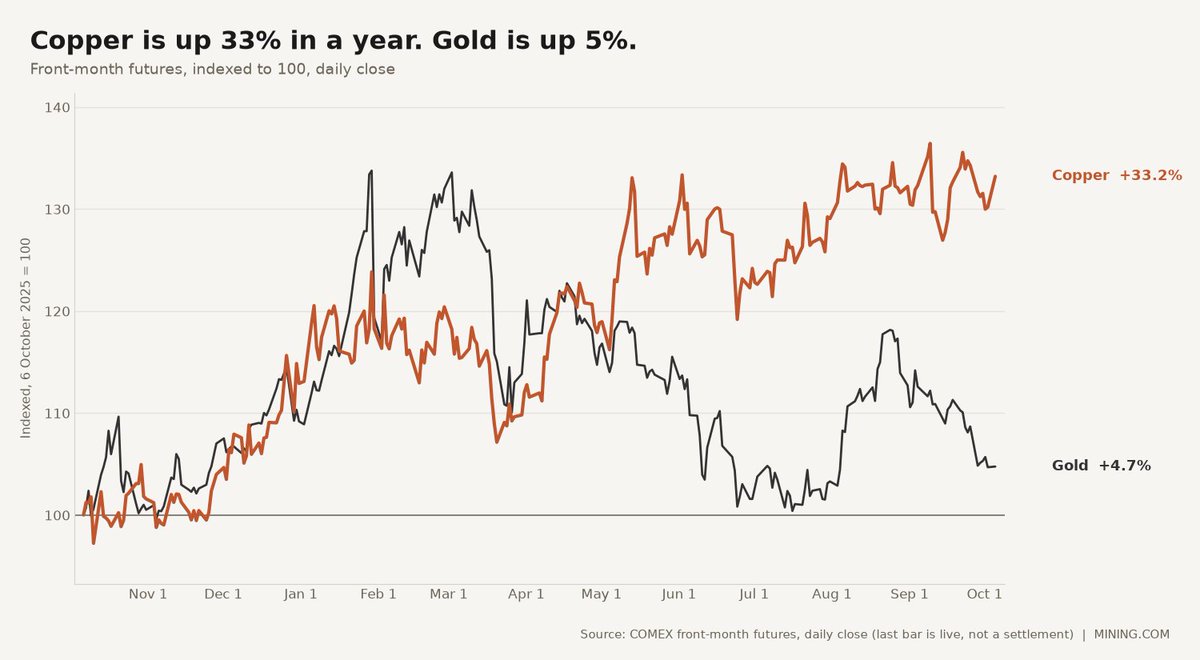
Deutsche Bank's head of metals research says the US and China have probably locked up about 70% of the world's aboveground copper.
His target: $22,050 a tonne by Q2 2027, almost 50% above today.
Ghali calls it the most acutely scarce copper market since the 1980s.
In 2012, Delta purchased a recently shuttered refinery in Pennsylvania for $150 mil, plus another $100 mil in planned capex to restart it. The investment got off to a rough start but lately has been a windfall.
There is a lot of debate about whether/how airlines should hedge their jet fuel exposure. Airlines can add fuel surcharges when prices spikes and pass the added costs to customers. Higher fuel costs are correlated with a stronger economy and higher demand for air travel, providing a natural hedge. And if other airlines choose not to hedge but collectively help set ticket prices, your hedges may not be reducing risk.
In addition, corporate finance experts are highly skeptical of upstream vertical integration, particularly of commodity inputs. It adds unnecessary complexity and is often a poor allocation of capital. Companies typically vertically integrate at the moment of maximum frustration with the supply chain, when asset prices are at their peak, and then divest when markets are loose and asset values are low.
Originally, the purchase was a mess. Superstorm Sandy disrupted the restart. Refinery margins fell. Prices for renewable credits soared.
In these situations, a successor CEO will often unwind the integration. Indeed, the 5 years after the then-CEO left in 2016 were terrible for refineries.
Luckily for Delta, they didn't dump it at the bottom. The successor and still CEO had been involved in the decision to buy it and has stuck with the strategy. And since 2022, it's printed money.
Refinery margins spiked in 2022-23, generating >$1.1 billion in operating income. In 2Q of 2026 alone, it made $351 million. And 3Q results, when released, will be even better.
This case study alone doesn't validate upstream integration. There are still many reasons to be highly skeptical. It is a lesson that if you choose to do so, you have to have long-term commitment to the strategy. Too often, these decisions are made based on the most recent years of performance.
Bank Lending Is Sending A Much Bigger Warning Than It Looks
A friend recently brought this up, so I decided to dig deeper into the bank lending data. What I found is more concerning than simply asking whether standards are tighter or looser.
The real signal is why banks are competing so aggressively for certain borrowers while becoming increasingly defensive toward everyone else.
Banks still need loan growth and earning assets, but the pool of borrowers they actually want appears to be getting narrower.
That creates a classic late cycle barbell.
Banks fight for strong credits while becoming much tougher on marginal borrowers.
Competition Does Not Mean Confidence
The Fed’s July lending survey showed that among banks easing commercial and industrial terms, the dominant reason was competition from other banks, nonbank lenders and capital markets.
Far fewer banks cited a better economic outlook.
Banks were narrowing spreads and easing some credit line terms while overall approval standards remained broadly unchanged.
That distinction matters.
Better pricing for a prime borrower does not mean credit is getting easier for the economy.
Dallas Fed data showed a similar setup in August. Banks still had ambitious lending goals, improving deposits and relatively healthy current loan performance. One banker explicitly said the institution had high loan goals and needed deposits to fund them without relying on additional borrowing.
That gives banks every incentive to fight for high quality borrowers.
Then September Changed
By September, the tone shifted sharply.
• Loan demand fell from 46.7 to 8.2
• Credit standards moved from minus 1.7 to minus 10.4
• Loan pricing jumped from minus 3.2 to 25.0
• The 6 month business outlook collapsed from 24.2 to minus 14.8
Bankers cited rising Treasury yields, higher borrowing costs, gasoline and diesel prices, the Iran conflict, weaker loan opportunities, deposit funding and future economic weakness.
One banker said “loan opportunities had fallen off a cliff.”
That is not the language of growing confidence.
The Credit Market Is Splitting In Two
In a healthy expansion, banks compete because there are plenty of attractive projects and borrowers.
Late cycle, they can compete because everyone is chasing the same shrinking pool of borrowers still capable of qualifying at today’s rates.
Prime borrowers get
• Lower spreads
• Better terms
• More competition for their business
Marginal borrowers get
• Tighter covenants
• More collateral requirements
• Shorter maturities
• Higher pricing
• Rejected refinancing
That is how credit can look loose at the top while becoming much tighter underneath.
The Warning Comes Before Defaults
Banks do not need to wait for borrowers to miss payments before tightening.
A business can still be current on an older low rate loan while failing to qualify for replacement financing at today’s rates, collateral values and operating margins.
Yesterday’s loan can still perform while tomorrow’s refinancing no longer works.
September’s supplemental survey reinforces the shift. Roughly 25% of banks expected business lending standards to tighten further, while nearly 30% expected tighter commercial real estate standards.
Most still expected no change, so this is not yet a banking system shutdown.
But the direction matters.
What This Is Foreshadowing
Banks are not suddenly confident.
They are competing for scarce good borrowers while increasingly worried that higher rates, energy costs and weaker demand will turn today’s marginal borrower into tomorrow’s credit problem.
Credit can remain competitive for the strongest borrowers at exactly the same time it becomes unavailable to weaker ones.
And once refinancing failures, weaker cash flow and rising delinquencies begin validating those fears, tightening can become self reinforcing very quickly.
FIGHT INFLATION FIRST – THEN SPRINT ON PRODUCTIVITY
Although we talk lots about our cost-of-living problems, they’re just a symptom: it’s inflation that’s the cause:
- Our wages aren’t buying as much because prices outsprinted them.
- Our tax burden is nudging record rates because inflation acts as a tax.
- And our mortgage rates are up because the Reserve Bank needs them there to fight inflation.
So if we want to start to get on top of our cost-of-living problems, then TINA – There Is No Alternative but to fight inflation first.
And whether that happens via the RBA playing a lone hand or if some other spending is also cut to help them along the way doesn’t matter as much as ensuring that the job actually gets done ASAP.
But wait, there’s more ... Fixing inflation is vital, but it isn’t enough. There’s a deeper problem. Australia keeps getting spurts of inflation because the productivity engine of our economy is completely clapped out. We start to generate more inflation every time this nation gets more than five minutes of economic sunshine.
The solution is a faster economic speed limit. Once this nation does get inflation down, we need to turn absolutely all our energies towards getting productivity up.
A decade of being stuck in the slow lane is eviscerating our politics. We’re getting better and better at hating each other, but worse and worse at solving our problems.
The most read book in policy circles in recent years is Abundance. It argues that nations need to cut through the thicket of well-meaning regulations that have crippled the ability to advance in everything from housing to health care.
But Australia has spent decades becoming the anti-Abundance nation.
We’ve stalled our living standards.
And unless and until we create a growing pie-per-person, our politics will keep scrapping viciously over stagnant slices of the pie.
It’s long past time to get serious on productivity.
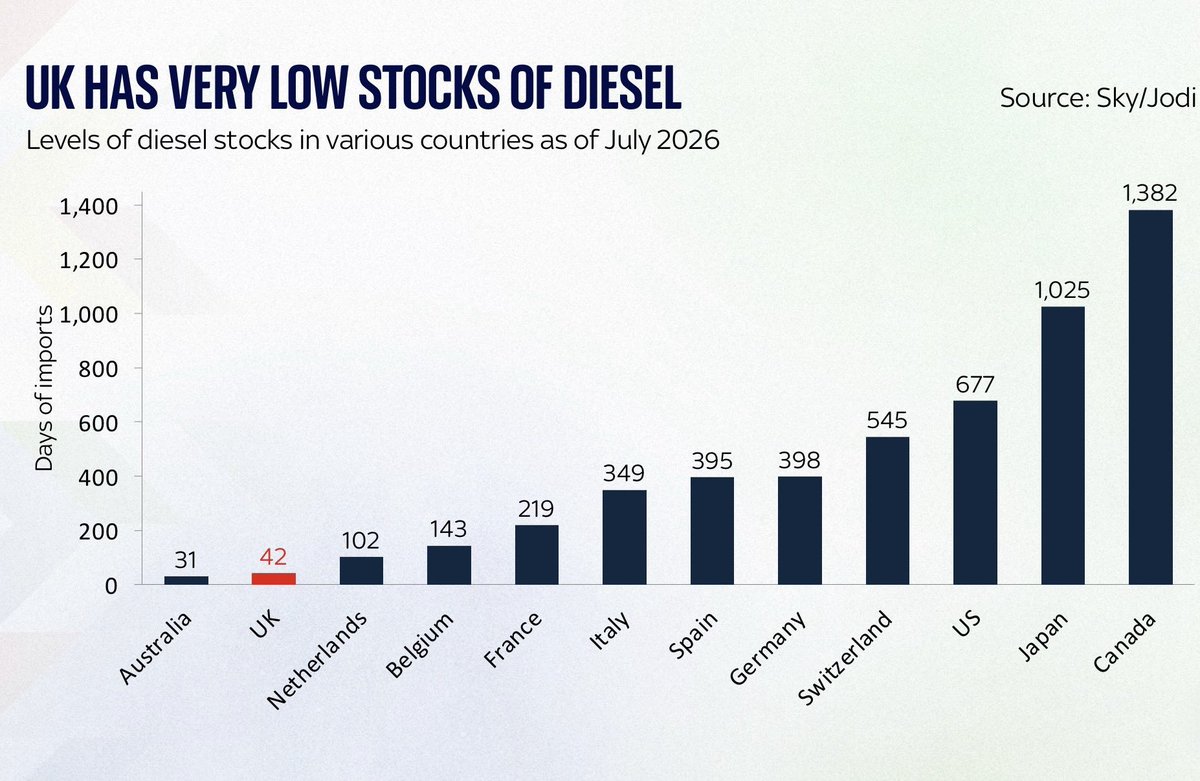
BREAKING: Australia could face diesel rationing within weeks and prices above A$4 a litre, nearly 40% above today, if the US goes ahead with its export ban, the most worrying development in global fuel markets since the war began, per MST Marquee's head of energy research.
Australia is the world's largest importer of diesel in absolute terms, accounting for 1% of global fuel demand but 10% of the world's seaborne diesel imports, and it runs an economy weighted to agriculture and mining. A ban could force the government to stage 3 and 4 of its National Fuel Security Plan, which covers demand reduction and directed allocation of supply.
The US exports about 1.3 million barrels of diesel a day, a quarter of its refining output, and has been covering the gap left as Russia and China stopped exporting refined fuels.
The UK is now preparing rationing plans of its own, with 42 days of diesel left as of July.
Macklemore performed an anti-Israel rally as Ed Sheeran's opener and got fired ➡️ launched his own solo tour
Adam Brody announced he thinks the war Hamas started is a genocide ➡️ his show premiers on Netflix next month
Florence Pugh just said she lost followers for speaking up about Palestinians ➡️ her new show debuts this week
Ms. Rachel spread blood libel saying Israel targets children ➡️ her album debuted the same week
Susan Sarandon said she's been blacklisted ➡️ she took center stage at her film debut in Venice
It's not advocacy for suffering people if all the attention is being used to promote your latest concert, film, or TV show.
Palestinians are not your publicity tool.
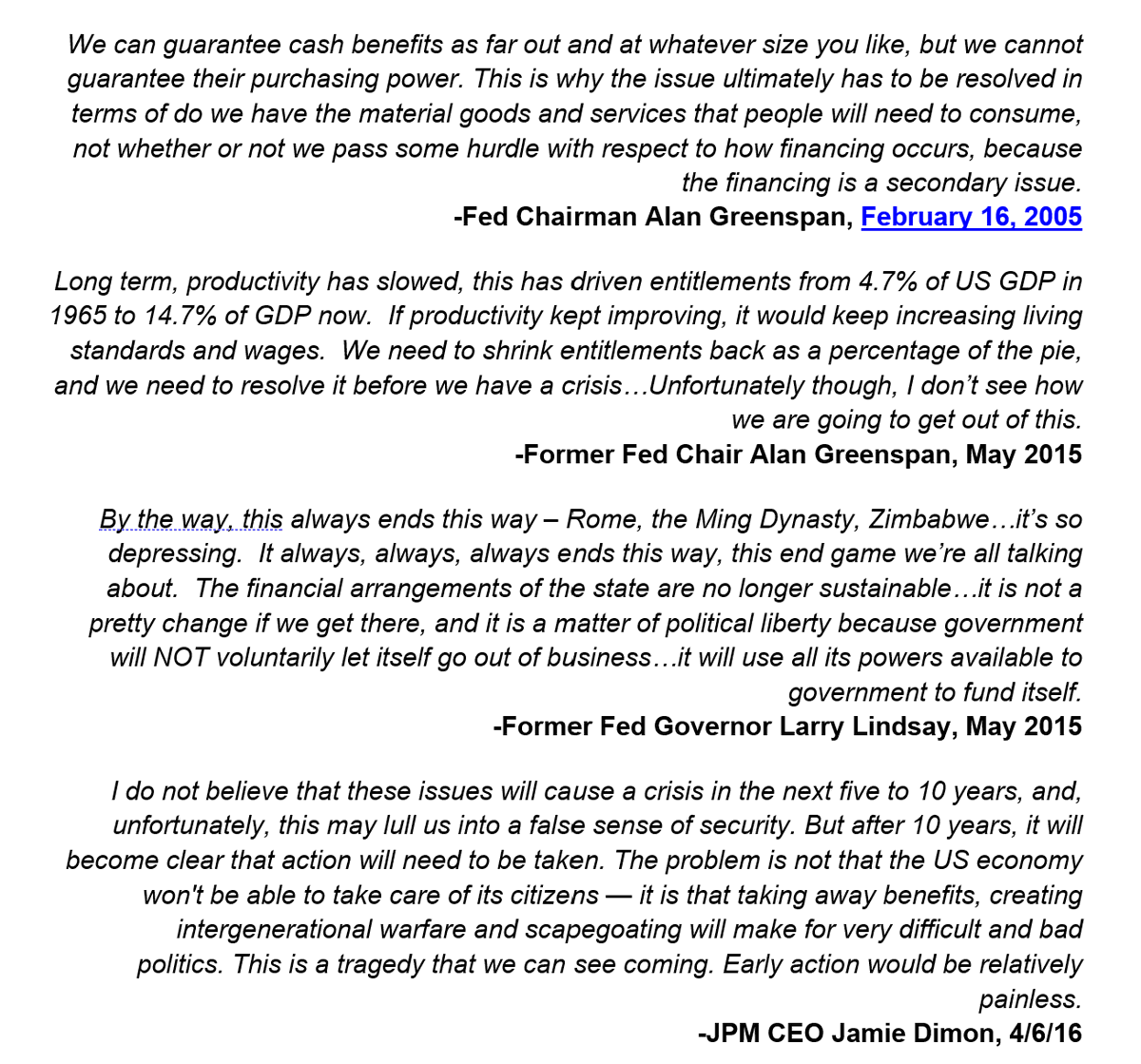
If only we could ask Alan Greenspan about how to deal with this debt problem.
Oh wait, Greenspan warned about this 20 years ago & 10 years ago, concluding, "Unfortunately, I don't see how we're going to get out of this before we have a crisis."
PS: Jamie Dimon agreed with him👇
Something I heard recently from a US electrical infrastructure manufacturing exec:
"I'd rather have copper in my warehouse than cash in the bank, because based on what I'm seeing in supply chains, I'm concerned that cash may not be able to secure me actual copper at some point."
The fact that people still care about 25 basis points is evidence that they don’t yet appreciate the depth of the fiscal dominance we are in.
Anyway, have a nice weekend.
Are demographics a major driver of housing demand? Absolutely.
But the number of adults per household is higher today than in 2005.
So more Australians are forced to cohabitate whether they want to or not.
What changed from 2005? The level of migration relative home builds.