World"s first and only ICU where Doctor is singing kirtan & nurses repeating it.
( DR Shyamlal Prabhu singing kirtan in Bhaktivedanta Hospital ICU )
Double Cure~ Body + Soul 🙏🏻
Shannon Entropy: Measuring Uncertainty in Information
H(X) = - ∑ P(xᵢ) log P(xᵢ)
This is the legendary formula by Claude Elwood Shannon (1916–2001); the father of Information Theory.
Entropy quantifies how much uncertainty (or average information) is contained in the outcome of a random variable X. The more unpredictable the outcomes, the higher the entropy.
From data compression and cryptography to AI and communications; this concept powers the digital world.
The Riemann Hypothesis is the biggest unsolved math problem in history… and it secretly runs half of computer science.
Your encryption, AI randomness, prime-based algorithms - they all quietly depend on it.
Let me explain it so even non-math CS folks get the “whoa” moment. 🧵
The tweet about aliens 2,000 light years away seeing the Roman Empire is wrong, and the actual physics is stranger. To see one person on Earth from that distance, you'd need a telescope wider than the distance from the Sun to Pluto. That's 50 times farther than Earth is from the Sun. No civilization can build that, ours or theirs.
It sounds like exaggeration, but the math requires it. By the time light from a person on Earth reaches a planet 2,000 light years away, it has spread across so much empty space that catching enough to form an image would need that solar-system-sized lens. The geometry doesn't bend, no matter how clever the engineering.
A SETI Institute team led by Sofia Sheikh worked all of this out in February 2025. Our loudest signal is planetary radar, the focused radio beams scientists fire at asteroids and planets to map them. Beams from the now-collapsed Arecibo dish in Puerto Rico could reach 12,000 light years away, about a tenth of the way across the galaxy. After that comes radar leaking from airports and military bases. A giant ground antenna like the Green Bank dish in West Virginia could detect those signals from around 200 light years out, roughly the distance to a few thousand of our nearest stars. A next-gen NASA telescope still in development could spot air pollution like nitrogen dioxide from factories and cars at 5.7 light years away. That puts Proxima Centauri, our nearest star at 4.2 light years, just inside the range. City lights at night go dark past the icy outer shell of our solar system, around 2,300 times the Earth-Sun distance.
The famous "I Love Lucy" idea is also wrong. The story goes that aliens are watching our 1950s sitcoms because the broadcasts are still spreading through space. Astronomer Seth Shostak crunched the numbers years ago. A radio antenna the size of a city, sitting 55 light years away, couldn't pick that signal up. Not even close. At that range, the broadcast is a million times weaker than what the antenna can pick out of the background noise. Old TV signals fade out within the first light year of travel.
So at 2,000 light years away, an alien civilization with our level of technology would see Earth as a tiny dot of light next to the Sun, with hints of oxygen, methane, and maybe some industrial pollution in its atmosphere. They'd see weather. They might guess that something living is here from the chemistry. Continents, cities, individual humans, the Roman Empire, single events: none of those would be visible. The information was lost within a few light years of leaving Earth, well before reaching the closest star.
We're loud to anyone within 200 light years. Past that, we go silent. That signal bubble has only existed for 75 years, so the actual sphere of civilizations that could know we exist is small. And it's getting smaller. Television broadcasts are dying. Satellites use tight focused beams aimed at receivers on the ground, not the sky. Earth's window of being a noisy planet may already be closing.
Ask anyone about India’s space journey, & you will hear legends like Vikram Sarabhai, Homi J. Bhabha, Satish Dhawan, & A. P. J. Abdul Kalam. But ask about Brahm Prakash… & the story usually begins with a Google search.
If Dhawan was the statesman, & Kalam the builder, Brahm Prakash was the alchemist. Not the man who launched rockets, the man who made them possible. He did not design trajectories, he designed the very metals that could survive them.
When Brahm Prakash (MIT educated) became the 1st Director of the Vikram Sarabhai Space Centre (VSSC) in Thumba in 1972, he inherited a collection of small, scattered units. Much of the early materials research happened in an old church building. While the West used expensive, pre-made industrial alloys, Brahm Prakash realized India could not import them due to sanctions. He set up the Propellant Fuel Complex (PFC) & the Materials & QC Group. He treated metallurgy as a Sadhana (disciplined practice), ensuring that every batch of indigenous steel was perfect.
Early SLV-3 used imported 15CDV6 steel. For larger vehicles like PSLV, stronger, lighter maraging steel (especially 18Ni M250 grade) was needed. Western export restrictions applied due to dual-use (missile/nuclear) nature. Brahm Prakash championed indigenous development at MIDHANI (Mishra Dhatu Nigam Ltd.), where he later served as Chairman (1980-84). India became 1 of the few countries with indigenous high-grade maraging steel production for rocket motor casings, a major strategic autonomy achievement still used in PSLV/GSLV.
Before space, he was a key figure under Homi Bhabha in the Department of Atomic Energy (DAE). His pioneering work on zirconium-hafnium separation (using pyro-chemical/vapour phase dechlorination methods) was original & globally acclaimed in the 1950s. Zirconium (neutron-transparent) is essential for nuclear reactor cladding/fuel; hafnium (strong neutron absorber) must be removed. He played a major role in setting up the Nuclear Fuel Complex (NFC) in Hyderabad (as Project Director) & contributed to fuel fabrication for CIRUS and later reactors.
Brahm Prakash is the reason India has Strategic Autonomy. Because he mastered the materials, India did not have to beg the world for the special metals required to build the GSLV/the Agni missiles.
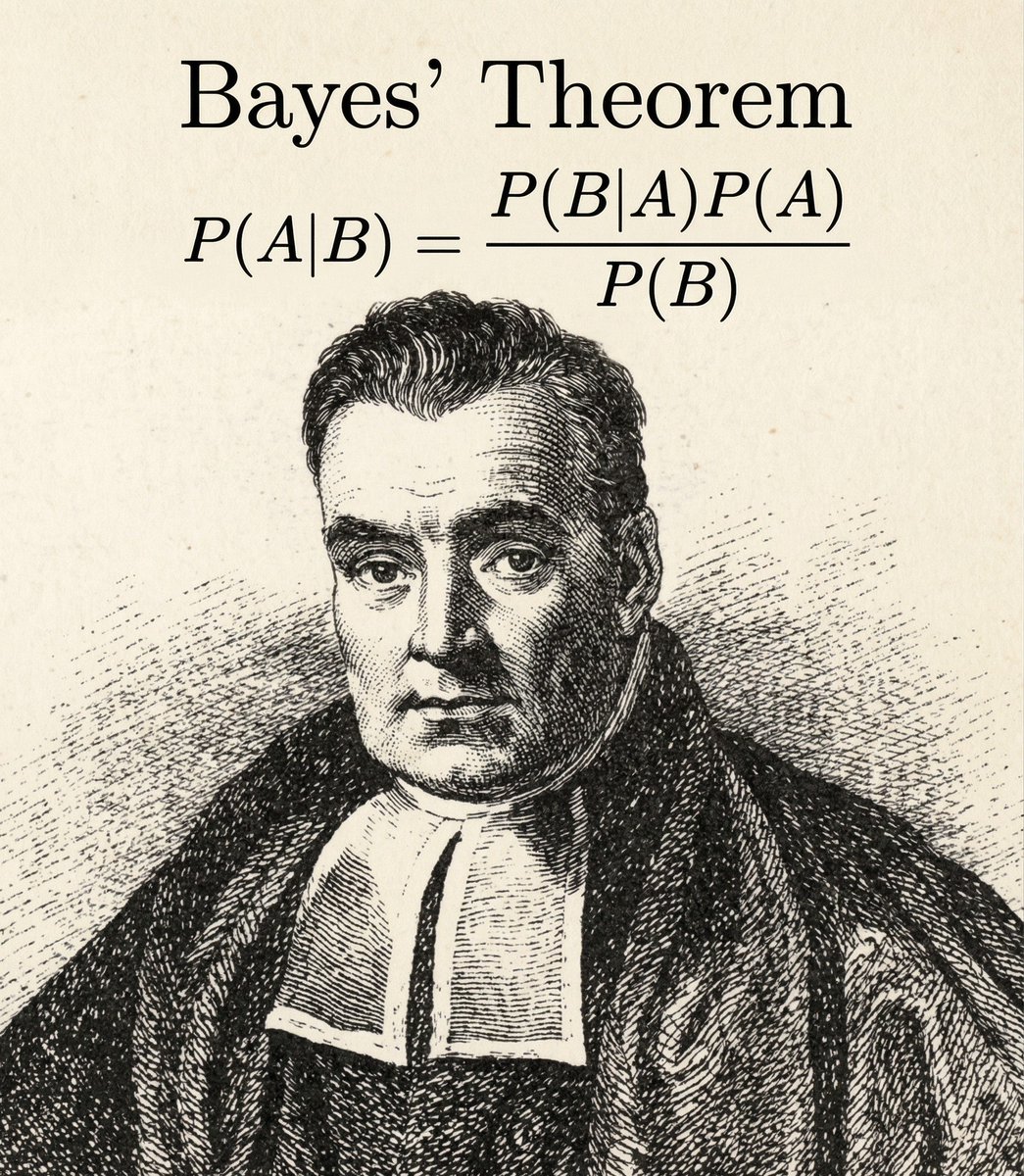
Most engineers have seen this formula.
P(A|B) = P(B|A) × P(A) / P(B)
Almost none can explain what it actually does.
Here's Bayes' Theorem in plain English, and where it's hiding inside systems you use every day.
The core idea in one sentence:
Bayes' Theorem updates your belief about something after seeing new evidence.
That's it. Four terms:
Prior → what you believed before the evidence
Likelihood → how probable the evidence is, given your hypothesis
Evidence → how common the evidence is overall
Posterior → your updated belief after seeing the evidence
A concrete example:
Say 40% of all emails are spam (your prior).
You see a new email containing the word "lottery."
10% of spam emails contain "lottery." Only 1% of legitimate emails do.
Plug into Bayes:
P(spam | "lottery") = (0.10 × 0.40) / P("lottery") ≈ 87%
The word "lottery" updated your belief from 40% → 87%.
That's Bayes in action. Prior belief + new evidence = updated belief.
Where it lives in AI:
1/ Spam filters
The Naive Bayes classifier, the algorithm behind most spam filters - applies this exact calculation word by word across an entire email. Each word shifts the probability up or down. It's called "naive" because it assumes each word is independent of the others, which isn't realistic, but works remarkably well in practice.
2/ Medical diagnosis AI
A patient has symptom X. What's the probability of disease Y? Bayes updates the base rate (how common the disease is) with the likelihood of seeing that symptom in patients who have it. Same formula, different domain.
3/ Your LLM's uncertainty
Modern language models don't just predict the next token, they assign a probability to every possible token. The sampling process (temperature, top-p) is directly working with those probability distributions. Bayesian reasoning is embedded in every response your model generates.
The insight most engineers miss:
Bayes doesn't give you certainty. It gives you a rational way to update uncertainty.
That's exactly why it's foundational to AI - real-world systems are never certain. They're always working with incomplete, noisy, probabilistic information.
Every model that learns from data is, at its core, doing some version of this:
Start with a belief. See evidence. Update the belief.
That's Bayes. That's machine learning.
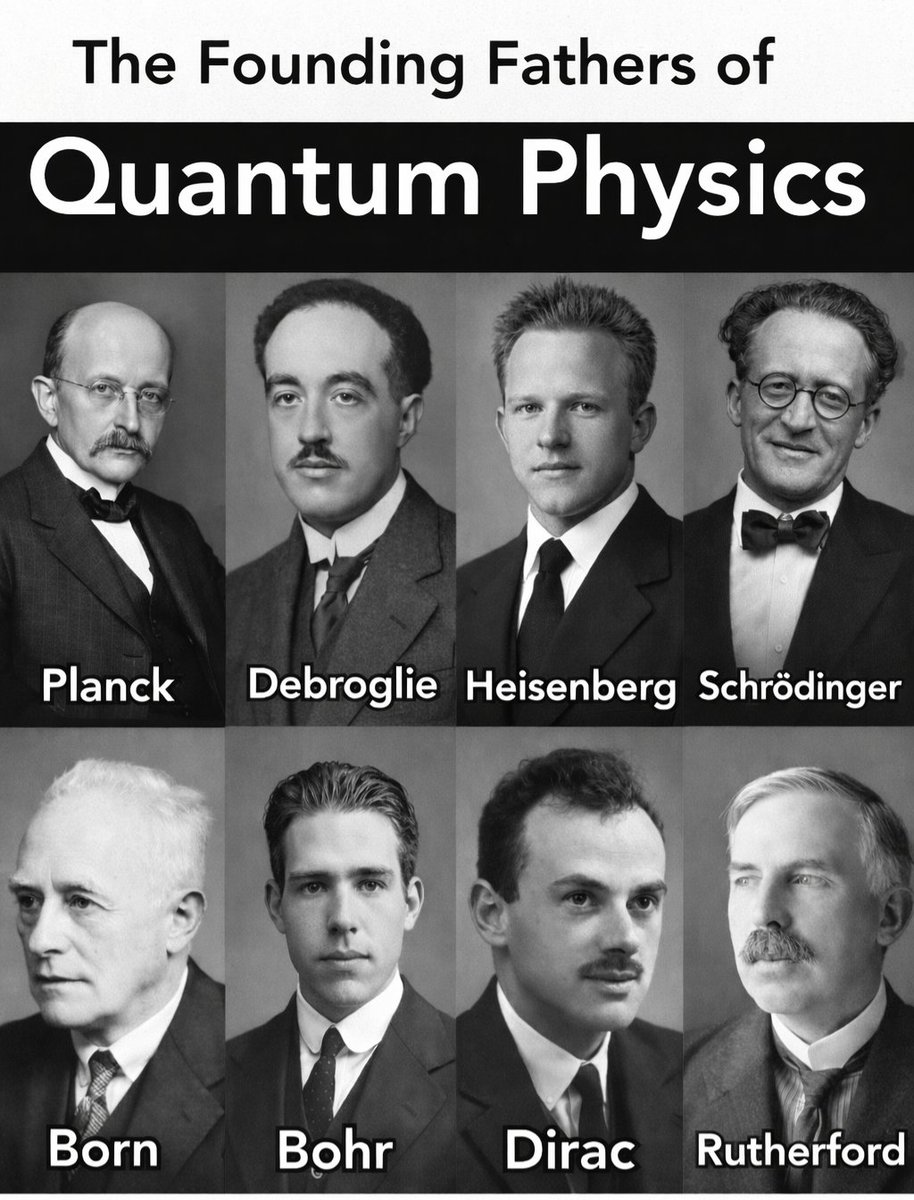
When we think about energy in everyday life, we often imagine it as smooth and continuous. But in quantum physics, energy is not continuous—it comes in small, discrete packets called quanta.
These packets of energy are known as photons. Instead of a smooth flow, energy is exchanged in tiny, separate units.
At a fundamental level, the universe is made up of particles, not continuous substances.
So the classical idea of continuous energy is replaced by quantum physics—the study of how these energy particles interact with one another.
Shree Hanuman is seen as a warrior of strength.
In the Kishkindha Kanda, when Rama/Ram first meets Hanuman, he does not praise his muscles; he praises his Syntax.
Rama/Ram remarks to Lakshmana/Lakshman that Hanuman spoke for a long time without a single grammatical error:
नूनं व्याकरणं कृत्स्नम् अनेन बहुधा श्रुतम् ।
बहु व्याहरताऽनेन न किञ्चित् अप शब्दितम् ॥
nūnaṃ vyākaraṇaṃ kṛtsnam anena bahudhā śrutam |
bahu vyāharatānena na kiñcid apaśabditam ||
Surely, the entire grammar (vyākaraṇa) has been thoroughly and repeatedly learned by him. Though he has spoken much, not a single word has been uttered incorrectly (or improperly).
Ancient Vedic texts identify Hanuman as the navavyākaraṇārthavettā: the knower of the 9 systems of grammar.
Happy Hanuman Jayanti!
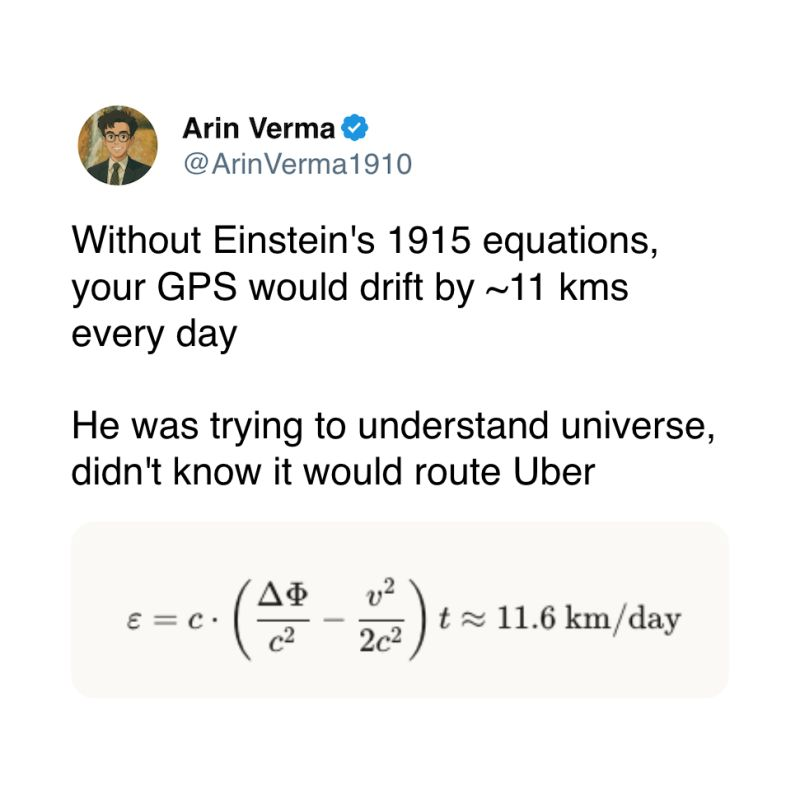
In 1905, Einstein published special relativity. In 1915, he published general relativity. Einstein was just trying to understand the universe.
But without Einstein's math, Google Maps would be wrong by 11 kms every single day.
Let me tell you why - this is very interesting :))
Your phone doesn't "talk" to GPS satellites. It only listens. Each satellite is broadcasting one thing, constantly: "I am satellite 'A', and it is currently 14:23:00.000000."
Your phone receives signals from 4 satellites simultaneously. Because light travels at a known speed, tiny differences in arrival time tell it exactly how far it is from each satellite.
'A' satellite tells you: you're somewhere on a sphere of radius 20,000 km.
'B' satellite: that sphere intersects another sphere - now you're on a circle.
'C' satellite: that circle intersects a third sphere - now you're at 2 points.
'D' satellite: eliminates the last ambiguity and only one point remains.
That's you!
Except there's a problem nobody thought about until Einstein.
The satellites are orbiting at 20,200 km altitude, moving at 14,000 km/h.
Two things happen to their clocks simultaneously:
- Special relativity: Moving clocks tick slower. At orbital velocity, the satellite clock loses 7.2 microseconds per day
- General relativity: Clocks in weaker gravity tick faster. At that altitude, gravity is weaker. The clock gains 45.9 microseconds per day.
Net effect: 45.9 - 7.2 = +38.7 microseconds per day.
In 38.7 microseconds, light travels 11.6 kilometers.
So without correction, the system would accumulate 11.6 km of error. Every single day. In a week, your navigation is useless.
The fix is one of the most elegant things in all of engineering.
Before each satellite launches, its atomic clock is physically tuned to tick slightly slower than it would on Earth - by exactly 38.7 microseconds per day.
Once in orbit, relativistic effects speed it back up. And it arrives at exactly the right rate.
Einstein's 1915 paper is baked into the hardware of your phone's navigation system.
The next time Google Maps routes you correctly, you're experiencing general relativity.
You just didn't know it.
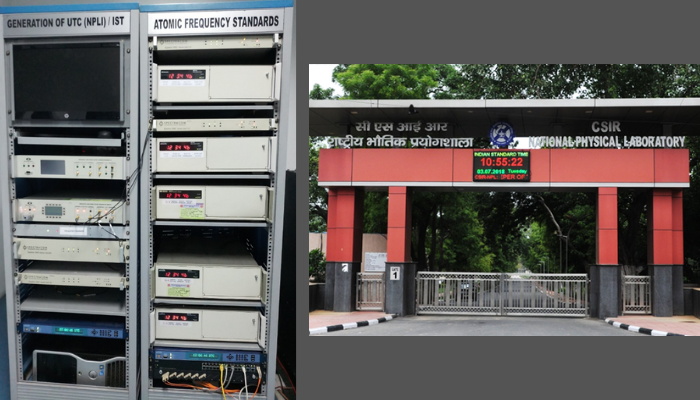
A few days back, I was reading about how Indian Standard Time (IST) is actually generated. IST is not generated by a single clock, it is a synthetic time.
The National Physical Laboratory (NPL) in New Delhi is the guardian of Indian Standard Time. NPL maintains an ensemble of 5 Cesium atomic clocks & 2 Hydrogen Masers.
These clocks are kept in a specialized, environmentally controlled vault in New Delhi. The true IST is a weighted average of all 7. If one clock drifts by even a nanosecond, the others vote it out of the calculation.
The Hydrogen Masers are the stable anchors, while the Cesium clocks provide the accuracy. This allows India to maintain a time signal that is accurate to within 20 nanoseconds of the Bureau International des Poids et Mesures (BIPM) in France.
The Most Important Number You’ve Never Noticed: e
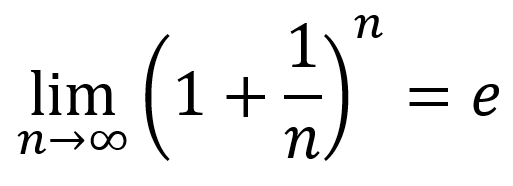
e ≈ 2.71828…
It’s everywhere—from compound interest and population growth to radioactive decay and the spread of diseases.
Imagine you have $1 and a bank offers 100% interest for one year.
If it compounds once, you get $2;
twice, $2.25;
quarterly, $2.44;
monthly, $2.61;
daily, about $2.714;
hourly, around $2.718
If it compounds every second, it gets closer and closer to 2.71828…
As the compounding becomes infinitely fast, the value approaches a special number: e.
This number isn’t random—it naturally appears whenever growth is continuous.
Whether it’s bacteria multiplying, money compounding, or atoms decaying, e is the natural rate behind exponential change.
It’s quietly present in the background of the world, and understanding it means understanding growth itself.
There's an integral so elegant, so mysterious that it shows up everywhere—from physics to probability to quantum mechanics.
It's called the Gaussian integral.
This integral defines the shape of the normal distribution, also known as the bell curve. It's why test scores cluster around an average, why errors in measurements behave predictably, and why the universe tends to have a most likely outcome even within randomness. And its answer—this is it. Not an approximation, not a coincidence, just pure mathematical magic.