Fructose has a reputation as the sugar that goes straight to the liver, but it also reaches the gut first, and a short study in young, healthy adults showed how quickly that can matter. Three days of eating more fructose, with total calories held the same, was enough to raise bacterial endotoxin in their blood.
Blood from the gut drains straight to the liver, so what happens in the gut and what happens in the liver end up closely connected. In this study, researchers swapped some of the complex carbohydrate in a standardized diet for either fructose or glucose for three days at a time, kept calories steady, and gave everyone a washout period in between.
After the fructose days, endotoxin in the blood went up, and so did ALT, an enzyme that rises when liver cells are under strain, while markers of nitric oxide, which our blood vessels rely on to relax, went down. The immune cells in the blood also turned up the receptors that recognize endotoxin, leaving them primed and ready to react. None of this happened with the same amount of glucose, and nobody's weight changed with either sugar.
Endotoxin is a piece of the outer wall of certain gut bacteria, and normally very little of it gets past the intestinal lining. Fructose appears to loosen that lining and to favor the kinds of bacteria that make endotoxin, and once endotoxin reaches the blood, the liver is the first organ to meet it. Repeated exposure like this is one of the paths toward fatty liver and insulin resistance.
Three days is a shorter stretch than many people's usual week of sodas, juice and dessert, which is what makes the speed of this change worth noticing.
If someone is trying to protect their liver and their metabolic health, it's clear that the type of sugar matters, and cutting back on fructose-heavy foods and drinks helps protect the gut lining and the liver even when calories stay the same.
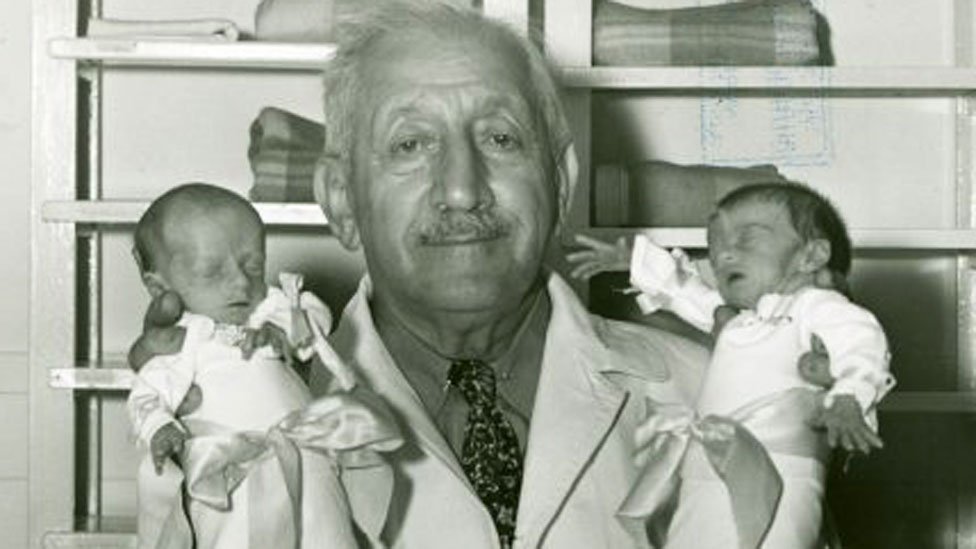
For forty years, the best place in America to save a premature baby was a sideshow at Coney Island, between the freak shows and the roller coasters, where you paid 25 cents to look at them.
In the early 1900s most hospitals would do almost nothing for a baby born too early. Premature infants were seen as weaklings, and many were simply left to die. Incubators existed in Paris, but American hospitals would not spend the money.
Martin Couney would. He was a German immigrant who called himself a doctor and had probably never qualified. In 1903 he opened a building at Coney Island's Luna Park with rows of glass incubators, a staff of nurses who lived on site, and wet nurses on a strict diet to feed the babies. Over the door a sign promised that all the world loves a baby. Crowds queued to watch babies smaller than a bag of sugar fighting for breath. Their quarters paid for everything, and the parents never paid a cent.
Desperate families brought their babies to him, and before long doctors were quietly sending them over too. Some parents were too ashamed to let their child be put on show, and those babies nearly always died. His own daughter Hildegard had been born six weeks early at three pounds, and she grew up to nurse alongside him.
He kept the show running until 1943. He said he would close it when the hospitals finally did the job themselves, and that year he did. By his count he had taken in about 8,000 babies, and around 6,500 of them had lived. Some were still alive into their nineties, telling interviewers that without the man at Coney Island they would never have had a life.
The hospitals turned those babies away. The fairground kept them alive for a quarter at the door.
The AAP issued this policy statement recommending only pasteurized dairy. I agree. This statement impacts a small percentage of families.
Where is the policy statement recommending no juice given the rates of obesity, fatty liver disease, and diabetes in millions of kids?
So much time and money is spent trying to live longer, but what if one of the biggest levers is a hormone most people never think about?
People are paying for plasma transfusions and taking all kinds of bizarre drugs. Meanwhile, insulin gets very little attention in the longevity conversation, even though the evidence linking it to lifespan is strong.
This is one of the studies that changed how I think about aging. In 2017, Templeman and colleagues published a study in Cell Reports using mice with reduced insulin gene dosage. These mice had 25 to 34% lower circulating insulin. Their IGF-1 levels did not change. In old age, they had lower fasting glucose and better insulin sensitivity. And they lived longer, on two different diets. This was in mice, but it showed that lowering insulin itself can extend lifespan.
The human evidence points the same direction. In the Leiden Longevity Study, the middle-aged offspring of long-lived nonagenarian siblings had lower non-fasted glucose than their partners, with similar insulin and IGF-1 levels. When researchers measured insulin sensitivity directly, the offspring were more insulin sensitive than controls, and the more insulin sensitive they were, the longer their parents had lived.
Centenarians show this too. In 1996, Paolisso and colleagues found that healthy centenarians were more insulin sensitive than people over 75, and about as insulin sensitive as adults under 50. Their insulin action was preserved.
Long-lived families are typified by insulin sensitivity. If someone wants to age with a healthier metabolism, it's clear that keeping insulin low and insulin sensitivity high deserves a central place in the plan.
In 1953 a Harvard nutritionist named Jean Mayer proposed that hunger is not driven by how much glucose is in the blood, but by how much glucose the brain is able to use.
He called it the glucostatic theory.
The idea was simple. Specialized cells in the hypothalamus act as glucose sensors. When those cells are taking up and using plenty of glucose, a person feels full. When glucose use falls, a person feels hungry and starts looking for food.
Mayer's key point was that the absolute level of blood glucose is not the signal. The signal is glucose utilization. He estimated it from the arteriovenous difference, which is the gap between glucose in the arteries going into the tissues and glucose in the veins coming out of them.
This explained something that bothered physicians at the time. People with poorly controlled diabetes often have very high blood glucose and are still constantly hungry. Without enough insulin, their cells cannot take the glucose in. The blood is full of fuel, but the tissues are using very little of it.
Mayer published the idea in the New England Journal of Medicine in 1953. In 1955 he expanded it, and he placed it next to a second idea, the lipostatic hypothesis. That hypothesis held that the body also tracks how much fat it carries over the long term.
That pairing turned out to be important.
Over the following decades the glucostatic theory was shown to be incomplete:
- Hunger is controlled by many signals, not one.
- Gut hormones, stomach stretch, learned meal times, and reward all play a role.
- The discovery of leptin in the 1990s confirmed that fat tissue signals the brain about long-term energy stores, which is much closer to Mayer's lipostatic idea.
But the glucose part of the story never went away. Modern measurement methods brought it back.
Campfield and colleagues, 1996:
- 18 healthy adults were isolated from food and time cues, with blood glucose monitored continuously.
- In 83% of them, rising hunger and spoken meal requests were preceded by a brief drop in blood glucose.
- The average low point was about 10% below baseline, reached around 27 minutes into the drop.
- In a small preliminary arm, insulin was infused to mimic these drops, and hunger ratings rose. When glucose stayed stable, hunger did not change.
Melanson and colleagues, 1999:
- Time-blinded men who drank a high-fat or a sugar drink requested their next meal during the decline in glucose that followed the post-drink peak.
- After the fat drink, the next meal request took about twice as long (126 vs 65 minutes).
Lennerz and colleagues, 2013:
- 12 men ate a high-glycemic or low-glycemic meal matched for calories, macronutrients, and taste.
- The high-glycemic meal produced 2.4 times more glucose in the first 2 hours.
- 4 hours later, glucose was lower after the high-glycemic meal (4.7 vs 5.3 mmol/L) and hunger was higher.
- At that point, brain imaging showed greater activity in the nucleus accumbens, a region tied to reward and craving.
Wyatt and colleagues, 2021:
- 1,070 people wore continuous glucose monitors across 8,624 standardized meals.
- The size of the glucose dip 2 to 3 hours after a meal predicted hunger better than the size of the glucose peak.
- Bigger dips were linked to a shorter time until the next meal, more energy eaten 3 to 4 hours later, and more energy eaten over 24 hours.
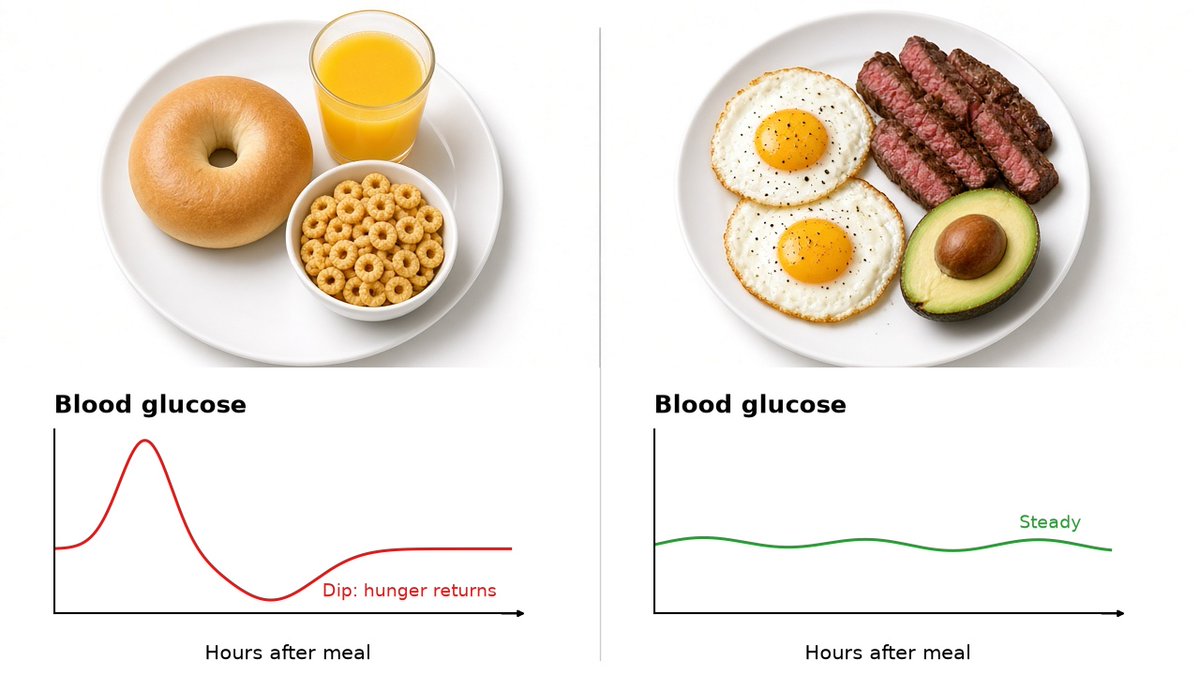
These studies show the same pattern. The rise in glucose is not what drives the next round of hunger. The fall is.
That is where insulin comes in.
A large glucose spike brings a large insulin response. Insulin moves glucose out of the blood and into tissues, and when the response is large it can push glucose below where it started. That drop is the dip. The insulin infusions in Campfield's work produced the same kind of drop and the same rise in hunger.
Mayer had the right instinct. The brain pays close attention to glucose, and the timing and direction of glucose changes after a meal shape when people eat next and how much. He was wrong only in thinking it was the whole story.
The hormone that controls those changes is insulin. If the goal is to control hunger after a meal, it's clear that meals which avoid a large glucose spike, and the large insulin response that follows it, are the more reliable way to avoid the dip that drives a person to eat again.
🍫The Chocolate that Changed My Appetite 🎃
1/4) The reason you should not mix carbs and fat has nothing to do with taste.
Research shows that, at a SUBCONSCIOUS level, the combination fires up your nervous system to drive overeating.
Here’s how it works… (and don’t miss 3/4)
My biggest concern is that if there is a clean sweep by Democrats of the House, Senate and Presidency in 2028, they will:
1. Make DC and Puerto Rico states to gain a strong majority in the Senate.
2. Open the borders and legalize everyone living in America illegally to cement a permanent majority.
3. Increase the size of the Supreme Court to gain an immediate majority.
This would result in America becoming a permanent one-party state and the end of democracy in any meaningful sense of the word.
All that is needed to ensure this doesn’t happen is 51 Republican senators in 2029. That is why you should vote for Republican senators this election. Other reasons are irrelevant compared to this one.
Today marks a historic milestone for metabolic psychiatry!
Baszucki Group is launching the Global Network for the Advancement of Metabolic Psychiatry (MetPsy), alongside a $20 million investment to establish the McLean Center for Metabolic Psychiatry at McLean Hospital, a Harvard Medical School affiliate.
For years, I've argued that mental disorders can be understood as metabolic disorders impacting the brain. Advancing this field requires rigorous scientific research, innovative clinical care, and education and training to bring emerging discoveries into clinical practice.
This investment will help advance all three.
I'm particularly excited to be leading the education and training initiatives at both McLean Hospital and MH². We'll be developing clinical case conferences, journal clubs, symposia, CME programs, and other opportunities for clinicians and scientists to learn, collaborate, and help shape the future of metabolic psychiatry.
I am deeply grateful to Baszucki Group for their extraordinary commitment to this field and to the many researchers, clinicians, patients, and families who have helped bring us to this moment.
Patients deserve better treatments, and together, we have an opportunity to transform mental health care.
Read the full announcement:
https://t.co/YwX2zOo96g
Researchers tend to have their best, most innovative ideas early in their careers. But for decades, researchers have had to wait longer and longer to test their own ideas.
Thrilled by the progress we’ve made so far on this front, including the huge milestone of setting a new record for grants supporting early-stage investigators.
Being gay forced me to think about faith instead of simply inheriting it. What do I actually believe? What is theology and what is culture? What is conviction and what is fear? I do not think questioning faith necessarily destroys it. Sometimes it is the first time you actually make it your own.
Vitamin C and glucose compete for entry into cells, and glucose often wins.
In tissue from the human small intestine, glucose cut vitamin C uptake by more than half. Other gut transporters that carry the oxidized form of vitamin C are blocked by glucose at very low concentrations. In both humans and mice, higher blood glucose went with less vitamin C inside red blood cells, and those cells were more fragile.
This helps explain why people with chronically high blood sugar can run low on vitamin C even when they're well fed, and why scurvy still turns up in patients with obesity and diabetes. The evidence is clear that a person's vitamin C status depends on more than intake. The amount of glucose competing with it matters too.
Truth:
"Bottom line, you have the right to assemble a healthcare team that treats your curiosity as an asset rather than a threat.
The best clinicians I know aren’t threatened by informed patients. They help create them."
🚩 Red Flags to Find a New Doctor 🚩
I had an interesting interaction with a clinician this morning that prompted me to write this post.
It’s not informed by decades of clinical experience; nor by time doing an MD PhD; but by my experiences as a patient.
Let’s start with a joke: What do you call the doctor who graduated at the bottom of their medical school class?
Doctor.
Jokes aside, I don’t mean to doctor bash. To the contrary…
There are some truly remarkable clinicians, including people in my life who I consider bona fide heroes. (see video below 👇 )
And then there is another species of doctor, those who seem to the white coat makes them the arbiter of medical truth. “God complex” is an appropriate term.
In the worst cases, this bleeds into clinical bullying and harmful blanket recommendations blinded by arrogance.
I’ve seen it, and had it aimed at me.
So let me give you three red flags that indicate it’s probably time to find a new doctor.
🚩Red flag #1: They speak in absolutes.
For example:
“Lower ApoB is always better.”
“Diet and lifestyle can’t change ApoB.”
Medicine is contextual and personalized. When a clinician repeatedly makes broad, definitive statements that are easily falsifiable, even by edge cases, that tells you something.
Maybe they genuinely don’t know better. More likely, and more concerningly, they may believe nuance is unnecessary because the patients and general public couldn’t possibly understand it.
Good clinicians don’t dumb it down to the point of inaccuracy. They teach.
🚩Red flag #2: When challenged fairly, they become defensive rather than curious.
Point out an error and watch what happens.
Do they say, “Interesting. My mistake. Let me look at that and/or learn more”?
Or do they pivot and make the disagreement about you rather than the evidence?
Which brings me to the third red flag.
🚩Red flag #3: They treat questions as insubordination rather than participation.
A good doctor doesn’t need you to obey them. They need you to understand the options well enough to make an informed decision about your own body.
That means explaining means discussing uncertainty and acknowledging trade-offs.
And it means being willing to say, “I don’t know.”
Bottom line, you have the right to assemble a healthcare team that treats your curiosity as an asset rather than a threat.
The best clinicians I know aren’t threatened by informed patients. They help create them.
The menstrual cycle is also a brain cycle.
Fluctuations in oestrogen and progesterone can alter glutamate, GABA, serotonin and dopamine signalling across the brain.
Here’s how these hormonal fluctuations affect these systems, and what those effects mean for clinicians in practice. 🧵👇