If you are a designer (product designer, ux designer, ui designer, ui/ux designer) and needs a resume written to pass the ATS screening, you can reach out to me.
It will cost you a token 🙂
Many people see an African founder with a great idea and immediately jump to the investment conversation instead of the growth conversation. I try to do the opposite for many reasons.
1. I have lost too much money on people who know how to start but can't finish the job. Entrepreneurship is a journey and not a destination. Not many people are equipped for that journey, and these days I can easily tell who isn't, so I don't waste my time with them.
2. Investing in a startup venture is a relationship that takes years to perfect. It's much like any other long-term relationship. It is not a one-night stand where you come to collect the child after they have been raised. You build a life together. I learned a lot about this from my previous losses and wins. The difference was clear.
3. Growth comes from thinking through problems creatively instead of throwing money at them. I always ask founders what immediate problem they are raising money to solve. Most of the time, they can solve it without money, with the right relationships or partnerships.
This was my greatest unlock in African entrepreneurship. I once tried to raise money for an office, but eventually partnered with someone who gave me an office free of charge, and I paid him in services.
I learned from that, and now I always explore partnerships before anything else. If you look hard enough, someone needs what you offer and can provide what you need. Many founders are always too impatient and don't talk to enough people.
4. Vanity is the greatest sin in entrepreneurship. If you are simply raising money to look "cool," you will never make it. Sadly, the media circus around fundraising created a validation death spiral for many. Some of the best African entrepreneurs I know have raised millions of dollars from serious investors without a public announcement.
They stay quiet for a reason: they work amid uncertainty and try to create markets that didn't exist before. Drawing attention would invite needless competition before they have even figured out the market. This has been the curse of African fintech. Many are building, but very few understand the true economics. This is why exits are rare.
I am usually very blunt with entrepreneurs, and a few still dislike me for it after a decade. They went out to try to prove me wrong, and they succeeded in raising a lot of money. Years later, they faced the reality I told them on day one. Easy wins and constant growth are very different things.
Never envy those you think have succeeded and wear their proof openly. Many are good at the "Ponzi scheme" of raising money forever. People eventually catch on that creating markets in Africa is much harder than pretending they exist and convincing DFIs and others with no skin in the game to part with money.
At Alta, we prioritized local LPs for a reason; I now see the sense in that after almost a decade. Foreign funding without real local ties has created a false sense of entitlement and unmet expectations. I am not in that game. You shouldn't be either.
Again, venture investing, as it is currently done in Africa, needs an overhaul. We still have so much to learn about creating new markets that we don't understand yet. We shouldn't be distracted by "fundraising theater"; we should focus on learning more about growth.
I am doing my part to change it, one new interaction at a time, and creating better outcomes while learning more in the process. Prioritize learning over everything, and you will never lose.
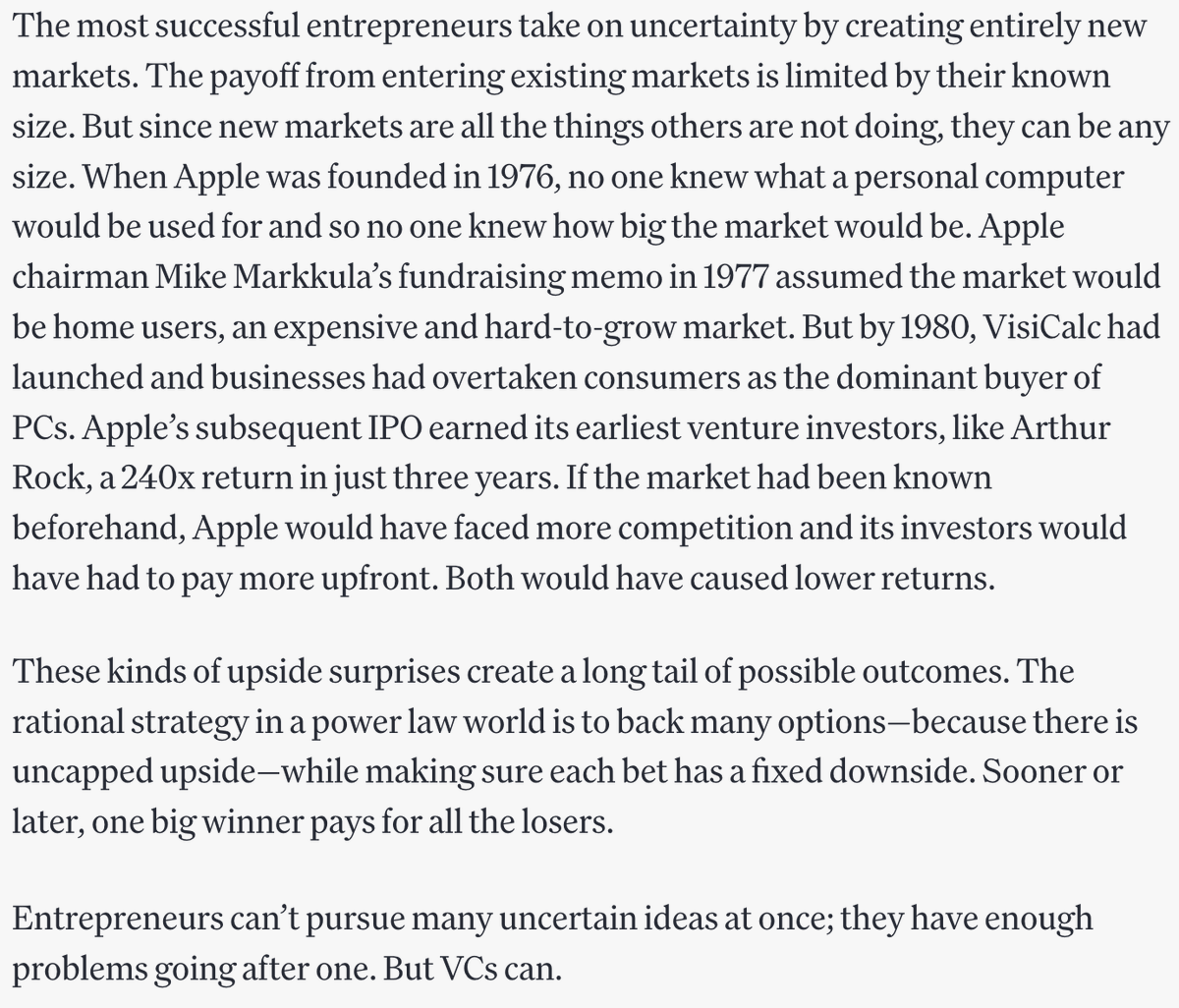
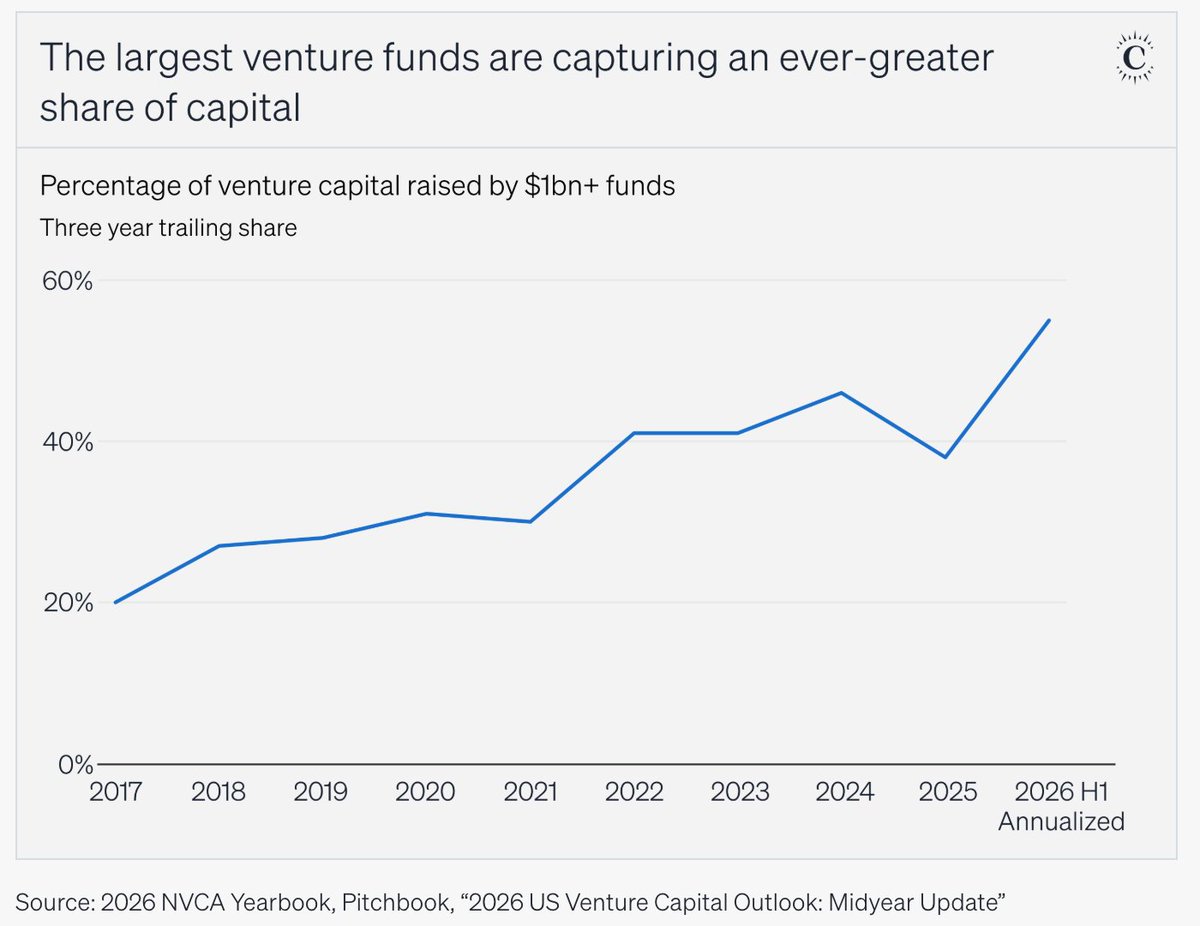
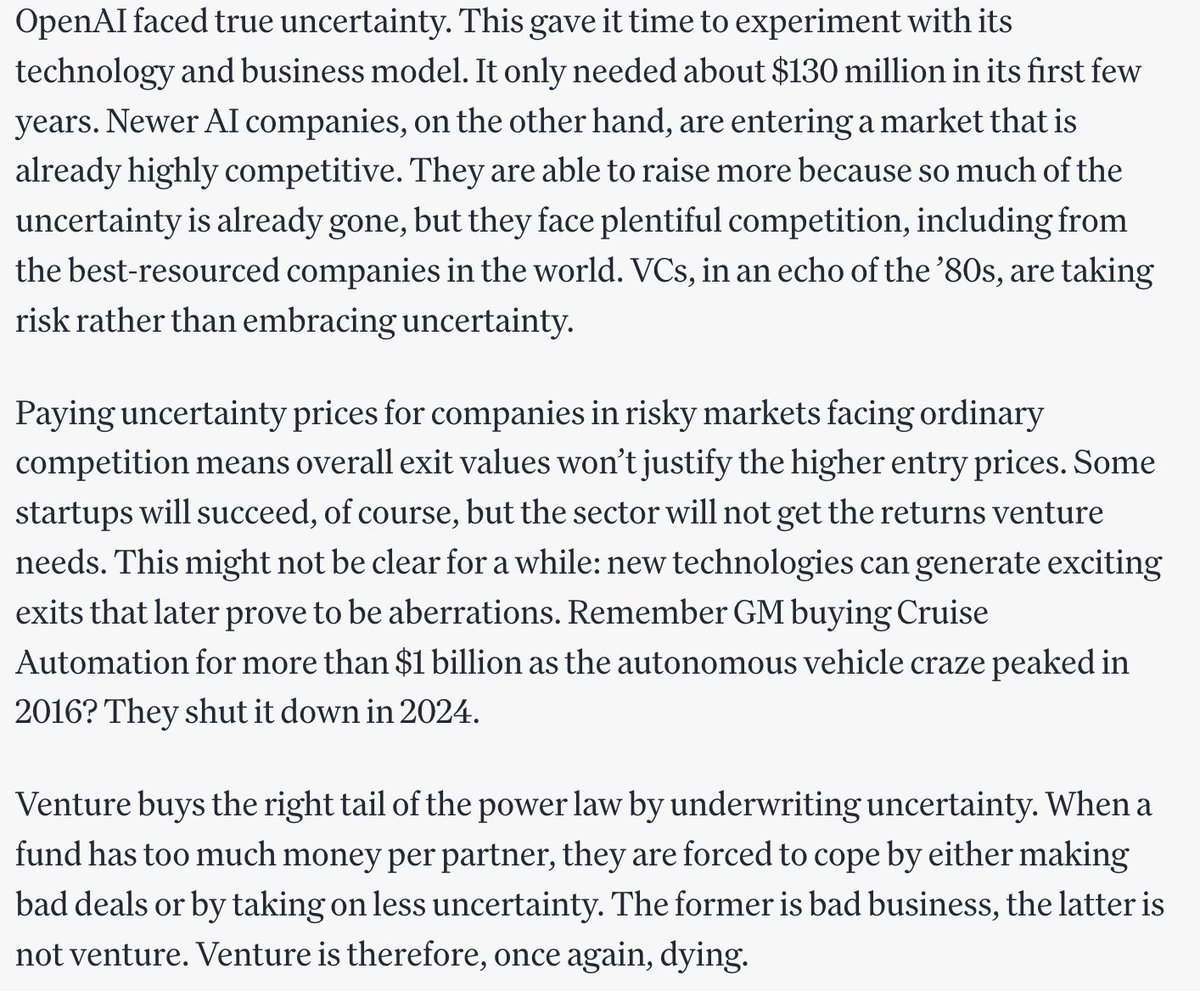
This is a fantastic article. and recommended reading for startup investors in Africa. True venture is about investing in uncertainty and creating new markets. Investing in known markets is just risk management through efficient capital allocation.
https://t.co/SkewOvdGvr
I recently read a post where an African founder complained that African investors are only interested in companies with proven traction. It is not just an Africa thing. Investors globally are now optimizing for risk instead of uncertainty, as many macro variables have changed.
Venture Capital as we used to know it is dying. LPs are moving into investing in risk management rather than creating new markets by investing in uncertainty. Nothing wrong with their capital-conservation approach, but I think it creates new opportunities for entrepreneurs and smaller players to run longer experiments with different models.
Truthfully, the current VC model never really worked for Africa. Most investments have optimized existing markets rather than create new ones. Investments in sectors like telecommunications created new markets by building the infrastructure for business in Africa. We need more of the longer incubation cycle that an entity like OpenAI enjoyed before it created a new market.
When we started investing over a decade ago, we explored uncertainty and the possibility of creating new markets with African founders. These days, I see people trying to raise a lot of money and say the right things to please VCs who have also raised a lot of money and want to manage risk.
Can AI help to open up new markets in Africa or globally? Definitely!! Those who make it happen have to think radically differently from the crowd and understand foundational demographic shifts.
Numbers and traction may prove you can conquer uncertainty, but the thesis logic matters now more than ever. 10m+ people can sign up for an app in a week, but what do the trends in the data you have gathered tell you about their needs? What new products can be built with that data?
I don't think Venture alone is dying, but platforms as we used to know them are going the same way. I watch my kids and their preferences more closely than ever. They have different needs and are the present and future of markets.
@asemota Mine is with my car. Once I’m parked anywhere especially parking garage, it takes me less than 5 secs to open my car, climb in, and lock from inside
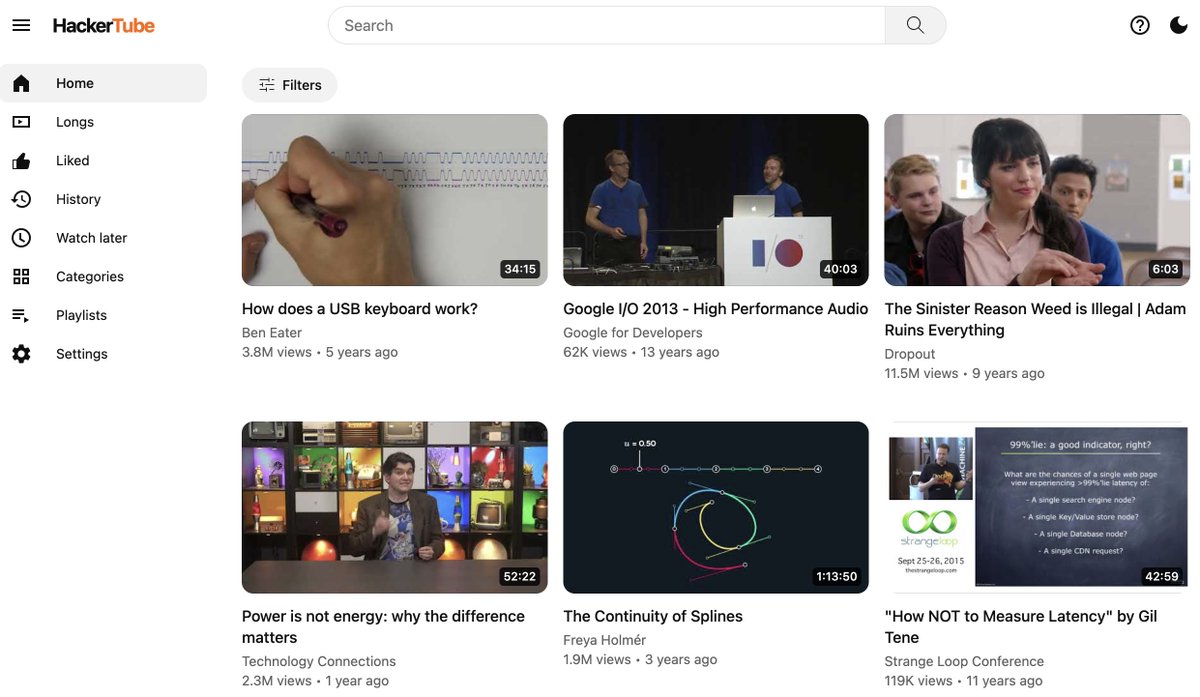
Weekend hack: HackerTube. I was annoyed with YouTube's recommendations so I had Claude filter down 43M comments over 20 years of HN to 6,454 videos that keep being recommended. *Significantly* better viewing experience, ~2 hours with Opus 5.5:
https://t.co/JIhXN7OSh1
- Excellent recs without any logins (state is kept in local browser session)
- Thumbnail is a representative frame from middle of the video instead of the super duper A/B test hyper-optimized user uploads
- Underlying data from the comment analysis as one zip file, point your Claude at it and ask for your own version
- HackerTube Longs ✊
A bit more on the process:
I use Claude Code (desktop app for Mac), Opus 5.5 on Medium effort as my default. I only talk to Claude and have it do everything, the only "manual work" I helped with in tandem was in the browser (reminiscent of MenuGen): 1) I had to create some kind of API key from Google Cloud UI to query YouTube for video metadata, 2) I booted up a VPS box for serving and 3) I bought the domain name. Once the box was up I gave Claude the IP and told it update, secure, harden, deploy and optimize the code, and it did the whole thing.
Many awesome projects that would have normally taken weeks/months even can now be few-shotted for breakfast. What else are we not thinking of.
The Python9ja Developer Survey 2026 is finally here!
This is our first edition, and we're glad to share what we've been able to gather from the community. Rather than presenting the results as just numbers and charts, we chose to tell the story behind the data, highlighting the experiences, challenges, opportunities and perspectives of developers within Python9ja.
The survey received 120 voluntary responses. The findings are based on those who participated, not a representation of every developer in Nigeria. We've included a methodology section to explain how the data was collected and interpreted.
We've made efforts to ensure the figures and interpretations are accurate, and there may be minor errors or inconsistencies in some calculations. We welcome constructive feedback and corrections.
Most importantly, this is a starting point. We hope the next edition will be bigger, more detailed and more insightful, with even greater participation from the community.
To everyone who participated, shared the survey or contributed in any way, thank you for being part of this first edition.
Explore the report: https://t.co/ybfbbFK3i2
They said African languages were too fragmented, too complex and too commercially insignificant to build advanced AI for.
We disagreed. So we built it.
64 languages. 166 voices. 3 billion parameters. ONE model.
Today, we are unveiling STORM-Ensemble 3.0, the most capable multilingual speech synthesis model we have built at PlotWeaver.
From Yorùbá, Igbo, Hausa and Nigerian Pidgin to Swahili, Amharic, Wolof, Zulu, Xhosa and dozens more, STORM-Ensemble 3.0 generates speech across 64 languages, with 166 distinct speaker voices.
Every voice you hear is generated by our model, not a prerecorded sample.
But the real breakthrough isn't the numbers.
It's what becomes possible when this technology is in the hands of people who can build with it.
-African filmmakers distributing stories across languages.
-Banks and telcos serving customers in their mother tongues.
-Education platforms reaching more children.
-Developers building voice AI products without starting from scratch.
We are not building AI for African languages simply to prove it can be done. We are building the infrastructure to make our languages commercially viable at global scale.
Next week, I will be speaking at the Commonwealth Business Forum in Antigua about unlocking the Commonwealth's creative potential. This launch is a practical demonstration of that ambition.
Africa must not simply consume the future of AI. We must build, own and shape the infrastructure that powers it.
Watch the video. Listen to the voices. Imagine what's possible.
Introducing STORM-Ensemble 3.0.
PlotWeaver. Build Once. Speak Every Language.
#PlotWeaver #STORMEnsemble #VoiceAI #AfricanLanguages