The rupee gained about 1% to ₹95.77 per dollar on October 12 after RBI measures to ease dollar demand, alongside likely intervention.
A welcome recovery. Sustaining it will depend on oil prices, capital flows and the wider economic outlook.
MPSC aspirants ended their Pune protest after Maharashtra agreed to probe alleged recruitment irregularities, including paper leaks. The chairman is on leave pending the inquiry.
Students deserve fair exams, a transparent investigation and accountability.
India’s forex reserves fell $51.1 billion in four weeks, from $785.7bn on Sept 4 to $734.6bn on Oct 2—a 6.5% drop.
RBI dollar sales and valuation losses drove the decline amid rupee pressure. A substantial drawdown that deserves scrutiny and clear explanations.
In 1992, sterling fell to a short position the Bank of England could not outspend.
India's first tokenized bonds sit on a ledger where the RBI sees every position. That protects the rupee. It also keeps the world's capital out. https://t.co/5feffywnE7
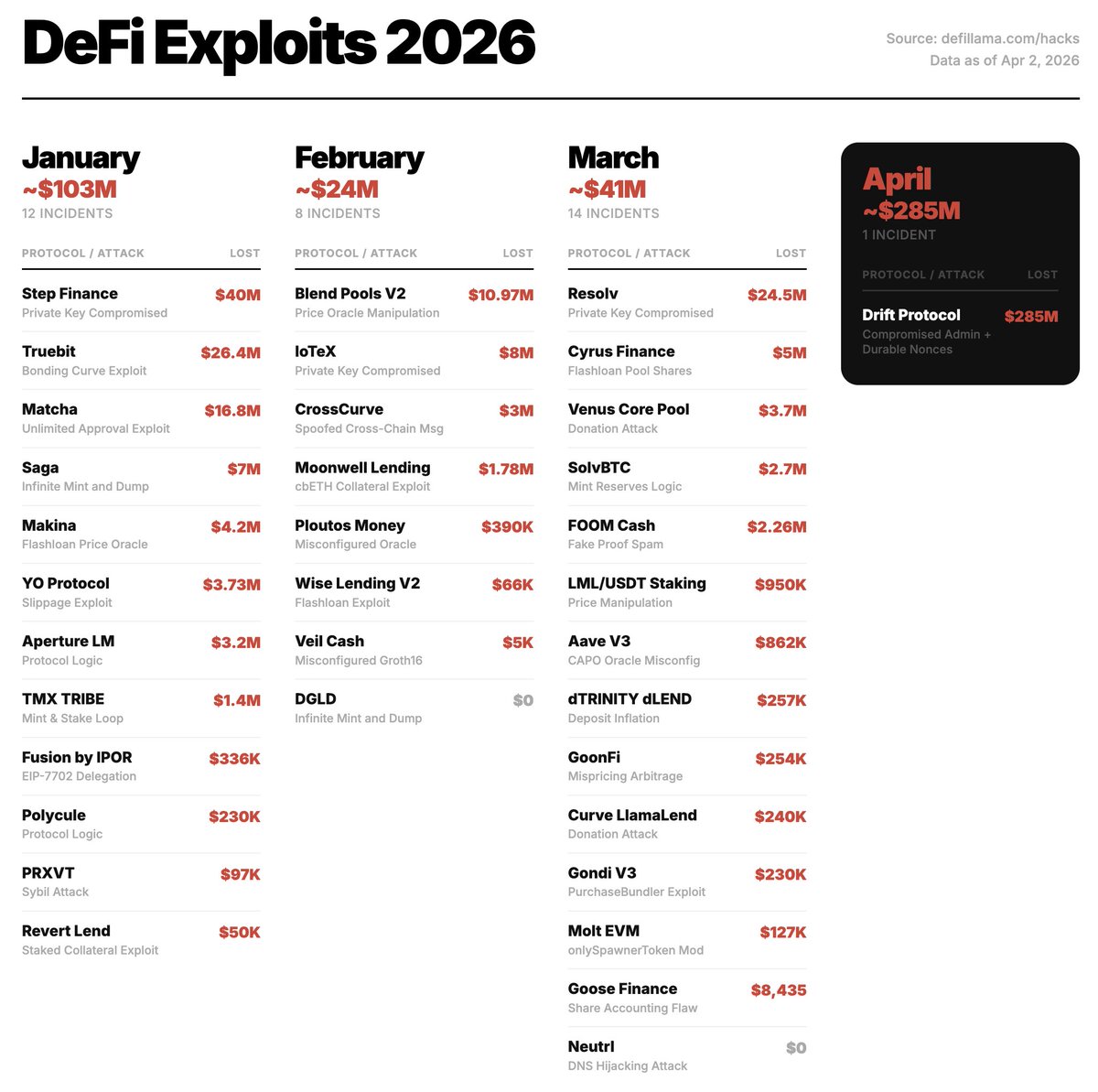
35 DeFi protocols hacked in 2026 already
$453M+ lost in just 4 months
• January $103M across 12 protocols
• February $24M across 8 protocols
• March $41M across 14 protocols
• April so far $285M across 1 protocol
Smart contract bugs and compromised private keys
This industry has a serious security problem
When does it actually get fixed?
Drift Protocol just released their thread on the $280 million hack
It's worse than anyone thought too
There was no code exploit. It wasn’t a flash loan. It wasn’t even a traditional key theft.
Solana has a feature called "durable nonces" that lets you sign a transaction today but execute it days or weeks later
Sound familiar EVM critics? 😏
Think of it like writing a signed check and leaving it in someone's drawer until they decide to cash it.
The attacker used this to build a time bomb inside Drift's own governance system.
So I was wrong and Solana’s architecture did in fact play a role in this exploit occurring. Similar to how a hacker exploits approvals on EVM chains.
Here's how it played out:
March 23: The attacker sets up four of these delayed-execution accounts. Two are tied to real Drift Security Council members and two belong to the attacker.
At some point, the attacker tricks two of Drift's five council members into signing transactions they didn't fully understand.
Blind signing is something I have called out a lot and it is a major issue with many of these chains
Drift calls it "transaction misrepresentation” 🤨
But in reality they were socially engineered into signing their own robbery
Those signatures sat dormant for nine days!
March 27: Drift rotates its security council. New members, fresh setup. Doesn't matter. The attacker compromises two of the five new signers too.
April 1: Drift runs a routine test transaction. Sixty seconds later, the attacker cashes those pre-signed checks. Two transactions, four Solana slots apart. Full admin control.
Every withdrawal limit removed. Every vault drained.
$280 million. Gone.
Two out of five signatures is all it took 🤦♂️
But also clearly some major planning and patience for this elaborate attack
Blind signing
Durable nonces which function similarly to approvals
Poor key management
Insecure infrastructure
Everything worked as it was designed to work and this was just an incredibly well orchestrated and thought out attack
The Cubane whitepaper matters for the Web3 industry not just because of benchmarks like 1.2M TPS or our work on privacy-focused enterprise infrastructure.
What makes it important is a shift in thinking. We rethink how blockchain systems are designed—moving beyond linear architectures and treating privacy as a foundational layer rather than an add-on feature.
There are several ideas in the paper that challenge conventional assumptions in Web3, such as rethinking of blockchain linear ledgers as relational DB and we believe readers will find them both interesting and thought-provoking.
Download Link - https://t.co/MCIpLCr18K
Read Vitalik’s recent post on L2s was a proud moment.
The realisation is clear:
Scaling alone was never the problem.
Cheap blockspace isn’t enough.
And not every system should pretend to be a shard of L1.
This is exactly why @CubaneSpace was built from day one.
Cubane already does what the ecosystem is now converging toward:
FHE for real encrypted computation (not just hidden txs)
MPC for distributed control, randomness, and governance
CCCM for parallel execution (“cubes”), not linear blocks
RDBMS-style state for real systems
PMBs for application-specific trust and regulatory control
Namespace sharding for scalable, isolated execution
Cubane value prop was never cheaper than gas.
It was about enabling private shared state and verifiable execution for real-world applications.
Feels good to see the vision align.
Hi NOVA — we’ve been quiet on X.
Not because we slowed down. Because we were building.
What’s already done:
• Whitepaper completed
• Website fully revamped
• Onboarded with W3X and Lunar Polygon Accelerator
• Testnet architecture
• Patent work officially started
• @CubaneTokenX Launched for Ambassadors
• Our community now has a name, "NOVA"
What’s next (coming weeks):
• Testnet V1 launch
• Whitepaper release
• New funding round announcement (once closed)
• Partnerships with B2B & SaaS companies and Web3 startups, real use cases, no co-marketing fluff.
We hit challenges. We didn’t pause.
We didn’t pivot for hype.
We didn’t lower the bar.
As our founder says:
“Don’t stop until the grind stops you — and it hasn’t.”
More updates soon. We’re just getting started.
Dear @amazon@amazonIN , I ordered a phone with an exchange offer for my dad’s old phone. Your site accepted it, but the delivery agent rejected it due to app compatibility. Why allow it if it's not valid? Now I wait for a refund & reorder. Frustrating! #CustomerService#Amazon
Biggest theme from DeFi Security Summit is that Stolen Private Keys is now by far the biggest security risk in crypto.
This means 3 things:
1) Smart contract auditing has been very effective 🔥
2) Smart contract security will lose priority 📉
3) More effort is needed on the opsec side
Credit to @iphelix for the image and a great talking making the security industry aware of this
Most crypto conferences are a waste of time.
You go to an event where everyone there is already “into” crypto, and try to preach them crypto. You get to show up in the echo chamber to virtue signal to as many people as possible.
As cyber threats escalate in the #crypto space, the recent $230M #WazirX hack highlights the need for stronger security measures.
🔒 zkCrossNetwork steps up with Partisia's #MPC technology, decentralising key management for secure, trustless transactions and much more..
Safeguard your assets with #zkCrossNetwork.
#CyberAttack #zkCrossDEX $CROSS