Every trader dreams of catching a stock that goes up 500% or 1,000%.
Very few spend time studying how those stocks actually looked before they made those moves.
That's the real edge.
The greatest winners leave behind a blueprint. Study enough of them and you'll notice the same things over and over again 👇
1. They don't break out randomly. They build clean bases, shake out weak holders and show repeated institutional accumulation.
2. They often look "too expensive." The biggest winners usually make new highs while most traders are searching for cheap stocks near their lows.
3. They reward patience. A life-changing winner rarely happens in a few days. The biggest gains come from holding through multiple consolidations while following your rules.
4. They teach you what quality really looks like. Once you've studied hundreds of historical leaders, average stocks become much easier to reject.
Every weekend I still spend hours reviewing past market winners.
Not because I enjoy looking at history. Because history trains my eyes to recognize tomorrow's leaders before everyone else does.
GPT 5.6 Sol can one-shot convert an arXiv paper into an interactive Marimo notebook!
Great for papers best understood hands on (lots of fun examples in interpretability, inference engineering, agent harnesses, benchmarking, and more)
Play around with the notebook, inspect the code, or try the same workflow with your own agents below
Growth in trading doesn't come from finding the perfect setup.
It comes from building the right habits, one layer at a time!
Most traders skip the fundamentals and wonder why they never become consistent.
Here's the path that changed my trading 👇
1) Find a trading style that fits YOU.
Don't copy someone else's strategy because it made money. Swing trading, day trading, momentum or value investing all work—but only if they fit your personality, available time and decision-making style. A great system that doesn't suit you will never last.
2) Commit to one approach.
Stop jumping from one strategy to the next after every losing trade. Every profitable trader has periods that test their confidence. Mastery comes from depth, not variety.
3) Study historical winners.
I spent thousands of hours reviewing charts of the biggest stock market winners. The patterns repeat. The more examples your brain sees, the faster you recognize high-quality opportunities in real time.
4) Learn when NOT to trade.
Stock selection matters. Market timing matters just as much. Build a simple market trend model that tells you when conditions favor aggressive buying and when cash is the better position.
5) Master risk management early.
Your first goal isn't making money. – i's staying in the game long enough to develop real skill.
Small losses are part of the business. Large losses destroy confidence, capital and years of progress.
6) Track every trade.
Keep screenshots. Write notes. Review both your winners and your mistakes.
Your trading journal becomes your personal textbook. Every review teaches you something the market is trying to show you.
7) Aim for consistency before profits.
Most traders chase huge returns too early.
I wanted something different. I wanted to become consistently break-even first. Once you can protect your capital and repeat good decisions, profitability becomes much easier.
8) Eliminate recurring mistakes.
Every mistake deserves a new rule.
If you keep buying extended stocks, write a rule. If you keep selling winners too early, build a management rule. Progress comes from removing the mistakes that repeat over and over again.
9) Become consistently profitable.
This is where everything starts to compound.
Not because you suddenly found better stocks, but because your execution, timing and risk management continue to improve. Small improvements repeated hundreds of times create remarkable results.
10) Scale only after you've earned it.
Increase position size only when your process has already proven itself over many months.
Never scale a broken system.
Fix the process first. The money will follow.
Trading isn't about finding shortcuts.
It's about building a process you can trust for the next 10, 20 or even 30 years. That's where real confidence comes from.
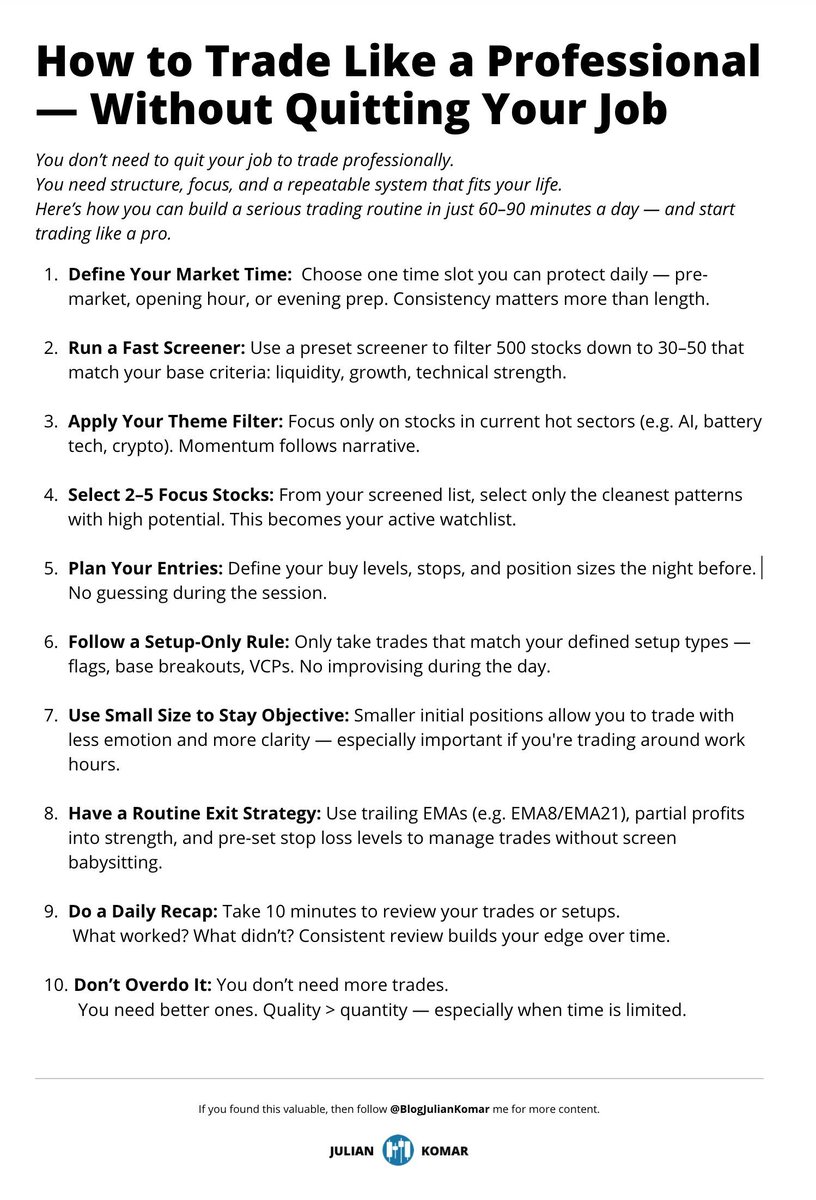
You don't need to quit your job to trade like a professional.
I traded part-time for almost 20 years.
During that time I built a track record, managed my risk, and developed a repeatable system—all while having a full-time career.
Here's what made it possible:
• I focused on the daily chart, not minute-by-minute action.
• I prepared before the market opened and planned every trade in advance.
• I traded only a handful of high-quality setups.
• I accepted that missing trades was part of the process.
• I let my system do the heavy lifting—not my screen time.
Professional trading isn't about sitting in front of charts for 10 hours a day.
It's about making a few high-quality decisions with discipline and consistency.
A full-time job isn't your biggest obstacle.
A lack of structure is.
@BlogJulianKomar oops. meant 2 & 3.
I like 2-3 days of flat consolidation after a breakout in 2.
Usually a great sign of high demand for the breakout.
But 3 is good too.
@askalphaxiv What I really love about @askalphaxiv is that not only they've made following the literature much easier, but also they share the topline papers here in Twitter.
Well done! Really appreciate what you do for the scientific community.
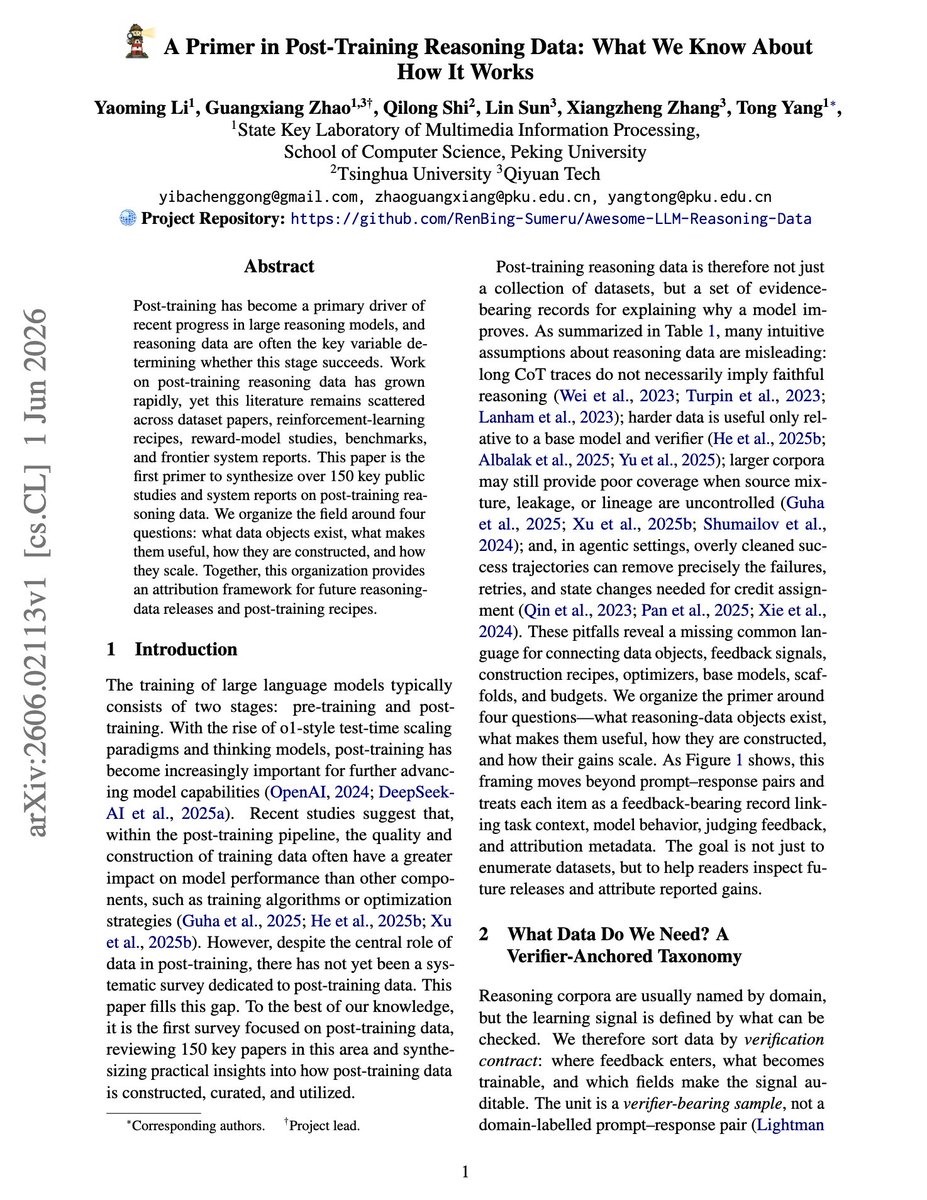
Nice primer on post-training reasoning data.
(bookmark it)
This is one of the first primers to pull the scattered post-training reasoning-data literature into one place, synthesizing over 150 public studies and system reports that previously lived across dataset papers, RL recipes, reward-model studies, benchmarks, and frontier reports.
It organizes everything around four questions. What data objects exist, what makes them useful, how they are constructed, and how they scale.
Paper: https://t.co/royylAHk3y
Learn to build effective AI agents in our academy: https://t.co/LRnpZN7L4c
Marriage counselor: I think at its core your relationship simply needs more patience, so let's try working on that
Couple: how much patience are we talking?
Counselor: are you familiar with the 2026 oil market?
@options_insight Interesting. But wouldn't this also be reflected in IV z-score (or percentile) of VIX?
Feels like a correlated measure with an added intuitive reasoning.