I just spent months handwriting a 200 page guide on the entirety of ML foundations and math from scratch.
The guide features:
- Neural Nets (Backprop, Adam, SGD, Batch Norm)
- ML Algorithms (SVM, Grad Boosting, K-means, PCA)
- Hardware (Tensor Cores, Systolic Arrays, CUDA)
- Transformers (Multi-Head Attn, KV Cache, LoRA)
- Vision (ViT, Convolutions, MAE, IoU, NMS, VLM)
- Agents (OpenClaw, ReAct, Memory, Orchestration)
Everything I wish I had years ago, for free.
I spent 4 brutal months building a full Stereo Visual SLAM system from scratch in C++17 + CUDA.
NO pre-made libraries. NO black-box magic.
I just wanted to understand the underlying mechanics behind SLAM.
Here’s the intuitive breakdown
(the full SLAM pipeline, the math that almost broke me, and the real KITTI footage)👇
cc @aelluswamy your work in this space is a massive inspiration for tackling this from absolute scratch
I implemented @GoogleResearch's TurboQuant as a CUDA-native compression engine on Blackwell B200.
5x KV cache compression on Qwen 2.5-1.5B, near-loseless attention scores, generating live from compressed memory.
5 custom cuTile CUDA kernels ft:
- fused attention (with QJL corrections)
- online softmax
-on-chip cache decompression
- pipelined TMA loads
Try it out: https://t.co/m5vkJxWIY6
s/o @blelbach and the cuTile team at @nvidia for lending me Blackwell GPU access :)
cc @sundeep@GavinSherry
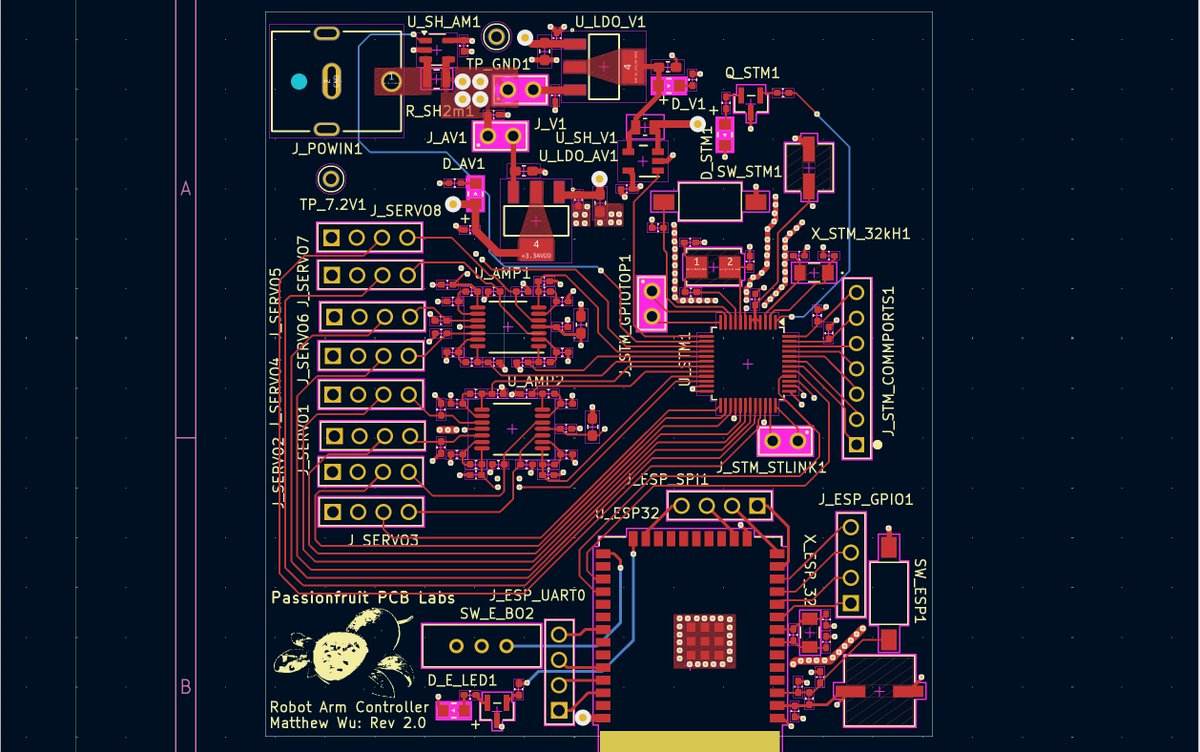
My 6-axis robotic arm controller PCB that I designed back in high school.
The v2 specs:
- 4-layer board, 12A max current
- Dual ESP32 + STM32 integration
- Custom op-amp servo feedback
- Optimized for thermals & signal integrity
- Fully validated
But getting to this point wasn't easy. I learned a lot the hard way.
v1 had major signal integrity issues that forced me to cut traces, add bodge wires, and do a ton of messy rework just to get basic functionality.
But that board forced me to learn:
power distribution, spacing, layout discipline, and hot loop control.
Now that exact stuff is the foundation for the RF + power electronics boards I design at UWaterloo.
🛟 Introducing Floaty for @float_financial
> me and @4derekwang went to the Susa x KP event
> thought about panel talk on: Execution > Idea
> decided to execute in 24 hrs
> researched and built an MCP over Float API with 60+ tools
shoutout @anirudhbv_ce@gtskeg@shaheersan
🤵 we built @cursor_ai for fashion
> made it in 24hrs @ nexhacks (cmu)
> got noticed by vcs and businesss
> now we’re building it for production as an ai stylist
@4derekwang@YTExo1k@dishes_io
cannot fathom how Waterloo students are this locked in. just organized a project building event in uw cs club.
damn these waterloo students are cracked. 👩💻