Building a startup means staying close to the market, and sometimes the biggest opportunity isn’t the one you started with.
That’s been the journey for @linewiseAI. The company began on the factory floor, and after following the market to a growing need for real-world training data for robotics and physical AI, they’re returning to the name where it all started. This time, with a much broader scope.
As physical AI advances, video is only part of the picture. Linewise is expanding across the full manufacturing process, capturing the data behind how things are designed, built, and improved. The longer-term vision is Physical RSI: a world where AI and robots can learn from this industrial knowledge to help design, manufacture, and continuously improve physical things.
This is a great example of evolving the company around what you learn.
Excited to see what @jameskujkrub, Zhichu Ren, @WillWenboWang, and the Linewise team team build from here!
Learn more: https://t.co/MLXDePE7ic
@christine_tsai@TonyW@vishalharnal@atxfrench@leoclee
We're Linewise again. The line is where things get made, and wise isn't only knowing things. It's knowing the right way to do them.
Machines are learning to build in the physical world. Almost everything they need is already on the floor, in the hands of people who do the work every day. We're making sure none of it gets lost.
Introducing "Scaling In-Context Imitation Learning" (SAIL) to be presented at #IROS2026. This work is a collaboration between Sakana AI and the University of Tokyo.
Blog: https://t.co/b6xgwIMkUP
What does a robot need before it can tackle a new task?
Teaching a robot something new usually starts with collecting demonstrations and training a policy. But foundation models have already learned from vast amounts of images, text, and robotics-related data. We wanted to see how much of that knowledge we could draw out for robot control without changing the model itself.
Recent demonstrations suggest that GPT-6 Astra can operate physical robots alongside its general language and vision capabilities. Earlier work has also shown that LLMs/VLMs can generate entire sequences of robot movements from a few demonstrations.
However, a foundation model does not necessarily produce a reliable robot trajectory in a single generation. Performance depends on the context provided, and a small error in a movement target can cause the entire task to fail.
We propose SAIL, a method for more reliable VLM-based robot trajectory generation through test-time scaling.
SAIL uses a policy VLM as a robot trajectory generator, conditioned on a few successful demonstrations. It tests the generated trajectory in a simulator and uses an evaluation VLM to review the resulting video and identify where progress stalled. The policy VLM then uses this feedback to revise the trajectory, with Monte Carlo tree search (MCTS) exploring alternatives while refining promising candidates. Only the selected trajectory is sent to the physical robot.
Across six manipulation tasks in simulation, increasing the search budget from one candidate to 45 raised the average rate of finding a successful trajectory from 25% to 73%. We also evaluated SAIL on a physical robot. Our results suggest that robot trajectory generation can benefit from test-time scaling, with additional computation enabling the model to test and refine its proposed actions in simulation.
We think there is more to learn about what existing models can do with this kind of feedback, and how far those improvements carry over to physical robots.
Paper: https://t.co/robokip5Nc 🐟
Sushi 🍣 + cocktails 🍸 + good company.
Join 500 Global for Investor Sushi Night: Japan during #SFTechWeek.
An intimate evening for venture investors to connect with peers, joined by Japanese founders participating in the J-StarX Silicon Valley Extended Program, who are spending the Fall in San Francisco and getting to know the local tech ecosystem. 🇯🇵✨
No pitches, no structured intros, and no fundraising agenda. Just an opportunity to meet interesting people, and enjoy great food and conversation.
🗓 Thu, Oct 8 · 6 - 8pm PDT
📍 San Francisco
🎟 Free · Approval required · Request to attend:
https://t.co/QNLn0ooje1
@JETRO_jgc@JETRO_info
Introducing the Sakana AI Frontier Intelligence Group 🪷
https://t.co/wdVBRGcIGI
Current AI systems are incredibly capable, but is intelligence “solved”? And if not, what’s missing?
At Sakana AI’s Frontier Intelligence Group (FIG), we believe that there are still breakthroughs to be made in AI. The Transformer and language modeling may be incredibly powerful, but it doesn’t mean that better alternatives don’t exist.
Natural intelligence still beats artificial intelligence across many dimensions. Agents lack the deep insights and creativity of humans. Individual models require far more data than the brain to learn robustly, and require far more energy to run. If we set these as targets, what kinds of AI systems could we develop?
Research at FIG has sought to address the gaps between natural and artificial intelligence. Here are some of our works, and the fundamental research questions that motivated them:
• Continuous Thought Machines: How can we improve information processing by leveraging temporal dynamics?
• Augmented Lagrangian Predictive Coding: How can local learning solve multilayer credit assignment?
• Sparser, Faster, Lighter Transformer Models: How can we massively increase data efficiency and generalization?
• The AI Picbreeder Experiment: How can we make artificial open-ended systems?
• Smart Cellular Bricks: How can physical systems achieve collective intelligence and self-repair without a central brain?
We hope that this encourages other researchers to also explore different paradigms, and take a leap of faith with us. After all, in the words of a dear friend of ours, “greatness cannot be planned”.
The slope of progress changes when the right people end up in the same room.
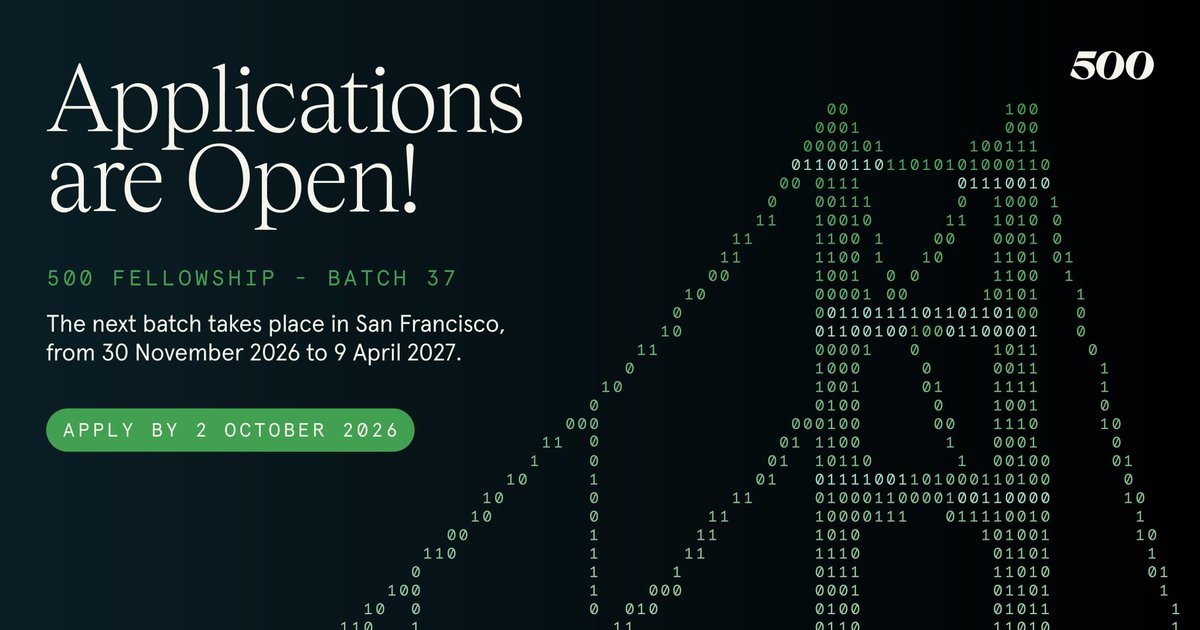
500 Fellowship Batch 37 is open. 4 months in SF, Nov 30 → Apr 9. Founders can receive up to $50K with potential for up to $1M.
Apply by Oct 2: https://t.co/u8Wv3RflWz
Massive Bio is expanding into South Korea, appointing Intralink to build relationships with hospitals, labs and oncologists across the country's oncology sector, strengthening our real-world data network for pharma partners across Asia.
Read more: https://t.co/DZNjQQS1n0
#Oncology #ClinicalTrials #PrecisionMedicine #SouthKorea #CancerCare
For @trans_celestial, AI infrastructure doesn't stop at the data center.
As AI compute and data centers move into orbit, Co-founder & CEO @jharohit believes we can no longer rely on communications technology developed more than 100 years ago to move ever-growing amounts of data.
His answer: take the light inside fiber optic cables and run it wirelessly. Transcelestial's laser communications systems use AI to precisely point and track lasers across ultra-long distances, creating high-bandwidth links between satellites and back to Earth.
The bigger vision is to build the connectivity backbone for the space economy, supporting satellite networks, orbital data centers, and eventually AI and robotics deeper into space.
Great to see Rohit share this vision on NYSE Live. Full conversation below 👇🏻
@vishalharnal@khailee@AriefJohan@atxfrench
Radio has hit its limit in space.
One image from Mars can take almost a day to download. Closer to home, the problem is scale.
Satellites already collect more data than radio can send down, and AI and data centers moving into orbit will multiply that many times over. Radio spectrum is limited and crowded. It can't keep up.
Our CEO @jharohit joined @NYSE Live to explain what replaces it: laser links that carry fiber-grade data between satellites and down to Earth.
Most AI models are trained to be assistants. @humansand is exploring a different category: AI designed to model people.
The team introduced Persimmon, a large-scale user model designed to simulate how people behave in multi-turn, multi-user conversations, including how differently people communicate, share information, and change over time.
Starting from NVIDIA’s 550B-parameter Nemotron 3 Ultra, Persimmon was mid- and post-trained on a diverse collection of public conversations between people, using thousands of Blackwell-generation GPUs on the team’s recently built cluster.
In testing, Persimmon’s conversations were significantly harder to distinguish from human conversations than those generated by frontier assistant models prompted to simulate people.
It’s an interesting direction for AI that can better understand differences between people and explore how they may respond as situations unfold.
Congratulations to co-founders @gharik, @ericzelikman, @YuchenHe07, @noahdgoodman, and the humans& team!
More on Persimmon, including limited research preview access: https://t.co/Ntks8KGm51
@christine_tsai@TonyW@vishalharnal@atxfrench@leoclee
For AI to work with us, it needs to understand us
Today, we're introducing Persimmon, the first large-scale model designed to realistically simulate how people talk and interact
For founders without large content teams, video creation can still be a heavy lift. @chin_jlyc has created @videoclaw , a video creation agent that's simple enough, yet powerful enough
Start with an idea, reference link, or raw footage, then use the agent to script, generate, and refine launch videos, demos, ads, and more.
Congrats on the launch, @chin_jlyc 🚀
AI video creation is getting more powerful, but only a few have figured it out.
Thats why I built Videoclaw.
I want it to be so easy, you don't need to figure it out. Just prompt, and watch it edit, generate and create video :)
Today we launch.
The video was made entirely with Videoclaw, blending human and generated footage. To show how truly easy it is, prompts and proofs for each project are in the thread.
Try it for free.
Oh, and there’s one more thing 👇
Access to reliable compute is becoming a key differentiator for AI companies running production workloads.
Singapore-founded Aolani is partnering with FriendliAI to supply the GPU cloud infrastructure supporting its growing inference services globally and increasingly across Asia.
Purpose-built for AI workloads, Aolani combines GPU infrastructure with orchestration, automation, and lifecycle management to help AI-native companies deploy and manage compute more efficiently. For FriendliAI, that infrastructure will support growing customer demand for fast, reliable inference across open-weight and custom AI models.
Excited to see Aolani becoming an infrastructure partner to AI companies building for global demand.
Full story here: https://t.co/Ljza2RIH4j
@vishalharnal@khailee@ariefjohan@atxfrench
Algolia is now available as a native integration in the Vercel Marketplace, putting AI-powered search directly where applications are actually being built.
Developers can add @algolia without creating another account, managing another set of credentials, or introducing a separate billing relationship. And with Agent Studio supporting the Vercel AI SDK, that extends to conversational search that can interpret intent and determine the appropriate indices, filters, and search parameters.
Algolia already handles more than 1.75 trillion queries annually across 18,000+ businesses. Integrations like this become even more powerful as sophisticated AI capabilities become building blocks developers can readily incorporate into their applications.
Full story here: https://t.co/BYcG3CL3oG
@christine_tsai@TonyW@vishalharnal@atxfrench@leoclee
Algolia is now a native integration on the Vercel Marketplace.
Click install, pick a plan, deploy. Your API keys are already in your env vars and usage bills through Vercel.
Free tier: 10k transactions/month.
see: https://t.co/1CV22uTgsk
Sakana AI’s new Fugu Max and Fugu Ultra v2 models are their strongest evidence yet for the power of orchestration.
Fugu coordinates a diverse pool of models, dynamically selecting the right combination for each task. Fugu Max delivers performance within striking distance of elite models, with output pricing 40–60% lower than several competing models, while Fugu Ultra v2 achieved the best or joint-best result on 5 of 8 challenging benchmarks.
Notably, Ultra v2 achieved those results without Fable 5, Fable 5.1, or GPT-6-Astra in its agent pool.
We’re excited to see @SakanaAILabs keep pushing orchestration forward, and demonstrating how smarter coordination between models can open up new paths to both capability and efficiency.
More details here: https://t.co/7yk5EALcMO
@christine_tsai@TonyW@vishalharnal@atxfrench@leoclee
Introducing Fugu Max and Fugu Ultra v2: the next evolution of Sakana Fugu’s multi-agent orchestration system.
Try: https://t.co/hhO6qT9YqD
Blog: https://t.co/vjyNB5lWGp
The frontier that actually matters is the Pareto frontier: capability on one axis, cost on the other. But the industry still treats it as a static menu of isolated models. Today we are resolving that with a dynamic architecture:
Fugu Max expands the Pareto efficiency frontier. By orchestrating our largest pool of open-weights and specialized models to date, including NVIDIA Nemotron family, it dynamically routes tasks to the leanest capable model. Fugu Max delivers performance within striking distance of elite models at two to six times lower cost.
Fugu Ultra v2 pushes the peak capability of orchestration higher than ever before. On Chartography, it outperforms Opus 5 and Fable 5. On DeepSWE, it outperforms models that cost three to five times more per token. Crucially, it does all of this without Fable 5, Fable 5.1, or GPT-6-Astra in its agent pool.
The Fugu orchestration system evolved with model resiliency in mind. It does not rely on individual frontier models to deliver frontier output. By orchestrating a swappable pool of open and specialized models, it outperforms closed ecosystems while protecting users from vendor lock-in, API revocations, and sudden service cutoffs.
Fugu Max expands the Pareto frontier outward. Fugu Ultra v2 pushes it upward. Orchestration does not force a choice between cost and capability. It advances both simultaneously.
Talkdesk and Microsoft are expanding their partnership, allowing enterprises to put existing Azure commitments toward Talkdesk CXA through the Azure Marketplace.
What stands out is how @Talkdesk is approaching automation. CXA is designed to move beyond bots that hand work back to humans, coordinating specialized AI agents to access enterprise data and complete workflows across existing business systems.
Just as importantly, companies don’t need to rebuild their contact center around AI. CXA works across cloud, hybrid, and on-premises environments, bringing more capable automation into the technology environments enterprises already operate.
Full story here: https://t.co/lqyLTMQWbN
@christine_tsai@TonyW@vishalharnal@atxfrench@leoclee
Talkdesk and Microsoft are expanding our partnership to accelerate AI automation for enterprise contact centers worldwide!
Want to learn more?
Check out the press release linked below:
https://t.co/ULyTs8Y8hT
#CXA#Talkdesk#Microsoft
Introducing Site Survey by eino: an AI-native validation solution for private cellular, DAS, and Wi-Fi.
Every measurement lands in your site's digital twin. Agents compare deployed vs. designed and recommend fixes.
Available now: https://t.co/B8YTSDgjbz
Persimmon is a genuinely different idea: a model of how people actually talk, not another assistant.
Proud to support @humansand on this launch with DeepCluster, a dedicated NVIDIA Blackwell cluster we deploy and operate.
Excited to see where it goes.
https://t.co/cCABZaMiap