Jev is a new type of model that is optimized for making decisions, not generating text
This is the best article I’ve found so far breaking down how it works - required weekend reading imo
Anthropic just dropped a 3-hour course on how to actually master Claude Code, taught by the engineer who built it:
00:07 – everything new in Claude Code
24:39 – Boris Cherny builds a full app live
55:38 – the complete prompting playbook
1:29:07 – the "thinking" lever almost everyone misses
1:52:58 – how to pick the right model for the job
2:24:22 – how Anthropic itself codes with Claude
This 3-hour watch will replace 10 paid Claude Code courses on the internet.
Watch it now, then read how to build an AI that codes while you sleep, in the article below.
Fable 5 returns today. That makes this pattern more relevant.
The pattern is:
> Fable 5 as advisor
> Sonnet 5 as efficient implementer
Another option is to use GPT-5.5 as implementer in Claude Code with the Codex plugin. You can use it with your ChatGPT sub.
Then, of course, we know GPT-5.6 comes soon too, and you’ll be able to add it into this pattern.
Also new in Claude Code: dynamic workflows (research preview).
For the hardest tasks, Claude makes a plan, runs hundreds of parallel subagents, and verifies its work before reporting back. Think a migration touching hundreds of files.
Read more: https://t.co/7gt06kGkDN
Google acaba de hacer algo que Claude Design no esperaba.
Y lo hizo gratis, en abierto, para todo el mundo.
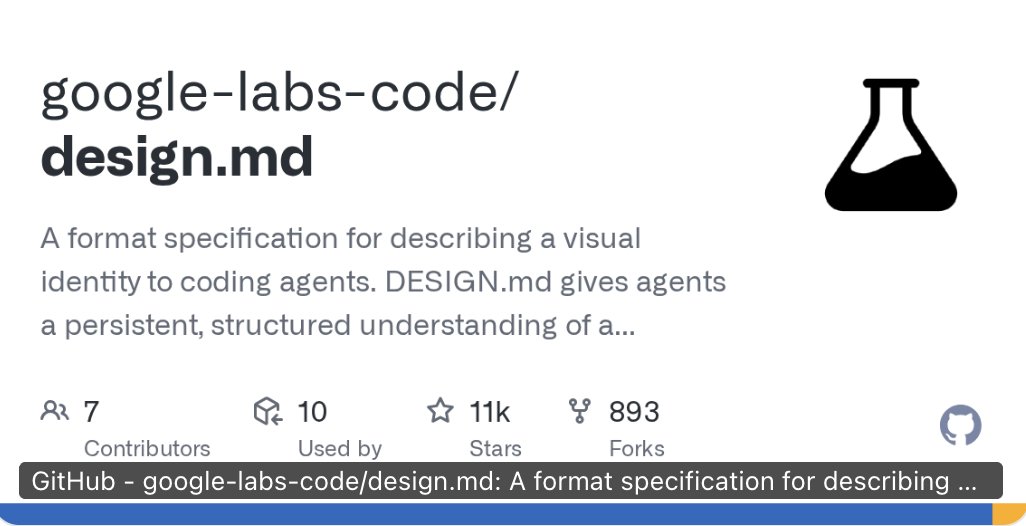
Se llama DESIGN.md.
Pero primero hay que hablar de lo que provocó esto.
Anthropic lanzó Claude Design con límites de uso ridículos.
Cerrado. Caro. Controlado.
La herramienta de diseño con IA más potente del momento, pero con la llave en su bolsillo.
Google vio la jugada.
Y respondió de la única forma que duele de verdad:
Abrió el código. Gratis. Para todo el mundo.
Se llama DESIGN.md.
Un estándar abierto que cualquier IA puede leer.
En cualquier herramienta. En cualquier plataforma.
El problema que resuelve es real:
Los agentes de IA no tienen ni idea de tu sistema de diseño.
No saben qué significa tu color primario.
No saben si ese botón es accesible.
No saben para qué sirve cada componente.
Cada vez que usabas IA para diseñar, empezabas de cero.
DESIGN.md lo resuelve con un solo archivo.
Tres cosas concretas que hace:
1️⃣ Tokens de diseño
Tus colores, tipografías y espaciados con descripciones en lenguaje natural.
La IA entiende para qué sirve cada valor, no solo cuál es.
2️⃣ Validación de accesibilidad
El agente comprueba sus decisiones contra las reglas WCAG.
Sin que tú tengas que revisar cada detalle manualmente.
3️⃣ Portabilidad total
Exportas e importas tus reglas de un proyecto a otro.
Un archivo. Cualquier herramienta. Cualquier plataforma.
Incluidas las de Anthropic.
Eso es lo que más duele en ese lado de la mesa.
Anthropic construyó muros.
Google tiró la pared entera.
El repositorio está en GitHub: https://t.co/UJ5RVJPvwJ
Esto es lo que pasa cuando los grandes se pelean.
Nosotros ganamos.
🚨 Anthropic's own team just showed how to actually use Claude Code properly.
30 minutes. free. the person who created Claude Code.
watch the workshop. bookmark it.
worth more than every $500 course you almost bought.
you've been using Claude without knowing 40 of its commands.
Then read the guide below.
A Rust dev just killed Headless Chrome.
It's called Obscura. The open-source headless browser purpose-built for AI agents and scrapers at scale.
Chrome vs Obscura:
- Memory: 200MB+ → 30MB
- Binary: 300MB+ → 70MB
- Page load: 500ms → 85ms
- Startup: 2s → Instant
- Anti-detect: None → Built-in
Single binary. No Node, no Chrome, no dependencies.
Stealth mode is brutal:
→ Per-session fingerprint randomization (GPU, canvas, audio, battery)
→ 3,520 tracker domains blocked by default
→ navigator.webdriver masked to match real Chrome
→ Native function masking so detectors can't sniff it out
Drop-in replacement for Puppeteer and Playwright over CDP. Zero code changes.
If you run agents or serious scraping at scale, this repo prints money.
100% Opensource.
Stanford just released a 1.5-hour lecture on “LLM Architecture.”
This is the exact thing systems engineers at Anthropic and OpenAI require to understand at a deep level.
Give it some time.
This might be the highest-ROI learning you do this month.
Anthropic pays engineers $750,000+ a year to understand how LLMs work.
Stanford just put a 2 hour lecture that covers 80% of it for FREE.
Bookmark this. Give it 2 hours today.
It might be the highest ROI thing you do this month:
대한민국에서 평생 돈 마를 일 없는 사업 TOP 5
1. 남자의 성욕: 데이팅 앱, 성인용품 등 본능은 불황을 모른다.
2. 여자의 미(美): 죽을 때까지 예뻐지고 싶은 욕구는 지갑을 열게 한다.
3. 자녀 사교육: 내 아이만큼은 성공시키겠다는 부모의 집념은 무적이다.
4. 노인 건강: 죽음 앞에서는 그 어떤 비용도 아깝지 않은 법이다.
5. 빈자의 조급함: 부의 지름길을 찾는 이들의 열망이 교육 시장을 폭발시킨다.
6. 아이러니: 결국 이 모든 것을 가르치는 '강의팔이'가 제일 부자가 된다.
7. 결론: 기술 이전에 '사람의 결핍'이 어디에 있는지부터 찾아라.
Now that ZKEVMs are at alpha stage (production-quality performance, remaining work is safety) and PeerDAS is live on mainnet, it's time to talk more about what this combination means for Ethereum.
These are not minor improvements; they are shifting Ethereum into being a fundamentally new and more powerful kind of decentralized network.
To see why, let's look at the two major types of p2p network so far:
BitTorrent (2000): huge total bandwidth, highly decentralized, no consensus
Bitcoin (2009): highly decentralized, consensus, but low bandwidth - because it’s not “distributed” in the sense of work being split up, it’s *replicated*
Now, Ethereum with PeerDAS (2025) and ZK-EVMs (expect small portions of the network using it in 2026), we get: decentralized, consensus and high bandwidth
The trilemma has been solved - not on paper, but with live running code, of which one half (data availability sampling) is *on mainnet today*, and the other half (ZK-EVMs) is *production-quality on performance today* - safety is what remains.
This was a 10-year journey (see the first commit of my original post on DAS here: https://t.co/Fa0jKFgObW , and ZK-EVM attempts started in ~2020), but it's finally here.
Over the next ~4 years, expect to see the full extent of this vision roll out:
* In 2026, large non-ZKEVM-dependent gas limit increases due to BALs and ePBS, and we'll see the first opportunities to run a ZKEVM node
* In 2026-28, gas repricings, changes to state structure, exec payload going into blobs, and other adjustments to make higher gas limits safe
* In 2027-30, large further gas limit increases, as ZKEVM becomes the primary way to validate blocks on the network
A third piece of this is distributed block building.
A long-term ideal holy grail is to get to a future where the full block is *never* constituted in one single place. This will not be necessary for a long time, but IMO it is worth striving for us at least have the capability to do that.
Even before that point, we want the meaningful authority in block building to be as distributed as possible. This can be done either in-protocol (eg. maybe we figure out how to expand FOCIL to make it a primary channel for txs), or out-of-protocol with distributed builder marketplaces. This reduces risk of centralized interference with real-time transaction inclusion, AND it creates a better environment for geographical fairness.
Onward.
The best indicator you will ever find is not on TradingView.
It has no settings, no parameters, and does not need to be optimised.
It is your mind.
Because you can have the best strategy in the world, the perfect levels, the right confluences... but if you are not stable inside, you will ruin everything anyway.
It is not the market that screws you over.
It's you, when you get caught up in anxiety, haste, the desire to recover, the euphoria after a win.
The chart doesn't force you to click.
It doesn't force you to increase your size.
It doesn't force you to move your stop.
Those are your choices.
And that's where you see the difference between those who survive over time and those who burn through everything in a few months.
When you learn to manage yourself, trading becomes strangely simple.
Not easy — but simple.
You know when to enter.
You know when to stay put.
You know when enough is enough.
And that's why, in the end, the real edge is not an indicator, it's not a pattern, it's not a secret strategy.
It's your ability to stay clear-headed when everything around you is noise.