@CatSE___ApeX___@Defiantclient2 Do they even have plans to do a 3 engine with SRBs? And we don’t even know if this vehicle is designed to take the force of 6 SRBs at launch. I think our best chance in the near term is just the h3-24
@Defiantclient2@GewoonLukas_@AST_SpaceMobile Wikipedia says the 24L gets about double the payload to LEO vs GTO so if we go off that the 22L would only be ~8tonnes to LEO, so 1 maybe 2 BB’s. I think having the 4 SRB’s on the 24L/24W is the only way to get 3 up there
@8lackPrince@booster_10 In the stream they said it was an adhesion failure and subsequent delamination between the cfrp outer shell and the sandwiched aluminium honeycomb structure of the payload support structure (PSS)
To help you mentally my dear followers.
I've been DOWN close to -50% three times in my life.
1. 2008 housing crisis
2. 2020 COVID
3. 2022 banking crisis
And each time, my portfolio went back to all-time highs within a year or less.
RED is temporary.
Do NOT have short-term thinking.
You are scared, but THIS is where millionaires are made.
Let's take this opportunity together.
@CytoplasmicANA@Defiantclient2 Traveling boomers have a *lot* of money here and camping/roadtrips are deeply rooted in Australian culture. User uptake and ARPU will be among the highest of western countries
2/2 at the same time there has been a breakdown in the correlation between the put/call ratio and open interest. This could be large call positioning prior to launch campaign, shorts hedging with calls, or other? Interested in others thoughts on this
$ASTS: 💡Some info on AST bandwidths and speeds
@AST_SpaceMobile bandwidth will be shared by all simultaneous users using the service at the same time within a beam.
The number of simultaneous beams per satellite will also depend on availability of spectrum.
+ Block 1 FPGA has 1,000 MHz processing capacity.
+ Block 2 FPGA has 3,000 MHz processing capacity.
+ Block 2 ASIC has 10,000 MHz processing capacity.
Divide the capacity by size of MHz channels to get your total number of beams. For example, assuming for 10 MHz channels:
+ Block 1 FPGA can support 1,000 / 10 = 100 beams
+ Block 2 FPGA can support 3,000 / 10 = 300 beams
+ Block 2 ASIC can support 10,000 / 10 = 1,000 beams
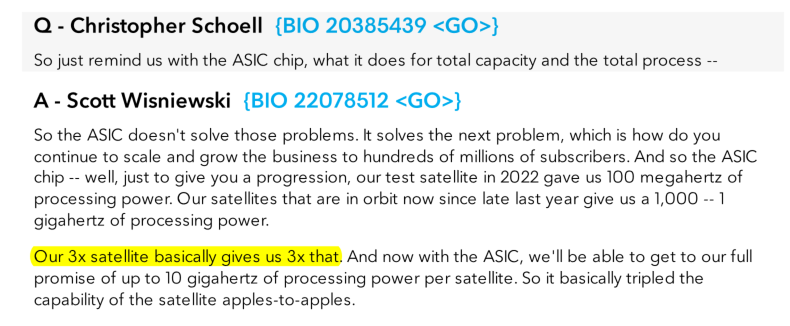
Source for Block 2 FPGA providing a processing capacity of 3,000 MHz is @scottwisniews at the @UBS Global Media and Communications Conference on December 8, 2025, screenshotted below.
Then, using their status quo spectral efficiency of 3 bits/Hz, each beam with 10 MHz channel can support up to 30 Mbps downlink and around 15 Mbps uplink (half of downlink).
You can play with your own assumptions using the above info.
Note that using MIMO technology, @VodafoneGroup has stated that the spectral efficiency will double to 6 bits/Hz. Then, using @pulsone's Universal Spectrum Multiplier, spectral efficiency should increase further by another 50%+, leading to 9 or 10 bits/Hz minimum. I outline some specific examples here: https://t.co/js25dVbpvH
For more FAQ, please visit my page: https://t.co/wQfxs6Y3Iz