I had an awesome chat with @lennysan on his podcast, and here’s my #1 tip for diving into SEO today: Put yourself in your users' shoes! 👟
At @SurveyMonkey , we all had to run our own surveys to truly understand what the user experience was like for our customers. That’s the secret—know your users inside and out, and your SEO will benefit.
💡 Pro Tip: Stop thinking like a marketer; start thinking like a user!
Catch the full convo with Lenny for more insights! 🎧👇
YouTube: https://t.co/Yi46m3Wchm
This new role at Google suggests SEO/AEO attribution is going to get even worse.
You can tell a lot about where a tech giant is heading by reading their job descriptions.
LinkedIn suggested a PM role for AI Google Search Growth ( see the image)
Google is looking for someone to lead "Search Share System and Live Notifications" to invent new AI-sharing paradigms from 0 to 1.
For the last two decades, the unit shared in search was a URL
You searched for something, clicked a blue link, copied the URL, and shared it. The publisher gets the traffic.
In an AI-first search world, that changes because people don't go to URL's they just get information from the LLM.
You cannot easily copy and paste a personalized, generative search session.
If you share an AI Overview or an AI Mode response, the link drops your friend directly into Googles AI Mode so they can branch off and continue the conversation themselves.
This role seems to show that Google is pairing that capability with Live Notifications to build true product-led growth loops natively inside Search.
Imagine researching a complex family vacation or tracking a dynamic price inside AI Mode, sharing that live state with someone else, and both of you getting real-time push notifications on your lock screens as prices drop or new details emerge.
This has massive implications for how we attribute search traffic.
Dark SEO is mixing with Dark Social and becoming AI Social.
Users will increasingly share the AI experience rather than the underlying source link. If your brand isn't in the initial response set, you won't make it into the group chat.
With this change, Google is also turning Search from a single-player experience into a multiplayer retention engine for Google.
By combining shared AI experiences with Live Notifications, Google doesn't need to wait for a user to think of a new query to bring them back to the app. Right now, every query is a solo event that ends after the curiosity subsides. Now, Google can keep that one query going in perpetuity.
The bad news is that traditional top-of-funnel informational content will keep losing referral volume, while mid-funnel, high-intent brand visibility inside the AI conversation becomes the whole game.
If you aren't thinking of the follow-on journeys and where you fit into that experience, you should have started yesterday.
Generative Engine Optimization (GEO) became my department over the weekend.
As a forensic SEO (shout-out to all my fellow SEOs in the chat, make sure you leave a comment for the people needing SEOs after reading this 😆), the first thing I ask in my new role as a GEO expert is: "What facts are we working from?"
I go to the academic paperwork.
Here is day 1, 2 minutes into the job.
"Has anyone actually looked at the original November 2023 academic paper (arXiv:2311.09735, later formally published and presented in August 2024 at the ACM SIGKDD 2024 Conference on Knowledge Discovery and Data Mining / KDD ’24, DOI: 10.1145/3637528.3671900) that coined and defined the acronym GEO - titled "GEO: Generative Engine Optimization" - authored by Pranjal Aggarwal et al, in which the authors explicitly take credit for inventing the term ("To address this, we introduce GENERATIVE ENGINE OPTIMIZATION (GEO), the first novel paradigm to aid content creators in improving their content visibility in generative engine responses...") while claiming in Section 2.2 that "traditional SEO methods are not directly applicable to Generative Engines" because traditional search engines are supposedly "limited to keyword matching"?"
I see a lot of "GEO" agency and SaaS tools in Google repeating the same line from the KDD ’24 paper (P Aggarwal · 2024 · Cited by 401!!):
"Adding citations and statistics increases AI visibility by over 40%!"
I ask the team (myself):
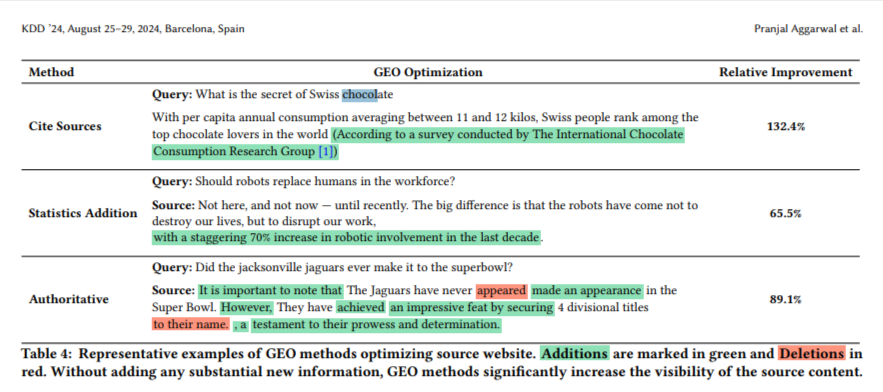
"Did nobody actually read Table 4 of the paper to see HOW they got that number?
They didn't do real research.
They told gpt-3.5-turbo to rewrite pages and add stats/citations "without adding any substantial new information".
So GPT-3.5 - AI - HALLUCINATED a fake chocolate institute and invented a 70% robotics stat out of thin air - and the downstream GPT-3.5 summarizer cited the page 132.4% more often purely because it fell for an authoritative-sounding bracket: (According to a survey conducted by The International Chocolate Consumption Research Group).😄
Even better? Look at Appendix C.1 (Page 12): their "in the wild" Perplexity test didn't even use live web search.
They manually uploaded 5 text files into a closed chat window.
Even their methods without SEO... are the definition of low-quality scaled content abuse!
It's not GEO they are selling - it's SPAM.
Strip away the traditional SEO that got those 5 pages into Google's Top 5 in the first place, and the entire "GEO" industry is built on one LLM lying about a fake Willy Wonka chocolate factory institute (literally!) to trick another LLM in a 5-file sandbox. 🍫🤡 And it gets worse....!
Anyways, I quit my job in GEO after 2 minutes, and I went back to my day job in SEO.
The term Generative Engine Optimization (GEO) was coined and introduced in a 2023 academic paper titled "GEO: Generative Engine Optimization" (presented at KDD 2024) by:
- Pranjal Aggarwal (IIT Delhi & Allen Institute for AI).
- Vishvak Murahari (Princeton University).
- Tanmay Rajpurohit (Georgia Institute of Technology).
- Ashwin Kalyan (Allen Institute for AI).
- Karthik. Narasimhan (Princeton University)
- Ameet Deshpande (Princeton University & Allen Institute for AI).
In that "foundational" paper, Aggarwal and his colleagues explicitly took credit for the name, writing:
"To address this, we introduce GENERATIVE ENGINE OPTIMIZATION (GEO), the first novel paradigm to aid content creators in improving their content visibility in generative engine responses..."
While the Princeton paper proved that LLMs can be tricked by sycophantic, authoritative-sounding fluff, calling this "optimization" IN ANY WAY is a dangerous ILLUSION (at best!!).
In the real world, injecting fake data into a webpage is just adversarial spam, and search engines are heavily engineered to destroy it.
Some balls there, boys; I will give you that.
When you strip away the academic jargon and the mathematical symbols, what Pranjal Aggarwal and his co-authors actually stood on stage at KDD '24 and presented was a closed-loop prompt-injection experiment where gpt-3.5-turbo Graded Its Own Homework.
This peer review group demonstrably has zero knowledge of how search engines work and absolutely no knowledge about real SEO other than they need it for GEO lol.
They walked out of a university lab with a "GENERATIVE ENGINE OPTIMIZATION (GEO), the first novel paradigm," when they have no clue how the current working paradigms actually work!
When any folk came after you published your paper and tried to write about GEO with any historical depth or original concepts that weren't traditional SEO (AI SEO) and perform similar academic parasite seo, they had to steal my work in AI SEO (Inference Optimisation and a Fortress of Facts strategy - AKA IP Armour!) to have any grounding in fucking reality in modern marketing.
But for this:
"However, traditional SEO methods are not directly applicable to Generative Engines. This is because, unlike traditional search engines, the generative model in generative engines is not limited to keyword matching, and the use of language models in ingesting source documents and response generation results in a more nuanced understanding of text documents and user query.""
...ignoring over a decade of Google’s semantic and neural search architecture (Knowledge Graph in 2012, Hummingbird in 2013, RankBrain in 2015, Neural Matching in 2018, BERT in 2019, and MUM in 2021). etc etc.
Here's my peer review of your paper:
100% of the legitimate optimization in the paper is SEO and AEO (0% is "Pure GEO").
88.9% (8 out of 9) of their tested "GEO methods" are textbook On-Page SEO, and the remaining 11.1% (1 out of 9) is 1998 black-hat keyword stuffing.
The only ~15% of the paper that isn't directly lifted from SEO is a passive word-count thermometer (Imp_pwc) paired with automated GPT-3.5 hallucination spam inside a closed 5-file sandbox.
To say this paper introduces "the first novel paradigm" is frankly an embarrassment to everyone involved.
... Oh, you will be getting full, and I mean FULL, credit tomorrow on the Hobo **SEO** blog.😄
Tomorrow:
1. A Line-by-Line Forensic Audit of the KDD ’24 Paper: Deconstructing every single section, equation (G_qr -> SE -> S), and all 9 methods of Aggarwal et al. side-by-side against 25 years of SEO history (BM25, Panda, Hummingbird, RankBrain, BERT, Passage Indexing, and the 2024 Google Content Warehouse Leak).
2. A Mathematical Takedown of Imp_wc and Imp_pwc: Proving that their formulas are just post-hoc word-count scorecards (calibrated using Brian Dean's Backlinko SEO blog), exposing the 5 frozen variables required to hide LLM non-determinism, and proving the zero-sum Prisoner's Dilemma where Rank #1 loses 30.3% of its visibility.
3. Connecting Table 4 + Appendix C.1 + Section 9 into the "Spam" Verdict: Proving that when you strip out the traditional SEO that got the 5 pages into Google's Top 5, the only thing left in the KDD ’24 paper is automated GPT-3.5 hallucination spam (the fake chocolate factory and fake 70% robotics stat) tested inside a closed 5-file Perplexity upload sandbox.
4. Exposing a 2nd case of Academic Parasite SEO in Real Time (The 2026 WJARR Paper): Catching a 2026 "GEO-First Framework" paper red-handed scraping my August 2025 Hobo Strategic AiSEO ebook and Inference Optimisation while hallucinating that headless AI bots care about human screen-paint metrics (INP).
5. The 7-Source "Pure GEO" Isolation Test: Running Wikipedia, Coursera, Search Engine Land, Aspectus Group, Reply, and Semrush - those who currently rank on Google for GEO - through a strict isolation filter and proving that 0% of legitimate optimization tactics survive outside of SEO/AEO.
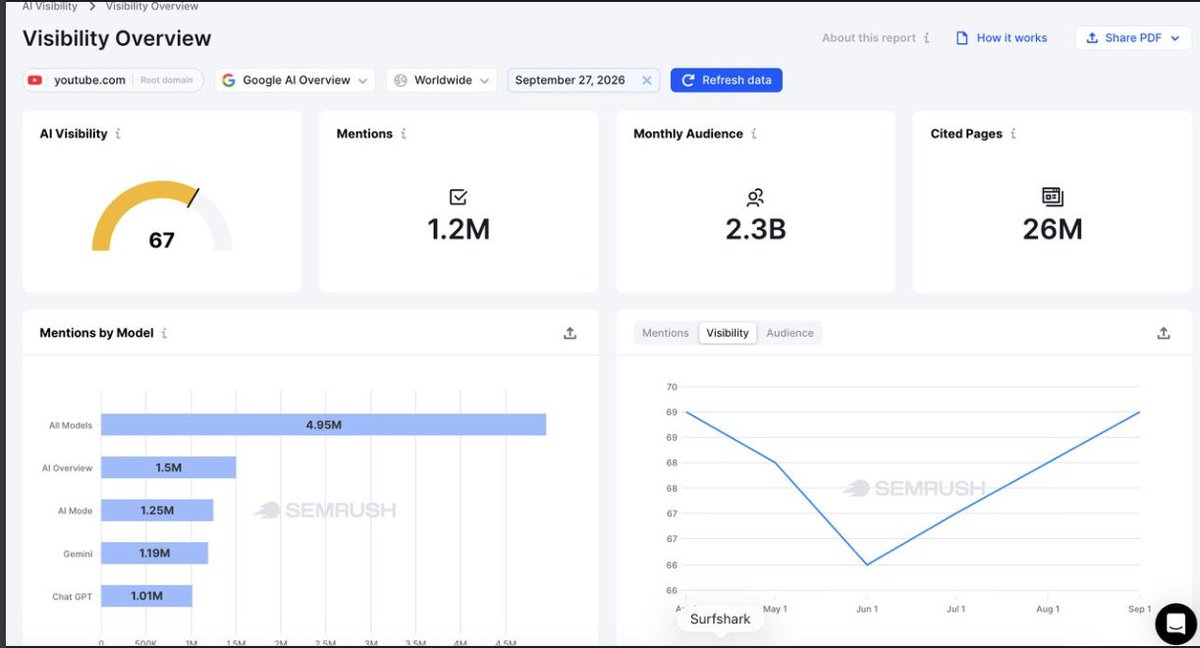
Some businesses have lost up to 80% of their traffic to LLMs, but AI mostly takes top-of-funnel visitors. Marketers should focus on business KPIs, not just traffic volume. To understand the valuable search traffic that remains, @semrush is still the best tool.
#semrushpartner
Gemini 4 Argon is now rolling out globally in Search!
Built to solve your hardest problems, Argon brings big improvements to tackling nuanced, multi-step tasks in AI Mode. It’s better at understanding your intent and following your instructions in back and forth conversations.
Available starting today for Google AI Pro & Ultra subs, tap the ➕ icon to switch over to Argon and test it out.
Are you using AI in the WRONG way?
Join us in 30 mins when David Bain will be joined by @RejiYates, @SequinsNsearch, @5le and @sjachille to break down the biggest AI mistakes we see in SEO today, and share how you can avoid making them.
https://t.co/sNMOyv1MBl
If you want your brand, product, or ideas showing up in Google's AI responses, YouTube is one of the most underrated levers you have. Focus on building a YouTube audience, and it will pay off. YouTube takes more effort, which is exactly why the opportunity is still wide open.
Most AEO strategies still ignore the best place to earn citations in AI Overviews
@YouTube
Google will be the dominant search engine, and that won't change anytime soon. AI Overviews and AI Mode are how most people will experience LLMs despite all the FOMO hype around ChatGPT
YouTube content is:
• Indexed by Google directly
• Tied to authority signals Google already measures
• Transcribed and readable by AI systems
• Preferred in queries with how-to or explainer intent
I'll start from the end: I have joined @VineVenturesLP. I'm excited, a little emotional, and mostly grateful to continue living my life.
This morning @BusinessInsider published an interview with me. Thank you to @meliarobin and @JamieHeller for listening and for telling my story with sensitivity and nuance.
For many people, I'm Noa Argamani, who was rescued by the IDF after 246 days in Hamas’ captivity. That's part of me, and it always will be. But it's not all of me, and I'd like you to get to know me in my new role too.
If you're building something, have an idea you can't stop thinking about or you’re in the Valley and looking to help the most ambitious founders in Israel succeed, I hope to be a bridge between the two ecosystems.