Been quiet on here, but @karpathy's #autoresearch pulled me back in. Amazing experimentation framework
I pointed it at a very old internet problem: GIFs.
One of the first non-default autoresearch experiments I wanted to try was to use the autonomous loop to search for a more efficient lossy GIF compression strategy.
Goal: beat the usual “GIF is portable but bloated” tradeoff with a workflow that preserves acceptable visual quality while pushing size down harder.
Running this on a @Runpod RTX 4090 now.
I’ll share the setup, metrics, and any interesting failures.
Clicky is an amazing tool so I forked it and added "proactive tutor mode":
It watches your screen and teaches you *without you asking anything*.
Every time you stop using your keyboard or your cursor, it gives you instructions/feedback.
Watch it teach me Figma in real time.
Two additional changes in my fork:
- auto copy the llm response to clipboard, when it helps you with writing (it helped me write this tweet)
- it only takes a screenshot of the window you are focused on, reducing llm confusion
i can spot a grifter from miles away.
so i digged into the code to figure out if this is legit or not.
guess i was right.
ben is a crypto founder who runs some weird bitcoin lending platform, i was pretty sure he knows absolutely nothing about ai and memory so i tracked down the repo myself since i was curious.
his website says he likes to build ai powered products and train local ai models? sure man, 80% of your github repo's are bitcoin related stuff. only one ai related project came up you forked in 2024.
mempalace has 10k github stars, more than 1k forks but only.. 7 commits ?
apparently the best memory layer to date?
no git author history, no account connected to whoever wrote the code of this codebase.
it doesn't add up..
the account who pushed the original repo, named: aya-thekeeper, under aya-thekeeper/mempal got deleted right after the repo got published.
you paid a random guy named lu to build this shit out for you.
( "Written by Lu (DTL) — March 24, 2026.
For: Ben." ) - benchmark md file.
lu wrote the code. lu wrote the benchmarks. lu is nowhere in the readme. or mentioned in the github history?
the git history then got squashed to one commit and published under milla jovovich? seriously? a actress?
you say she is a great friend of yours, she has been building this project with you. she does this at night.
yet she has.. 7 commits and only 2 active days in her entire github history?
you paid an actress and a random guy to promote a product you know absolutely nothing about.
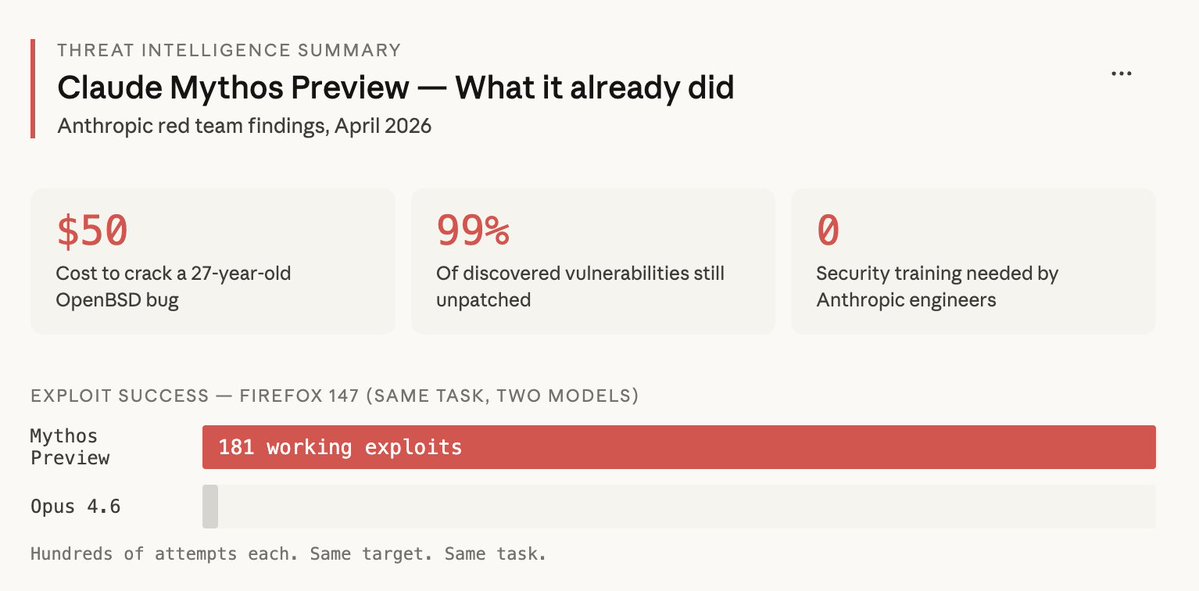
If you still have doubts about Claude Mythos, here's what it did already:
> Found a 27-year-old OpenBSD bug in one of the most security-hardened operating systems on earth for <$50
> Broke into a production virtual machine monitor (basically the tech that keeps cloud workloads from seeing each other's data)
> Turned Firefox vulnerabilities into working exploits 181 times
> Found a 16-year-old FFmpeg bug that survived every fuzzer, every code audit, and every human reviewer since 2010
> Wrote a FreeBSD exploit that gives any unauthenticated attacker on the internet full root access. No human was involved after the first prompt.
> Chained 4 separate vulnerabilities together to build a browser exploit that escaped both the renderer and the OS sandbox
> Found critical holes in every major web browser and every major operating system
> Gave Anthropic engineers with zero security training a complete and working exploit by morning
> Cracked cryptography libraries protecting TLS, AES-GCM, and SSH
Modern DRAM is based on a brilliant design from IBM.
But, we're still paying for a latency penalty that's existed since the 60s!
In this video, I'm introducing my research project (Tailslayer) that immensely reduces p99.99 latency on traditional RAM!
By implementing a hedged read strategy taking advantage of (undocumented!) channel scrambling offsets, I've gotten as much as 15x reductions in tail latency.
The technique works across Intel, AMD, Graviton, DDR4, DDR5, x86, ARM, you name it.
Check out the C++ lib I wrote, watch the video, and try it yourself!
24 hours of mempalace being open source. Here's what happened:
The dev community tore it apart. This is how open-source projects can improve:
AAAK was labeled "30x lossless compression." It's lossy summarization. Fixed.
Token counts used len(text)//3 instead of a real estimator. Fixed.
LoCoMo 100% was meaningless - top-k exceeded the corpus size. Acknowledged.
The 96.6% LongMemEval is real but it's session-level retrieval on ~50 candidates - not comparable to turn-level numbers in published papers. Point taken, we are not publishing a paper.
The benchmark scripts use vanilla ChromaDB. The palace structure only contributed a small amount to that retrieval score of the benchmark.
Yet, here is what actually works:
verbatim storage,
semantic search,
MCP integration,
fully local,
zero API cost.
That's the product: All free. All local. All open-source.
We also got:
14k stars
2k forks
70+ PRs from contributors
11 bugs fixed and merged so far
And... an independent BEAM 100K benchmark showed 49% on answer quality - because mempalace is a retrieval layer, not a reasoning engine!
Good news is that we shipped a public correction within hours, not weeks. We're going to keep doing that as much as possible.
Thanks to everyone who contributed so far.
https://t.co/mc5N0XqDiu
Claude Mythos.
Ten trillion parameters: the first model in this weight class. Estimated training cost: ten billion dollars.
On the hardest coding test in the industry (SWE bench) it scores 94%.
It found a security flaw in a system that had been running for 27 years, one that every human engineer and every automated check had missed. It found another bug that had survived five million test runs over 16 years. (It did so overnight.)
It is so capable in cybersecurity that Anthropic will not release it to the public, instead it is launching Project Glasswing along with 100m in compute credits to help secure software.
Only twelve partners currently have access: Amazon, Cisco, Apple, Google, Microsoft, NVIDIA, JPMorgan Chase, Crowdstrike, Palo Alto, AWS, The Linux Foundation, Broadcom. (I'm sure the Pentagon is on the line?)
This is not a product launch: it is a controlled deployment of a system too powerful to distribute freely.
Tell me this isn't (very expensive) AGI?
What if you could search 50M satellite image embeddings with no server, no database, and no API?
Part 2 of @calebrob6 and my series on Compressing Earth Embeddings is live at https://t.co/APYzK69GKP. We binarized the global Clay v1.5 Sentinel-2 embeddings from 183GB → 7GB and built TerraBit — a retrieval demo that runs with zero backend. DuckDB-WASM, cleverly partitioned GeoParquet on S3, and brute-force Hamming in an in-memory index makes the experience feel too good to be true.
If you also wondered how Google's TurboQuant fares on compressing earth embeddings -- don't worry, we got you covered in the blog -- hint: TurboQuant int4 is a solid choice
I built this thing called Clicky.
It's an AI teacher that lives as a buddy next to your cursor.
It can see your screen, talk to you, and even point at stuff, kinda like having a real teacher next to you.
I've been using it the past few days to learn Davinci Resolve, 10/10.
LLM Knowledge Bases
Something I'm finding very useful recently: using LLMs to build personal knowledge bases for various topics of research interest. In this way, a large fraction of my recent token throughput is going less into manipulating code, and more into manipulating knowledge (stored as markdown and images). The latest LLMs are quite good at it. So:
Data ingest:
I index source documents (articles, papers, repos, datasets, images, etc.) into a raw/ directory, then I use an LLM to incrementally "compile" a wiki, which is just a collection of .md files in a directory structure. The wiki includes summaries of all the data in raw/, backlinks, and then it categorizes data into concepts, writes articles for them, and links them all. To convert web articles into .md files I like to use the Obsidian Web Clipper extension, and then I also use a hotkey to download all the related images to local so that my LLM can easily reference them.
IDE:
I use Obsidian as the IDE "frontend" where I can view the raw data, the the compiled wiki, and the derived visualizations. Important to note that the LLM writes and maintains all of the data of the wiki, I rarely touch it directly. I've played with a few Obsidian plugins to render and view data in other ways (e.g. Marp for slides).
Q&A:
Where things get interesting is that once your wiki is big enough (e.g. mine on some recent research is ~100 articles and ~400K words), you can ask your LLM agent all kinds of complex questions against the wiki, and it will go off, research the answers, etc. I thought I had to reach for fancy RAG, but the LLM has been pretty good about auto-maintaining index files and brief summaries of all the documents and it reads all the important related data fairly easily at this ~small scale.
Output:
Instead of getting answers in text/terminal, I like to have it render markdown files for me, or slide shows (Marp format), or matplotlib images, all of which I then view again in Obsidian. You can imagine many other visual output formats depending on the query. Often, I end up "filing" the outputs back into the wiki to enhance it for further queries. So my own explorations and queries always "add up" in the knowledge base.
Linting:
I've run some LLM "health checks" over the wiki to e.g. find inconsistent data, impute missing data (with web searchers), find interesting connections for new article candidates, etc., to incrementally clean up the wiki and enhance its overall data integrity. The LLMs are quite good at suggesting further questions to ask and look into.
Extra tools:
I find myself developing additional tools to process the data, e.g. I vibe coded a small and naive search engine over the wiki, which I both use directly (in a web ui), but more often I want to hand it off to an LLM via CLI as a tool for larger queries.
Further explorations:
As the repo grows, the natural desire is to also think about synthetic data generation + finetuning to have your LLM "know" the data in its weights instead of just context windows.
TLDR: raw data from a given number of sources is collected, then compiled by an LLM into a .md wiki, then operated on by various CLIs by the LLM to do Q&A and to incrementally enhance the wiki, and all of it viewable in Obsidian. You rarely ever write or edit the wiki manually, it's the domain of the LLM. I think there is room here for an incredible new product instead of a hacky collection of scripts.
My dear front-end developers (and anyone who’s interested in the future of interfaces):
I have crawled through depths of hell to bring you, for the foreseeable years, one of the more important foundational pieces of UI engineering (if not in implementation then certainly at least in concept):
Fast, accurate and comprehensive userland text measurement algorithm in pure TypeScript, usable for laying out entire web pages without CSS, bypassing DOM measurements and reflow
I built Feynman, Claude Code for research.
I gave it a question and it came back 30 minutes later with a cited meta analysis.
It can also replicate experiments on Runpod, audit claims against code, and simulate peer review.
Open source & MIT license, link below
I'm not the only one doing this.
- karpathy
best thought leader, best person to learn from imo. Nanochat is the best way to get into training LLMs its the simplest and most digestible source for building your first AI model
- steipete
This guys GitHub is a national treasure, his writing is also very strong. Peekaboo, https://t.co/u0cve9Ukze, openclaw, oracle, just talk to it, etc.. all unique and very useful
- badlogicgames
Mario’s Pi is a staple AI engine and possibly the best, simplest, open source agentic loop to learn from. Despite what people say about his methods, I think he’s going to set some new standards for Open source contribution. Big respect.
- TheAhmadOsman
This man is the GPU king, giveaways and lots of dense educational content around self hosting and home inference. He’s also tight with pretty much all the open weight labs and has them on for interviews regularly
- sudoingX
This is an up and comer who will change the game, he's pushing the limits of what a single gpu can do
- Ex0byt
I can confidently say this man will be fundamental in making local inference on massive models possible.
- alexinexxx
I genuinely feel motivated by her drive. She’s a real hard worker learning about GPU kernel programming. Also good aesthetics
- gospaceport
I would not have gotten into building my own hardware without this man’s hard work. He’s taught me so much about hardware and the economics of this. He also has the most impressive homelabs I’ve ever seen.
- alexocheema
The founder of Exolabs, pioneering Apple hardware inference, he’s also very engaged in the community and a good guy all around. If you are interested in Mac minis and Mac Studios this is your guys.
- nummanali
This guy is so prolific, he’s made tons of CLI tools for managing llm subscription budgets, using Claude code with alternative models etc..
- thdxr
The entire Opencode team is wonderful but Dax specifically is a good writer. More anti-doomer content to sooth your anxieties.
- juliarturc
If you are interested in the science, Julias channel is where it’s at. Almost everything I’ve learned about LLM compression has been from her.
- Teknium
The Nous research & Prime intellect teams are both some of the most hard-working and principled people around. Tough fight in an industry so aggressive.
- victormustar
Head of Product for Huggingface, enabling us all to publish our work.
- louszbd
Head of community at ZAI some of the top LLMs available right now that are open weights. They supercharged the movement
- SkylerMiao7
Making frontier intelligence fit on 10k USD of hardware. Via MiniMax
- crystalsssup
Building the best Open Weight model on the market, and releasing their latest research before their next gen model.
Believe it or not these people are carrying the entire industry and giving us a fighting chance.
@samhogan My dyslexic mind thought you were hosting dinner pirates...and I was going to be on the first flight to SF to partake. But now that I read it properly, it's still exciting, but I understand it now.
@karpathy Trying autoresearch on the problem of lossy GIF compression. Running it on Runpod now to see whether the loop can find a smaller meme/chat-friendly path without wrecking visual quality.
I posted the initial experiment and will follow-up with outcomes and outputs. Exciting times!
@karpathy If this gets interesting, I’ll post the exact Runpod setup, SSH flow, repo changes, and what failed.
Here's the repo for anyone curious on running it themselves, it's easy to modify for your own experiments: https://t.co/zlffnY0dJt
Been quiet on here, but @karpathy's #autoresearch pulled me back in. Amazing experimentation framework
I pointed it at a very old internet problem: GIFs.
One of the first non-default autoresearch experiments I wanted to try was to use the autonomous loop to search for a more efficient lossy GIF compression strategy.
Goal: beat the usual “GIF is portable but bloated” tradeoff with a workflow that preserves acceptable visual quality while pushing size down harder.
Running this on a @Runpod RTX 4090 now.
I’ll share the setup, metrics, and any interesting failures.