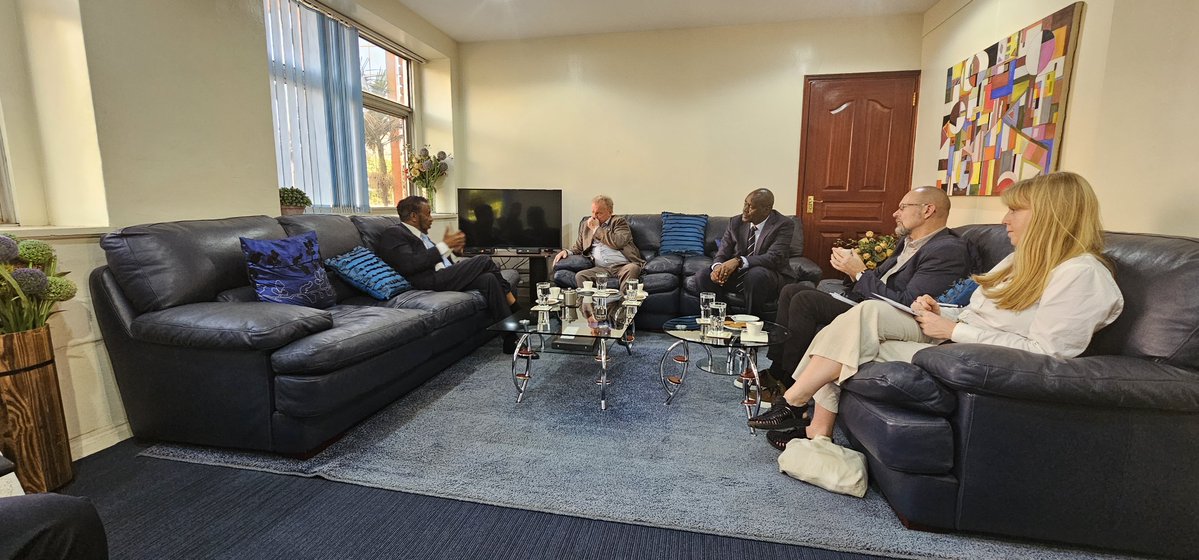
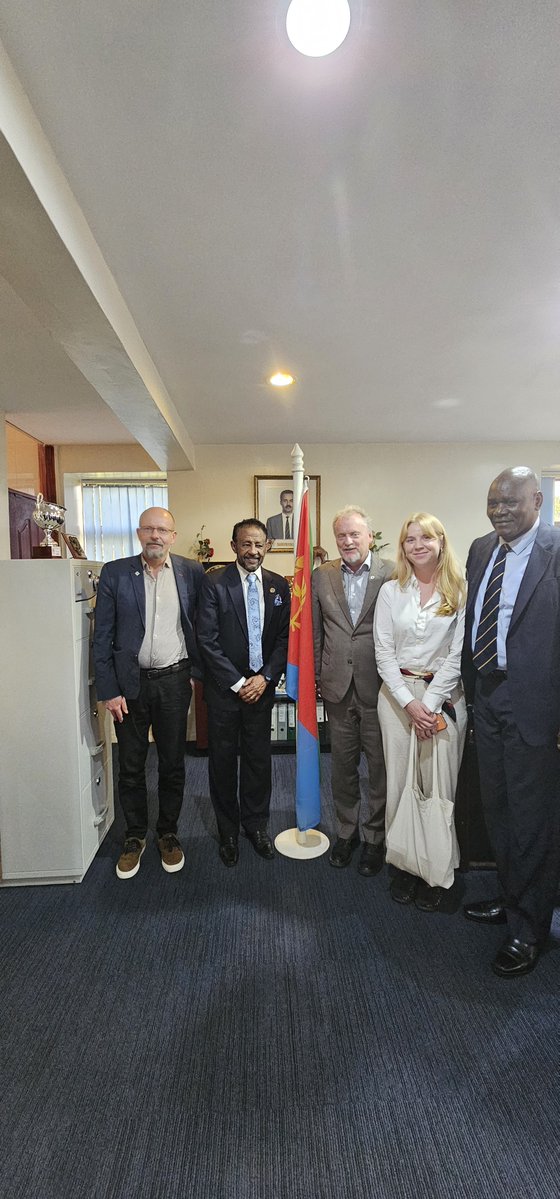
Today, the Embassy of the State of Eritrea in Nairobi had the pleasure of hosting Mr. Raymond Johansen, Secretary General of Norwegian People's Aid (@NPAid) and former Deputy Minister of Norway, alongside members of his organization.
Mr. Johansen is a close friend of Eritrea who previously served as a diplomat in our country.
During our lengthy meeting, we discussed the current situation in the Horn of Africa, and I provided an extensive briefing on the root causes of the present tensions between Eritrea and Ethiopia.
I thanked Mr. Johansen and his delegation for their visit. He also shared his plans to visit Eritrea soon to reconnect with his many friends in Asmara.
Held a meeting with Ambassador Melanie Higgins, Senior Advisor for #Africa at the US Mission (@USUN), to exchange views on #Eritrea|s priorities and engagement at the @UN, as well as broader issues relating to #Eritrea–#US bilateral relations.
Highlighted the importance of a more nuanced, balanced, and coherent #US policy towards #Eritrea, one that takes into consideration the country's objective challenges, historical experience, and legitimate national interests. While efforts to recalibrate bilateral relations are welcome, a meaningful reassessment would benefit from a clear understanding of the historical circumstances and policy choices that have shaped the relationship.
Underscored the importance of the longstanding people-to-people ties between the two countries. The thousands of #Eritrean Americans who contribute to American society across various fields, including service in the US military, represent an important foundation upon which stronger bilateral relations can be built. These connections make a compelling case for a relationship with #Eritrea that is constructive, forward-looking, and reflective of the close human links between the two countries.
Also expressed concern over the continued reliance on allegations and reports whose evidentiary basis and methodology merit closer scrutiny, as well as the repeated inclusion of Eritrea on various US designation lists. Such measures have had a lasting impact on #Eritrea's international standing and public perception, while doing little to create an enabling environment for improved relations. A genuine policy review should therefore include a careful reassessment of these measures and their broader implications.
Emphasized that a more productive bilateral relationship must be grounded in mutual respect, including respect for #Eritrea's laws, institutions, sovereignty, and the principle of non-interference in its internal affairs. Building the necessary confidence will require addressing existing differences with mutual understanding and recognizing the broader opportunities for cooperation that remain largely unexplored.
Developments in #Ethiopia and their implications for regional peace and stability also featured in the exchange. Expressed concern over efforts to externalize domestic political and security challenges, particularly through rhetoric and actions with potential regional ramifications.
While acknowledging recent US efforts to encourage de-escalation and avert further deterioration in the situation arising from the course pursued by #Ethiopia’s leadership, underscored the importance of principled and consistent international engagement.
Also emphasized that developments must be addressed on the basis of facts, international law, and established principles, rather than expediency or accommodation, as a consistent approach is essential to preventing further escalation and safeguarding regional peace and stability. A clear-eyed approach is essential to preventing further escalation and safeguarding regional stability.
Ultimately, stronger #Eritrea–#US relations would serve the interests of both countries. Advancing this objective requires candid dialogue, mutual respect, a better appreciation of each other's perspectives, and a willingness to move beyond entrenched assumptions.
We agreed to remain engaged and maintain dialogue on the issues discussed, with a view to fostering greater understanding, identifying opportunities for a more constructive bilateral relationship, and pursuing cooperation within the multilateral system in areas where #Eritrea’s and the US’ positions and interests converge.
😇😇ON THE LIGHTER SIDE😇😇
Potemkin Party Senior Political/Military officials have this innate gift/penchant for routinely making unhinged and outrageous public statements.
PP's Army Chief of Staff, "Field Marshall" Berhanu Jula's, address to residents of Mekelle, capital city of Tigray Regional Administration, last Friday accentuates this point.
The poor Marshall "announced", in the public statement that was subsequently broadcast by Ethiopian Tv, that the Eritrean towns and sovereign lands of Dogali, Gundet... and Adulis are "part and parcel of Tigray" in Ethiopia.
The cheap and transparent purpose of this ploy is to garner support - through promise of stakes/shares in the spoils of war - from the people of Tigray for PP's irredentist war of aggression against Eritrea.
But he unwittingly gives away the game, or deciphers the riddle, of PP's preposterous accusation of "invasion" by Eritrea in its letter to the UNSC on 9 October last month.
Indeed, Eritrea's army is deployed within its sovereign territories - a fact that can be easily verified by reference to the detailed, virtually demarcated, EEBC boundary maps in the possession of both countries as well as the UN Cartographic Unit.
In the event, PP's opaque/distorted reference to "Eritrean army presence in Ethiopia" makes perfect sense if, as the good "Marshall" is telling us, virtually all of Eritrea is part and parcel of Tigray/Ethiopia.
On a more broader level, the disconcerting and problematic fact is that Potemkin Party's propaganda/policies are routinely replete with abject lies and deception.
As we have all along underlined, Potemkin Party's signature media trademark is better encapsulated in the following algebraic equation:
PP propaganda = Optics + Posturing + Deception + Disinformation; (the four variables have different weights depending on the event/intended objective).
====
*It might be useful to recall here - although this will be the subject matter for another occasion - that the "Field Marshall" and his PP Leader are on record for profusely thanking the Government and Eritrean Defense Forces for their indispensable and unparalleled support during Ethiopia's "Darkest Period".
Video link below is verbatim sample of frantic and inflammatory campaigns launched by Potemkin Party's senior Government/Military Officials for over three years now to rationalize their unprovoked war of aggression against Eritrea.
The toxic and monotonous statements revolve around revisionist historical narratives that deny and denigrate Eritrea's very existence as an Independent State, and, peddle the PP's unlawful quest for "sovereign access to the sea" as well as the "establishment of a naval force" in Eritrea's southern coastline in flagrant violation of international law.
History is repeating itself in the Horn of Africa.
From Emperor Haile Selassie and Mengistu Hailemariam to Meles Zenawi, a succession of Ethiopian leaders have shared the same approach: using aggressive rhetoric, empty boasts, and brute force to suppress Eritrea’s right to self-determination.
Today, Abiy Ahmed has become the loudest of them all, deploying deafening threats and political machinations.
Yet, history guarantees that his efforts will yield the exact same result as his predecessors:
Absolute failure!!
https://t.co/TG5ASpVXLw
Congratulations to everyone who showed up in Geneva today and raised their voices in the call for peace. Your presence, courage, and principled stand made us incredibly proud. You demonstrated that the desire for peace, dignity, and respect for all our peoples remains strong and unwavering.
Today, just like yesterday, you stood tall, and we salute you...Enjoy one of my all time favorites...have a great weekend.
ዓወት ንሓፋሽ!
#Eritrea , #Ethiopia , #Somalia, and #Sudan
You are an anti-Christian extremist and terrorist. Abiy Ahmed’s supporters routinely scapegoat Eritrea whenever Ethiopian civilians are killed by Oromo extremists like you. @FarahMaalimM was a friend of Eritrea long before Oromummaa took power in Ethiopia. Cry harder. By the way, this is your. 👇👇
Only few weeks back, J-War was saying " Because Abiy is illiterate, he can't look further than tomorrow, and he looks at things in a simplistic form. With his current capacity, Abiy is in no position to fight against Eritrea or Tigrayan forces except a cowards courage. Abiy has sold Ethiopia's souveignity to the UAE and what we witness today is he is being forced to wage war by his handlers and bosses.' #Eritrea #Ethiopia
ERITREA: ANCIENT AND NEW
A Thursday Reflection
#Eritrea is mourning the passing of His Grace Abune Lucas, Administrator of the Office of the Patriarch, Member of the Holy Synod of the Eritrean Orthodox Tewahdo Church and Archbishop of the Southern Region, Adi-Keih. His passing is a moment of sorrow for the faithful and the wider Eritrean community.
It also draws attention to the enduring place of the Church, its spiritual institutions and their custodians in our country's history. Debre #Libanos, where he was laid to rest, is not simply a burial place. Like Debre Bizen, Debre Sima and other ancient monasteries across Eritrea, it forms part of a much older inheritance of faith, learning, memory and cultural continuity.
There is something profoundly revealing about standing before an ancient monastery in #Eritrea. Perched on a mountain, overlooking valleys and landscapes that have witnessed centuries of human history, these institutions seem almost indifferent to the passage of time. Their stone walls, manuscripts, traditions and accumulated memories speak of generations long gone, yet remain very much present.
I was fortunate enough to visit Debre Libanos some years ago. I remember the mummies discovered there and the arrangements governing access to the main building, where women were not permitted. I was content to remain with the women in the smaller church midway up the ascent, taking in the beautiful scenery and reflecting on the history surrounding us. It is an experience that has stayed with me.
Debre #Bizen, traditionally dated to the fourteenth century, became an important centre of monastic scholarship and manuscript preservation. Debre Libanos, associated with the early Christian monastic tradition of Semenawi Bahri, is linked to an older religious heritage.
Debre #Sima and other ecclesiastical institutions form part of a landscape in which religious, cultural and intellectual life developed over many centuries. Their significance lies not only in their age, but in their endurance. Through changing political authorities, successive administrations, wars and invasions, they have preserved an inheritance that cannot be confined to the chronology of any modern state.
#Eritrea's historical depth is also reflected in its archaeological landscapes, ancient settlements, languages, diverse communities, maritime connections and cultural traditions. Archaeological discoveries at Sembel, in the greater #Asmara area, reveal settled communities dating back to the first millennium BCE.
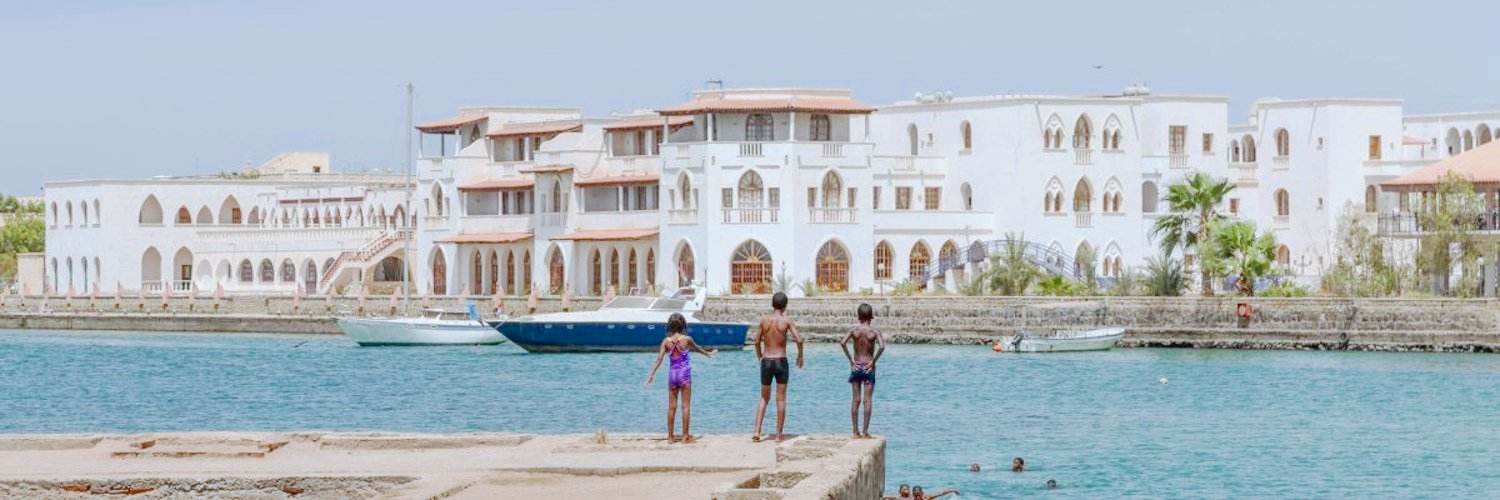
Further evidence from Adulis, the ancient Red Sea port city where recent excavations have uncovered even earlier traces of human activity, illustrates how these lands were connected to wider African, Arabian and Mediterranean worlds through centuries of trade and cultural exchange. Eritrea's history is not the story of one civilization, religion, community or period. It is a tapestry woven from diverse peoples, cultures, beliefs and experiences.
And then there is #Asmara, Eritrea's beautiful capital, where history, culture and architecture come together in a city unlike any other. Anyone who has walked its streets cannot fail to be struck by its magnificent architecture: elegant façades, imposing public buildings, broad avenues, cinemas, theatres, churches, mosques and carefully planned urban spaces. Different periods, influences and styles have come together to create an extraordinary architectural landscape.
In 2017, UNESCO inscribed Asmara on the World Heritage List as Asmara: A Modernist African City, recognizing its exceptional modernist architecture and urban planning, particularly from the Italian colonial period of the 1930s and 1940s. UNESCO's recognition did not create Asmara's heritage; it acknowledged an exceptional legacy that had endured long before its inscription.
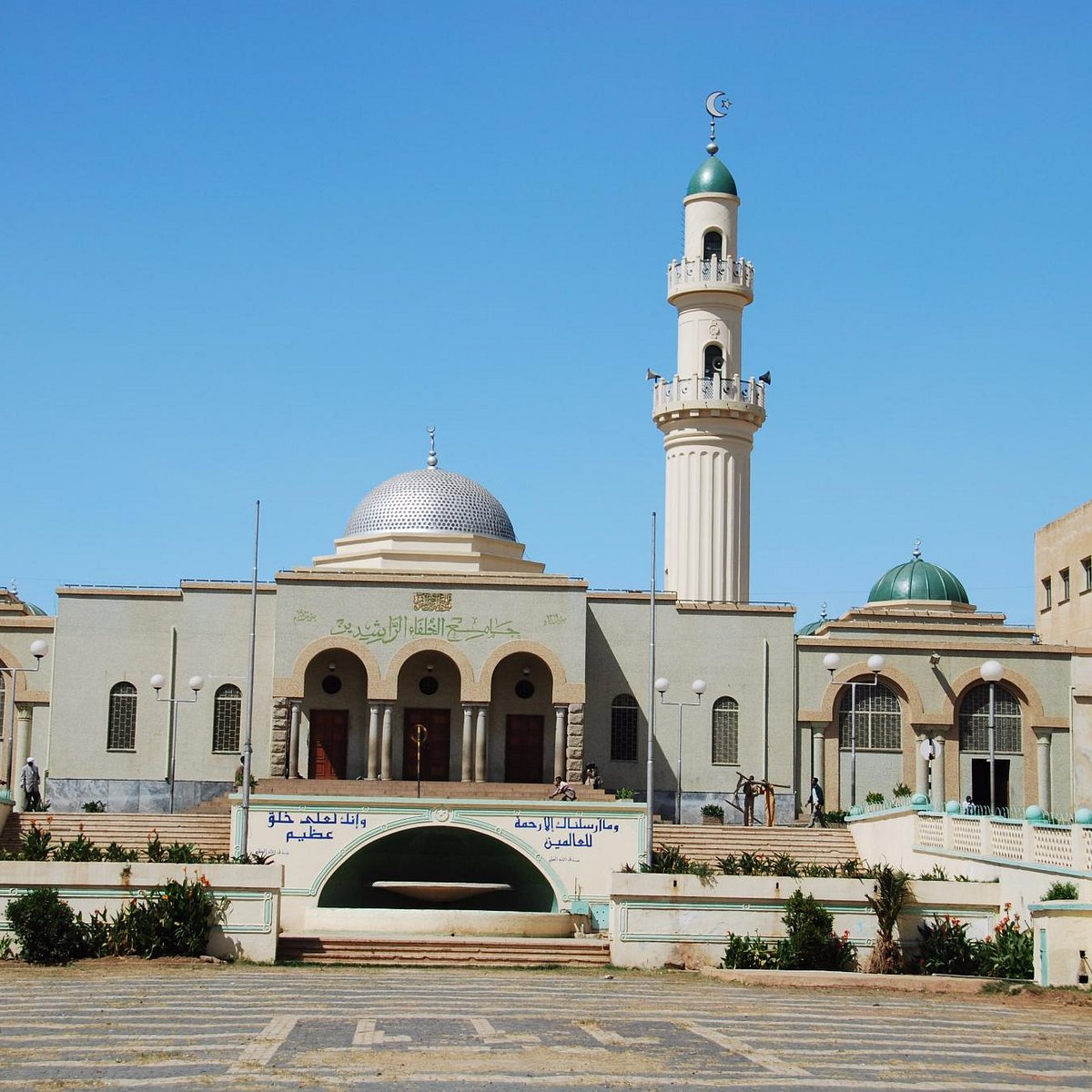
The Cathedral at the centre of Asmara, completed in 1922, is now more than a century old. Its imposing bell tower and Lombard Romanesque character have become defining features of the city's skyline. The Church of Our Lady of the Rosary, the Al Khulafa Al Rashiudin Mosque, the former Fiat Tagliero building, Cinema Impero and countless other structures contribute to Asmara's distinctive architectural identity. But there is something important to remember when admiring these buildings… the buildings predate Eritrea's independence. The people of Asmara and their history predate them.
Before modernist architecture transformed the city, there were already communities, families, neighborhoods, markets, places of worship and established social and cultural life. Asmara was not an empty landscape upon which an architectural experiment was imposed. It was an inhabited place with a history of its own.
The architecture we admire reflects a particular period in the city's development; it does not mark the beginning of Asmara or the history of its people. Colonial architecture can be preserved and appreciated for its historical and artistic value without confusing the legacy of colonial construction with the origins of the city and its inhabitants.
The same distinction applies beyond Asmara. Successive foreign powers that occupied or administered Eritrea constructed buildings, roads, fortifications, military installations, administrative centres and other infrastructure across the country. Some remain visible today and form part of Eritrea's built heritage.
They tell us about the ambitions and priorities of those who built them, but their presence does not make Eritrean history begin with their arrival, nor does it make the history of the country the history of its occupiers. An occupying power may leave its mark on the landscape; it does not thereby become the author of the land's history.
And then there is #Assab. Today, Assab is discussed in terms of strategic geography, maritime access and the economic requirements of landlocked #Ethiopia. Yet, long before it became the subject of contemporary geopolitical calculations or the site of a modern deep-water port, people lived in this region, sustained communities and livelihoods, and maintained their own social and political institutions.
#Assab was not an empty coastline awaiting European discovery. It was home to established Afar communities, including the Ankala, whose old settlement at Assab Saghir and traditional presence across the wider Dankalia coast are documented in historical sources. These communities were part of the wider Afar world, with established connections across the Red Sea and surrounding territories.
#Assab was #Eritrean under the 1952 federal arrangement. Its subsequent annexation by #Ethiopia, following the unilateral termination of the federation in November 1962, must be understood in that historical context. Annexation did not erase the identity of the region or the history of its inhabitants. Assab's strategic importance cannot be separated from its history, and its history cannot be reduced to the interests of those who may wish to use it.
#Assab's history begins with its people, not its port. Its strategic importance, infrastructure development and commercial potential do not alter its historical identity or its place within #Eritrea. A port can be constructed, a harbor modernized and infrastructure developed to transform a town's commercial importance. None of these developments creates the historical existence of the people who live there or establishes sovereignty over the surrounding territory. Building a port, a road or other infrastructure does not confer sovereignty over the land on which it stands. Construction is not a deed to sovereignty.
Eritrea is ancient and new at the same time. Ancient in its peoples, civilizations, cultures and historical roots; new as a modern sovereign state, born of a long struggle for self-determination and internationally recognized in 1993. Independence did not begin the history of the Eritrean people; it opened a new chapter in it. Eritreans did not come into existence with the end of colonial rule, the termination of the federation, liberation in 1991 or the 1993 referendum. These were milestones in the political history of the modern state, not the origins of the people who made it possible.
Long before modern statehood, our forefathers built communities, cultivated the land, worshipped, traded and crossed the seas. The modern Eritrean state emerged through a turbulent history of Italian colonialism, British administration, federation with Ethiopia, its unilateral termination and the annexation of Eritrea in 1962.
The liberation struggle was the assertion of the people's right to determine their own future. 1993 marked the emergence of #Eritrea as an internationally recognized sovereign state, not the creation of the #Eritrean people or their historical identity.
#Eritrean identity is not a recent discovery, our historical presence is not a diplomatic invention, and our sovereignty is not a concession granted by anyone else. Our monasteries, archaeological sites, historic cities and coastal communities bear witness to the depth and diversity of our historical experience. They remind us that while Eritrea is a young sovereign state, the society and people it represents have much older roots.
#Eritreans did not fight for independence to become a people. They fought for independence because they were a people, with a history, an identity and the right to determine their own future. That history continues through their independence and theirsovereign statehood…
#ThrowbackThursday #ThursdayThoughts #Thursdaywisdom
A lunch meeting with H.E. Stan Smith, PR of the #Bahamas to the @UN, provided an opportunity for a timely and substantive exchange of views on developments in our respective regions, the pressing situation in #Haiti, and the broader challenges confronting multilateralism.
We discussed the evolving international response to the crisis in Haiti, including the UN-authorized Gang Suppression Force (GSF), its mandate to address the threat posed by armed gangs, secure critical infrastructure and protect civilians. The situation underscores the complexity of translating international decisions into effective and sustainable responses on the ground.
At a time when multilateralism faces multiple and increasingly interconnected challenges, exchanges of this nature are particularly valuable. Understanding the historical, political, security and regional contexts in which crises unfold is essential, not only to informed diplomatic engagement, but also to shaping responses that are realistic, balanced and responsive to the needs of the countries and peoples concerned.
Developments across the greater #Horn of #Africa warrant precisely this kind of deeper examination. From #Eritrea, #Ethiopia and #Djibouti to #Sudan, #SouthSudan and #Somalia, the region is shaped by interconnected histories, political transitions, security challenges, sovereignty questions, competing external interests and the aspirations of its peoples.
These developments cannot be adequately understood through headlines, isolated security assessments or prevailing geopolitical narratives. They require a broader appreciation of the region's historical experience, internal dynamics, relationships among neighbouring states and wider strategic significance. A nuanced understanding of these interconnected dimensions is indispensable to responsible diplomacy, preventive engagement and constructive multilateral action.
Effective multilateralism requires more than responding to immediate crises; it requires understanding their underlying causes, appreciating their regional dimensions and sustaining informed, principled dialogue among Member States...
Over the past few days, many of Abiy’s media sycophants have been circulating a load of fabricated stories about the capture of Badme town. They seem to think they are being clever by trying to create divisions between #Tigrayans and #Eritreans.
They are hoping that some Tigrayans will become so emotionally invested in the Badme issue that they will be drawn into supporting Abiy’s war against #Eritrea.
Just as Abiy has used border towns such as Welkait, Moyale and Raya to extend his grip on power, he is now trying to use Badme for the same purpose.
That is precisely why #Ximdo was created in the first place. Engagement of people in border towns to engage in sustainable peace. #Eritreans are already two steps ahead!
@StalinTeklu@tigraionline@OmnaTigray@ElsaHagos3
History has already delivered its verdict: there can be no lasting peace in the #Horn of #Africa when sovereignty is violated, internationally established borders are challenged, and hegemonic ambitions are placed above international law.
This is a powerful and timely articulation of #Eritrea|s historical experience, principled position, and unwavering commitment to sovereignty and territorial integrity. Peace and stability in our region must be built on mutual respect, sovereign equality, and respect for internationally recognized borders, not territorial revisionism, coercion, or the pursuit of strategic interests at the expense of another nation's sovereignty.
#Eritrea seeks neither what belongs to others nor relinquishes what is rightfully its own. This is a position firmly anchored in sovereignty, territorial integrity, sovereign equality, and respect for international law. #Eritrea has no claims over the territory, resources, or sovereign rights of any other nation, and expects the same unequivocal respect for its own.
Its ports, coastline, islands, and territorial waters are not bargaining chips to be traded away or instruments to be appropriated in pursuit of another country's strategic or economic ambitions. Nor can one state's perceived needs confer rights over another state's sovereign territory. Economic interests and legitimate commercial arrangements can be pursued through cooperation and mutual agreement; sovereignty, however, cannot be claimed, negotiated away under duress, or acquired through threats and coercion.
This is ultimately a matter of principle, historical justice, and national dignity. #Eritrea|s commitment to peaceful relations and regional cooperation remains firm. But peace cannot be secured through appeasement, territorial concessions, or the subordination of one nation's sovereign rights to another's ambitions. Peace must begin with respect for sovereignty, and stability must rest on the recognition that what belongs to one nation cannot become the entitlement of another.
The rule of law must prevail over the law of the jungle!
For decades, the #African Union has been totally derelict in its duties on #Eritrea#Ethiopia conflict. Recently, when #Eritrean diplomats to the @_AfricanUnion in its HQ in Addis Ababa were expelled by the #Ethiopian regime in violation of AU Charter, AU was deafeningly silent.
Welcomed Ms. Elena Piriondi, Chief of the Executive Board Branch, and Mr. Robert Stevens for a briefing and exchange on the development of the new @UNFPA Country Programme for #Eritrea. Discussions focused on the programme's substantive elements, strategic orientation, development process and alignment with Eritrea's national development priorities.
The briefing provided an opportunity to review the proposed areas of cooperation, expected results and the framework for UNFPA's continued engagement in #Eritrea. Emphasis was placed on ensuring national ownership, meaningful consultation with relevant national institutions and coherence between the programme's objectives and Eritrea's development priorities.
The exchange also took place against the backdrop of wider UN reform discussions, including system-wide concerns surrounding the proposed mergers of UN entities, institutional restructuring and the broader implications of the reform process for the UN development system.
Issues of particular relevance include the potential implications for institutional mandates, accountability, governance arrangements, resource allocation, country-level presence and the delivery of development assistance.
The importance of ensuring that reform does not undermine specialized mandates, diminish Member State oversight or compromise the ability of UN entities to respond to the distinct priorities and circumstances of programme countries was highlighted.
The UNFPA representatives outlined the next steps in the programme development and approval process, confirming that the new Country Programme for #Eritrea will be presented to the @UNFPA Executive Board in 2027.
The grim spectacle (photos in the link below) of Potemkin Party's senior government officials undergoing, and even eulogizing, some misplaced military training and "militarism", provokes a host of perplexing questions on the PP's perspectives and modus operandi.
To be clear, the spiraling domestic conflicts that are besetting Ethiopia and the escalating tensions in the region stem from the Potemkin Party's willful and misguided policies.
They are indeed the offspring of the PP's wars of choice; so to speak.
The recent upheaval in Moyale that has ignited internecine conflict between the Somali and Oromia Regions; the ferocious wars raging in the Tigray and Amhara Regions etc... stem from its dysfunctional governance architecture.
In the wider Horn of Africa Region, the Potemkin Party continues to instigate and manufacture unnecessary and avoidable tensions with Eritrea, Somalia, and the Sudan respectively in pursuit of myopic and ill-advised agendas of territorial irredentism and destabilization; often to advance, as a surrogate party, the larger schemes of certain external powers.
In the event, the Potemkin Party does not require additional "militarism" but therapeutic introspection - ናይ ክልተ ሸውዓተ ማጨሎት ደርዓንቶ!
Ethiopia and the region cannot indeed afford, and must be spared from, yet another cycle of costly conflicts and turmoil.
https://t.co/M11ekqQkEr
In the current international/diplomatic discourse regarding the imperative of adherence to, and respect of, foundational pillars of international law as well as the maintenance of regional peace and security, the following salient facts and sequence of events must be recognized, without any equivocation, as the kernel/principal causes behind the prevailing grave situation:
1. On 13 October 2023, the Potemkin Party willfully manufactured an unnecessary and avoidable crises between the two countries by formally and publicly declaring its hostile agenda of acquiring "sovereign access to the sea", apparently and ultimately through invasion and occupation of Eritrea's sovereign lands. This dangerous declaration constituted a flagrant violation of foundational pillars of international law as well as the Joint Declaration of Peace and Friendship signed between the two countries in Asmara on 9 July 2018.
2. This initial declaration was ramped up in subsequent years through relentless and incendiary media campaigns; associated saber-rattling, and massive rearmament. The scope of the PP's impending invasion was also broadened to include forcible incorporation of Eritrea's southern coastline (see attached map) for the establishment of "a sovereign naval force with strategic depth".
3. The war agenda was further ratcheted up and translated into an operational plan when the PP regime launched its military operations in the Tigray Administrative Region in mid-September this year. Indeed a couple of days after the eruption of the war, the PP's Deputy Chief of Staff announced that "Mekelle will be a mere stop-over... the main objective is to install our flag in the Red Sea".
4. And on 9 October last month, the PP regime went further to ominously "notify the UNSC" on the unleashing of its war of aggression against Eritrea under the spurious pretext of "self-defense".
The writing on the wall is thus crystal clear; eliciting, as it does, unequivocal condemnation as well as requisite deterrent measures in accordance with explicit provisions of the UN Charter and associated instruments.