Agent fleet infrastructure, born from our needs delivering personal agents to thousands of users @JOIN_A_LIST.
New paradigms for computing are coming fast. Today’s agent hype will be tomorrow’s agent revolution.
We had a problem at A-LIST.
OpenClaw made AI way better, so we gave one to every user.
It almost bankrupted us.
It cost $100K a month. We needed it to be $2000.
Today we share the solution. It's called Chariot.
Elastic claws that cut costs by 98%—while they get smarter.
@AIDSfinder@SamoBurja The politicians may like the current political economy, but I think voters would prefer "money for everyone" over the obfuscated kleptocratic system that's not overtly advertising "money for everyone".
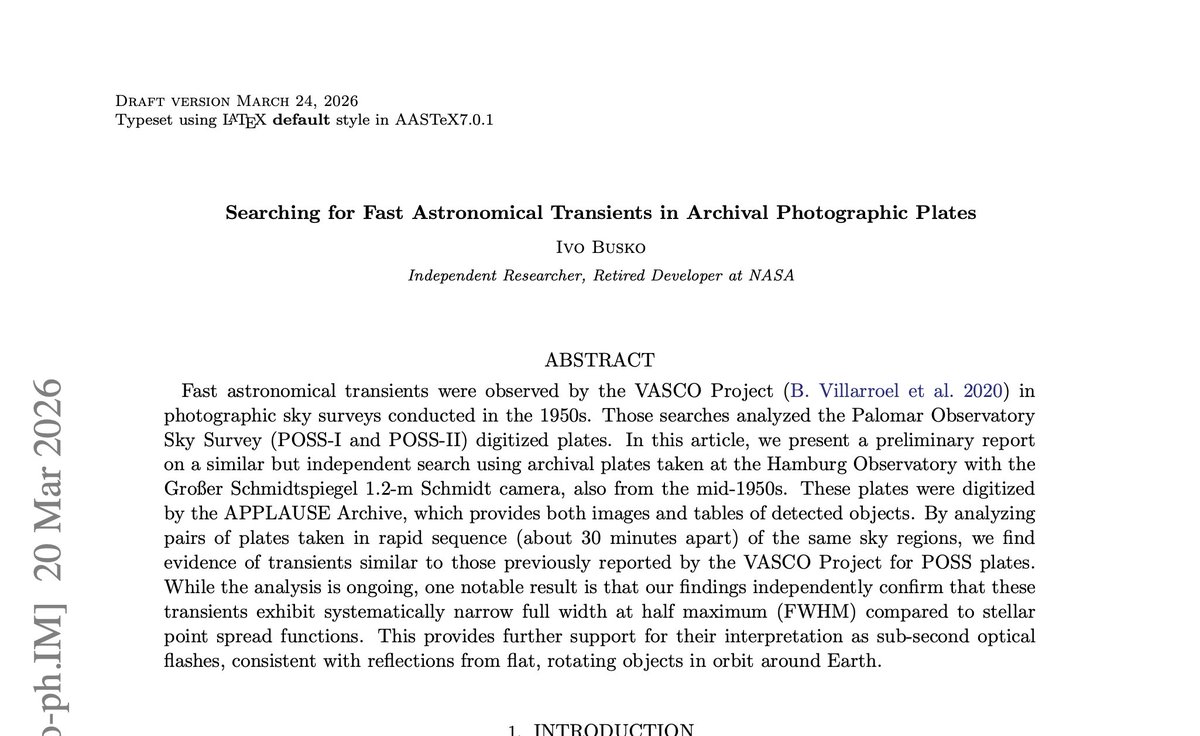
What a lovely surprise this morning! ☀️Independent detections of similar transients in European plate archives — exactly the kind of cross-validation this field needs. So it’s not just Palomar anymore.
The study was carried out by a retired NASA scientist.
This is how a signal begins to emerge from the noise.
https://t.co/5Gq8HLm0u5
Designing agentic systems for physics discovery is applied philosophy of science, recapitulating a century of debate on:
How much should the system defend its theoretical commitments against anomalies vs how much should it be licensed to violate its own priors?
One has to blend (in just the right proportions) Popper's falsification, Lakatos on the rational structure of research programs ("protective belts"), Feyerabend's "anything goes" methodological chaos/creativity, and Peirce's abductive logic linked to Deutsch's "explanations-that-work" meta-criteria.
But more pressingly, (human) knowledge creation remains a sociological process (as Pierce understood) of communities of inquiry structured by rational principles and self-correcting norms converging (haltingly, indefinitely) at those "truths" that clear the collective epistemic bar (in a given era).
Feyerabend was more cutting, seeing scientific institutions as exerting coercive authority on what counts as knowledge.
This demarcation line is what is challenged by AI-driven science--which threatens to push the marginal means of scholarly production far outside the walls of the cloistered Academy, and destabilize the generate-verify balance underlying the (strained) peer review process.
The emerging AI-for-science systems (including the one's we're building at PSI) are thus not merely technologies in the instrument sense of "co-pilot" tool, but nascent and novel forms of scientific institution, that have their own internal (and rapidly scaling) agentic ecosystems shaped by recursively improving search-exploit criteria, epistemic graphs, hierarchies of self-critique, and collective dynamics.
They are emerging within, co-penetrating, and also bypassing the legacy structures (universities, USG labs, non-profit institutions) that have historically shaped research priorities, funding flows, and career potential for practicing physicists.
The scaffold of physics in the 20th Century was a matrix of bureaucracies doling out grants and prestige, rate-limited by budgets and the context windows of given human collaborative collectives.
The scaffold of physics in the 21st Century will be literally an agentic scaffold, defining in a readme the boot-load for a recursive hierarchy of reasoning systems and experimental feedback loops (orchestrating human physicists as meat puppets where we still add value).
Which means the philosophy of science is no longer academic meta-commentary on what scientists do. It is the system prompt -- and the people writing it (my technical staff) are making bets, in code, that Popper and Feyerabend spent careers arguing about in seminars.
The difference is those bets now compound recursively, at machine speed, with consequences that will outpace legacy processes, whether those institutions recognize the transformation underway or not.
We are in the AI fast takeoff now.
We will shortly be in the physics fast takeoff.
The shocks from that non-linear acceleration -- ontological, technological, and institutional -- are right now thundering over the horizon.
The flash precedes the boom, which will arrive very soon.
@Andercot Honestly one of the more compelling explanations for a simulation. It seems reasonable that at some level of advancement one’s development and growth encompasses living many lives through many eras.
@balajis This seems totally feasible, without even having some kind of gov issued crypto ID. As long as the system can parse out distinct interests and unique questions, spamming wouldn’t even matter.
@balajis We need AI that synthesizes and represents the actual voice of the people in the correspondents room. Anyone can input questions and the data is open for everyone to inspect.