İzmir'deysen, iPhone kullanıyorsan ve yeni bir şeyi herkesten önce denemek istersen DM'den yaz. Üzerinde çalıştığım şeyin kapalı betası için birkaç kişi arıyorum. Tek şartım dürüst yorum.🖖🏿🫵🏾
Stanford Deep Learning for Computer Vision taught by Professor Fei-Fei Li (@drfeifei) and Assistant Professor Ehsan Adeli.
Such an enjoyable YT series. (link in comment)
We have to take the LLMs to school.
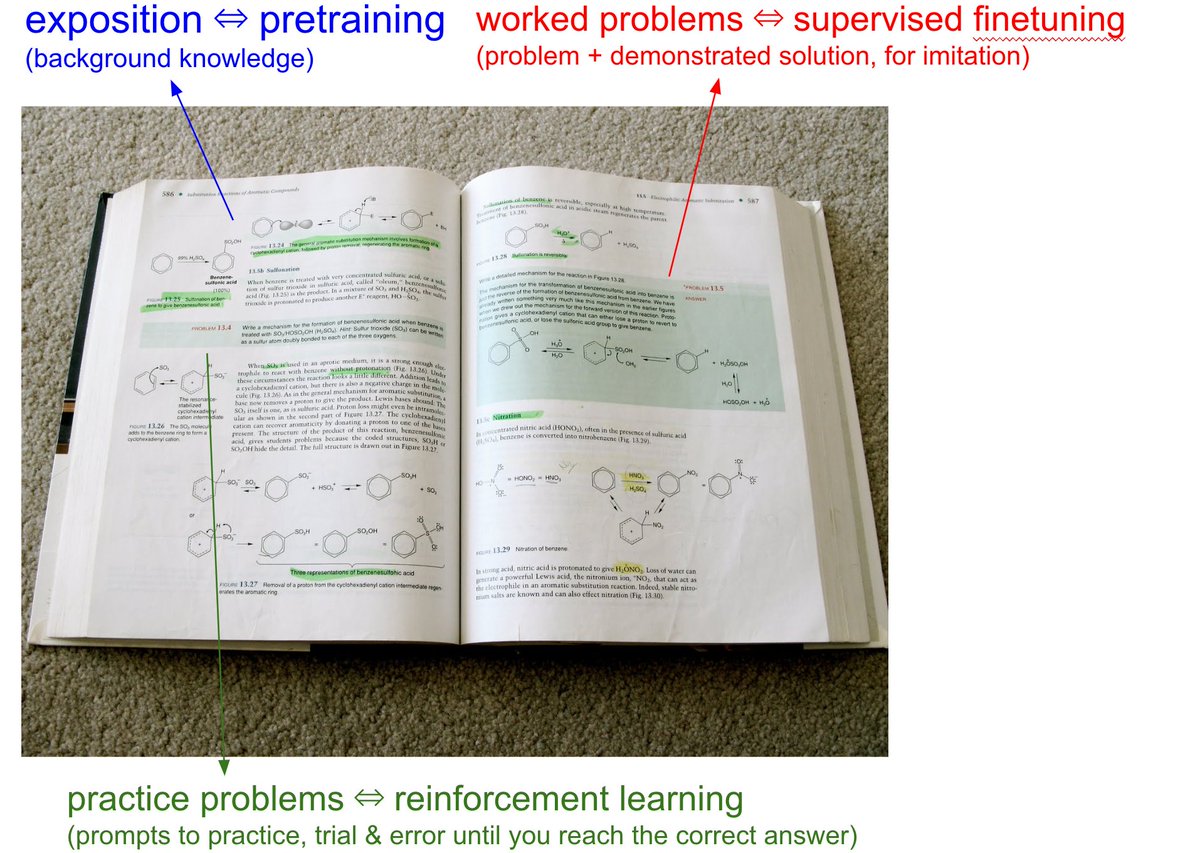
When you open any textbook, you'll see three major types of information:
1. Background information / exposition. The meat of the textbook that explains concepts. As you attend over it, your brain is training on that data. This is equivalent to pretraining, where the model is reading the internet and accumulating background knowledge.
2. Worked problems with solutions. These are concrete examples of how an expert solves problems. They are demonstrations to be imitated. This is equivalent to supervised finetuning, where the model is finetuning on "ideal responses" for an Assistant, written by humans.
3. Practice problems. These are prompts to the student, usually without the solution, but always with the final answer. There are usually many, many of these at the end of each chapter. They are prompting the student to learn by trial & error - they have to try a bunch of stuff to get to the right answer. This is equivalent to reinforcement learning.
We've subjected LLMs to a ton of 1 and 2, but 3 is a nascent, emerging frontier. When we're creating datasets for LLMs, it's no different from writing textbooks for them, with these 3 types of data. They have to read, and they have to practice.
Today OpenAI announced o3, its next-gen reasoning model. We've worked with OpenAI to test it on ARC-AGI, and we believe it represents a significant breakthrough in getting AI to adapt to novel tasks.
It scores 75.7% on the semi-private eval in low-compute mode (for $20 per task in compute ) and 87.5% in high-compute mode (thousands of $ per task). It's very expensive, but it's not just brute -- these capabilities are new territory and they demand serious scientific attention.
I created a full short film using free open source AI video models. I jumped into the role of the wizard Trogus and transformed myself into him using AI.
Imagine what kind of movies you would have made if you had this tool as a kid!
🆕 One of my favorite @NoPriorsPod discussions: the wonderful @karpathy on
- status of autonomy, tesla v. waymo
- humanoid robots
- bottlenecks to AGI
- our future exo-brains
- small models, open source
- eureka labs, education
- what young people should study in the age of AI
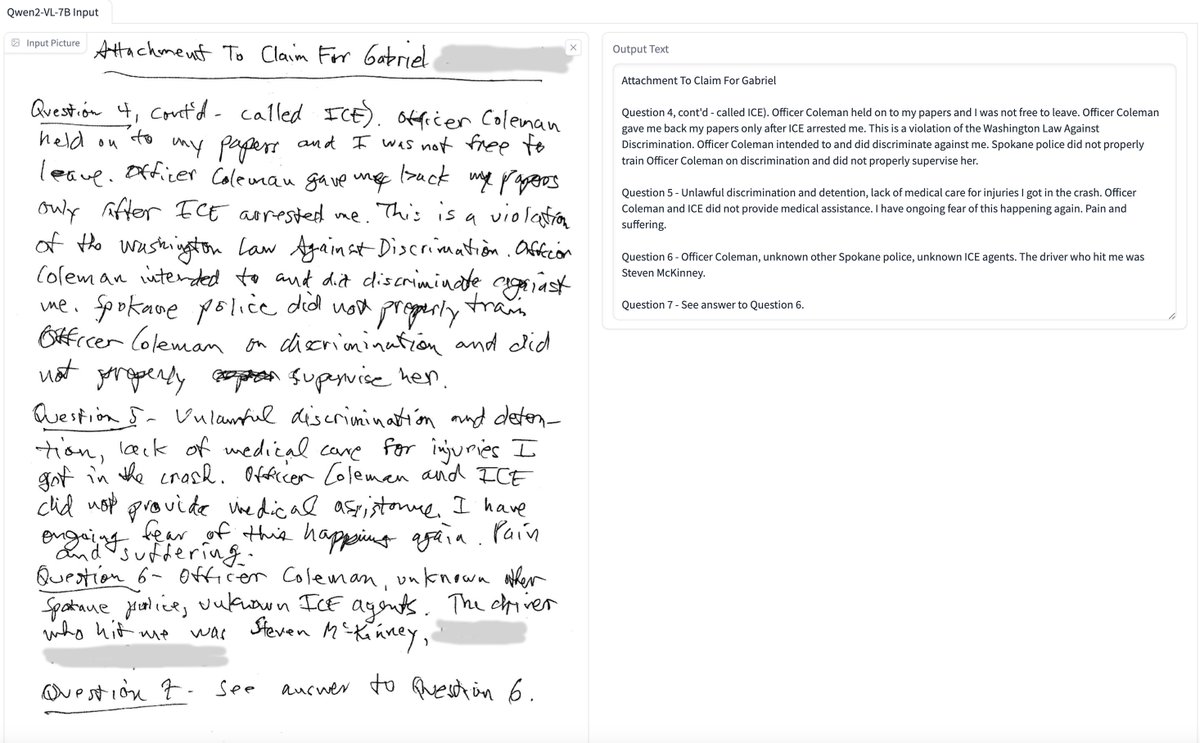
The new Qwen2-VL-7B Instruct model gets *100%* accuracy extracting text from this handwritten document. This is the first open weights model (Apache 2.0) that I've seen OCR this accurately. (Thank you @fdaudens for the tip!)
https://t.co/AB9r3bKDF0
We chant in English (prompting), and silicon bricks learn to control a set of metal (Optimus) to manipulate other sets of atoms. Inanimate components are being brought to life by invisible tokens from a neural network.
If this isn’t magic I don’t know what is.
Oldies but goldies: William Thomas Tutte, How to draw a graph, 1963. Shows how to embed a planar graph in 2-D by solving a Laplacian linear system. Heavily used in mesh processing to compute surface parameterization. https://t.co/9bmfufLAyS https://t.co/DiLz29Oksv
wow. The new model from @LumaLabsAI extending images into videos is really something else. I understood intuitively that this would become possible very soon, but it's still something else to see it and think through future iterations of.
A few more examples around, e.g. the girl in front of the house on fire
https://t.co/wDiCirpmUa
📢New: Part 2 (of 3) What We Learned from a Year of Building with LLMs
https://t.co/RE0OCdSCCy
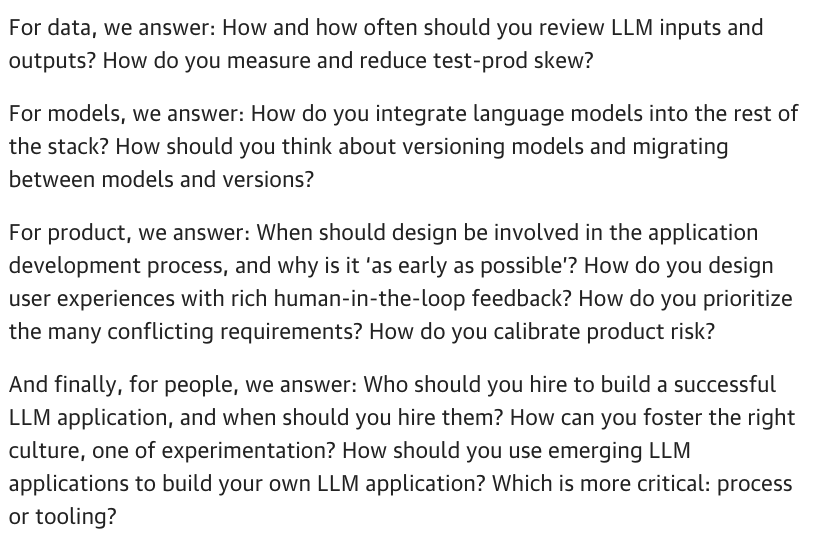
If you liked Part 1, Part 2 is a banger. We answer the following:
Some of my favorite takes:
AI Engineering Is NOT All You Need
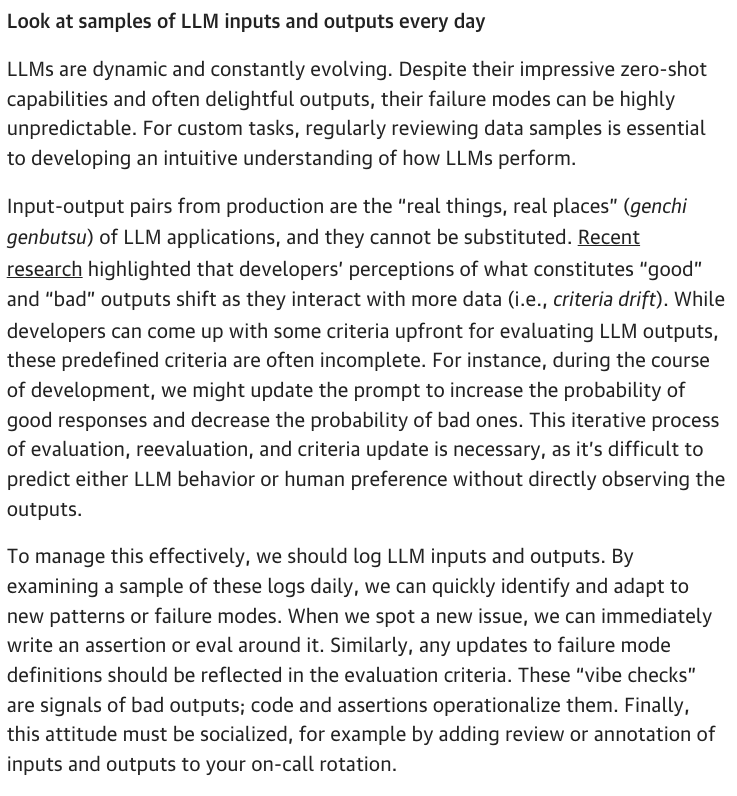
Look At Your Data
We found that most people are not looking at their data as frequently as they should. You have to do this if you are serious about improving your AI
Evals Are About Iterating Quickly
Some people think that Evals are an academic exercise. But it is not! Evals dramatically increase the speed at which you can ship.
You can read the full article here: https://t.co/RE0OCdSCCy
You can follow the authors of this paper to hear additional commentary and hear about upcoming Part 3: @eugeneyan@BEBischof@charles_irl@sh_reya@jxnlco@HamelHusain
What's the best model for fine-tuning? Can 8B param models really beat GPT-4 when fine-tuned to specific tasks?
@predibase we've put together our most complete guide to fine-tuning to date, answering these questions and more: the Fine-Tuning Index:
https://t.co/nFPXC66u85
Retrieval Augmented Generation (RAG) is one of the most popular techniques to leverage large language models for almost any type of use case.
In a RAG workflow, the user asks a question, like “What is Weaviate?”, and that query is sent into a vector database to search for related documents or chunks to the sentence. Then, that context, along with the original query, are put together in a prompt for the LLM. The LLM will then output a conversational response to the original question using the provided context.
There’s a lot of benefits to RAG systems. Unlike other techniques, like fine-tuning, RAG can be much easier to update with new data or delete old or outdated information without retraining a whole model. They can help reduce hallucinations and errors seen in LLM systems normally, and users can directly see the source information used by the model, allowing increased transparency and trust.
Even though there are a lot of tutorials and resources for RAG now, it’s still a big technical undertaking to make a good, advanced RAG application. This is why we’ve build Verba, the golden RAGtriever - we wanted to provide advanced RAG techniques to anyone, even if they didn’t have a technical background, and make it super easy to use and customize.
Check out the full explanation in our video: https://t.co/Ump3VzzhTq
GitHub: https://t.co/xSD3tE84n1
Demo: https://t.co/0Y8aNBDk5x
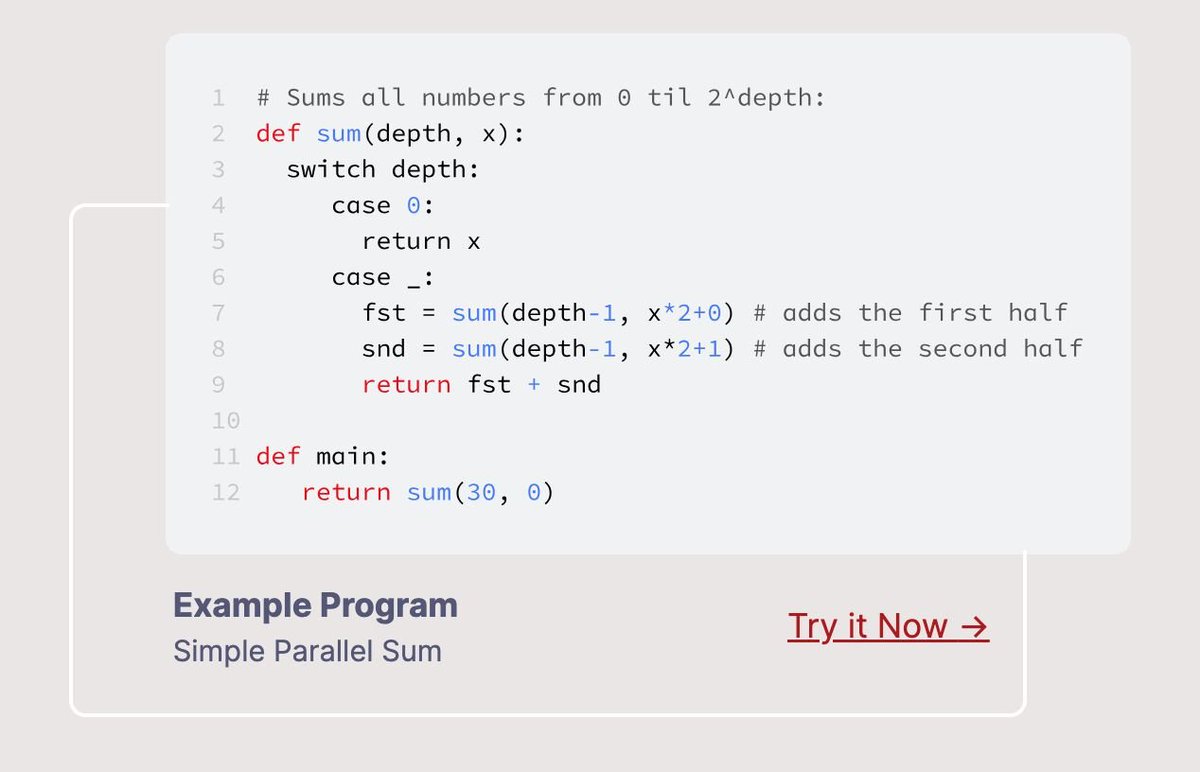
AI is math. GPU is metal. Sitting between math and metal is a programming language. Ideally, it should feel like Python but scale like CUDA. I find two newcomers in this middle layer quite exciting:
1. Bend: compiles modern high-level language features to native multi-threading on Apple Silicon or NVIDIA GPU. Supports difficult constructs like - lambdas with full closure, unrestricted recursion and branches, folds, ADTs, etc. Bend compiles to HVM2, a thread-safe runtime implemented in Rust.
All open-source:
- https://t.co/qb5VckRXVH
- https://t.co/F3n8tw8pwy
2. Mojo: a CUDA-flavored, Python like language the executes at C speed. Mojo is conceptually lower level than Bend and allows you to have stronger control over exactly how the parallelism is done. Especially suited for coding modern neural net accelerations by hand.
- https://t.co/aYQ5LtgsVb
- Llama2 in one Mojo source file: https://t.co/wW2ANhKPPT