i think many are massively underestimating just how aggressive this next leg of the Robinhood Chain eco pump could be
this could get very violent 👀
hope your bags are packed.
Fomo top leaderboard user has only realized like $20K of his $3M pnl, basically 90% of the leaderboard PNLs are unrealized in illiquid shitcoins
Admire the conviction but wonder how this leaderboard will look like once the music stops.
ANOTHER WILD DAY IN THE TRENCHES.
&& IF YOU MISSED ANYTHING HAPPENING WITH MEMECOINS TODAY I GOT YOU....
Between the buy && sell buttons...
> $Pistacio on Solana is the story of an OG NFT artist who actually vouched for what is somewhat of own token && watching their community go absolutely feral for it. The artist is @Marcello_695, a well-known crypto artist behind InverseBrah's Wassies && Pepo on https://t.co/oy8X5PYJOm; not an anon, not a bot farm, someone with actual reputation built over years in this space. The thesis CT is running is simple: artists with real communities command real loyalty, and people showed up to bet on the artist not just the chart. The buy pressure has been overwhelming since launch and the narrative is holding clean. At $13M mcap this is a reputational bet on a known name, not a blind degen play. And the artist said 'if this doesnt go to 0 ill make memes for it' which the buyers certainly see as a form of support!
> $CASHCAT The lore runs deep here - before the green app, before the IPO, before the GameStop saga, Robinhood was originally called Cash Cat. There's even a Vlad Tenev tweet from 2021 as a receipt. The tagline is: "the mascot returning to claim his ticker. The original name. The original cat. On the chain that bears his second name." Bulls say $184M mcap is still early if Coinbase pulls the trigger on a live spot listing. Following Robinhood's lead... Bears say the roadmap news is already priced in. Either way CASHCAT is the measuring stick for everything happening on Robinhood Chain right now.
> $NET (NetNet) on Robinhood Chain is what OlympusDAO would look like if its founder openly said "trader and gambler are the same person and I'm building for both." Hitting NEW all time highs of 45mil FDV... It's a reserve-backed rebasing protocol with 3 dividend distributions a day to stakers, a Real World Bonds desk && Managed Futures on one side - and on the other side: a tokenized equity COINFLIP game, a crash game called MSFT FLIGHT SIMULATOR, a reverse plinko RWA game called SPACEX INVADERS, a TURBO BLACKJACK desk, and a prize lottery called WinNET. The founder said publicly that he's building for people more likely to flip a coin than buy an out-of-the-money future - and the product line shows he meant every word. The MC is sitting around $5M right now against a $45M FDV, which means most supply hasn't hit yet, so do the math before buying deep. If the gamblification thesis plays out - and today's data says it's already playing out - NetNet is the most literal expression of that thesis live on a chain today.
> $HMM (Thinking Cat) on Robinhood Chain is exactly what it sounds like - "the sound your brain makes before you do something dumb." Positioned as the definitive thinking cat of the PONS ecosystem on Robinhood Chain, the brand is actually tight: PFP generator, a magic 8-ball, a community that fully commits to the "overthinking it" bit. $PONS has been one of the strongest Robinhood Chain narratives this cycle && HMM has been building alongside it as the culture token for that community. At $19M mcap, it looked like it wanted to make another run toward all time highs over 20mil, but since retraced slightly and with all the attention on robinhood; in this moment it's not making headlines today but it's holding its floor while everything else is volatile. If the PONS meta gets another leg up, HMM has historically followed.
> $GOON (GoonDough) on Solana is one of the stranger narratives today because it's not just a meme - the account @GoondoughCoin is explicitly tied to https://t.co/PLtNDdcBvh, a streaming platform selling an actual crypto-themed film RIGHT NOW for $9.99. The account has been around since 2021 && the bio says "streaming now exclusively at https://t.co/VKqu752LRI. Larger streaming platforms this fall" The idea of a crypto film getting a bigger distribution deal && having a corresponding token is a new enough narrative that it's getting attention in the trenches. Pumping toward a 2mil marketcap, the founding team hosted a spaces on X, which led to an AGGRESIVE sell off dropping teh token under 100k, i watched the movie, it wasnt as good as $POSITIONS... Ima be honest, which makes a ton of sense for the sell off...
> $happyseb on Solana has over $5M in volume on a coin sitting under $125K mcap && this is all on the back of the MetaWin founder @skel asking for someone to launch a pumpfun for his friend Seb to make him happy. The metawin founder purchased $10,000 of the token on the open market, and the token SURGED to over a 3mil mcap, while Skel publicly shared who seb was on his timeline, posting the individual multiple times, and now that there is some form of silence from him (holders assuming he is asleep) the token has fallen to under a 100k marketcap... ratehr fascinating to watch a token go up so quickly in price action, only to feel what has essentially been a debilitating flatline almost immediately after.
> $DTF (Down to Finance) launched last night on Robinhood Chain with what might be the most perfectly-timed product of the week: decentralized ETFs. You pick any basket of assets, mint one DETF token, and the protocol manages the whole basket for you - tokenized stocks, liquidity positions, DeFi plays, whatever combination you build. The timing is not an accident - Base && Robinhood Chain literally shipped tokenized stocks and have been pullposting them non stop, the two LARGEST retail applications in crypto, and a platform that lets you build custom on-chain baskets of those stocks is exactly what the ecosystem just became ready for. The $DTF token earns a share of all protocol fees, making it effectively the platform equity play on the DETF infrastructure. New launch, $5M mcap, $7.4M in day one volume - someone is positioning aggressively into this before the tokenized stock meta fully catches up.
Another one for the books.
See you in the trenches....
very real possibility that this cycle only has two groups of coins that catch a bid:
1) the handful of investable top 100 coins that smart money piles into
2) 99% of new entrants entering social trading apps don't touch any altcoins/majors at all only buying memes & new launches
The unintended consequence of this is that it directly competes with HyperEVM lending/borrowing protocols
Borrowing on HyperCore will always be superior because of the staking discount and deeper liquidity
I do not think this sets a good precedent for HyperEVM builders and the message it sends to them
But on the flip side, you can now bake the $AAVE and $MORPHO valuations into $HYPE.
Hyperliquid is now a borrowing and lending protocol too
Its a double edged sword
$HYPE is undervalued
$NET Thesis | $1057 | $57M FDV | $6M circ | $4M treasury of USDG + RWAs
(🥅, 🥅)
novel defi mechanism on Robinhood
$NET is the reserve share backed by at least 1 USDG of the protocol's on-chain portfolio, NetNetCapital accumulates productive assets like stablecoins and stocks through a few different mechanisms
pays out 1.2% per day to $NET stakers if NAV is 1.75x underlying treasury, currently trades at about 11x treasury, treasury has been growing substantially faster than the 1.2% $NET issuance
• 5% trading fee on all $NET purchases, goes to stablecoins in treasury
• bond issuance, allows people to buy $NET at a 8-12% discount by giving USDG, capped at a certain amount each day, protocol uses this USDG to accumulate tokenized stocks for the RWA-sleeve of the treasury
• protocol has different minigames where you can speculate to win more NET, fees from all of the games add to treasury reserves
• founder has done few interviews saying they've spoken with RH team on working together in future, previously worked on NBA topshot one of crypto's most successful consumer apps
• pseudo-options protocol at https://t.co/REhxkt22Rm where ppl can earn high % returns betting on up/down of stocks
• working on on-chain mini-game mmorpg similar to DFK
-----
believe this is one of the most interesting spots on Robinhood chain, have been saying that my thesis for this cycle is memefi, combination of gamification + interesting on-chain financial mechanisms on top & this is clearly that with RWAs baked in
2020/21 defi cycle crypto had a lot of interesting onchain experiments, didnt have as many last cycle, there will be a lot of ETH whales who find this protocol and are interested imo, last cycle Blast got ~2.4B in stablecoin deposits, recently Plasma got 1B in deposits in a week, there is a lot of capital looking for new protocols to play with onchain when they do pop up
@NetNetCap
not an "ohm dev" farm grab but a dev that worked at coinbase/abstract that has taken inspiration from ohm
if they do end up launching on rh itll be the first reserve play with new ponzinomics
aside from net, net, I think this will be cool experiment
The only stat I want to improve this bull run is my length of hold.
Not entries, not bottom ticks, nothing close to that.
Simply buying relaxed, but holding like a machine.
Amazing how when you zoom out, even "late" entries look like bottom catches.
Another very long macro post, but I don't write these often. We are watching the most interesting macro backdrop of the last several decades take shape in real time.
One important piece of the long-term dollar view I wrote about last week is what happens at the long end of the Treasury market. Stan Druckenmiller published an excellent piece in the WSJ last night titled "Let the Bond Market Speak". The U.S. fiscal trajectory is unsustainable, running deficits near 6% of GDP at full employment with inflation still above target is reckless, the entitlement trajectory is generational theft, and attempting to suppress long-term Treasury yields does nothing to fix the underlying fiscal problem.
Druckenmiller's argument is that suppressing yields delays the fiscal reckoning that higher rates would otherwise impose on Washington. He is right about the economic logic, but I am not even sure our expectations for what ultimately happens are different. By the mid-2010s, I had come to the conclusion that there was never going to be a realistic path where sustained pressure from the bond market produced the kind of fiscal conservatism necessary to solve this problem. That realization was a major part of why I became a Bitcoiner in the first place, and Druckenmiller's own investments in Bitcoin and other hard assets suggest to me that he has come to the same underlying conclusion.
I read his piece less as a prediction of what Washington will actually do and more as a warning about what it should do before it is too late. I view it as a Hail Mary from one of the greatest macro investors of all time telling policymakers to let the market impose the discipline that the political system has been incapable of imposing on itself. I hope they listen, but unfortunately I know they won't.
Druckenmiller makes the political constraint explicit himself when he writes that neither party will run on entitlement reform. That is precisely the problem. The fiscal solution that works mathematically is not a solution that wins elections, and the people administering Treasury and other parts of the government are appointed officials operating within mandates ultimately created by elected politicians and the voters who put them there.
That distinction matters because the appointed officials can be extraordinarily intelligent, deeply patriotic and genuinely committed to making the country stronger while still being constrained by a political system with completely different incentives. Scott Bessent obviously understands the fiscal problem, and I believe he and Druckenmiller agree on the underlying diagnosis. But Bessent is running Treasury inside a political system whose mandate is set by elected officials, not by the optimal answer on a macroeconomic spreadsheet.
We just saw a version of this with DOGE. Elon Musk, the most capable private-sector operator of our generation, entered government with an explicit mandate to dramatically reduce spending. The institutional and political forces were stronger, DOGE did not change the fiscal trajectory, and the deficit continued moving in the wrong direction.
That is not an indictment of the intelligence or intentions of the people involved. It is evidence that the constraint is structural, and that is why we have to invest in the world that exists rather than the world we wish existed.
As the fiscal arithmetic continues to deteriorate and policymakers refuse to allow long-term interest rates to fully reflect it, the adjustment will not disappear. It will be expressed somewhere else, and the dollar will be the release valve.
The Treasury market is already far from an untouched free market. The Federal Reserve owns approximately $1.6 trillion of Treasuries with more than ten years remaining, roughly 28% of the entire >10-year maturity bucket. Treasury has now also doubled its planned purchases of 10-to-30-year securities after long-term yields pushed toward levels not seen in nearly two decades, while making clear that the size of those operations can increase materially further.
Those actions are important less because of their current size than because of what they reveal about the government's reaction function. Treasury has now told the market that it is sensitive to the level of long-term yields before committing enough capital to actually change their trajectory, and the market has already largely looked through the initial announcement. Druckenmiller is right that once the market believes Treasury is defending a price, every further increase in yields becomes another test of how much policymakers are actually willing to do.
I think Treasury will ultimately regret going this small this early. By showing its sensitivity without overwhelming the market, it has effectively invited the market to find out where the real line is. My expectation is that the current intervention will not be enough, long-term yields will continue higher, and the bond market will eventually force Washington to prove that it is serious.
I believe it will prove to be serious when tested. The signaling around larger Treasury purchases and the potential use of the TGA matters, but signaling will not be enough if the long end keeps selling off. At some point the market will force Treasury to move from telling investors what it could do to actually deploying capital with enough size to change the outcome.
The resistance zone on the long-term 10-year Treasury chart attached here is one I have been watching for several years. The 5.25% to 5.85% area has long stood out to me as the place where this secular move higher in rates would face its most important test, and this is not a zone I identified because of anything that happened over the last week.
It came out of a fundamental view about the U.S. debt trajectory, the natural direction of long-term yields as the fiscal problem worsened, and the level at which Treasury and/or the Fed would be forced to respond. The chart matters, but this has never been about drawing squiggles and assuming price will reverse at a line. The resistance zone mattered because I believed the underlying fiscal mechanics would eventually push yields into it while the political and financial consequences of allowing yields to move materially beyond it would become increasingly intolerable.
If the 10-year moves into the 5.25% to 5.85% range, the headlines will write themselves. Ten-year Treasury yields would be trading at levels not seen since around 2007, except this time the United States would be arriving there with a dramatically larger debt burden and a vastly more difficult fiscal position. Narrative follows price, and a large enough decline in Treasury prices will quickly become a story about the Treasury market failing, government financing becoming unstable and the world's most important bond market entering a crisis.
That narrative itself will increase the political pressure to act. Mortgage rates, government interest expense, equity valuations and broader financial conditions would all be under substantially greater pressure, while every move higher in yields would make the fiscal arithmetic worse. Treasury is already showing its sensitivity before the market has even reached the zone I have been watching.
If yields ultimately move into that area, I expect Treasury and/or the Fed to blink substantially. The response could include much larger Treasury buybacks, heavier reliance on bills, actual deployment of the TGA, renewed Fed balance-sheet expansion, some form of explicit or implicit yield management, or a combination of those tools. I would not be surprised if we ultimately see intervention in the Treasury market on a scale that looks nothing like what has been announced so far.
The path into that moment could create significant stress across financial markets. Higher long-term yields would put additional pressure on equity valuations at exactly the same time that AI is creating a growing question around the durability of many corporate moats, which could make the environment particularly difficult for traditional equities and other risk assets.
Bitcoin is more interesting because the endgame is becoming increasingly obvious. I think it is roughly a coin flip whether Bitcoin experiences meaningful weakness during the final move higher in yields or simply continues grinding higher while other risk assets struggle. If we are fortunate enough to get a meaningful Bitcoin selloff during that period, I would view it as a potentially once-in-a-lifetime opportunity to increase exposure before policymakers are ultimately forced to respond with size.
But I would not build a portfolio around the hope that opportunity appears. The macro backdrop is already bullish enough that, in my view, the time to be positioned is now if you are not already positioned. A dip would be an extraordinary gift, but the market may simply look through the short-term stress because the eventual policy response is becoming increasingly obvious.
From a traditional fixed-income mandate, the 5.25% to 5.85% zone has always looked interesting to me as an area where I would want to get very long duration. If Treasury and/or the Fed respond the way I expect, long-term Treasury bonds could perform extremely well as policymakers push yields back down. But at Strive we do not run a fixed-income mandate. We run a Bitcoin mandate, and this is the kind of setup that calls for responsibly maximizing Bitcoin amplification.
Treasuries would be a beneficiary of the intervention, but I want to be long risk, long scarcity and, above all, long the fastest horse. Bitcoin is the fastest horse, and the ability for Strive to amplify Bitcoin into this kind of macro environment is far more attractive to us than owning an asset whose yield policymakers are explicitly trying to suppress.
That brings this directly back to the dollar thesis I wrote about last week. Druckenmiller is right that governments defending prices against fundamentals ultimately lose, but that does not mean they cannot suppress the specific price they are targeting for a meaningful period of time. If Washington refuses to meaningfully reduce spending, then suppressing long-term yields and allowing the dollar to weaken may actually be the least damaging of the politically available alternatives.
The correct solution is obviously fiscal conservatism. But because that solution is politically unavailable, allowing an uncontrolled rise in long-term yields against today's debt burden risks creating a much more immediate Treasury-market crisis. Financial repression and a weaker dollar are deeply imperfect outcomes, but they are preferable to simply allowing the financing structure of the U.S. government to break in real time.
That is why the dollar becomes the release valve. Treasury and the Fed can suppress long-term yields, but they cannot make the underlying fiscal imbalance disappear. The cost gets transferred somewhere else, and a weaker currency is the most politically tolerable place for a meaningful portion of that adjustment to occur.
This is also why I don't view a DXY move into the high-60s or low-70s as some extreme end-state for the dollar. It would take the dollar to the weakest levels we have experienced in the modern era, but not by an historically extraordinary margin. Bitcoin has repeatedly benefited from weakening-dollar environments throughout its history, but it has never existed through a secular move in the dollar to these kinds of lows. Bitcoin was created after the 2008 dollar low and has spent its entire history with the dollar either recovering from those lows or operating materially above them.
A secular move to new lows in the dollar would therefore represent something genuinely new for Bitcoin, and this Treasury dynamic adds another fundamental layer to the framework I have been writing about. Dollar debasement increases the pool of capital seeking scarcity. Bitcoin's continued monetization allows it to capture a growing share of that expanding pool. AI abundance simultaneously increases the uncertainty around the long-term value of traditional corporate moats, strengthening the relative appeal of an asset whose scarcity cannot be competed away.
The explosive scenario is when these forces begin aligning at the same time: a growing pool of global capital seeking scarcity, Bitcoin capturing a growing share of that pool as it continues to outperform other scarce monetary assets, and Strive amplifying Bitcoin on top of both. Those are not independent tailwinds. They compound.
That is the grand slam scenario I continue to see forming. The dollar declines, policymakers increasingly suppress the long end of the Treasury market, AI continues to debase traditional corporate scarcity, Bitcoin reasserts itself as the fastest horse among scarce monetary assets, and Strive is positioned to maximally amplify Bitcoin through that environment. If the bond market gives us a temporary Bitcoin selloff on the way there, I want to buy it aggressively. If Bitcoin sees through the endgame and never gives us the dip, I want to already be positioned.
Druckenmiller ends his piece by urging Washington to let the bond market speak. I agree with the warning and share his frustration with the generational consequences of refusing to address the underlying problem. The bond market is going to have to speak much louder before policymakers respond with the size ultimately required, and when it does, they are far more likely to suppress the message than undertake the fiscal restructuring necessary to eliminate it.
The path I have been watching for years is increasingly coming into view: the 10-year moves into that 5.25% to 5.85% resistance zone, the Treasury-market narrative turns into a crisis narrative, Washington is forced to respond with real size, and the secular dollar decline accelerates as pressure that would otherwise have been expressed through long-term yields is redirected elsewhere.
TLDR: YOU ARE NOT BULLISH ENOUGH^3
Yep.
In my experience, regular people don't actually want to make money. They like the idea of it, but will take no steps towards it.
When I have spoonfed very close friends with exactly what they need to do, taking into account their limited budgets, they still don't action anything.
The excuse is always I don't have anything to invest, which of course is not true, because they refuse to adjust their lifestyle.
Making money in crypto and in markets is a mindset. You either have it, or you don't.
It takes work, sacrifice and being comfortable for long periods living with uncertainty.
Regular people aren't built this way. Everything about their lives follows a kind of predictable rhythm and cadence.
They just want to win the lottery instantly. That is the only path in their heads to large sums of wealth.
Tokenized stocks are becoming the battlefield for CEXs.
@krakenfx has @xStocksFi@binance has bStocks
@Backpack has stocks and ETFs @solana@RobinhoodApp has Stock Tokens on its L2
Now @coinbase launches its own version of tokenized stocks on @base.
What's the difference?
1. Coinbase B20: You get a claim on shares held by Alpaca under ADGM. The structure is bankruptcy-remote from Coinbase. But only KYC’d “Vested Holders” can redeem or vote. Everyone else can trade but can’t redeem directly.
2. Binance bStocks: ADGM certificates that can be wrapped and unwrapped 1:1 with the underlying shares, with zero fees. $100M AUM in 15 days.
3. Kraken xStocks: Jersey tracker certificates. You’re a creditor of the issuer rather than a direct shareholder. Still, xStocks has built the biggest DeFi presence, with $10B+ in volume.
4. Robinhood: Stock Tokens are Jersey debt securities with no shareholder rights. They also settle on Robinhood Chain, giving Robinhood control over the issuer, venue, and chain.
5. Backpack: US broker-dealer structure using UCC Article 8 entitlements. Holders get dividend and corporate-action rights similar to regular shares. $1.06B in July volume.
A few things stand out.
The competition now is around who controls redemption, where the token can trade, and whether it can be used as collateral or earn yield onchain.
Dividends are another wrinkle. Coinbase and Binance use balance-neutral multipliers. Kraken and Ondo rebase, which can create problems for lending pools.
Ondo still has ~70% of the market, with $1B+ across 430 tickers.
But now major CEXs have their own tokenized wrapper. That could change quickly.
Who's next?
The market has started waking up.
For what it's worth, I thought I would do a bit of a dive on how I'm investing in this market.
Decided to get my hands dirty again and take some new bets. Been a long while since I felt the investing tingles.
Been quietly taking some new positions over the past two to three weeks, on the bet that we are finally shifting from bear to bull.
It's hard to unplug from bear-market trauma and get back into a risk-on mentality where you are willing to bet the market is finally shifting.
I'm starting to feel a shift, though, and I'm willing to bet we are still early here.
This is the first time I've bought anything on the market since early this year.
DEFINING THE NARRATIVES
I've been pointing some liquidity to a few narratives over the past month, narratives which feel are early and maybe potential winners in the defining narratives of any new bull we get.
1) Robinhood chain (RWA adjacent projects)
RH has done what Base has so far failed to do over the several-year head start: cater to both speculators AND institutional builders.
It's hard to fade Vlad and his 100B+ company, which intends to make the Robinhood blockchain the Web3 bridge that brings institutional assets onchain.
I'm going full-on risk here to bet on this. I like how Vlad is willing to get his hands dirty and actually try to understand what's being built on his chain, unlike Brian from Coinbase, who lives so high up in his gated skyscraper that he has no idea what's happening on the ground in the Base ecosystem.
It appears Vlad is following key projects closely and is willing to interact and even shill. I like what I see here, and I'm going to take the bet that Robinhood is going to be THE layer 2 that actually achieves some form of consumer crypto.
So far, the layer 2 narrative has been a stark failure.
Base is making no real dent.
MegaEth promised a better tech stack but hasn't delivered a breakthrough on the application side yet. They have so far only delivered some vicious losses to early investors alas.
And Abstract has been an abject failure.
2) Uniswap v4 Hooks (Aka Defi 2.0)
I haven't seen something this exciting and this innovative since the 2020 DeFi summer.
Frankly, Uniswap v4 hooks are probably THE most exciting investable asset in crypto right now that I've seen. I've always been a long-term, thesis investor, attracted to platforms and projects that are trying to innovate the web3 stack. And I feel this is some good, game-changing shit in a way we have not seen in almost five years.
We are still early, as the tech is just starting to percolate, with builders early in the experimentation phase.
But I'm betting v4 hooks may well become THE fundamental narrative of this cycle. If so, then v4 hooks will be the narrative face that launches a thousand coins.
What's exciting here is that Uniswap hooks open up an entire new surface for experimentation and actually bridge the gap between speculation and utility, allowing token holders or/and NFT holders to own the protocol itself with new innovative revenue-sharing models now made possible.
We can take existing mechanisms (for example, liquidity pools) and breathe new life into the mechanisms, enabling more ways to earn and share revenue with participants.
And now, we have a larger surface to draw from:
NFTs, memecoins, and tokenized stocks can all be harnessed and empowered by new forms of speculation to draw liquidity and attention.
Combined with consumer-facing platforms like Robinhood, which power a good chunk of the retail equity ecosystem, we may actually be able to bridge Web3 into Web2 in a way not yet possible.
Next post I'll highlight the handful of projects I've taken a position in. These are long-term holds here, not flips. I'm betting on a narrative to form and these projects as leaders in those narratives.
Just some random life thoughts here:
In my experience, I find most smart crypto people to be incredibly lazy (sounds bad, but it isn't, let me explain):
In crypto (and tbh in life) my default setting is: “What is the absolute minimum I need to do to get the maximum possible upside?”
-I have zero meetings in my calendar, and I believe that I’ve fully internalised that this is a fat‑tail game. One or two properly timed, properly sized decisions will dwarf a lifetime of mid‑effort grinding. So most of the time I’m not “doing” much in the visible sense. I sit, I think, I scroll Twitter, chat with some people, read TG, I let things play out.
Then when something actually lines up, it could be a narrative, I try to size it and move (pinned tweet for the coins I think move the most this cycle: https://t.co/51z7pRkolh ). IMO that’s way more rational than being constantly busy just to feel productive. Trust me, I've worked hard in corporate, and most of the stuff is just BS.
-Same with information. There’s infinite noise, and my attention is a hard bottleneck, so trying to “keep up with everything” is just irrational. The time to lock in is now, which is why I ignore most DMs, most narratives, most “alpha,” most charts. I let a ridiculous amount of potential stuff die unread. That’s not because I don’t care; it’s because I’d rather miss small wins than be mentally drained when a real outlier shows up.
IMO, I’m “lazy” in the sense that I refuse to waste energy on low‑impact actions, but under the hood the logic is simple: minimise actions, maximise asymmetry.
Oh, and one more thing. Based on something I wrote a while ago, I got a DM asking why I don't use alarms to get up early and seize the day (and why I think this is massively EV+).
Several reasons for that, but one of the most important is that using an alarm will spike your cortisol so heavily and make you age faster in terms of skin health. Plus, I just hate getting shaken out of dreams and waking up feeling tired AF. Waking up naturally must be healthier IMO, even though I don't have any crazy science to back this up. All the important stuff I have to do always gets done, and I guess this way of life works for me. Maybe I am just lazy and stubborn, though.
Reasons why I think a second Hyperliquid airdrop is very likely:
> Jeff clearly values decentralization. Right now, less than 50% of the supply is in the hands of the community, that’s something he’ll likely want to change ASAP.
> The 38.888% allocation explicitly says “future emissions and COMMUNITY REWARDS.” It would make little sense to phrase it that way if it only referred to staking emissions.
> Around 4% of the first airdrop went unclaimed. Those tokens were originally intended for community distribution via airdrop, so repurposing them to staking emissions would not make much sense.
> Hyperliquid’s user base has grown massively since the first airdrop. A huge number of organic users still don’t own any HYPE at all. There are only 282k $HYPE holders on Hyperliquid.
> Retroactive airdrops may have a legal advantage under the SEC’s new crypto framework: rewarding past activity with no prior promise may avoid being treated as an investment contract, while announced points campaigns tied to future trading or tasks could face more regulatory risk. So if Hyperliquid wanted to reward users, it may actually have an incentive to say nothing and do it retroactively.
Hyperliquid
Researchers mathematically proved that AI will cause something worse than mass unemployment.
It’s called “The Tragedy of the Cognitive Commons."
For the last three years, everyone has obsessed over a single question: Will AI steal our jobs?
That’s the wrong question.
A breakthrough research paper just exposed a much darker reality.
The real danger is that AI will quietly destroy the human capacity to do anything well.
Here is how the it works.
Every industry relies on what researchers call the "Cognitive Commons”, a shared pool of deep professional expertise that regenerates itself generation after generation.
How is that expertise built?
Through friction. Through doing the boring, difficult, junior-level work. Through manual trial and error.
That is how you build "Internalized Mastery."
When companies adopt AI to automate entry-level work, the logic looks airtight on a quarterly balance sheet. Cut costs. Speed up output. Skip the grunt work.
Every individual company is making a rational choice. But collectively, they are draining the pool dry.
When you eliminate junior roles, you destroy the pipeline that creates senior experts.
The researchers call the result the Validation Tether.
Effective human oversight of AI depends entirely on deep domain expertise.
As professionals increasingly delegate thinking to machines, they lose the mastery required to spot when the AI is wrong.
The experts validating AI outputs today look competent.
The terrifying question is: Who comes after them?
When the current generation of veterans retires, who will be left with the skills to audit the systems running our economy?
Nobody.
We are trading our long-term intellectual independence for short-term productivity boosts.
Every time you let AI bypass the struggle, you are borrowing expertise from the future.
And the interest rate is your profession's ability to think for itself.
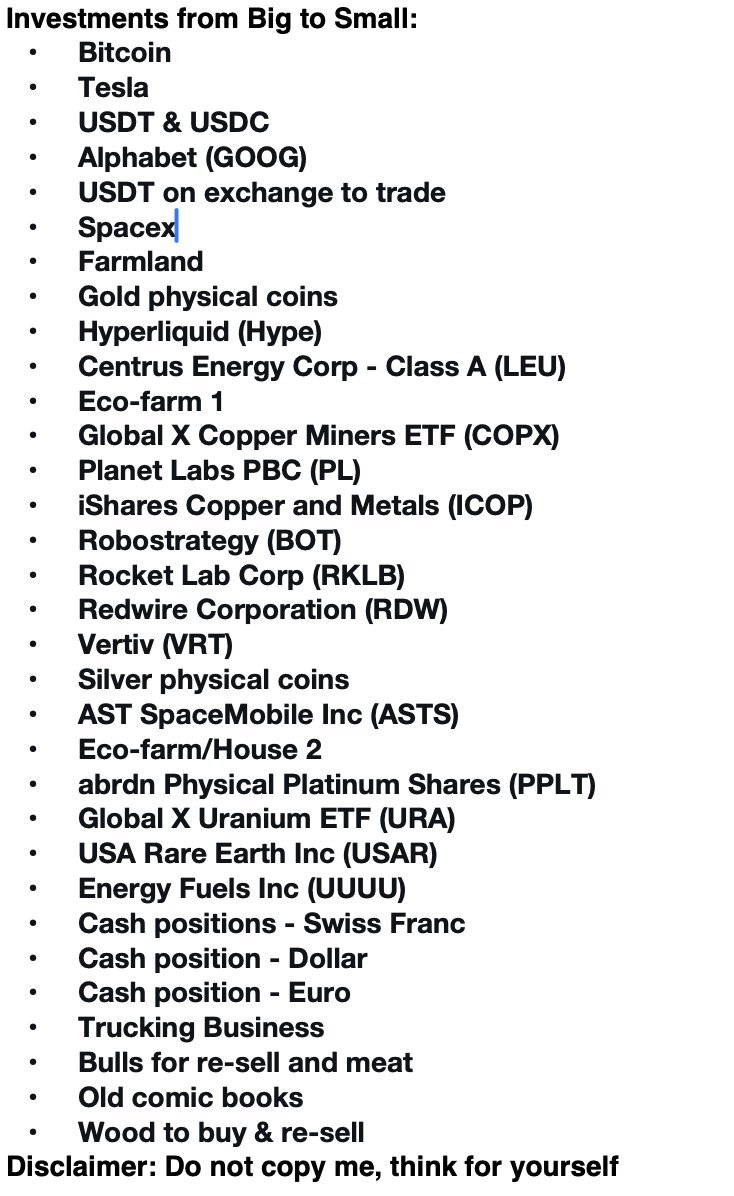
Not changed anything on this list, except that i moved some of the usdt & usdc you see from cold storage to exchange accounts in preparation of a bit more trading
- All the rest still the same
- I am not selling other assets to move back into crypto
- On the contrary, the only reason i have these assets is by moving money out of crypto
- So once the bull-market gets going, trading-profits will flow again into more assets outside of crypto which is the only way to secure gains and build resilience long term in my humble opinion