This panel was originally called “Industrialization of SI” until about midnight last night…
Enjoyed chatting w/ @danwrightSF and @7earse at this year’s @payloadspace Investor Summit
Incredible what @itsmoislam and team have built in a short time, privileged to be part of it
Another theme that emerged from our Q2 tour of datacenter industrials is that modular capacity is sold out, with demand growing faster than the pace of capacity bring-up. Modular is gaining share because it addresses the two biggest constraints on datacenter construction: time and field labor. Power and cooling systems can be assembled in factories while the shell goes up on site, compressing delivery timelines by up to 40% and reducing on-site man-hours by up to ~70% for some parts of the build. We broke down the different approaches—and the schedule, labor and cost savings—in our recent newsletter (1/4)🧵 https://t.co/7I01B8Udo9
To bring large AI data centers online requires building massive power plants, transformers, liquid cooling loops & chillers, as well as incredibly complex networking (especially for training clusters)
Consensus estimate is that ~15GW of AI compute produced in 2027 cannot be turned on in 2027.
This is harder than just finding power, as you also need to build out all the transformers, wiring, liquid-cooling, (massive) chillers & complex networking. https://t.co/cRXJ1Wrkri
The Wild Wild West Of LEGO Datacenters
Everyone Says They're Modular,
Do The Vendor Claims Hold Up?
Zuck's Tents, AWS's Houdini,
60GW+ Modular Capacity Tracked,
Full Vendor Landscape Mapping,
Vertiv's 2x Content Uplift Per MW
https://t.co/lTOeW9PB15
Today, Space VC becomes Ambition Capital
Five years ago, I launched a venture firm to little fanfare. Few in venture had heard of us, and even fewer believed the thesis
CoreWeave CTO Peter Salanki on where AI infrastructure economics are heading:
>~50% of CoreWeave compute is already inference. Reasoning, reinforcement learning and distributed key-value caching increasingly require training-grade networking.
>A 100,000-GPU Grace Blackwell cluster consumes ~250 MW and has ~16M connection points. At that scale, failure is inevitable. Goodput and completed work matter more than headline uptime.
>Losing 10% of cycles to failures, retries or poor orchestration raises effective token costs by ~10%. Cost per token is a full-system output, not a chip benchmark.
>Older GPUs can retain value through workload specialization: newest chips for prefill and frontier compute, older GPUs for decode, evaluations and smaller-model inference.
>Vera Rubin could cut inference costs by up to 90%, improve time to first token and increase density.
>Salanki “doesn’t lose sleep over power.” He sees enough transmission-level power in the US; the actual 2026 constraints are substations, transformers, cooling equipment and the skilled trades needed to turn grid capacity into an operating data center.
>CoreWeave is staying NVIDIA-only because of what they see from customers. Better focus and execution today, with obvious supplier concentration and bargaining-power risk.
AI workloads generate unprecedented heat, forcing new architecture of data center thermal systems
Every GW of new compute brings massive incremental cooling demand
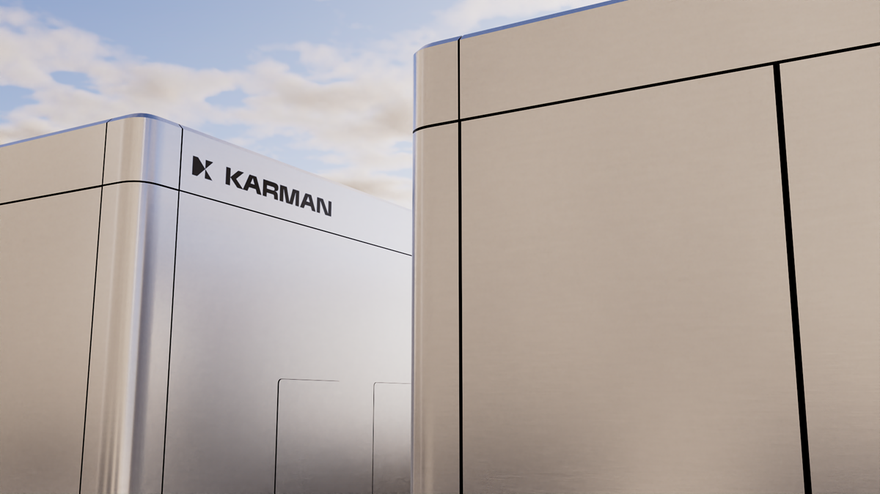
Karman built the HPU to solve exactly this. Proud to have backed team from day zero
https://t.co/7A1UoV0QdZ
Big day for Karman introducing the Heat Processing Unit (HPU): a new category of thermal infrastructure for giga-scale AI. As data centers push toward scale, heat has become the real bottleneck. The HPU is designed to reduce footprint, cut energy use & run with zero water.
@Andercot Actually almost all options is legacy technology not developed specifically for AI factories and thus are not great solutions for hundreds of MW to GW sized sites. But stayed tuned for an announcement from us in a few weeks 🤫
Reminder: I am actively investing $1M in founders raising their first round across:
⚡️energy generation & storage
🤖robotics & physical AI
🛰️defense & space tech
📶next-gen comms infrastructure
🏭manufacturing & industrials
DM if you're starting a company & raising soon 🙌
Is venture broken today? No.
But early-stage VCs need more courage.
In deep tech, the “weird,” the non-obvious, the misunderstood…those are the companies that break out.
Think:
– Desalination before @VitalLyfe
– Fishing automation before @ShinkeiSystems (@IanRountree)
– Industrial thermal energy before @7earse started Karman
As @caitlinbolnick1 says, it’s about “the weird & wonderful.”
Enough VC group-think chasing only AI & defense trends. It feels safer for IC memos & LP calls, but it’s worse for returns.
Go where others won’t. Back the founders building in overlooked markets. Build durable companies.
After popular demand, we broke down 'The Current State of Global Chip Supply, Power Constraints, & Competition'
Special thank you to Dylan Patel Founder of SemiAnalysis, Talal Al Kaissi, Group Chief Global Affairs of G42, Packy McCormick of Not Boring, and Gil Verdon of Extropic, for input, editing, & research.
Full piece linked below
@dylan522p@SemiAnalysis_@TalalAlKaissi@packyM@beffjezos