India is about to attempt one of the hardest industrial challenges it has taken on.
Five inputs go into a battery cell:
→ Cathode — dark powder, 30-40% of a cell's cost
→ Anode — graphite, baked four weeks at 2,800°C
→ Separator — plastic sheet, 5 to 16 microns
→ Copper foil — 4.5 to 8 microns
→ Electrolyte — the liquid
Together they are more than 60% of what a cell costs. India makes almost none of them.
For decades, Indian auto companies paid foreign partners royalties to use their technology.
That flow just flipped - Denso, Japan biggest auto parts maker after Bosch with $48 bn in yearly revenue, will now pay Sona Comstar royalties for its electric 2-wheeler and 3-wheeler powertrain technology. Denso came to India not for cheap labor or low-cost factories. It came because Sona built IP in small vehicle electric drivetrains that Denso did not have.
First Indian auto firm to earn royalty income from any of these global giants.
Sona Comstar was Rs 345 Cr company in FY15. It hit Rs 4,475 Cr in FY26, roughly 10x in 10 years
Q1 FY27 revenue grew 54% to Rs 1,310 Cr. Electric vehicle parts now bring in 44% of its auto revenue, up from 22% in FY24. It just launched its 4th business line, robotics and physical AI. Already won Rs 800 Cr in robot orders, including farm robots and radar perception systems.
Next target is another 10x by FY35, Went from forging gears to building robot platforms
Most JVs in Indian auto work like this. Foreign partner brings technology, Indian company brings low-cost manufacturing and local market access.
Denso-Sona works differently - Both sides bring IP. Both sides license it. Both sides earn royalties. Denso gets paid for high-voltage motors and inverters going into 4-wheelers. Sona gets paid for air-cooled traction motors and controllers going into 2-wheelers and 3-wheelers.
Denso valued Sona 2W/3W business at Rs 1,750 Cr - When someone that big pays you for your technology, that is IP validation at industrial scale.
This pic helped change the air war over Kargil. An IAF MiG-25 Foxbat took it in the third week of June 1999. And there is a reason to tell that story today. On 17 Aug 1981, 45 years ago, No. 102 Sqn was raised, beginning the MiG-25’s career in the IAF.
18 years later, the Foxbat was called upon to solve one of the most critical problems confronting the IAF in Kargil: accurately finding targets. It is also an important part of Safed Sagar that @NetflixIndia largely ignored.
Identifying Pakistani positions and fixing their precise coordinates had become a serious problem. The Army’s maps were dated and inadequate for extracting accurate coordinates. Newer Survey of India maps would only reach the troops towards the end of June.
The IAF therefore needed vertical aerial photography. It had the Avro 748, Jaguar, Canberra and MiG-25 available, but each had limitations.
The Avro was unsuitable for a hostile environment. Jaguars with Vicon cameras produced excellent low-level imagery, but operating low over Kargil meant exposure to SAMs. A No. 106 Sqn Canberra had already been struck by an Anza missile on its first reconnaissance sortie.
That left the MiG-25.
The Foxbat normally operated above 20 km at around Mach 2.4. Its 72-inch focal-length cameras offered enormous photographic coverage, while its Peleng-DM navigation system could associate accurate positional information with the imagery.
But at its normal altitude, the resolution was insufficient to identify small bunkers, sangars and concealed positions in Kargil. The Foxbat had to come down.
At around 8 km, the imagery was superb, but the aircraft would be dangerously exposed to shoulder-fired missiles. A 13–14 km profile offered greater safety, but required minimum reheat and pushed the aircraft to about Mach 1.3.
The eventual compromise was remarkable for a Foxbat: around 10 km and Mach 0.9. It gave roughly 5 km of vertical separation from the missile belts while allowing an effective fighter escort. The MiG-25 had no RWR, flares or chaff.
Two MiG-29s provided top cover, with two Mirage 2000s accompanying it. If seriously threatened, the escape plan was pure Foxbat: maximum afterburner, climb to 20 km, accelerate to Mach 2.4 and get out.
Navigation accuracy was equally critical. The Peleng-DM, like any inertial system, could drift. Its feed was integrated with the RSBN beacon system, and Wg Cdr P.J. Thakur went a step further, borrowing a handheld GPS from No. 7 Sqn to verify that the positions being generated were accurate.
The MiG-25 was ferried to Adampur on 18 June. Weather ruled out operations on 19 and 20 June. On 21 June 1999, Wg Cdr P.J. Thakur flew the first operational photo-reconnaissance mission over the Drass–Kargil sector.
Mirage 2000s flown by Wg Cdr S. Chhabra and Wg Cdr Rohit Verma accompanied the mission, while MiG-29s led by Wg Cdr S. Harpal Singh provided top cover.
Two Pakistani F-16s approached during the photographic run. The MiG-29s deterred them, and the Foxbat stayed on task.
The exposed film was then flown back to Bareilly for processing. When the photographs reached Western Air Command and Air HQ, the impact was evident. Tololing. Muntho Dhalo. Tiger Hill.
Positions that had been difficult to locate with confidence were now clearly visible. Enlargements revealed bunkers, sangars and camouflaged positions. Crucially, the imagery could be tied to accurate coordinates.
Strike crews could now study their targets before take-off, see how they would appear from release height, fix their coordinates and plan the direction of attack.
Look again at the photograph. In the Kargil mountains, where locating a small position could be almost as difficult as attacking it, imagery of this quality mattered enormously.
The MiG-25 went on to fly four more missions over Kargil–Drass, besides reconnaissance over Rajouri–Poonch and a sortie to establish the situation around Gultari.
The Foxbat is remembered for Mach 2.4 and the stratosphere. Over Kargil, it made a critical contribution by doing almost the opposite: coming down to 10 km and slowing to Mach 0.9 so its cameras could see what mattered.
Happy birthday, No. 102 Squadron! #IAFHistory @IAF_MCC
Michael Froman, the president of the Council on Foreign Relations and a former US Trade Representative, published a piece in @ForeignAffairs today titled “The Next Global Economic Crisis Could Be Made in China.”
I have been writing about this topic for a while, so I read it carefully. His argument overlaps with what the data has been showing for some time, and I think it is worth walking through in simple terms, because you do not need an economics background to follow it.
An economy runs on four engines. Homes get built, factories produce, households spend, and the country sells to the world. In China, three of these engines are struggling at the same time, and the fourth was never fully developed.
Property broke first. Home prices have fallen for 35 straight months, the longest streak on record. Chinese families hold 60% to 70% of their wealth in their homes, and independent estimates put the number of empty apartments somewhere between 65 and 80 million. New home sales have more than halved since 2021.
Factories were the answer to the property bust. Build more, export more. The output came, but the profits did not. Factory activity contracted for eight straight months in 2025, factory gate prices have been falling for more than three years, and close to 30% of industrial firms are losing money. More production, less profit.
Household spending is the engine that was never built up. In most economies it is the largest one. In the United States it is about 68% of GDP, and in the European Union roughly 52%. In China it is under 40%, and that was a design choice. Wages and savings were channeled toward building and exporting instead. Now, with home values falling, families are saving even more. Retail sales have slowed to a crawl and even turned slightly negative this spring.
That leaves exports, the last engine running. The trade surplus reached almost $1.2 tn in 2025, growing about three times faster than world trade, and net exports drove roughly 30% of China’s growth last year. Froman’s point is that the math has a limit. Sales cannot grow three times faster than customers’ incomes forever. Either demand runs out, or trade barriers go up. Both are already visible.
The question I tried to answer in my July report is where the losses from all of this have gone. The official answer is almost nowhere. Chinese banks report that only 1.52% of their loans have gone bad, roughly unchanged from before the property crash. Comparable crashes took bad loans to 5.6% in the US after 2008, 13.6% in Spain, and above 25% in Ireland. Applying those historical precedents, my estimates put the losses sitting inside the Chinese financial system somewhere between $3.9 tn and $12.2 tn, with a central case near $7.7 tn, against buffers of about $1.28 tn and state injections of $74 bn so far.
More here: https://t.co/eJO1NBjJJk
I may be wrong on the exact numbers. I do not think the direction is wrong.
The known fix is to grow household spending. Japan is a reminder of how long that takes. It began rebalancing in 1991 as one of the richest countries in the world, and the process still meant more than 15 years of cleaning up banks and two lost decades of growth. China is starting from a much lower income level, with a population that is already shrinking.
To be clear, none of this points to a collapse tomorrow. China has tools other countries did not have, and the most likely path is a slow, Japan style workout, absorbed quietly by savers over many years. What the Froman piece suggests to me is that this view is no longer a contrarian one. The open questions are who pays, and how long it takes.
Answering them means dismantling the machinery that built the miracle, which is why I titled my January piece “The Elephant No One Wants To See”.
Michael Froman’s article: https://t.co/Kpb2TDOqJI
My report and the January piece: https://t.co/JEEVUF0bQ2
@MikeFroman #China #Growth
China has 5x AC penetration compared to India, though weather-wise arguably the latter needs it more. Over the next decade, this would be a classic S-curve move where AC penetration rises sharply compared to income growth. This is very true for four wheelers as well, for example.
India aimed to push manufacturing to 25% of GDP, Right now it sits around 14%, peaking at roughly 18% back in 1995
Manufacturing share fell not because factories shrank but because services like IT, consulting, and tourism grew faster. China hit 32% manufacturing share before starting decline, India never reached that level.
Services contribute over 55% of GDP, manufacturing around 14%. For manufacturing share to rise, factory output needs to grow faster than services for many years in row, That has not happened yet.
Services do heavy lifting for India right now. Services exports crossed $421B in FY26, up from $254B in FY22. India earns enough from IT, consulting, and business services to cover nearly 2/3 of its goods trade deficit.
India hosts over 1700 global capability centers employing 2M people, bringing in $64.6B. Tourism forex earnings crossed Rs 2.93 lakh crore in 2024.
When people say manufacturing is weak, they forget services keep current account from blowing up. Economies with diversified income, factory and services both, compound better than concentrated bets.
China reached 32% manufacturing share and even Beijing admits recovering lost factory share is extremely hard once decline starts.
India committed Rs 18100 crore under PLI to build 50 GWh battery cell capacity by 2025. Only 1.4 GWh was running by October 2025, just 2.8% of target.
Manufacturing boost requires reforms, lower tariffs, and aggressive industrial policy running simultaneously. Any single policy fails alone.
India manufacturing is growing but slower than services. For share to rise, manufacturing needs to outpace services consistently.
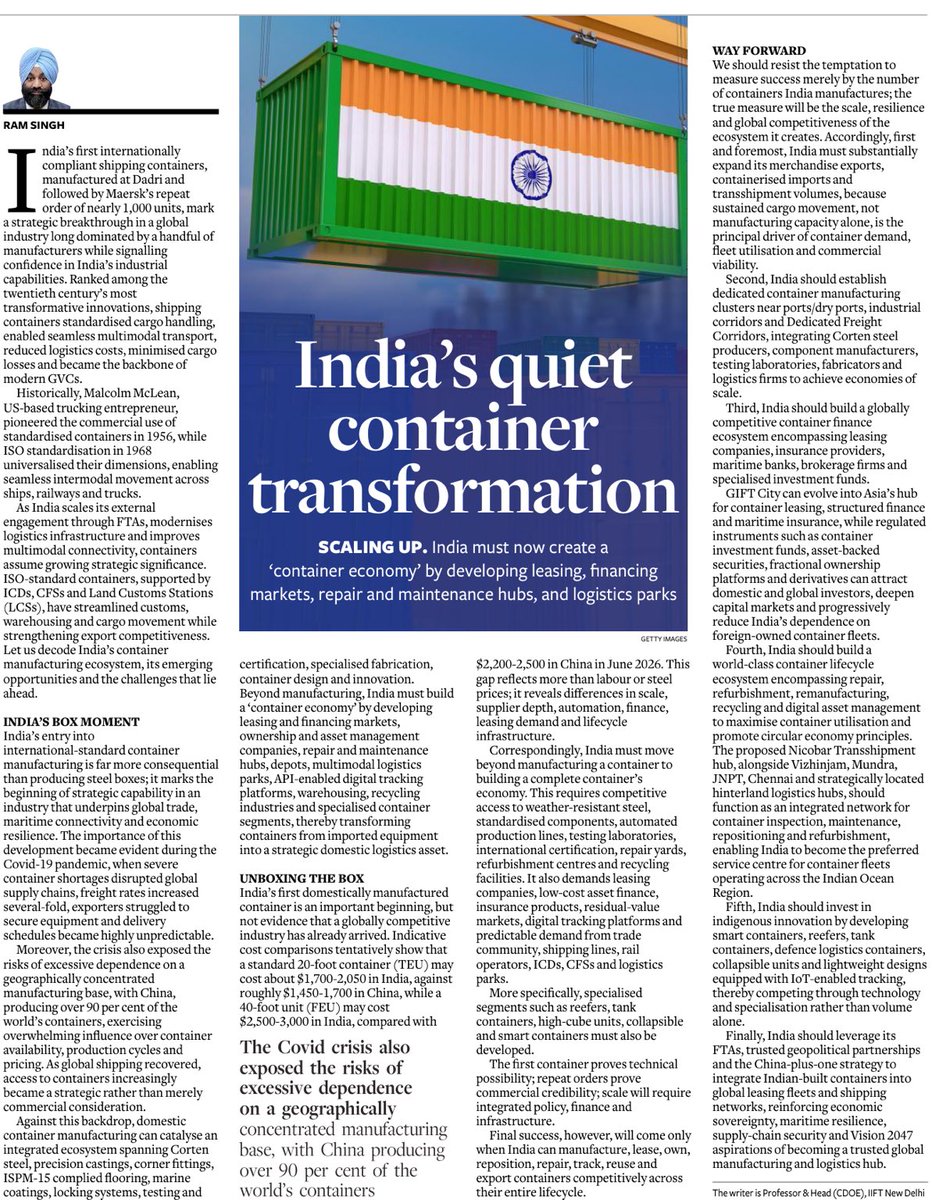
India has recently begun domestic manufacturing of internationally compliant shipping container in what looks like a seemingly small industrial milestone.
But this fine @businessline piece points to how a fledgling industry can become a capability-catalysing platform for an entire industrial ecosystem
including specialised steel, components, coatings, flooring, certification and testing, leasing and finance; repair, refurbishment and recycling, logistics parks and tracking and eventually specialised containers
As India is deploying industrial policy in multiple sectors, the key criterion to judge the outcome should not be merely be the number of units manufactured, but the depth of capabilities, supply chains, services and businesses that develop around it. This piece makes that argument particularly well.
How much of India’s Railways was developed after 2014?
• 100% of Dedicated Freight Corridors
• 100% of Rapid Rail System
• 100% of Premium Stations
• 97.4% of Bio-Toilets
• 87% of LHB Coach Production Capacity
• 69% of Railway Electrification
• 67% of Railway Safety Budget
• 66% of Locomotive Production Capacity
Railway infrastructure is built over decades.
But some decades build more than others.
India and China were near economic parity in 1980. Since then, China widened the gap, and India’s relative share declined until 2014. Since then, the decline has stopped, and India is rebuilding its economic weight. By 2030, India is projected to reach roughly one-fifth of China’s economy.
1980-90:
India $321B (+72%) | China - $361B (+89%)
1990-98:
India - $415B (+29%) | China - $968B (+168%)
1998-04:
India - $709B (+71%) | China - $1.9T (+105%)
2004-14:
India - $2T (+188%) | China - $10.5T (+430%)
2014-26:
India - $4.15T (+104%) | China - $20.8T (+98%)
2026-30:
India - $5.34T (+29%) | China - $24.1T (+16%)
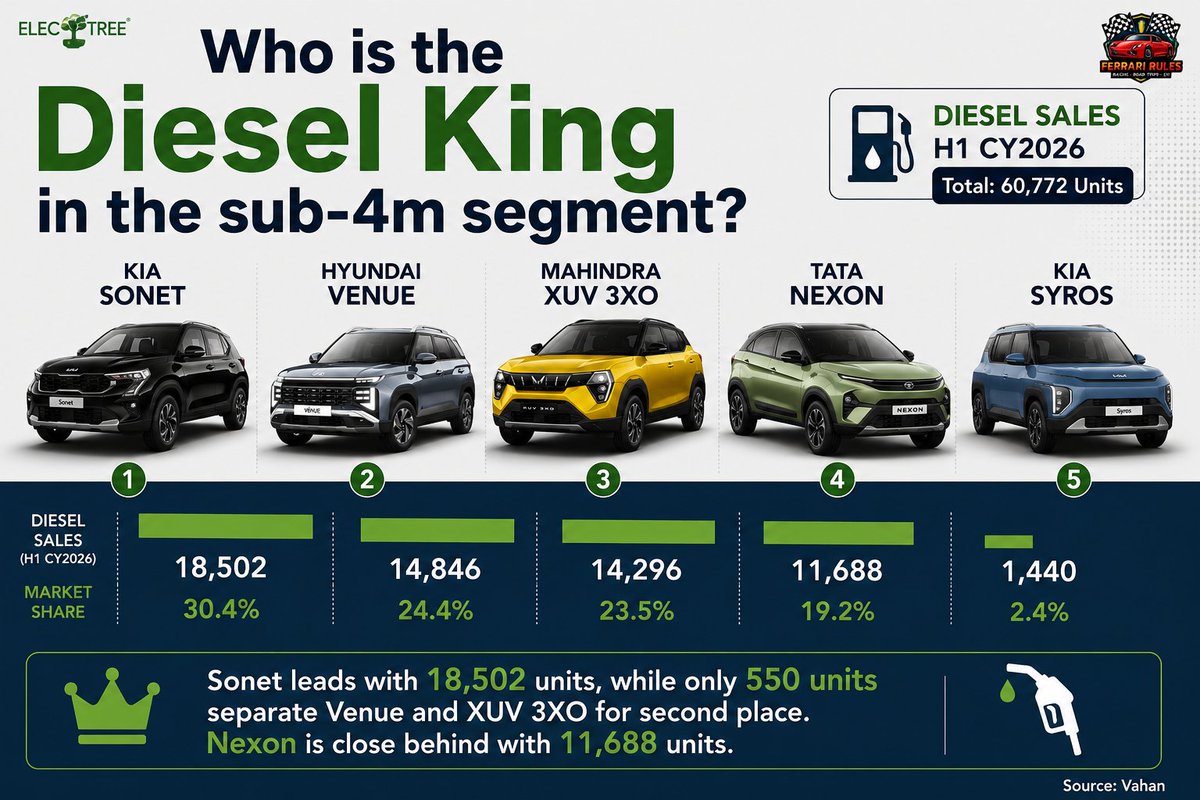
👑 Who is the Diesel King of India’s sub-4m SUV segment in H1'CY26?
🛢️Kia Sonet takes the crown with 18,502 sales
🥈 Venue: 14,846
🥉 XUV3XO: 14,296
🚙 Nexon: 11,688
Just 550 cars split Venue & XUV3XO
⛽️Why do you think Sonet Diesel outsells Venue Diesel?
Indian real estate is in a real bubble, but it is not bursting any time soon.
A lot of big people are involved in it, and they will never want that real estate to be in the hands of common people.
It is a hub of corruption. It is a hub of black money, and it will never go away.
You will have to pay 1 crore for a 2 BHK house, and you will keep paying emails for your life.
📉 India's labour force participation rate fell to 54.6% in Q1.
👷 The worker population ratio also declined to 51.7% .
👩 Female participation fell sharply to 33.2%, while rural unemployment rose to 4.8%.
https://t.co/HNvBrrT6ZD
India’s banking clean-up has a clear before-and-after story.
As former RBI Governor Raghuram Rajan noted, “a larger number of bad loans were originated in the period 2006–2008,” with too many loans going to “well-connected promoters” with a history of defaults.
The 2015 Asset Quality Review exposed previously hidden stress, while the Insolvency and Bankruptcy Code introduced a time-bound resolution framework. Recapitalisation, recoveries and wider banking-sector reforms further strengthened bank balance sheets.
The result: gross NPAs have fallen from a peak of 11.18% to just 1.80% in March 2026, the lowest level in recorded history.
हम शिकारी हैं, दुश्मन है शिकार
हिंसा के हम मालिक हैं , तुम बस किरायेदार
We are the hunters;
the enemy is the prey.
Violence is ours to command; you merely rent your place in it.
An entire PA post wiped out , 22 PA troops KIA, message written with their still warm blood.
Rumoured to be revenge for the inhuman torture and cold blooded murder of the ill-fated patrol led by Captain Saurabh Kalia (4 JAT).
The 22 dead included the PA officer who had tortured and murdered the captured patrol.He had since been identified and tracked for years until he finally met his maker in this cross border raid.
Never thought this day would come:
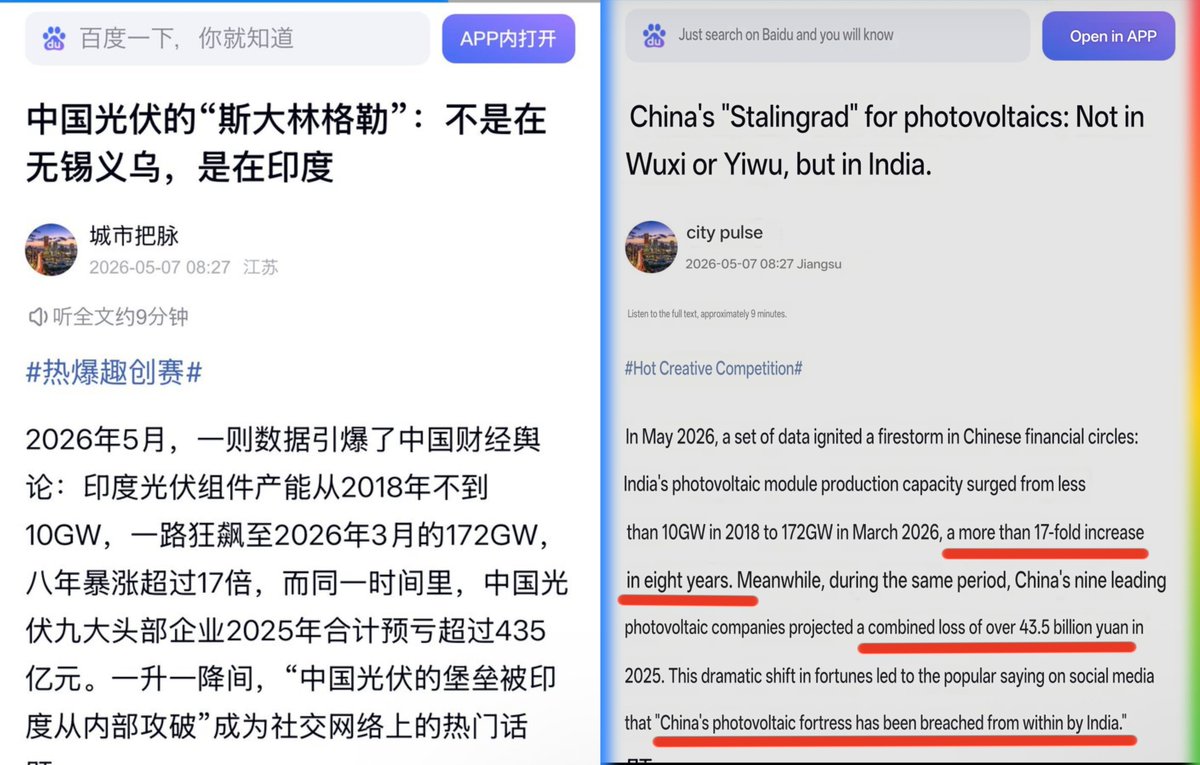
Chinese Netizens complaining about 17 fold increase in Indian Solar Component manufacturing since 2018 and how it is driving top Chinese Solar companies into deep losses
"Chinese Photovoltaic fortress has been breached from within by India"
"India is our Stalingrad for Solar Manufacturing" (World War 2 reference when German Army was trapped by Russians in city of Stalingrad)
Actually, I went to a Bio-CNG plant in Banas. Methane is actually only around 55 percent of the extracted Biogas and mixed in with Carbon Dioxide and Hydrogen Sulphide. However, desulphurisation and carbon dioxide scrubbing happens and the final output of a Bio-CNG plant is closer to 97-98 percent Methane.
Don't talk without knowledge