All in the last two days:
- Macron summoning the party leaders to warn them of some kind of Russian threat.
- Tusk warning of Russian missiles hitting European territory, with Nawrocki talking about Poland using its territory
- Merz warning of "decisive months if not weeks" for the freedom of Europe lying ahead of us and sending Eurofighters to Latvia
- Stubbe mentally preparing his population for drone and sabotage attacks
- Now this
Something's afoot. But what?
@MAGAFarmAnimals@ShazCoder Nope, Malaysia is a Muslim country with higher human capital.
Malaysia does outsourced semiconductor manufacturing for the west.
So much geopolitical naïveté from
Silicon Valley on US-China. The lessons of Cold War arms control are:
a. Early prophets always fail — Churchill as PM in 1950s zero impact.
b. Both sides need to stare into the abyss — arms control only begins after Cuba.
c. Both fearing losing duopoly helps control — fear of China going nuclear helped.
d. Asymmetric economic exhaustion drives concessions — By USSR unable to keep up.
e. Only collapse of one side truly ends it — Gorbachev and Bush reacting to 1989-91.
@PeterBerezinBCA You'd have to take into account selective immigration.
Asian Americans are basically the Asians or their parents who were smart enough to get in the US.
Asians in their home countries are Asians of varying intelligence.
Hunter Biden was so close to fixing his reputation and decides to throw it away at the 1 yard line with a bundled scam token launching at 70b mcap with $50k in liquidity - who tf is advising this guy lmao
There is upward selection bias in China’s results even beyond the geographic filter (limiting PISA to China’s wealthiest regions).
But there is still plenty of comparative value with proper and reasonable adjustments.
Adjusting for these biases, Beijing-Shanghai-Jiangsu-Zhejiang (BSJZ) (525-550) would rank slightly below Singapore (550-560) in Math, which ranks at the top of the list.
Then one can make some reasonable assumptions based on rural-urban disparities to extrapolate BSJZ to the rest of the country. Independent studies done in the 2015-19 period would extrapolate a 525-550 score for the wealthiest regions to ~450-470 for the entire country.
But China has urbanized by ~10-12% since 2015-19, shrinking the urban-rural education gap. To account for this we need to bump up the adjusted national average range to ~460-480. This would rank China — as a whole, including the poorest regions — at or above the OECD average today.
The momentum from rising urbanization (which naturally shrinks the urban-rural educational gap) should drive this figure upwards to the top of the range for the entire country by the late 2030s.
So the key conclusions I draw here are:
- China’s wealthiest regions (total population: 200-250 million) feature 15yos that are already at world-leading levels in Math.
- 15yos in China in aggregate are at or above OECD average levels.
- Country average will continue to rise from lagged effects in rising urbanization and recent investments in educational infrastructure to further close to rural-urban gap and gap between BSJZ and the rest of the country.
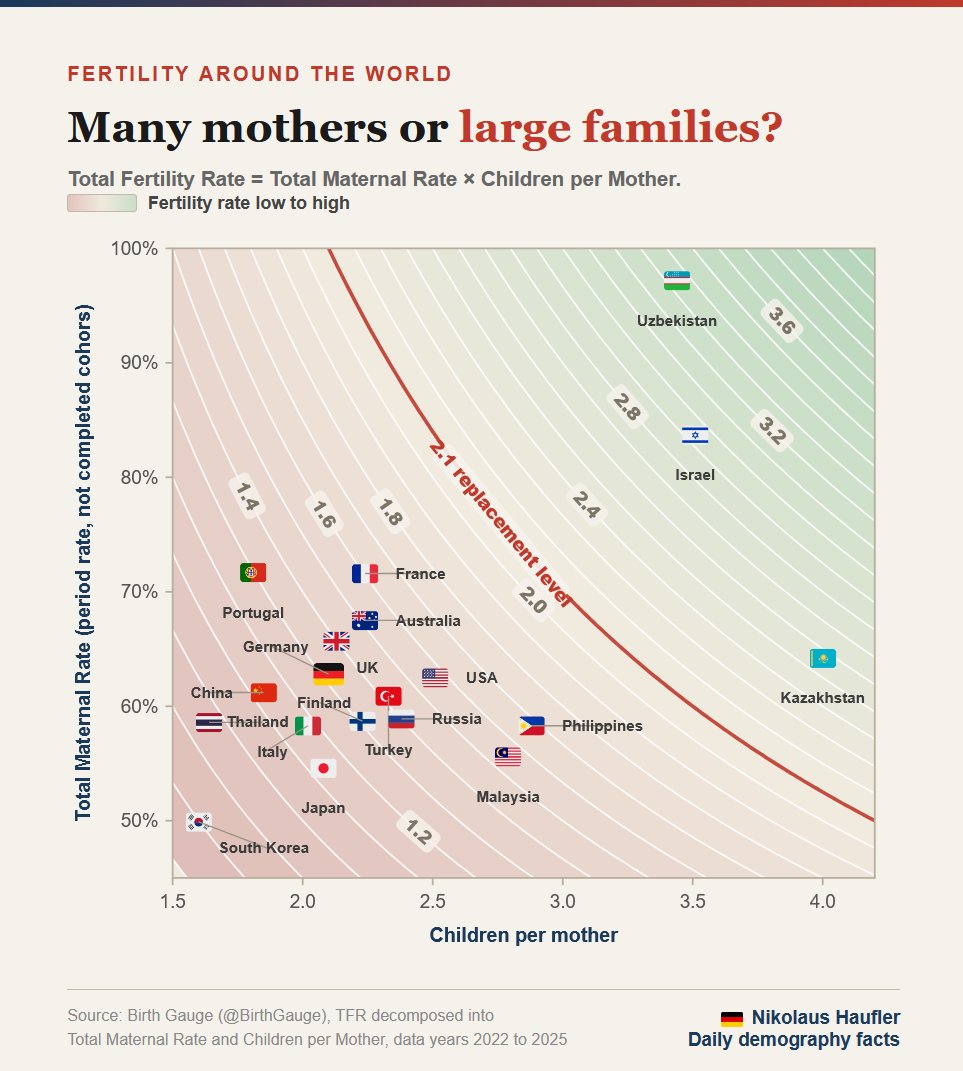
Birth rates: What drives them?
@BirthGauge says: Total Fertility Rate = Total Maternal Rate × Children per Mother.
Two countries, same fertility rate:
🇫🇮 Finland at 1.31, with fewer mothers and larger families.
🇵🇹 Portugal at 1.30, with more mothers and smaller families.
🧵
Milo Yiannopoulos says he was 'swarmed' by 15 ICE agents - and that 'one or two' of them refused to take part in detaining him once they recognized him.
Watch more 👇
📺 https://t.co/Ty7BWLpQAn
@piersmorgan | @Nero