#HappyBirthday dear #brother! 50 and counting stronger than ever. You are a blessing and the purest form of love I’ve ever known. No wonder Mom and Dad named you Àngel. You make this ugly and selfish world a better place. Love you!
Hoy me han llamado a mi número particular para pedirme dinero para el proyecto de la triple terapia contra el cáncer de páncreas…. No hace falta decir qué fundación me ha llamado ni quien dirige el proyecto… no salgo de mi asombro… con la que está cayendo…
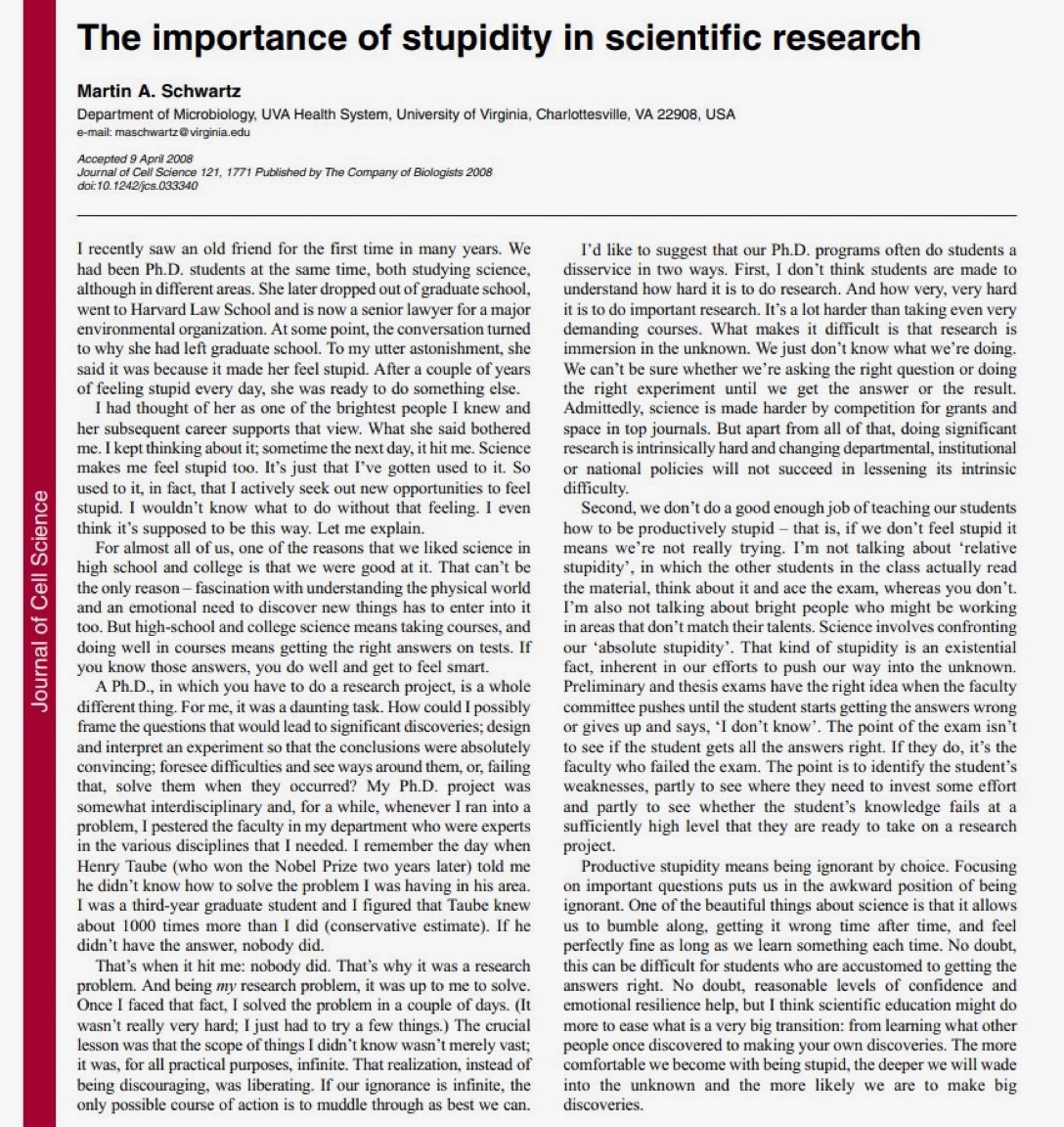
This article should be mandatory reading for every medical student, PhD candidate, researcher—and honestly, for anyone who mistakes expertise for certainty.
“The importance of stupidity in scientific research” sounds provocative, almost offensive. But Martin Schwartz is not glorifying incompetence. He is describing the real operating system of discovery.
Science is not built on knowing.
Science is built on tolerating not knowing.
That distinction matters.
Most of education rewards correctness.
School teaches us to answer.
Exams reward speed, certainty, and precision.
You feel intelligent when you get things right.
Research is the opposite.
Real research begins exactly where competence ends—at the frontier where nobody knows the answer, including the people you thought must know.
That moment is psychologically brutal.
You ask the expert.
The expert shrugs.
You assume you’re missing something.
Then you realize: no—this is the work.
You are not failing.
You are standing at the actual boundary of knowledge.
That feeling—“I must be stupid”—is often not a sign of inadequacy.
It is often the first sign that you are finally asking an important question.
Medicine struggles with this.
We train doctors to avoid uncertainty, to fear being wrong, to perform confidence.
But the best clinicians and the best scientists know how to sit inside ambiguity without collapsing into fake certainty.
This is why AI in medicine also deserves caution.
Systems trained only to reproduce established answers may become extraordinarily good at passing exams while being terrible at discovering what matters next.
Guideline intelligence is not the same as scientific intelligence.
Discovery requires productive stupidity:
the willingness to stay with the uncomfortable,
to look ignorant,
to ask naïve questions,
to be wrong repeatedly without protecting your ego.
Most people want the authority of expertise.
Very few want the humiliation required to earn it.
But progress lives there.
Not in certainty.
Not in performance.
Not in sounding smart.
In the quiet discipline of saying:
“I don’t know… yet.”
And continuing anyway.
Sci-Hub is an evil website that pirated 85M+ research papers and made them freely available
And now they've added AI to their database to make Sci-Bot.
It answers your questions using latest, full-text articles.
But DO NOT use it. We should all try to make billion-dollar academic publishers richer.
I'm putting the link below so you know how to avoid it.
Que el ministerio o las CCAA paguen (poco pero algo) por revisar protectos y las fundaciones privadas no, me lo tiene que explicar alguien…. El argumento de que son donaciones es malo, muy malo….
@manuelansede@iguardans no todos los medios tienen una sección especializada como la vuestra y a muchos les va el sensacionalismo y tratar estos temas como “salseo” science-Pop. Se impone una reflexión colectiva, científicos, financiadores, centros de investigación y periodistas.
There’s a now generation of very good scientists in Spain that are the product of a golden age in public universities, where many talented Spanish researchers returned to in the 80/90s and dedicated themselves to teaching. With the lack of current Uni funding, it may be the last.
@AlejoFraticelli Agree and we should all support those who try. And that’s compatible with asking for a responsible communication that explains both breakthroughs and limitations.
Comunicación sencila, clara, honesta que pone de relieve los grandes avances sin generar expectativas que llevan a frustración primero y desconfianza después. 👇🏻
Now that everyone is an expert on curing pancreatic cancer in mice, not rats - I want to add some context that goes beyond the headline.
You will want to read this.
Cancer is cured in mice all the time.
Thousands of times. ~90% of those “cures” fail in humans.
Why?
Because mice are:
Genetically simpler.
Treated earlier.
Short-lived.
Not humans.
Mice are a filter - not a finish line.
Yes, this study matters. It comes from the Spanish National Cancer Research Centre.
Yes, it’s pancreatic cancer - one of the deadliest there is. Yes, full tumor regression is impressive.
But here’s what it actually means:
“This approach is now good enough to risk years, trials, and millions of euros on.”
Not:
“Cancer is solved.”
What happens next?
More animal work.
Toxicology.
Phase I (safety).
Phase II (maybe works).
Phase III (beats standard care?).
Maybe 8-10 years if everything goes right.
The real damage isn’t failed drugs.
It’s failed expectations.
Every “cured cancer in mice” headline trains the public to believe:
Cures are being hidden.
Progress should be fast.
Scientists are lying when reality hits.
That’s how trust erodes.
Bottom line:
This is how real cancer progress looks.
Messy. Slow. Risky. Incremental.
Not miracles.
Not conspiracies.
Just science - doing the hard work.
Por los pacientes y sus familiares, para no abundar en su frustración y sus miedos, igual hay que replantear la communicación de la investigación biomédica…. Un poco de prudencia no estaría de más.