75+ activists from across the state are gathering in Hamden to plan for #2025Session and our upcoming #fiscalroadblock fights! Our communities are in survival mode while @GovNedLamont touts a high credit rating and billions in surplus. It’s time to #FundOurFuture
Congrats to the Volkswagen workers in TN on their historic vote to join @UAW!
Our research shows that unions are not only good for workers, they’re good for communities and for democracy 🇺🇸
https://t.co/IToJeQ6yU1
CT's focus on 'concentrated poverty' is a good start to focus on neighborhood context for addressing differentials in social, economic, and health outcomes. https://t.co/tzxEcFdd8C
Male college enrollment and completion rates have dropped significantly in the last half century.
Check out our latest research brief on male college enrollment and completion:
https://t.co/dHuAszI4IK
Men's share of Bachelor's degrees dropped from 57% in 1970 to 42% in 2021, with steeper declines at other degree levels.
In 2022, 57% of male high school graduates and 66% of female graduates enrolled in college. Women's college enrollment has been steadily increasing, while men's enrollment has been more stagnant since 1964.
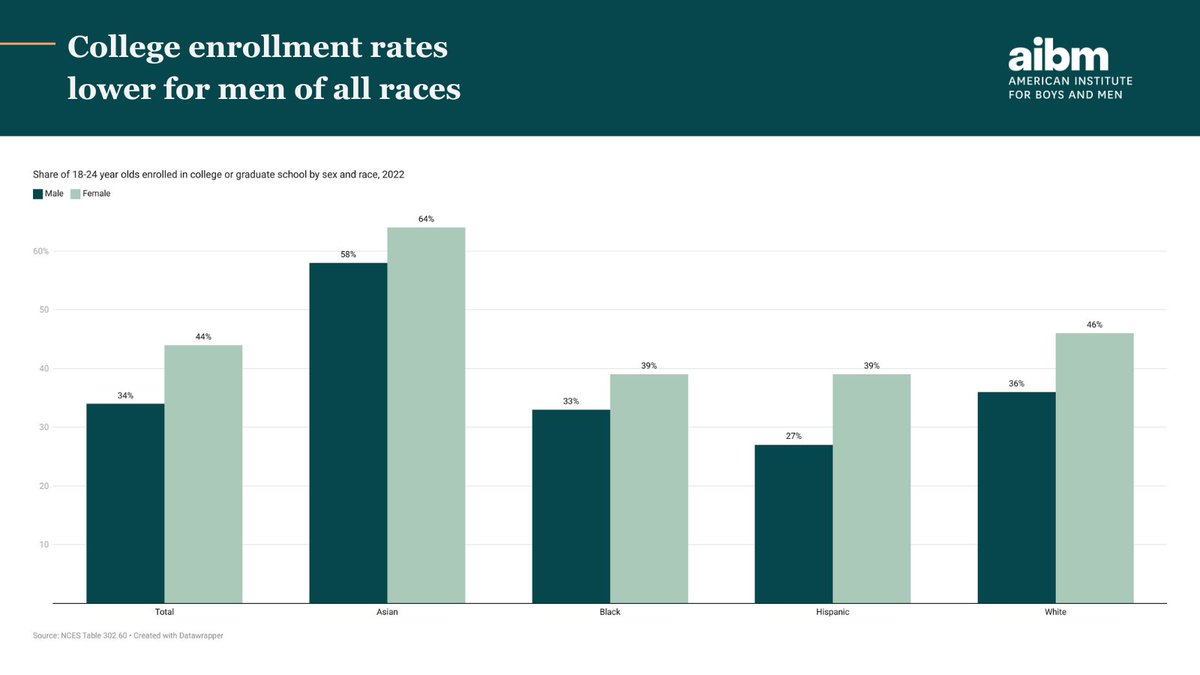
Of course, not all college students start right after high school, but the overall enrollment share is still much lower for men, with a ten-point gap between men and women aged 18-24.
When broken down by race, the widest gaps are between Hispanic men and Hispanic women with a 12 percentage point gap, while Asian students have high enrollment rates and the smallest gender gap, with men trailing women by only 6 percentage points.
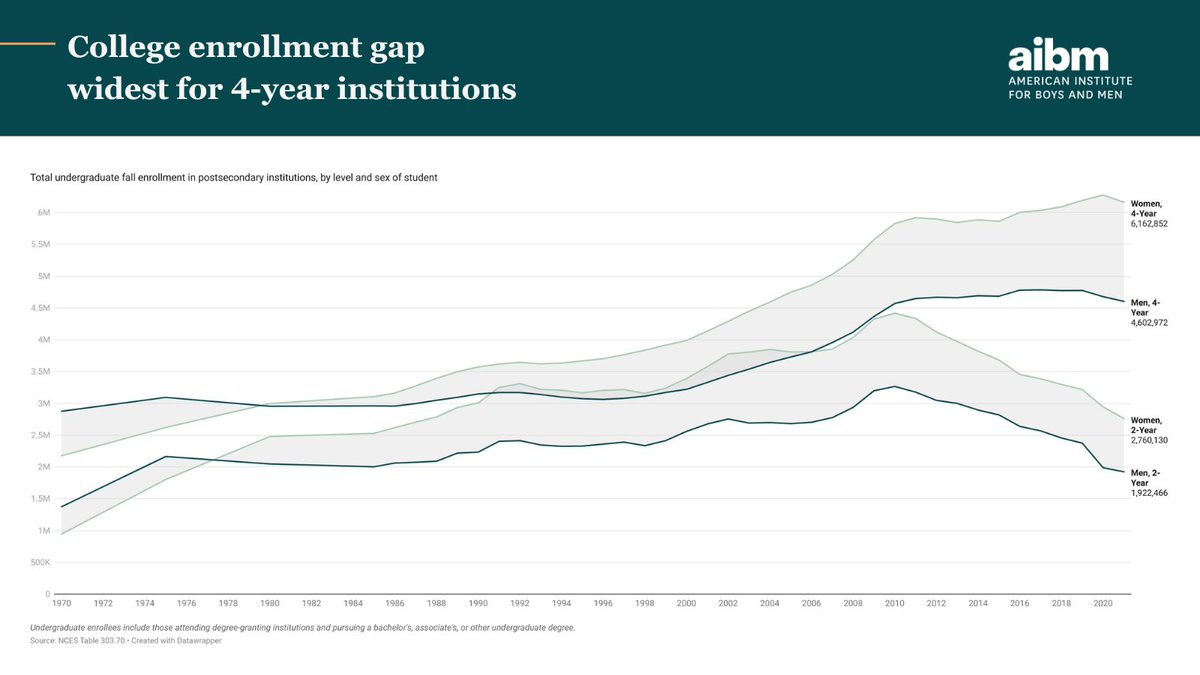
In raw numbers, there are 2.4 million fewer men pursuing degrees than women. This gender gap has been widening since the 1980s.
Completion rates are also persistently lower for men - 6 year graduation rates are 61% for men and 68% for women.
Men’s declining achievement in higher education is a problem, as higher education is key to economic and social advancement for both men and women. Policymakers and higher education institutions must urgently confront this issue.
A new ABCI article on how strong coalitions between labor unions and community organizations that advocate for expanded public sector resources through collective bargaining have been a successful way to combat inequality. https://t.co/IlVwktjKr5
New research from ABCI: Connecticut's community college consolidation failed to deliver promised efficiencies; Administration has ballooned, faculty have decreased, and deficits have grown. Blame lies with the college administration and Governor Lamont. https://t.co/way0CrPrSl
A new ABCI report reviews the 2023 Tax Incidence Study: There are several errors and heroic assumptions; The tax system is overall regressive; The personal income tax is less progressive than it was because of a reduced EITC over the past 10 years. https://t.co/e2NQTuLlmy
@SFNDHE Virtual Forum
Thu 3/28 7pm ET
"The Big Con in Higher Ed: How Consulting Firms Are Transforming the University and How to Fight Back"
Forum will feature experts tracking the methods and impact and how to fight back.
@AAUP@HigherEdLabor
REGISTER:
https://t.co/Yx6H4SpKAh
The Biden administration is fighting to protect fast food and outsourced workers’ right to come together in unions—and shouldn’t let anti-worker lawmakers undermine these efforts.https://t.co/bzymea161v
Connecticut’s workforce faces housing burdens. Limited equity co-ops, like those supported by the Naugatuck Valley Project, offer permanent affordability and community support. https://t.co/pD7PR57JAv
With clean energy driving job growth, skilled workers are needed in fields like solar and wind. Education must prioritize preparing students for these roles for workforce development in the era of decarbonization. https://t.co/CndCuww4ni
Top three facts that prove immigrants are NOT taking jobs from U.S.-born workers and are revving up the economy instead (plus one factor that is actually harming workers):
Enrollment Decline in Connecticut State Colleges & Universities Is Not Inevitable: It Is a Policy Choice. CSCU has blamed enrollment decline and justified austerity on a smaller college-age population. In fact, the college-age demographic remains stable. https://t.co/MJ6f9vCpbz
A new commentary by the A Better Connecticut Institute reports that progressive policies improve life expectancy. If all states adopted policies like Connecticut, U.S. life expectancy would increase by 1-2 years. https://t.co/aRY7t3d16F
A Better Connecticut Institute is back, dedicated to a brighter future for all! 🌐 We're delving into research sharing insights on crucial state issues. Stay tuned for positive changes! https://t.co/7o62Lv9oht