Pre-registration for the 2026 Virtual Cell Challenge opens today. Start building your team and say hello in our Discord. The full competition launches August 20.
https://t.co/wTzlPZcGRK
@claudeai when oh when will my shared live artifact from cowork propagate code changes to those I've shared with?! they see the latest data but not the latest changes I make!
@benblumenrose I’ve been setting up the design system that I created for a product I launched. The first shot was decent but I’ve had to iterate Or rather repeatedly prompt to get it to fix visual and interaction elements
@JacobyBrandon I was asked by a non-designer to do a working session to ideate together on an existing product and highly encouraged to open up figma to design an alternative. I was confused a. being asked to think in figma b. didn't sound like a collaboration. I had to decline.
A year ago, I had the opportunity to build Evo Designer as part of my first collaboration with @arcinstitute — a tight partnership with @BrianHie, @garykbrixi, @davey_burke, Rajesh Ilango, and @etowah0 to design the best experience for showcasing the model's capabilities.
Seeing Evo 2 published in Nature today makes it all the more meaningful. 🧬
Try it yourself → https://t.co/dEZ72na3Ok
Tutorial to get started → https://t.co/lwhVk7WCEu
So proud to have contributed Evo Designer to the Evo 2 ecosystem with @etowah0 and Rajesh Ilango. Check out the tutorial I made to help you get started.
We developed Evo Designer to help you get started with Evo right away. This tool enables DNA generation from nucleotide and species prompts. Coding region annotation is provided, with 3D protein visualization (ESMFold) for prokaryotic sequences. Sequences are scored for perplexity and per-nucleotide entropy.
Check out our tutorial here: https://t.co/dx6Ney7QBD
We developed Evo Designer to help you get started with Evo right away. This tool enables DNA generation from nucleotide and species prompts. Coding region annotation is provided, with 3D protein visualization (ESMFold) for prokaryotic sequences. Sequences are scored for perplexity and per-nucleotide entropy.
Check out our tutorial here: https://t.co/dx6Ney7QBD
Virtual cell models need to see a diverse range of cell types dynamically responding to changes to be effective predictors. Excited to announce the Arc–Biohub–Tahoe dataset: 120M+ cells and 225,000 conditions making it 4x larger than Tahoe-100M
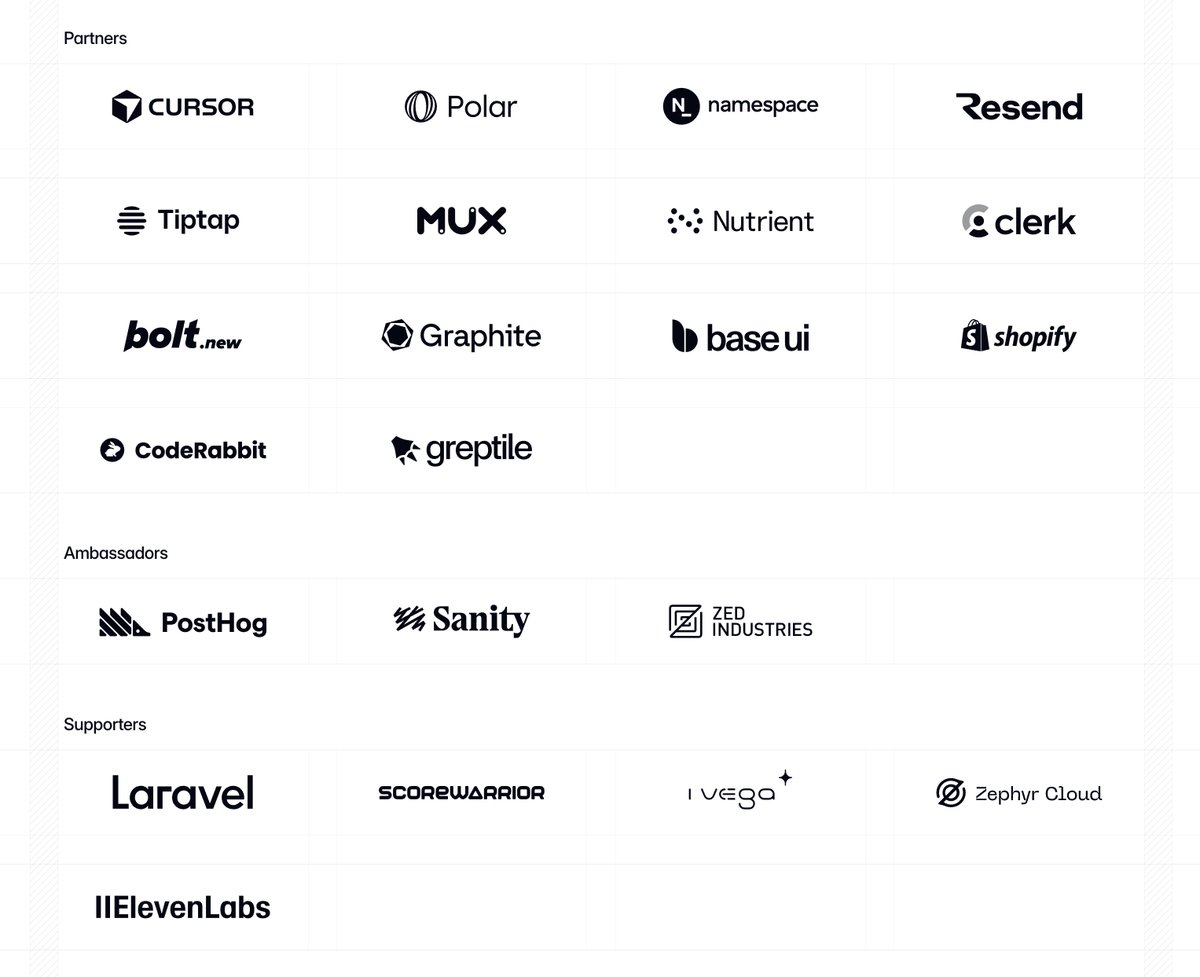
Today is a great day to say thank you to all of the awesome companies that support our work on Tailwind CSS ❤️ Their contributions make an enormous difference.
Thank you to everyone who made the inaugural Virtual Cell Challenge a success.
Over 5,000 participants from 114 countries competed to build AI models that predict cellular responses to genetic perturbations. Today we're announcing the winners and reflecting on what we learned.
The Virtual Cell Challenge's final test set is now available at https://t.co/AQn2Qd4vCG. Final scores will be based on the 100 new perturbations. The 7 day phase is single blind (no score feedback) and uses the latest cell-eval (bugfix'd last Friday). Good luck everyone!