Looking forward to showing off our ACT products with you! Join us today at noon Eastern https://t.co/EcqLWgQCDw to see demos of our Jupyter notebooks demonstrating the use of our Compton y-maps #ACT@NSF#CMB
The distortions in the images of galaxies and the CMB by gravitational lensing due to matter in the universe are related. Our new paper https://t.co/n1WmQfDdde measures this correlation with observations from @theDESurvey and @ACT_Pol.
!!!New Paper out on arxiv today!!!
We measure structure formation from the cross-correlation of CMB lensing and galaxy surveys, using the new @ACT_Pol DR6 lensing map and galaxies from unWISE.
1/6
https://t.co/3mnVoDUeaY
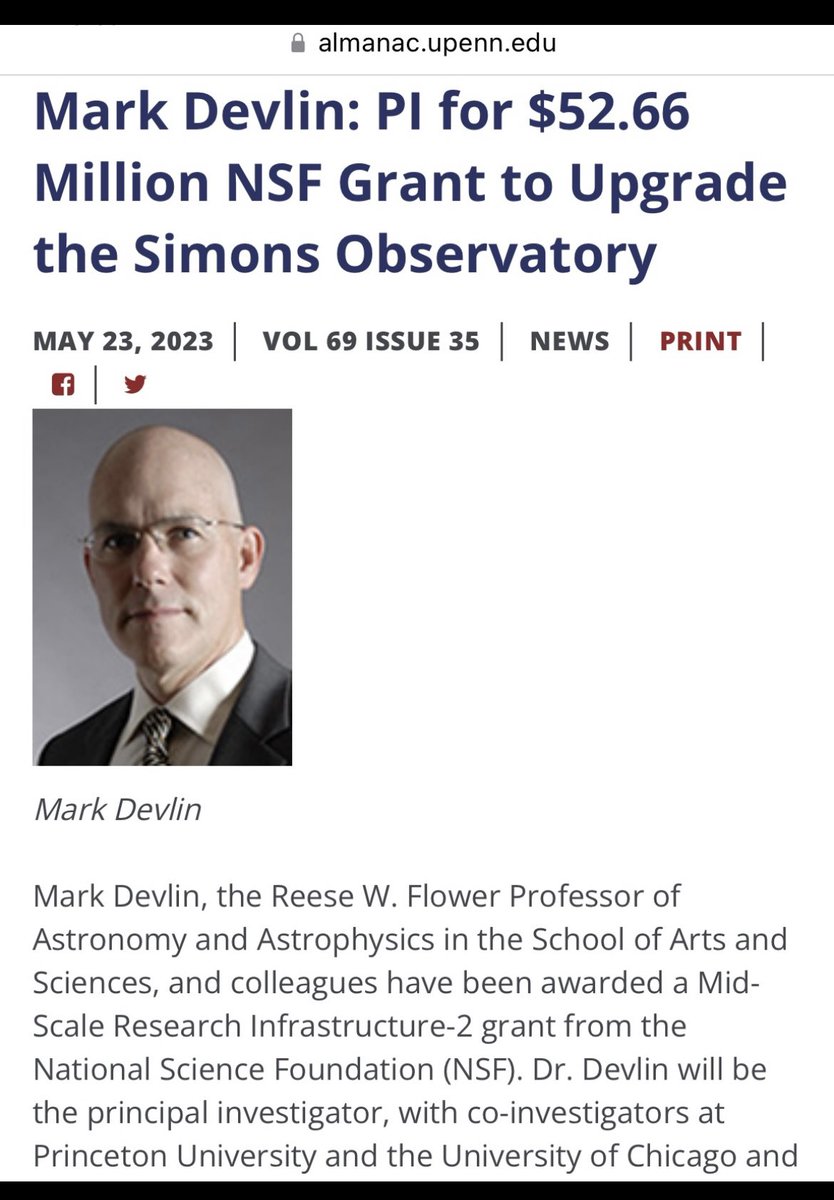
📡Proud to be part of @Penn who will extend the @SimonsObs scope to investigate the early Universe with the #AdvancedSimonsObservatory‼️
☀️Excited to lead work on this project to deploy a new renewable energy system that will make ASO a leader in green astronomy infrastructure‼️
We (@ACT_Pol) have a groundbreaking new image revealing the most detailed map of dark matter distributed across a quarter of the entire sky - drawn by CMB lensing and with implications for the growth of cosmic structures
https://t.co/x0JMczJZjO
Join us for a 1 hour webinar Tuesday, April 11 at 10am Eastern on zoom (pre-registration required): https://t.co/U4BFKzFOom, including Q&A about cosmology from a new measurement of gravitational lensing of the CMB, using ACT 2017-21 data. #cmb#cosmology@NSF
The results are based on three papers that will be posted to the ACT website (https://t.co/RcKzsOOr97) on April 11, and will then appear on the arXiv. The speakers will include lead authors from those papers. Make sure to register https://t.co/U4BFKzFOom #cmb#cosmology
Join us for a 1 hour webinar Tuesday, April 11 at 10am Eastern on zoom (pre-registration required): https://t.co/U4BFKzFOom, including Q&A about cosmology from a new measurement of gravitational lensing of the CMB, using ACT 2017-21 data. #cmb#cosmology@NSF
The Brick (insert brick emoji if there is one) is a massive, dense molecular cloud that has surprisingly little star formation. We find a well-ordered magnetic field in the Brick roughly aligned with its bean-like shape. (6/n) @ACT_Pol#molecularcloud
The Tornado is thought to be a supernova remnant, but the long tail is difficult to explain. We see the tail in total emission (left) but not polarized emission (right), and note that the magnetic field lines do change in the transition from head to tail. (7/n)
We can zoom in on objects like Sgr A*, the black hole at the center of the Galaxy. The magnetic field lines in the ACT data trace even higher resolution observations from #MeerKAT at 1.28 GHz. (5/n)
ACT also maps polarized radiation that allows us to infer the structure of magnetic fields. Most of the field lines run parallel to the Galactic plane, except in the very center where a strong vertical radio filament dominates the emission. (4/n)
The three ACT frequencies are sensitive to different emission mechanisms at work in the Galactic center. Red highlights emission from relativistic electrons while emission from dust grains appears blue. Look at how many familiar objects we are able to see! (3/n)
New @ACT_Pol paper presenting ACT maps of the #Galactic center now on arXiv (https://t.co/cVetKpAjHl). We showcase the Galactic science possible with a high angular resolution ground-based CMB experiment like ACT! @yilun_guan@suzIQUV @brandonshensley (1/n)