So if you’re wondering why protesting needs permission, it’s because we have an executive-centric constitution that has been interpreted by a historically executive-centred court, to uphold colonial executive-centric laws as constitutionally compliant.
One important thing to understand is that the legal architecture around the right to protest in India remains colonial in its design, and the Supreme Court has been enforcing this colonial architecture since 1960. The Constitution did nothing to change this.
The annual diwali bonus drama has started in my apartment. Every year we ask people to contribute a small amount for staff bonuses and every year there are people who find it a huge imposition and oppose it tooth and nail. The amount would be less than what any of us living here would spend on a restaurant meal. Indians are fucking vile
So why should you care about this unprecedented rupture in the Election Commission?
BECAUSE being eligible to be enrolled as a voter is no longer enough. In one state, 97 people proved they belonged, the officer agreed, and the software, controlled from Delhi, never let him record it. They're still off the roll.
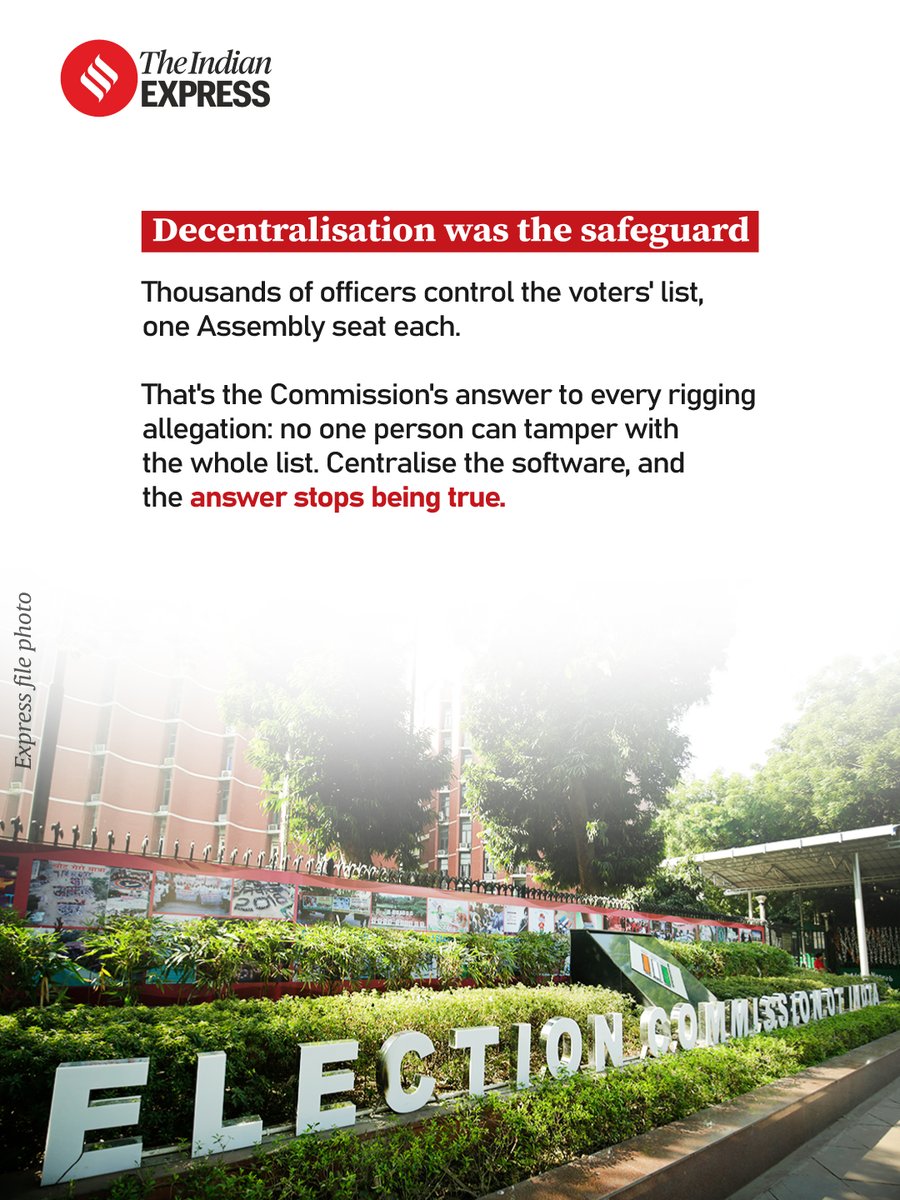
BECAUSE the reason you trust the voter list is that nobody controls it: thousands of officers do, one constituency each. Centralise the software, and that stops being true.
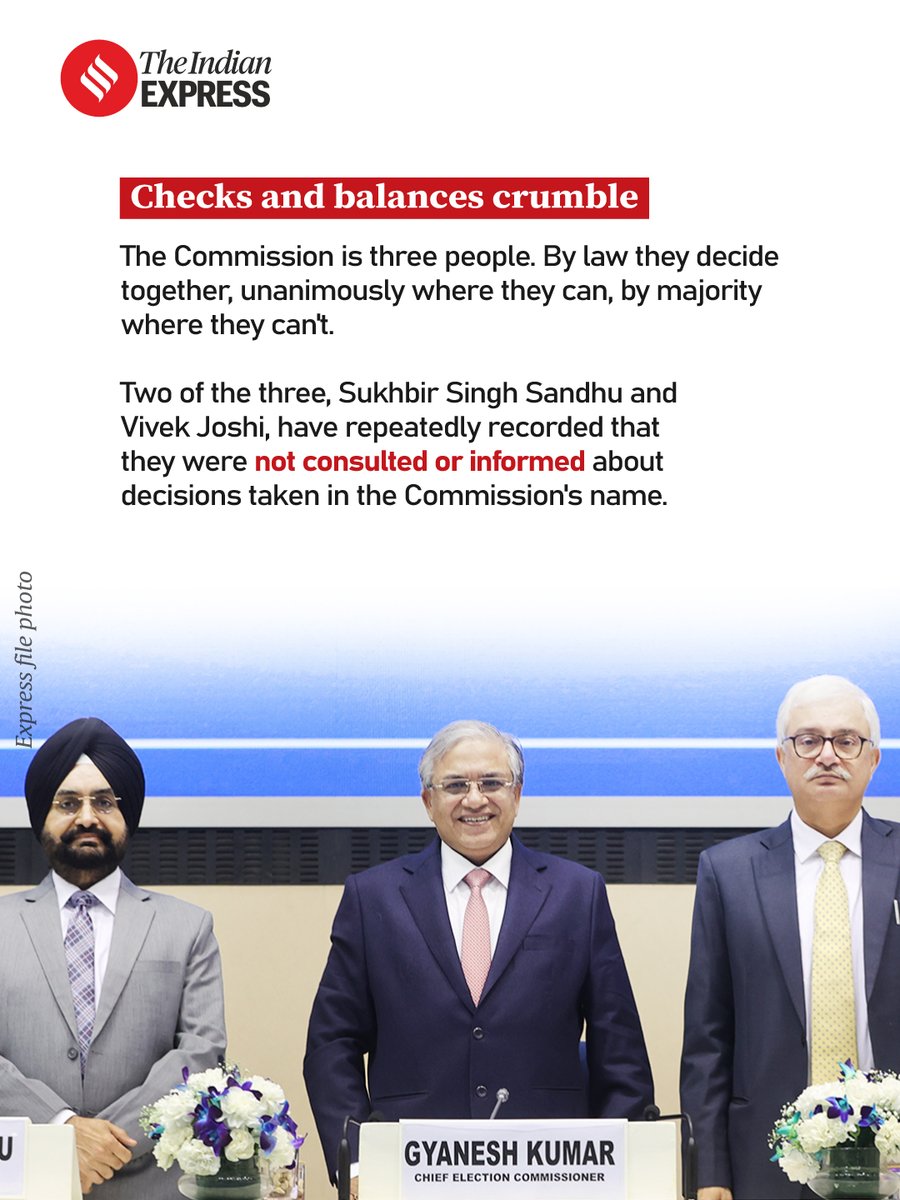
And BECAUSE the check built to catch this, three Commissioners deciding together, was tried.
But TWO of the THREE say they were kept in the dark on key processes rolled out to revise the rolls.
(9/10)
https://t.co/8g8HYlUcr4
Remember the name. Primecare Vet/Pet Hospital at Bellandur. Bastards were catching street dogs, breaking their legs and then practising surgery. This was done, since one must evidently be a total scumbag, without anaesthesia. https://t.co/v0MPbqNErD
Gujarat cops (accompanied by Delhi police) came to journalist Ravi Nair’s home over a story he did with The Washington Post on Adani. An FIR has been lodged against Ravi, but not The Washington Post, based on a complaint by an Adani Group staffer.
The police took away two of Ravi’s phones, his son’s laptop, and the laptop and iPad of a colleague who happened to be at home and is not an accused in the case. The cops had a judicial magistrate’s order. Refused to give hash value of the devices
Sachin Tendulkar has finally spoken on the student protests, and I had to read his note twice: once as a fan and once as an editor. The fan was disappointed, but the editor realised that this was a textbook specimen of the kind of writing that George Orwell warned about in his essay “Politics and the English Language”.
The essay was written in 1946, but it might well have been written yesterday about this very statement. Orwell’s point was that when people want to hide something, they stop using plain words and reach instead for the passive voice, for fog, for phrases that sound like they mean something while meaning nothing at all.
Consider the line, where students are disappointed that “their hard work hasn’t been rewarded”. Rewarded by whom, and denied by whom? There was a paper leak, which means somebody leaked it, some institution failed to prevent it, and an official presides over that institution. Yet none of them appears in the statement, and neither does the leak itself. A crime with identifiable custodians has been turned into something that simply happened to lakhs of children through nobody's fault.
Then comes the list of those who must set things right: parents, teachers, friends, relatives, schools and administrators. If you read that list again slowly, you will notice it covers everyone in India except the people the students are actually protesting against, which is to say the NTA, the education ministry and the government. When everyone is responsible, nobody is, and that is not an accident of drafting. It was engineered to deflect blame.
There is also a quiet sentence buried in the middle. “A society which prioritises outcomes over effort will seek shortcuts over meritocracy” is a line about those who take shortcuts, meaning the cheat. So a note on protests around paper leaks ends up gently lecturing the leaked-upon about honesty. His father’s lovely lesson—that failure is okay but cheating is not—is again aimed squarely at individuals, while the scandal and protests right now are about institutions that failed them.
The rest of the statement is what Orwell called ready-made strips of words, glued together. Full of dreams and energy, fuel to our success, safeguard their aspirations. Nobody can disagree with any of it, which is precisely the point, for this is prose engineered so that no one in power will find a single sentence to object to.
What an actual position would have looked like is a single sentence in the active voice: The government must find and punish those who leaked the paper, and fix the system that allowed it. He wrote 160+ words to avoid writing that one.
Here’s Orwell’s full essay for those interested:
https://t.co/VlPoJdOcDG
#PeekOnGround: A family of 8 lives in a small, dingy room that is not even tall enough for a person to stand straight - this is how many of the workers protesting for wage hikes in Noida live.
Peek TV’s co-founder @AgarwalVedanta visited one such worker’s house.
Went down the rabbit hole on this. Your brain treats a physical book like a landscape. It builds a spatial map of the text, the same way it maps trails, rooms, and city blocks. When you scroll on a phone, that map breaks apart.
Seven large-scale research reviews and direct brain scans confirm what you already feel.
A 2023 study in PLOS ONE attached brain-activity sensors to children’s heads while they read the same text on paper and on screen. Paper reading produced fast brain waves, the pattern linked to focused attention. Screen reading shifted the brain into slow waves, the pattern linked to mind wandering and daydreaming. Same kids. Same words. Measurably different brain states.
A separate 2022 study from Showa University in Japan scanned the front of the brain, the area that manages focus and comprehension, during phone versus paper reading. Smartphones sent that region into overdrive, meaning the brain was straining just to keep up with basic processing. Paper reading produced a moderate load that triggered natural deep breathing, which helped regulate brain function and sustain focus. The phone suppressed that breathing pattern entirely.
Since 2017, researchers have published seven major reviews combining hundreds of individual studies. Six of seven reached the same conclusion: people understand less on screens. A 2018 review of 54 studies and 170,000+ participants, literally titled “Don’t throw away your printed books,” found paper outperformed screens across the board for non-fiction. A 2024 follow-up with 49 more studies confirmed it. The gap has grown steadily every year since 2001. Being a “digital native” doesn’t help.
The best explanation is how your brain tracks where you are. Your short-term memory can only juggle about 7 things at once. A physical book gives you constant location cues: the weight shifting from right hand to left, where a paragraph sits on the page, how thick the remaining pages feel. Your brain hands off the “where am I in this text?” job to those physical signals, leaving more room for actually understanding what you’re reading. On a phone, every screen looks identical. Your brain has to track position and process meaning at the same time, and something gives.
A Norwegian eye-tracking study analyzing 25,000+ individual eye movements found screen readers processed text more shallowly. The students had no idea they were reading differently.
In 2019, nearly 200 reading scientists from 30+ countries signed an open letter warning that screen reading was degrading deep comprehension. Since then, Scandinavian countries, among the most digitized school systems on Earth, have started putting physical books back in classrooms.
Public information announcement:
India is still exporting refined petroleum and petroleum products No curbs are being imposed or contemplated 15 days into the oil war
Thank you for your attention to this matter
I’m not always comfortable with the term ‘global south’. But as both China & India have consistently taken the interests of developing countries seriously, I proceed as such. One has largely recovered with the global south since the 2000s, another has deviated, esp. since 2023.
Depressing part of growing older in a collapsing imperial gerontocracy (among many) is not only have I heard all these bullshit justifications for war before but I've literally heard them from the same people
No matter what Galgotia University did at the India AI summit, there is NO reason to humiliate its students.
Some of the worst Indians are from elite institutions like St. Stephens and the IITs and the best from non-elite ones.
Some of the worst humans alive are from Harvard.
american craftsmanship is declining. 20 years ago, if you wanted to manufacture a reason for a war, you had to make a map and do a little presentation at the UN. now you just say anything.