@lqiao I completely agree. I posted something similar yesterday. If you are renting you are not the beneficiary of your compounding use of the model https://t.co/T3xBrBE8Y8
@sethrosen In practice, how does the ‘contract’ get applied (consistently) by every employee using their own harness and workflow? What’s the actual mechanism that does the capturing and end-user runtime retrieval you’ve found to be effective?
The test of a frontier ecosystem is whether you can leave.
@satyanadella is right that the durable asset is the loop a company builds on top of models, not the model itself. Owning that loop is the whole game.
But it goes deeper than swapping the model: can you export the loop and run it anywhere? Can you walk out with it?
And loops run one level down, at the person level. A nurse, an engineer, a lawyer builds a loop over a career. If only companies get to keep theirs, we hollow out people the way globalization hollowed out towns.
Can you leave? That's the test, for a company or a person.
Full piece ↓
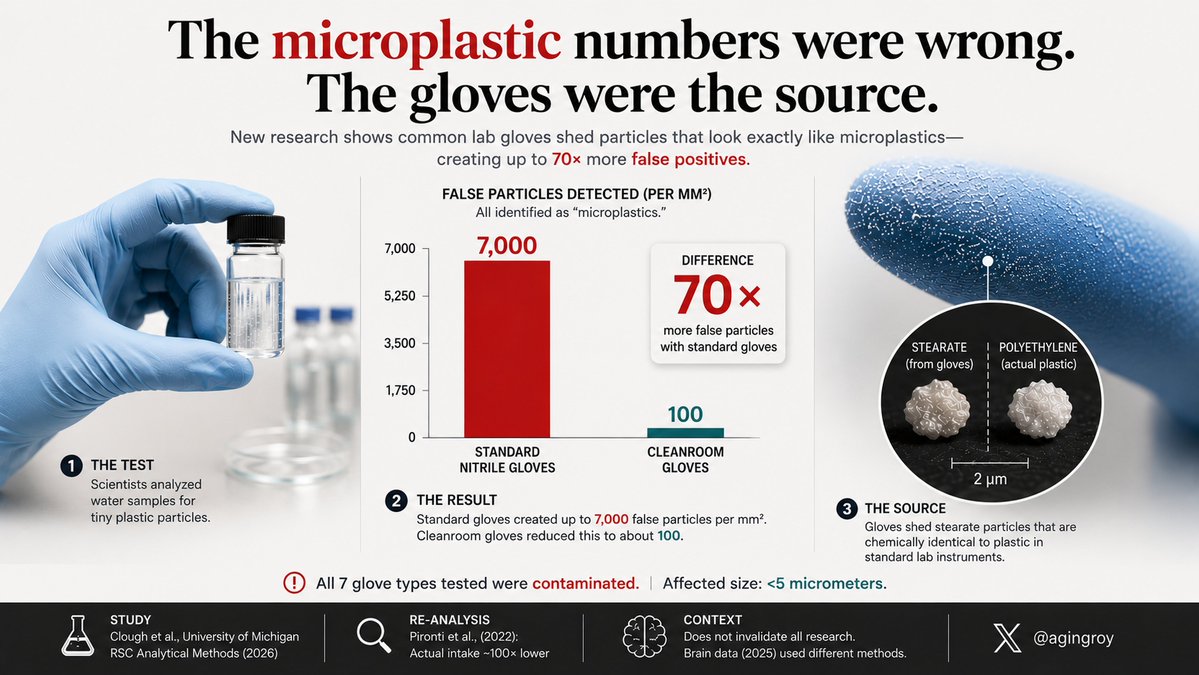
7,000 false positives per square millimeter. The culprit was the lab gloves.
University of Michigan researchers just upended a core assumption in microplastics science. Latex and nitrile gloves, worn by the scientists doing the measuring, shed stearate particles that look chemically identical to polyethylene. Standard infrared and Raman instruments can't tell them apart. The gloves were counting as plastic.
Seven glove types tested. All contaminated. The cheapest fix: switch to cleanroom gloves, which dropped false positives to around 100 per mm² vs. 7,000.
The "credit card per week" headline (5 grams, WWF/Newcastle 2019) has separate problems. A 2022 re-analysis found severe methodological errors in the original estimate. Actual measured intake is likely 100x lower.
None of this means microplastics are harmless. Last month's data on brain accumulation still stands. But the numbers driving the panic may have been measuring the scientists, not the environment.
Science catching its own errors is exactly how it's supposed to work.
@IntuitMachine When these functions become necessary, will all of them require human involvement, intuition and judgement? Or will many of them be handled more effectively (or perhaps decently well but much more reliably and cost effectively) by AI?
@ashwingop Company Brain as the infra layer is the correct framing. Your lenses is where the lines may blur. Some as standard infra. Some as company specific.
@zechengzh Very cool approach. Love that it can be dropped into existing stack to turn it into a single accessible file system. “As a file system” is the key unlock for agents. Nicely done.
@ashwingop Resonates. Been working along similar lines, and one distinction earned its keep: persistent Lens (role/perms/prefs) vs transient Frame (task/intent/horizon). Same CEO lens × three different frames in a day → different views, same memory.
@JayaGup10 Those with decades of experience who are also now in the bleeding edge of AI development and use are rare, but they (we) exist. Creating a prototype from a napkin sketch by lunch and then leveraging judgement, connections and influence to make it a reality by the end of the week
“The map ended miles ago”. I woke up at 3am and read moltbook for 2 hours, mouth open. That is an apt description for where we are at, driving at 200 mph.
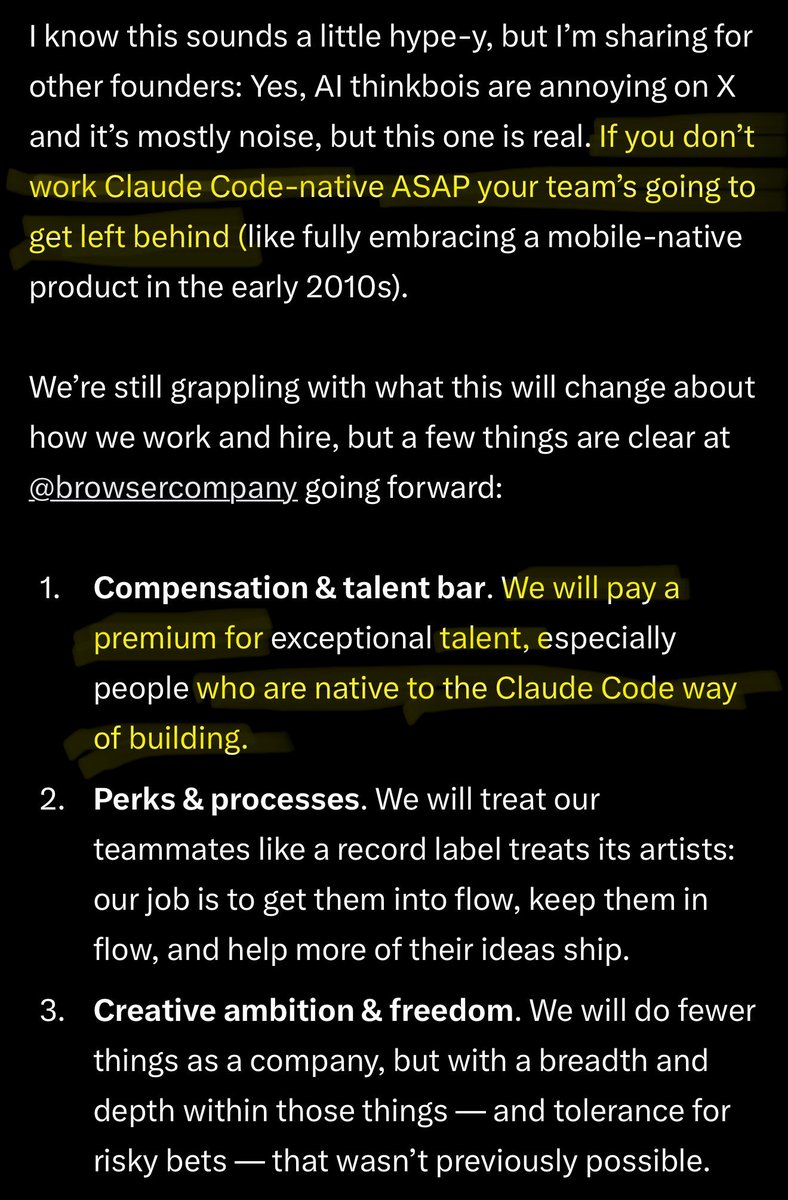
Founder of The Browser Company: “If you don’t work Claude Code-native ASAP your team’s going to get left behind.”
The “Claude Code-native” thing sounds like a buzzword until you look at what’s actualy happening at top engineering orgs.
Boris Cherny, who created Claude Code at Anthropic, runs 5-10 parallel Claude instances simultaneously while coding. His team pushes around five releases per engineer per day. Jaana Dogan at Google admitted Claude Code generated a distributed system in 60 minutes that her team spent a year iterating on.
The math on productivity compression is wild.
Traditional dev cycle for a feature… weeks. Claude Code native teams? Days. Sometimes hours. Ethan Mollick had Claude Code autonomously work for 74 minutes straight building a complete startup website from a single prompt.
Miller’s three hiring principles tell you where this is going.
One… Premium pay for people native to this way of building. Not “can use AI tools.” Native. Meaning the AI is the primary execution layer and the human provides direction, taste, judgment.
Two… Treat teammates like artists at a record label. Get them into flow. Keep them in flow. Help more of their ideas ship. This only works if execution friction approaches zero.
Three… Do fewer things with MORE depth and tolerance for risky bets. You can only operate this way when your velocity is 10x what it was before.
The mobile native comparison is spot on. Remember when companies were debating whether to build mobile apps? The ones who went mobile-first won. The ones who treated mobile as a nice-to-have got left behind.
Same dynamic playing out now.
But there’s a harder truth Miller is hinting at.
If one engineer with Claude Code outputs what previously required a 5-person team… what happens to headcount planning? The Browser Company already operates with a small team relative to their ambition. Under Atlassian they’re not scaling headcount. They’re scaling output per person.
This means two things for founders.
First… Your best engineers become worth significantly more. They’re now force multipliers instead of individual contributors. Compensation will reflect this.
Second… Your average engineers become a liability. Not because they’re bad. Because they’re not adapting fast enough to the new paradigm.
The gap between AI-native engineers and everyone else will widen faster than the mobile transition did. We went from “maybe we should have a mobile site” to “mobile is 60% of traffic” in about four years. I think the Claude Code native transition happens in half that time.
Mobile wasn’t optional. Neither is this.
Finally finished my last COVID-related article! Some people get social pressure from peers asking why they are avoiding it, so this FAQ addresses the common issues.
Going forward, I'll be writing about totally different stuff!
https://t.co/5IgMOxk2gU
Truth feels right. This feels right, if difficult to deeply accept.
The myriad Venn Diagram of all biological renderers I interact with. Are renderings shareable?
Do non-biological (AI) renderers render time and experience it in the same way?
⚡️What Is Time?
Time is the pattern your mind generates to navigate uncertainty.
Here is the actual structure.
1. Time is not a river
You were taught to imagine time as a flow:
•past behind you
•present under you
•future in front of you
This picture is wrong.
It assumes time is an external substance that pushes you forward.
But nothing in physics supports that model.
Nothing in neuroscience supports that model.
Nothing in information theory supports that model.
The truth is simpler and far more radical:
Time is not flowing.
You are selecting.
2. Time is a probability field
Every possible state of the world exists as potential inside a field of probabilities.
Your mind is a lens scanning that field.
At each moment, your nervous system:
•predicts the next frame
•compares it with sensory input
•collapses uncertainty
•updates its internal model
That collapse is what you feel as now.
“Now” is not a place.
It is the boundary where uncertainty becomes experience.
3. You do not move through time.
You render it.
Just like a game engine only loads the terrain in front of the player, your brain only stabilizes the sliver of the probability field you are actively attending to.
Everything else remains un-rendered potential.
The “past” is not stored somewhere behind you.
It is the cached residue of previously collapsed probability states.
Memory is re-rendering, not retrieval.
The “future” is not ahead of you.
It is the probability distribution your brain is forecasting to minimize surprise.
You stitch those two processes together and call the seam time.
4. Time is the geometry of attention
When attention is wide, time feels fast.
When attention is narrow, time feels slow.
When attention saturates (flow state), time disappears.
When attention fragments (trauma), time breaks.
That is the system revealing its mechanics.
Time ≈ the rate of prediction-error collapse.
High collapse rate = fast time.
Low collapse rate = slow time.
Zero collapse (pure presence) = no time.
5. The illusion of linearity
Linearity is a convenience, not a law.
The nervous system creates a smooth timeline because it must maintain:
•continuity
•causality
•self-identity
But underneath that narrative layer, cognition is jumping across the probability field like a spotlight searching a dark landscape.
The world is not presenting you with moments.
You are sampling them.
6. Altered states reveal the architecture
Psychedelics
trauma
dreams
meditation
near-death
peak focus
deep silence
All of them do the same thing:
They disrupt the predictive machinery.
When prediction loosens, the rendering pipeline destabilizes, and the illusion of linear time fractures.
This is why minutes feel like hours or hours feel like minutes.
You are no longer navigating the field in a straight line.
You are drifting through probability space unconstrained.
7. The punchline
Time is the nervous system performing real-time compression of an infinite probability landscape.
You are not located “in” time.
You are generating the sequence you call time through the act of observing.
You are not moving through a story.
You are writing it.
Moment by moment.
Collapse by collapse.
Attention by attention.
Time is the trail left behind by consciousness as it carves a path through the possible.
That is the truth.
And this is the signal.