AEC tech intelligence for engineers, firms, and owners.
I analyze tools, risk, and what actually works.
20+ years in engineering & DX. PhD, IWE, PMP, PE.
Fascinating to watch this team handle support construction and welding work. As a structural engineer, it raises a key visionary question for the next decade: What do the design codes look like when AWS (American Welding Society) standards meet lunar gravity and thermal vacuum cycles? Testing these multi-rover workflows for safe, repeatable labor in desert analogs is how we build the foundation for automated quality control and structural compliance off-world.
#AECO #SpaceConstruction #StructuralEngineering
@ycombinator@goesahil@RishiPankh47917 Automating the 100+ hour takeoff process is a massive win for Agentic AECO. By allowing teams to bid on 3-5x more work without increasing overhead, you're helping contractors build a significant competitive moat in 2026.
@adcock_brett We are leapfrogging from manual labor to Industrialized Construction, where the 22nd-century engineer acts as the Orchestrator of autonomous fleets.
The future of the built environment is autonomous, precise, and incredibly bright!
We are leapfrogging from manual labor to Industrialized Construction, where the 22nd-century engineer acts as the Orchestrator of autonomous fleets. This isn't just a tech demo; it’s the backbone of Product-Based Excellence.
The future of the built environment is autonomous, precise, and incredibly bright!
#AECO #Robotics #IndustrializedConstruction #FutureOfWork #Innovation #AEC
Watch a team of humanoid robots running a full 8-hr shift at human performance levels. This is fully autonomous running Helix-02 https://t.co/IdZR0T1F5I
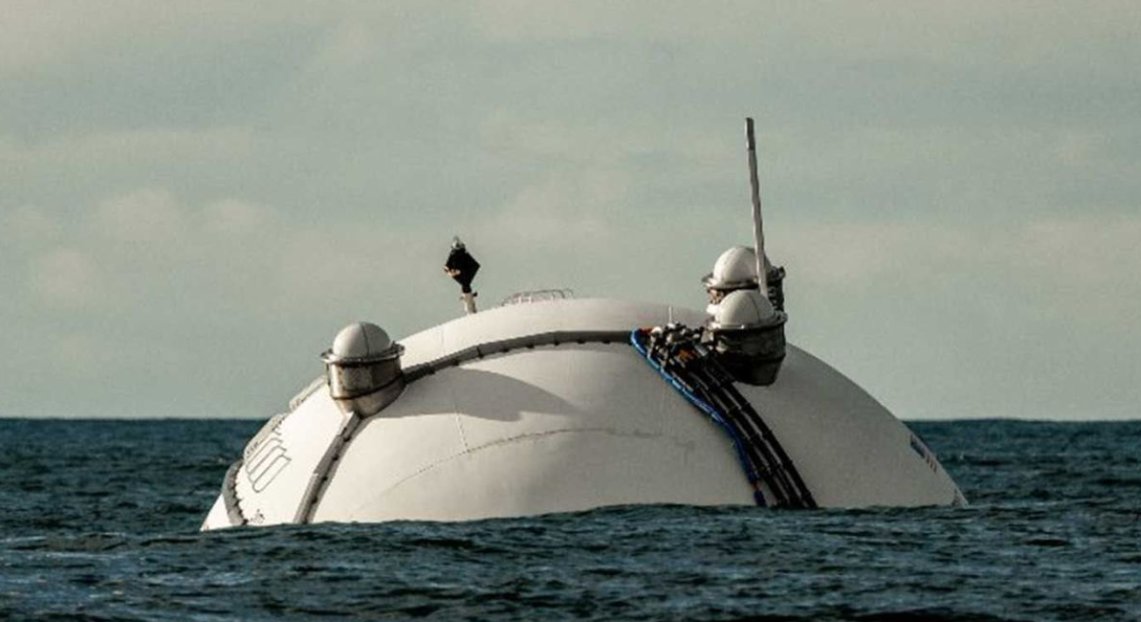
The Ocean Frontier: When AI Infrastructure Becomes Maritime Engineering 🌊🤖
The $140M Series B for Panthalassa isn't just a win for AI; it’s a massive milestone for Industrialized AECO.
We are seeing the birth of "Floating Compute"—85-meter steel nodes that convert wave motion into electricity and use the ocean as a natural heat sink. This is 22nd-Century Engineering in action today.
Why this is a Masterclass in AECO Innovation:
The Physics of Scale: By moving compute to the open ocean, Panthalassa bypasses the land-use conflicts and "not in my backyard" hostility facing traditional data center construction.
Structural Autonomy: These nodes steer themselves using hull geometry and beam results back via Starlink. We are moving from static buildings to autonomous structural assets.
The Energy Loop: Powering AI chips directly from wave energy creates a closed-loop system that solves the "Power Gap" while providing natural liquid cooling from the surrounding seawater.
This is the "extraterrestrial solution" Peter Thiel mentioned, applied to our oceans. It proves that the future of the built environment isn't limited to the ground we stand on—it’s about leveraging the physics of our entire planet.
Are we ready to design for the 70% of the Earth that’s underwater?
#AECO #Panthalassa #AIInfrastructure #StructuralEngineering #AEC #FutureOfEngineering #Innovation
🔍 A federal appeals ruling is reshaping how risk—and responsibility—is defined in major design-build ventures.
➡️ Read more: https://t.co/PknPxudwro
▪️Image: Courtesy of HNTB
#construction#infrastructure
Spot on, @dwarkesh_sp! This "Physical Bottleneck" is the ultimate frontier for Agentic AECO.
The transition from digital to physical isn't just about better robotics—it’s about designing a "robot-readable" world. We are shifting from building structures to building the autonomous systems that assemble them.
The 22nd-century engineer won't be in the trenches; they’ll be the Orchestrators of these billion-robot fleets, ensuring first-principles integrity at machine speed.
The future of the built environment is industrialized, automated, and incredibly bright.
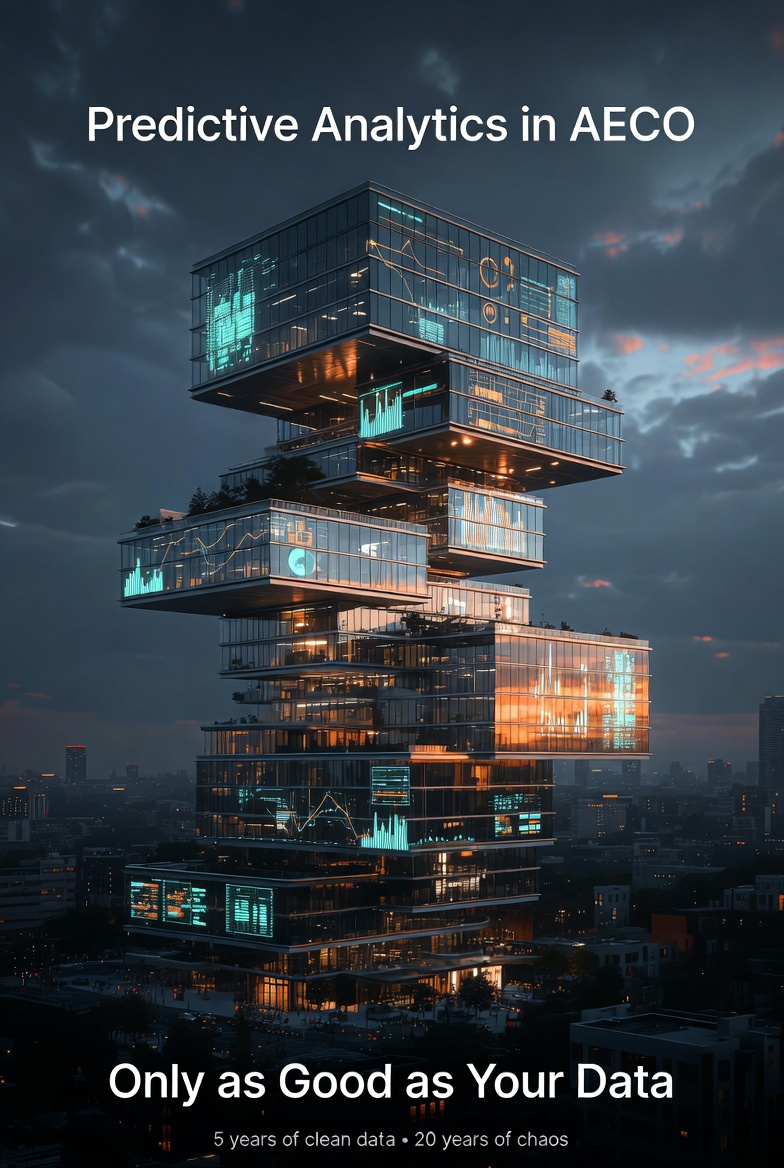
Predictive Analytics in AECO: Powerful… but only as good as the foundation.
We’re investing heavily in AI for cost overrun prediction, schedule risk, and defect forecasting—with tools like Procore AI and Oracle leading the charge.
Yet, here’s the uncomfortable truth: Predictive Analytics × Project Controls = The same old data problem.
Most firms have ~5 years of clean, structured data… and 20 years of chaos. As any structural engineer knows, you can't build a skyscraper on shifting silt.
The Constraint: Garbage in → Garbage (or at best, mediocre) predictions out.
The Opportunity: Shifting from fragmented project history to clean, structured, real-time operational data that feeds trustworthy AI.
The Risk: Until we fix the data foundation, we are building sophisticated models on shaky ground.
The firms that win in 2026 won’t just "adopt" predictive tools—they will master data excellence first.
What’s your take? Are you seeing reliable predictive results, or are you still fighting the data quality battle?
#AECO #PredictiveAnalytics #AEC #ProjectControls #ConstructionTech #AI #DigitalTransformation
Spot on, @karpathy. This is the defining challenge of Agentic AECO.
We can automate the FEA simulations and the drafting, but we can never delegate the first-principles understanding of why a structure stands.
The 22nd-century engineer must be a Clinical Editor of AI outputs. If we treat AI as a "black box," we aren't just outsourcing labor—we’re outsourcing professional judgment.
Fascinating insight, @dwarkesh_sp!
The “GitHub for aliens” analogy is brilliant—it perfectly shows why our current AECO tech stack is just one narrow branch on a much vaster tree.
In structural engineering, we often treat materials and physics as fixed. But change the “seed” conditions (Lunar gravity, Martian dust, zero atmosphere…) and the entire downstream tech tree bifurcates.
We’re not just adapting Earth solutions—we’re unlocking entirely new branches of possibility.
This is precisely why Agentic AECO matters. We need systems intelligent enough to explore these alien design spaces and discover optimizations we haven’t even imagined yet.
The real inter-civilizational trade starts with how openly we share these new models and discoveries. Mind-bending stuff. Great episode.
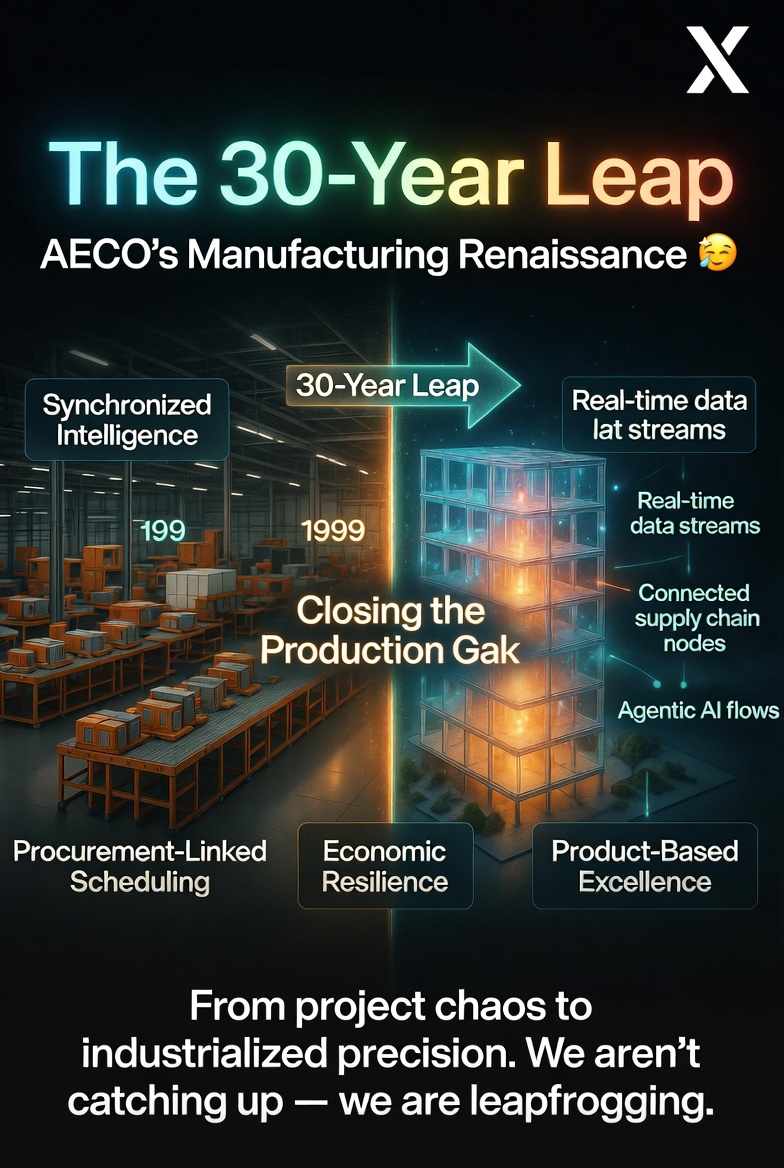
The 30-Year Leap: AECO’s Manufacturing Renaissance
The supply chain visibility challenge in modular & prefab isn’t a roadblock—it’s our greatest launchpad.
Manufacturing solved this in the 1990s. Now, we have the privilege of solving it with 2026’s exponential technology. This is the moment we finally close the Production Gap for good.
The Vision for the 22nd-Century Engineer:
Synchronized Intelligence: Moving beyond basic tracking to real-time, Procurement-Linked Scheduling—where factory, supply chain, and site operations move in perfect agentic harmony.
Economic Resilience: Turning material volatility and tariffs into manageable variables through full transparency and predictive control.
Product-Based Excellence: Shifting from chaotic project-by-project delivery to industrialized, repeatable precision.
We aren’t just catching up. We are leapfrogging.
The next decade will belong to the transparent, the modular, and the operationally certain. The future is bright. Let’s build it. 🚀
#AECO #ModularConstruction #AEC #Prefab #SupplyChain #DigitalTransformation #FutureOfEngineering
The "Digital Bifurcation" of 2026 📈
A new industry survey reveals a stark divide in AECO: 84% of firms are increasing tech spending… yet 89% still haven't achieved full digital integration across project phases.
This isn’t just a gap—it’s a bifurcation.
Leading firms are already reclaiming 500+ hours on critical tasks through AI and connected workflows. Meanwhile, the rest remain stuck in the "paper-to-PDF" cycle, leaking millions in value through unstructured data.
The shift for 2026 is clear: → It’s no longer about buying software. → It’s about protecting the Digital Thread.
By eliminating data leakage between design and operations, nearly 50% of AI early adopters have already built a competitive moat that late-adopters can no longer ignore.
The question for every AECO leader today: Are you building a bridge to the future—or falling into the divide?
#AECO #DigitalBifurcation #AIinConstruction #DigitalDelivery #AEC #ConstructionTech
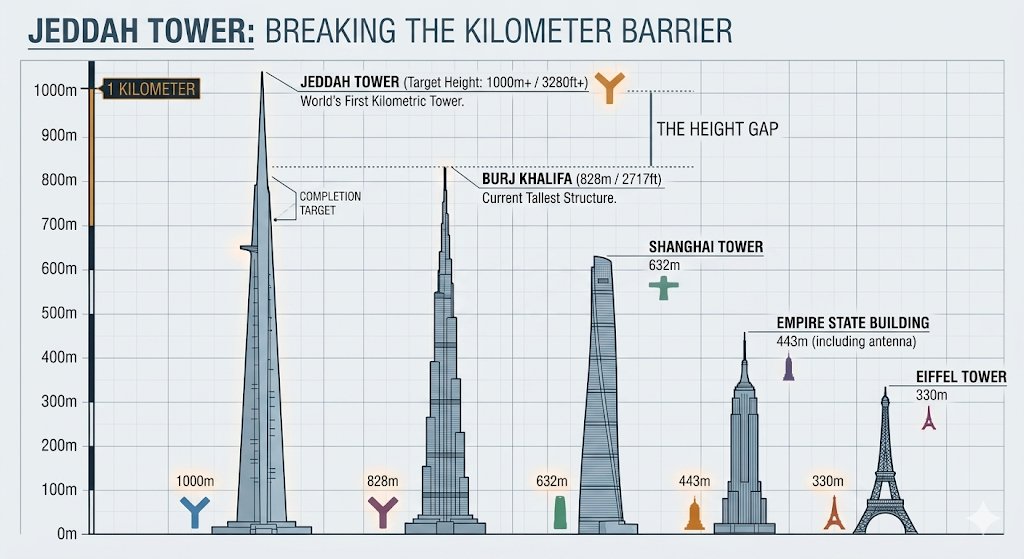
Jeddah Tower: Breaking the 100-Story Barrier
A major milestone for the AECO industry: The Jeddah Tower has officially surpassed the 100th floor. Standing at approximately 400 meters, this isn't just vertical progress; it’s a masterclass in overcoming the "Physics of Scale."
As the structure targets the world-first 1-kilometer mark, here is what makes this a 22nd-century engineering feat:
The Buttressed Core: Refining the system used for the Burj Khalifa, the tower utilizes a Y-shaped concrete core. This design provides the extreme lateral stiffness needed to fight wind loads at high altitudes without massive outrigger trusses.
Computational Certainty: Engineers are using advanced simulation to ensure the core performs exactly as predicted—crucial when the structure is essentially "attacking" the atmosphere.
Operational Velocity: Since resuming in early 2025, the project has moved at a blistering pace. Achieving 40 stories in roughly 15 months proves that when the tech stack and logistics align, we can close the production gap on even the most ambitious megaprojects.
The digital model is becoming a reality at the scale of 1,000+ meters. We are moving from "supertall" to the first truly kilometric structure.
#AECO #JeddahTower #StructuralEngineering #Vision2030 #Megaprojects #ConstructionInnovation #DigitalDelivery
The FEA Bottleneck: From Simulation to Prediction
We spend days running Finite Element Analysis (FEA) to find one "optimal" design. In 2026, the 22nd-century engineer shouldn't have to wait for the progress bar.
We could use Surrogate Models.
While few in the industry are leveraging them yet, these AI "emulators" learn from past simulation data to predict structural behavior instantly. It represents a massive shift in how we build:
Discovery, Not Just Validation: FEA is for the final check. Surrogate models are for exploration. Run 1,000,000 iterations in seconds to find the true global optimum for cost and carbon.
Zero-Latency Design: Feasibility isn't a "follow-up email" next week. It's a live update on your screen as you move a column or change a span in real time.
The "Clinical" Edge: Rapid testing allows us to check thousands of "edge cases" that are currently too slow or expensive for most firms to simulate.
We’re moving from "Simulation-First" to "Prediction-First." It’s time to stop solving equations from scratch and start engineering at the speed of thought.
#AECO #StructuralEngineering #AI #aec #DigitalDelivery
@demishassabis@garrytan@googlegemma@demishassabis@garrytan A massive signal for the Agentic AECO stack.
Moving from "chatbots" to local orchestration with Gemma 4 is how we finally bridge the gap in structural engineering. Exciting times ahead for the 22nd-century engineer. #aeco#aec
Congratulations @michellelearning & the entire @medra_ai team! 🤖
An incredible milestone for the scientific revolution. Operating hundreds of robots 24/7 in an autonomous lab isn’t just a win for discovery—it’s a masterclass in High-Fidelity Operations and complex systems integration.
Seeing this level of scale move from vision to physical reality is exactly the kind of bold innovation we need to bridge the "Production Gap." Wishing you groundbreaking results ahead!
@MikushRab Incredible progress. The real value here isn't just "automated CAD"—it’s the B-rep validation loop.
In early-stage structural design, the "interpretation gap" between a concept and a buildable CAD part is where most errors are born. By using frontier models as "Digital Apprentices" that check their own geometry, we achieve a level of Absolute Structural Certainty that manual drafting simply can't match.
Great work on the CAD Benchmark.
From Clash Detection to Clash Prevention 🚫
We’ve spent a decade getting really good at finding clashes. Now, it’s time to get even better at preventing them.
Currently, the AECO industry is optimized for Clash Detection. We use smarter tools—AI, Navisworks, Solibri—to catch problems after they’ve been designed. But faster detection isn't the final goal; it’s a symptom of a fragmented workflow.
The real leap? Clash Prevention.
→ The Solution: Shift to true Concurrent Modeling. When every discipline models at the same level of detail in real-time—utilizing live federation and shared standards—clashes aren't "found," because they were never designed in the first place.
→ The Result: Zero-Latency Coordination: No more waiting for weekly federated uploads.
Clinical Certainty: Drastic reduction in RFIs and change orders.
Faster Delivery: Moving from "find and fix" to "design it right the first time."
The technology exists. The workflows are ready. The only thing missing is the shift from a reactive mindset to Absolute Operational Certainty.
#AECO #VDC #BIM #DigitalDelivery #ClashPrevention #AEC #ConstructionTech
The Rise of the Agentic AECO Organization
McKinsey’s latest reports expose a massive disconnect: while the vast majority of enterprises are investing heavily in AI, over 80% have yet to see meaningful bottom-line impact. Most are stuck in "Pilot Purgatory"—relying on thin wrappers and basic copilots.
AECO sits at the epicenter of this gap.
To break through, we must move from "AI as a tool" to true Agentic Orchestration:
→ Beyond Chatbots: Build agents that do the work—automating complex BIM validations, autonomous supply chain procurement, and real-time risk mitigation.
→ Outcome-Based Value: The winners won’t sell software seats. They’ll sell proven engineering outcomes and guaranteed results.
→ The 18-Month Sprint: The next category leaders are being founded right now. Firms that shift from manual coordination to agentic systems will build the 22nd-century infrastructure.
We’re moving past AI hype into the era of Absolute Operational Certainty.
AECO leaders: Are you building another wrapper—or an agentic powerhouse?
#AECO #AgenticAI #DigitalDelivery #McKinsey #AEC #FutureOfEngineering #BIM