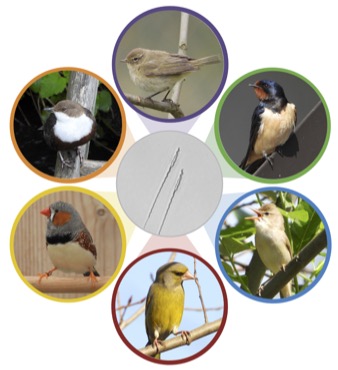
The AEEG's aim is to understand how temperate and tropical passerine birds optimize their allocation in resources in growth, survival and reproduction. @ivb_cas
Songbird species that evolved high blood glucose levels do not suffer elevated oxidative stress costs.
Check out our new collaborative study @J_Exp_Biol
Have you ever wondered why animals did not enter urban areas more frequently during the COVID-19 pandemic? Our research in @CommsBio shows that even in empty cities, the level of animal tolerance to humans remained the same as it was before the pandemic.
👉https://t.co/4kHBBJbfrx
Geographic variation in baseline and stress-induced blood glucose levels in tropical and temperate birds supports a unique montane pace of life combinig slow life history with fast-paced physiology.
Check out our @aeegivb new #macrophysiology paper @Ecology_Letters!
International study on avian tolerance towards human across open tropical ecosystems, led by colleagues from our working group, was published today in @NatureComms ! Congratulations!
(1/8) What factors influence #bird tolerance towards humans in open tropical ecosystems? I am delighted that work from our multinational team was published today in @NatureComms! @ivb_cas@fzpczu@science_charles@UCLAEEB Full story: https://t.co/QzyZBWHm36
English version 👇🏼
Our team member, @birder158, collaborated with a large international initiative exploring language barriers in conservation science. Results of their effort were recently published in @naturesustainab. Congratulations!
Our research on 👅barriers in conservation science was published in @naturesustainab today! We show that non-English-language literature represents 2/3 of all references cited in national biodiversity reports. @ivb_cas@fzpczu
Fulltext 👉 https://t.co/nvpvQh6KqD
Costly investments in #sperm? Males producing large ejaculates tend to live shorter lives in sexually promiscuous barn swallows. New paper from the members of our team!
Fulltext 👉 https://t.co/PAdM1ujkGv
⚠️Joint project call⚠️Interested in escape distances of 🐧🦆🦅🦉🦃🦤🦚🦜🦢🦩? We are currently working on 🌎🌍🌏 database for this trait. Share your primary data with us and join our international team!
Retweets much appreciated.
Details👇: https://t.co/AhmqJSHUJQ
Geographic variation in baseline and stress-induced blood glucose levels in tropical and temperate birds supports a unique montane pace of life combinig slow life history with fast-paced physiology.
Check out our @aeegivb new #macrophysiology paper @Ecology_Letters!
Are there parallels in how birds, machines, and humans learn to recognize bird vocalizations? Maybe. Teaching @MerlinBirdID to recognize birds by their sounds has been challenging for a variety of reasons.
Very pleased that our paper on recognition abilities of barn swallows got published in @SpringerANCO! We found that swallows are really good at sanitising their nest but probably not at defending themselves against conspecific brood parasitism. @animalcog
https://t.co/yTDdcUobVB
We are happy to share a recent work by our two members, @birder158 and @tom_alb1, exploring large-scale correlates of aerial displays in passerine #birds.
Available here: https://t.co/Z9LD5WNxQN
On the wings of love—A global analysis of aerial displays in male passerines revealed an effect of habitat, mating system and migratory traits #ProcB https://t.co/NHn7zfoa2v @birder158@tom_alb1@science_charles
Telomere length is highly repeatable and shorter in individuals with more elaborate sexual ornamentation in a short-lived passerine: https://t.co/vd5CwrUVjv. Check out the new study by our team members, Tereza Kauzálová, @OldrichTomasek and @tom_alb1.