Two friends, one lab. Systematic trading, building with AI. Sharing the journey, wins and dead ends. Not financial advice.
FTMO Max All.
Two Finance Degrees.
We're Nico and Petar.
Met through Twitter in Frankfurt. About 4 years of experience in financial markets, went through a lot of the bs, and more of it to come.
Prior to this, we have both been trading discretionarily (COT Positioning, Technicals etc.). Petar actually achieved multiple 5 figure payouts and got max allocated with FTMO, but we both realized we couldn't sustain this path long term.
So we made a hard cut and through the help of AI completely transitioned to systematic trading, developing various kinds of edges that we are successfully deploying within a strategy portfolio on our own as well as prop capital.
We both have a finance degree, interned at banks and hedge funds and are working on our CFA qualifications. What am I trying to say? We are not complete retards and actually do understand how to interpret and steer the outputs Claude Code and Codex are giving us. But we are also not pretending to be Citadel quants like a lot of the guys in this space.
Soon we will also go live with an equity funded 5 figure portfolio, and keep you posted on that.
Follow along to see that this shit is actually possible if you stay focussed and put in the necessary work.
Attached you'll see a photo of us and our two employers in Malta, great guys!
Not financial advice.
What we keep an eye on:
1. It got weaker. Since 2024, after all costs: profit factor 1.65 (1.74 over the full sample).
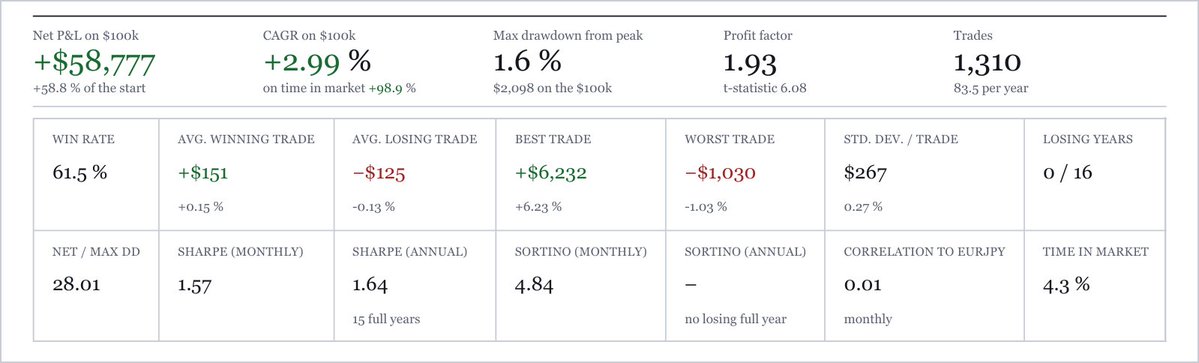
2. The best trade is Brexit night 2016, short leg: +6.2% on its own. Without it, +52.5% instead of +58.8% since 2011.
3. The worst days are Japan's currency interventions. A stop doesn't help there, so we control it with size.
Thanks @kieran__duff for the clue. Which yen pairs do you run it on?
Two weeks ago @kieran__duff left a clue: "research Gotobi Days."
So we did: Scraped research, stress tested and deployed it. On Tuesday our version took its first trade.
What it is: Japanese companies settle their bills on the 5th, 10th, 15th, 20th, 25th and at month end. Importers buy the dollars for that at the 9:55 Tokyo fix. Banks buy ahead of it, the yen weakens into 9:55, and part of the move comes back after.
The trade: long a yen pair from the evening before into the fix, short for a couple of hours after. No trades on Mondays.
Our backtest on EURJPY, 2011 to Sep 2026, no leverage:
• 1,310 trades
• profit factor 1.93 after spreads, 1.74 after commission and swap too
• win rate 62%
• no losing year in 16
• monthly correlation to EURJPY: 0.01
• random-sign test: p < 0.001
Backtest. Not financial advice.
Tuesday 20 Oct was a Gotobi day that we would trade. Our first trade, on our demo account:
Long Monday evening into the fix: +9.9 pips
Short after the fix: −6.4 pips
Our sweep found an optimal short window that was relatively short compared to the long window.
Net after spread, commission and swap: +0.04% of the account
One trade says nothing. The edge is a few basis points a trade, and you only see it over hundreds of them.
@MrMilkTrading@ZenomTrader 100%, can only recommend him. Nice to see people like you and him enrich the space.
Regarding perps, yeah just a WIP like so many other things. We'll see how they play out. Planning to post some stuff on them in the near future.
@MrMilkTrading Yeah, I think those firms are essentially a numbers game one could exploit but shouldn't rely on too much. @ZenomTrader has some interesting takes on this topic...
We started filming!
Most of trading happens behind a screen, alone. We want to take you into the process with us: the ideas, the backtests, the strategies we kill, and the life around it.
Video 1: a week in Frankfurt.
New one every week. Tell us what you think.
Check out the first video 👇
We started filming!
Most of trading happens behind a screen, alone. We want to take you into the process with us: the ideas, the backtests, the strategies we kill, and the life around it.
Video 1: a week in Frankfurt.
New one every week. Tell us what you think.
Check out the first video 👇
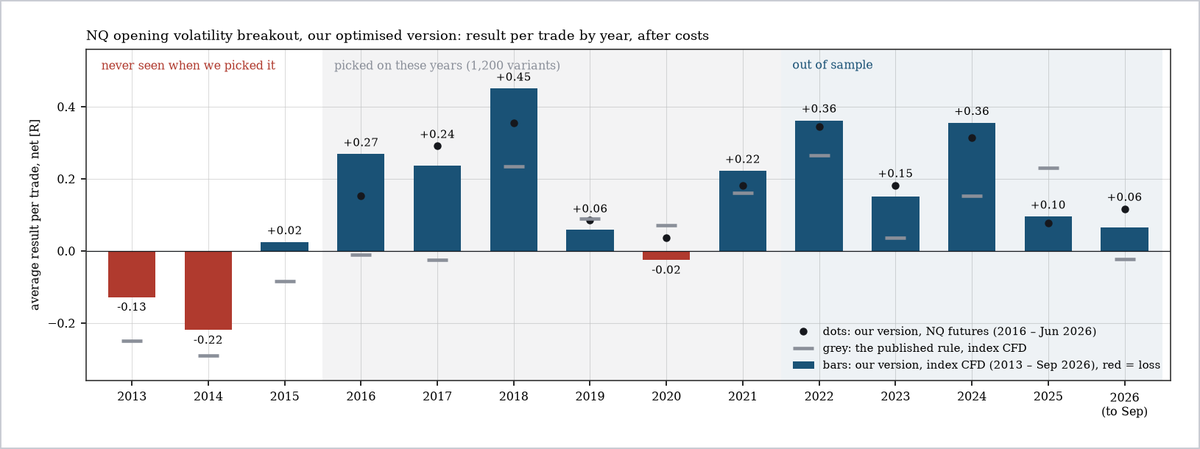
So: an edge, or a good fit? 2022 on says edge. 2013–15 says careful.
From Monday his rule runs on our demo account, rules frozen, and our version gets scored on the same days next to it. Six months, then we compare.
@SystematicPeter, did you ever try one entry a day? And have you looked at the years before 2018?
We tested an intraday NQ breakout that @SystematicPeter has traded live since May 2023. Then we optimised it.
And no, it's not the ORB.
Instead, it buys stop above and a sell stop below today's open, sized off yesterday's range. Stop the same distance, flat by the close. Long or short, whichever way the day breaks.
His rule, rebuilt: profit factor 1.19, but a 58% drawdown in 2016–17.
So we optimized it in sample and verified it out of sample. Our version: one entry a day, mornings only, a wider trigger, break-even sooner.
NQ futures, 2016 to mid-2026, 1% risk per trade, fixed:
• 1,747 trades, profit factor 1.40
• max drawdown 13%, no losing year
• win rate 34%, average win 2.7× the average loss
• in the market 6% of the time, monthly correlation to the NQ: −0.11
The fair test is 2022 on, years the pick never saw: +0.22 R a trade, profit factor 1.45.
The short side brings the decorrelation: since 2022 +0.24 R a trade (profit factor 1.48), monthly correlation to the Nasdaq-100 −0.40, and it wins in 79% of the months the Nasdaq falls.
Backtest. Not financial advice.
Where it's weak:
The best of 1,200 on the same years flatters itself. Over the whole grid, the in-sample winner doesn't beat chance (p 0.16). The 13% drawdown is partly fitted: shuffle the trades and the 95th percentile is 40%. Size for that.
The only years it never saw are 2013–15, on index CFD data: −0.09 R a trade, 2013 and 2014 negative. Better than his rule there (−0.19 R), but no edge.
And it lives on its winners: without the best 5% of trades the total is negative.